


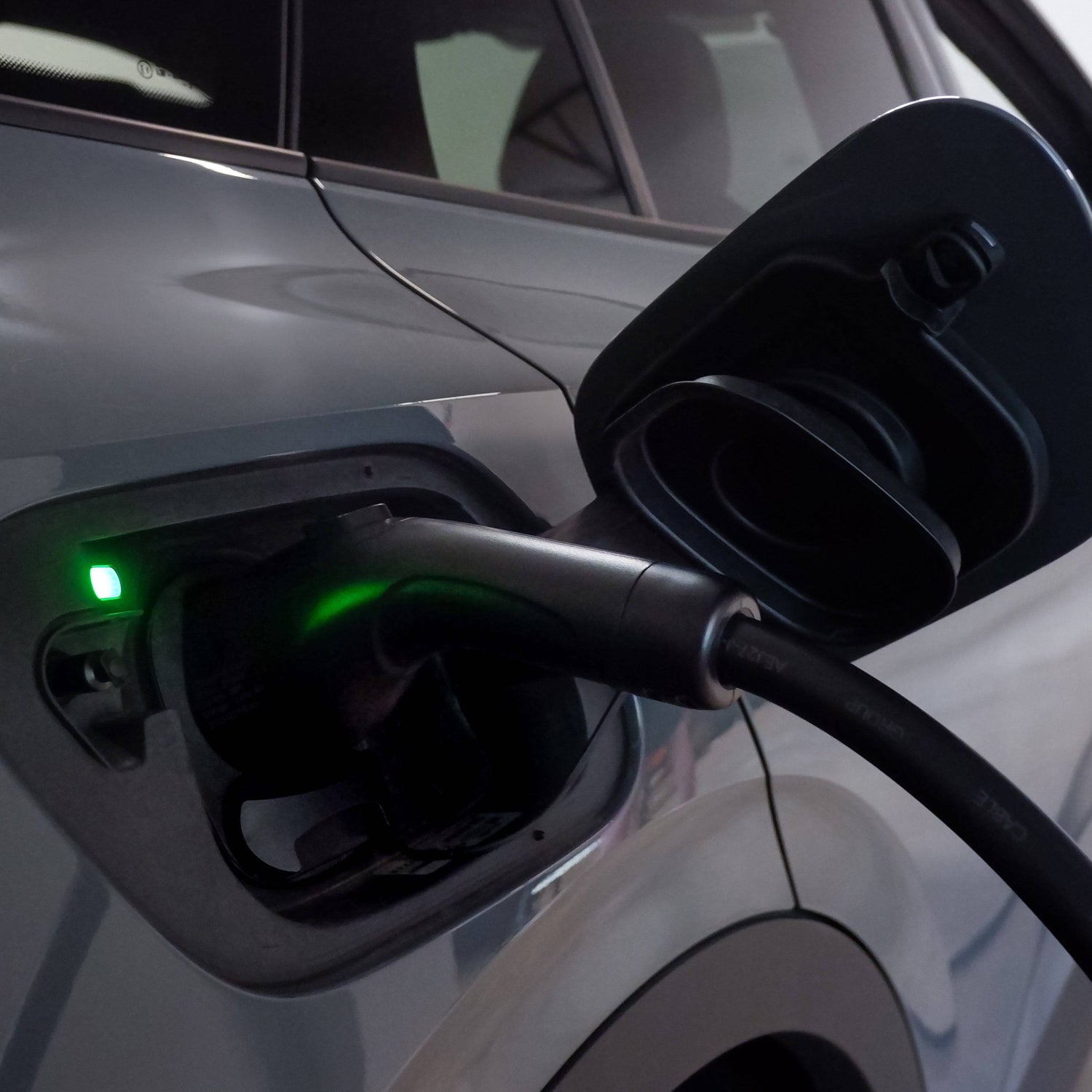
EV Charger Plug Types: A Complete Guide to Connectors, Outlets, and Compatibility (2026)
Understanding EV charger plug types is the single most important step before purchasing a home charging station. Every electric vehicle sold in North America uses one of two connector standards on the vehicle side — SAE J1772 or the North American Charging Standard (NACS) — and every home charger requires a specific wall outlet or hardwired connection on the infrastructure side. Matching both sides correctly determines charging speed, installation cost, and long-term compatibility. Battery Tender® brings over three decades of charging expertise to the EV space, offering Level 1 and Level 2 home chargers engineered with the same Infinite Sequential Monitoring (ISM) precision that has defined smart battery charging since 1991.
This guide breaks down every plug type encountered in residential EV charging — from the standard 120V household outlet to 240V NEMA configurations, from the universal J1772 connector to the increasingly adopted NACS plug. By the end, the correct charger-to-vehicle-to-outlet combination for any 2026 EV will be clear, along with the auxiliary 12V battery maintenance step most owners overlook.
Key Takeaways:
- The infrastructure side (wall outlet) and vehicle side (connector) are two separate plug decisions that must align with the charger.
- Level 1 charging uses a standard NEMA 5-15 or 5-20 outlet at 120V; Level 2 requires a 240V NEMA 6-50, 14-50, or hardwired connection.
- SAE J1772 remains the universal Level 1/Level 2 vehicle connector, while NACS adoption is accelerating across all major automakers in 2026.
- Every EV also contains a 12V auxiliary battery that requires separate maintenance with a dedicated smart charger.
What Are the Two Sides of EV Charger Plug Types?
Every home EV charging setup involves two distinct plug connections, and confusing them is the most common mistake new EV owners make. The infrastructure side is the plug that connects the charger to the building's electrical system — this is the wall outlet or hardwired junction box. The vehicle side is the connector that plugs into the EV's charge port. A single charger unit sits between these two connections, converting household AC power into the regulated current the vehicle's onboard charger accepts.
On the infrastructure side, plug types are defined by the National Electrical Manufacturers Association (NEMA) and governed by the National Electrical Code (NEC). On the vehicle side, plug types are defined by SAE International (SAE J1772) or by the NACS specification originally developed for proprietary use and now adopted as SAE J3400. Understanding both sides prevents purchasing incompatible equipment and avoids costly installation changes.
Infrastructure-Side EV Charger Plug Types: NEMA Outlet Configurations
The wall outlet determines the maximum power available to any EV charger. Four NEMA configurations account for virtually all residential EV charging installations in North America. Selecting the right one depends on the charger's amperage rating, desired charging speed, and existing electrical panel capacity.
NEMA 5-15 and NEMA 5-20 (120V — Level 1)
The NEMA 5-15 is the standard three-prong 120V, 15-amp household outlet found in every home. The NEMA 5-20 is its 20-amp sibling, identifiable by the T-shaped neutral slot. Level 1 EV chargers plug directly into these outlets with no electrician required, delivering approximately 1.4 kW to 1.9 kW of power. At these rates, a typical EV with a 60 kWh battery gains roughly 4 to 7 miles of range per hour of charging. While slow, Level 1 is ideal for plug-in hybrids, short daily commutes under 30 miles, or situations where 240V installation is impractical — such as apartments or rental properties.
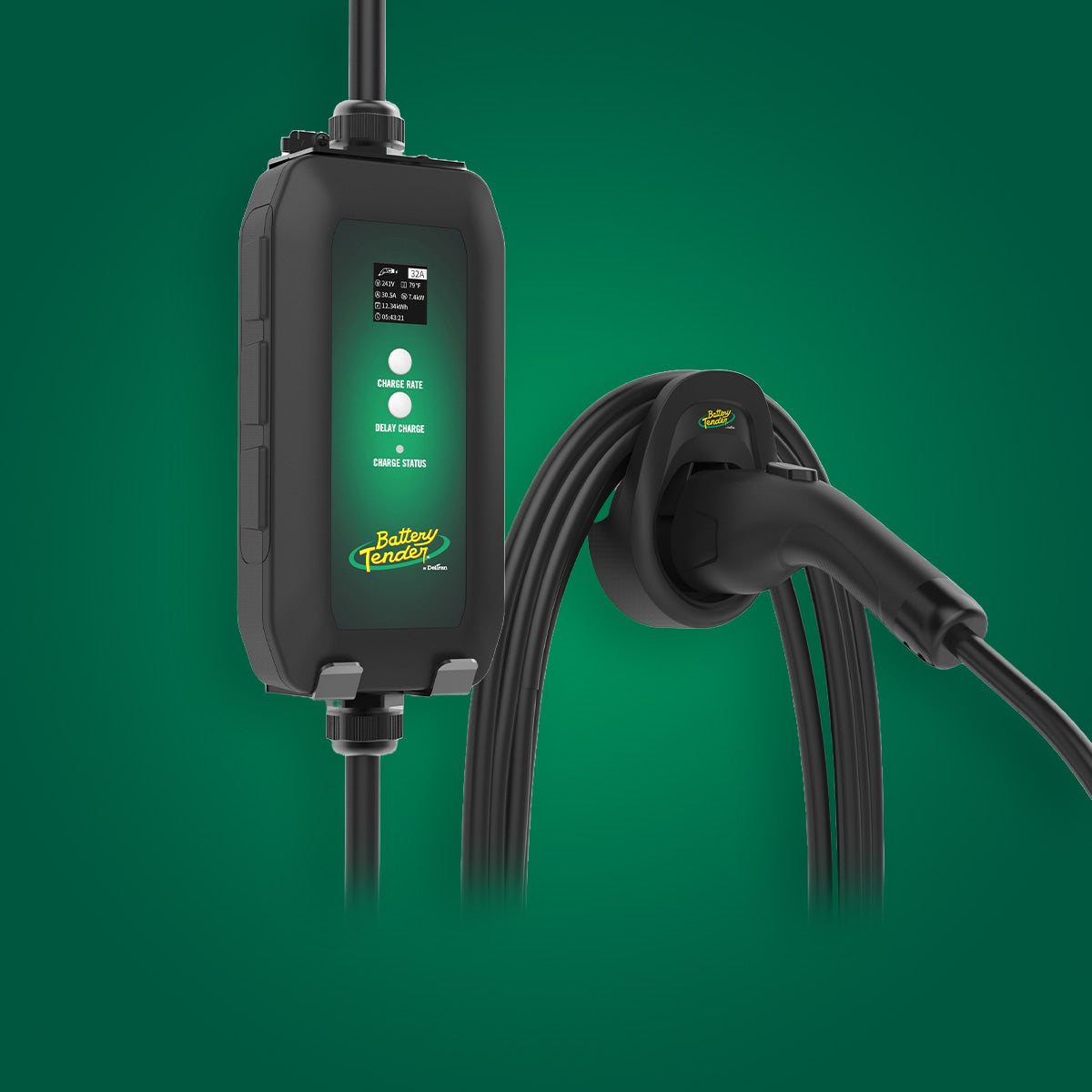
The Battery Tender eCharge 16A uses a NEMA 5-20 plug, drawing up to 16 amps on a dedicated 20-amp circuit. This delivers approximately 2 kW of charging power and roughly 7.2 miles of range per hour — the maximum a 120V outlet can safely provide under the NEC's 80% continuous load rule. No installation is necessary; simply plug into any properly grounded 20-amp outlet.
Battery Tender eCharge 16A Level 1 EV Charger
NEMA 14-50 and NEMA 6-50 (240V — Level 2)
Level 2 charging requires a 240V outlet, and the two most common residential configurations are the NEMA 14-50 (four-prong, 50-amp — the same outlet used by electric ranges and RV pedestals) and the NEMA 6-50 (three-prong, 50-amp — commonly used for welders and dedicated EV circuits). Both deliver 240V but differ in grounding and neutral pin configurations. The NEC requires a licensed electrician to install either outlet and typically mandates a dedicated circuit breaker in the main panel. Installation costs range from $300 to $1,500 depending on panel distance, existing capacity, and permit requirements as reported by the U.S. Department of Energy's Alternative Fuels Data Center.
Level 2 chargers rated at 32–48 amps deliver 7.6 kW to 11.5 kW, translating to roughly 25 to 42 miles of range per hour. For a 60 kWh battery at 20% state of charge, a 40-amp charger completes a full charge in approximately 6.3 hours: (60 Ah × 0.80) ÷ 9.6 kW = ~5 hours at the pack level, with conversion inefficiency adding roughly 15–20%.
Hardwired (No Plug — Direct Connection)
Some Level 2 chargers bypass the plug entirely and connect directly to a dedicated circuit breaker through conduit wiring. Hardwired installations are permanent, cannot be moved without an electrician, but are required by some local codes for chargers rated above 40 amps. The NEC permits a hardwired 48-amp charger on a 60-amp breaker, maximizing home charging speed. Hardwired setups also eliminate the outlet as a potential failure point, which can be advantageous in outdoor or high-humidity environments.
Vehicle-Side EV Charger Plug Types: J1772 vs. NACS
The connector that plugs into the vehicle determines cross-brand compatibility. Two standards dominate the North American market in 2026.
SAE J1772 (Universal AC Connector)
The SAE J1772 connector has been the universal Level 1 and Level 2 charging standard in North America since 2009. It features a five-pin design handling up to 19.2 kW (80 amps at 240V), though most residential chargers operate at 32–48 amps. Every non-Tesla EV sold in North America from 2010 through 2024 uses a J1772 inlet, and the connector remains on millions of vehicles currently on the road. J1772 handles the communication protocol between charger and vehicle, including signaling the maximum available current and verifying a secure connection before power flows.
NACS (SAE J3400 — North American Charging Standard)
Originally a proprietary connector, NACS was standardized as SAE J3400 in 2023. By 2026, virtually every major automaker — including Ford, General Motors, Rivian, Hyundai, Kia, BMW, Mercedes-Benz, Volkswagen, and others — has announced or begun shipping vehicles with native NACS ports. The NACS connector is smaller and lighter than J1772, handles both AC and DC charging through the same plug, and supports up to 1,000V DC fast charging. For home charging purposes, NACS operates identically to J1772 at Level 1 and Level 2 power levels.
Owners of J1772-equipped vehicles who encounter a NACS-only charger (or vice versa) can use a simple passive adapter. The Battery Tender eCharge product line ships with J1772 connectors compatible with the vast majority of EVs on the road. For NACS-equipped vehicles, a NACS adapter is available as an accessory (SKU 081-0400, $44.95).
How to Match EV Charger Plug Types to Charging Speed
Charging speed is determined by the weakest link in the chain: wall outlet amperage, charger amperage rating, and vehicle onboard charger capacity. The following table summarizes common configurations:
| NEMA Outlet | Voltage | Max Amps (80% Rule) | Power (kW) | Approx. Range/Hour | Battery Tender Charger |
|---|---|---|---|---|---|
| NEMA 5-15 | 120V | 12A | 1.4 kW | 4–5 mi | — |
| NEMA 5-20 | 120V | 16A | 1.9 kW | 7.2 mi | eCharge 16A |
| NEMA 6-50 / 14-50 | 240V | 32A | 7.6 kW | 28.5 mi | eCharge 32A |
| NEMA 6-50 / Hardwired | 240V | 40A | 9.6 kW | 36 mi | eCharge 40A |
| Hardwired (60A breaker) | 240V | 48A | 11.5 kW | 42.25 mi | eCharge 48A |
The Battery Tender eCharge 32A offers a unique advantage in the plug-type conversation: true dual-voltage compatibility. It operates on both 120V and 240V circuits, making it the most versatile portable option for owners who charge at multiple locations — home, workplace, or travel destinations with different outlet types.
Battery Tender eCharge 32A Dual-Voltage Portable EV Charger. Also available at Costco.com.
Level 2 Wall-Mount Chargers: Choosing Between 40A and 48A
For permanent home installations, wall-mounted Level 2 chargers provide the fastest residential charging speeds. The choice between 40A and 48A depends on electrical panel capacity and the vehicle's onboard charger limit. Many EVs from 2024–2026 accept up to 48 amps, making a 48A charger a future-proof investment even if the current vehicle maxes out at 32A.
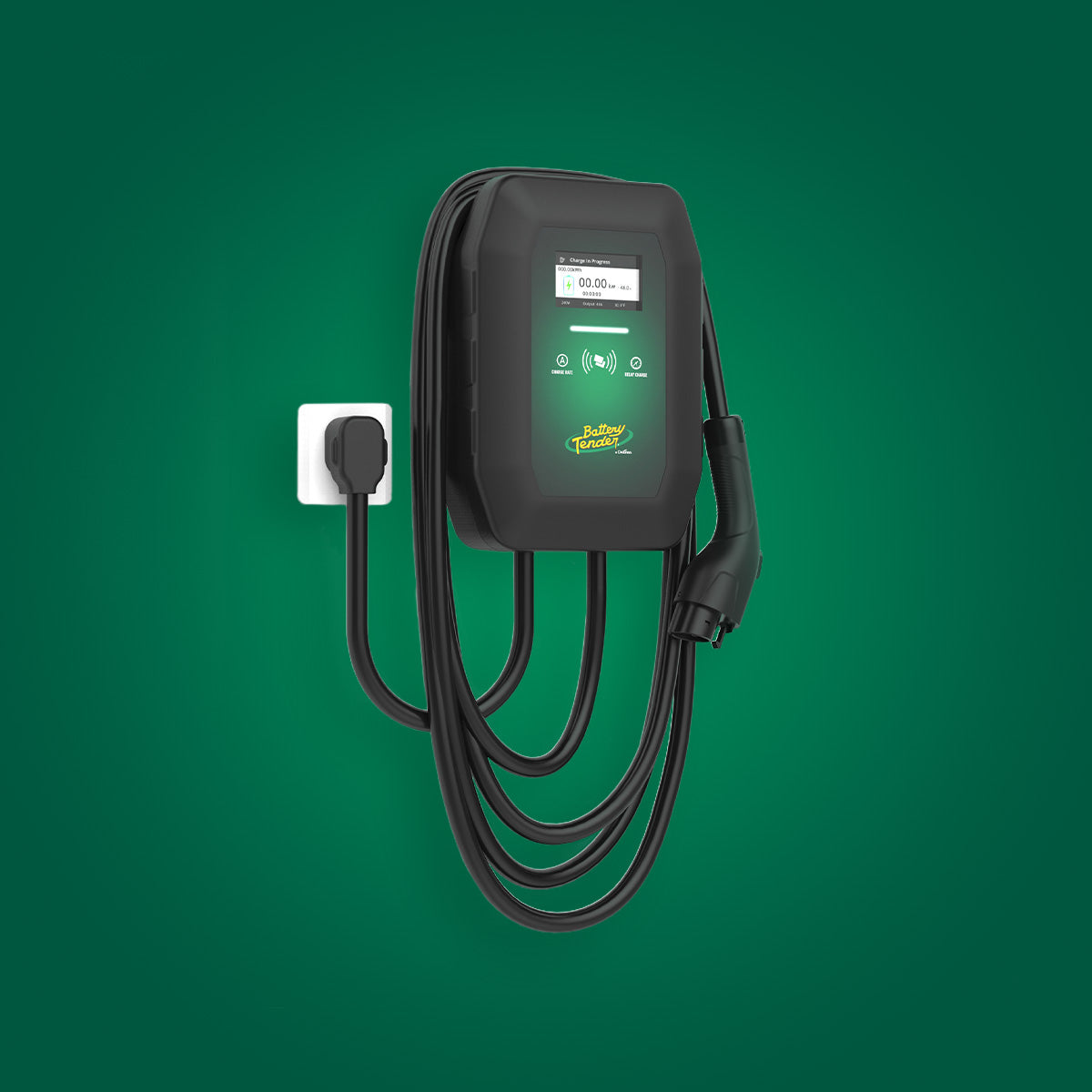
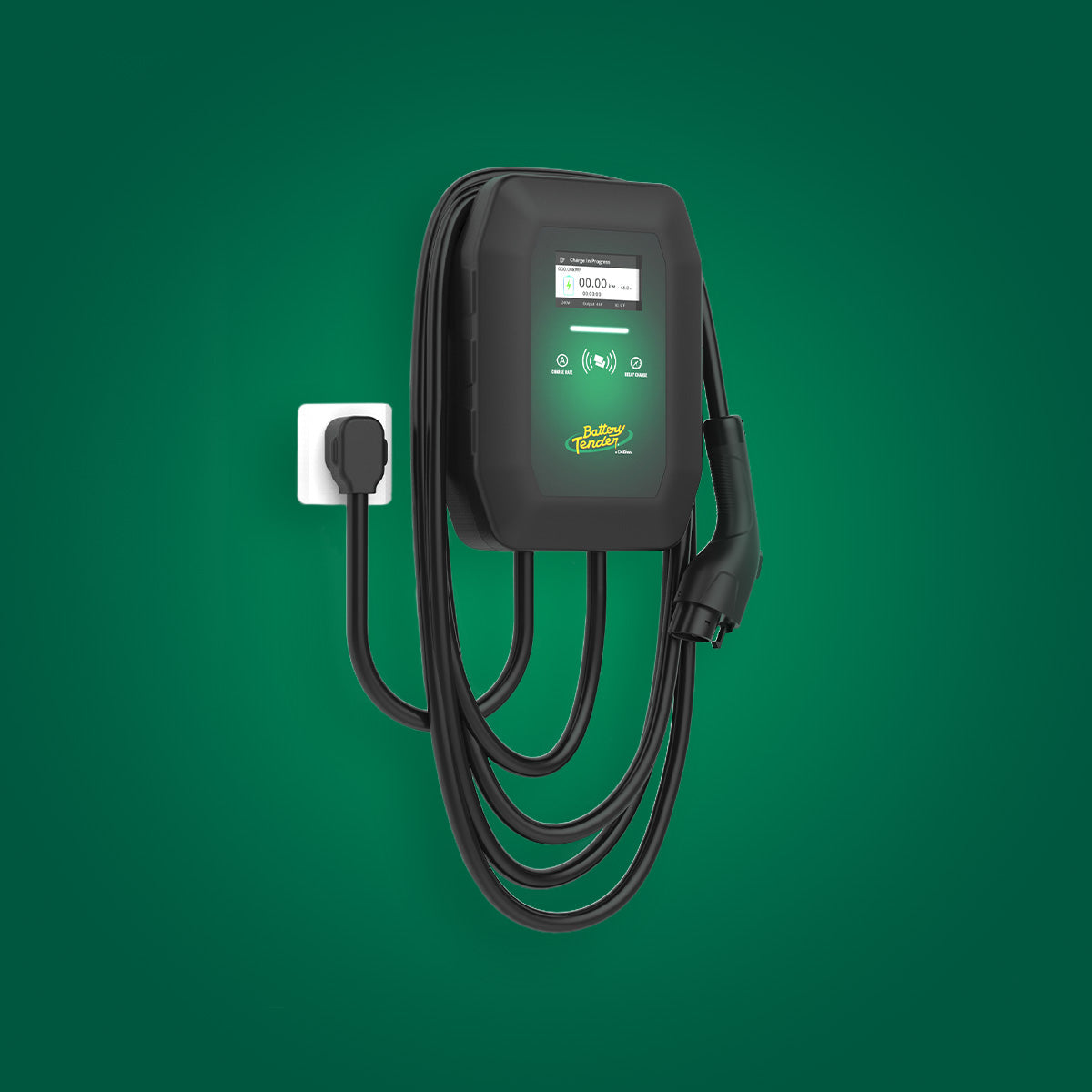
The Battery Tender eCharge 40A delivers 9.6 kW and approximately 36 miles of range per hour. It features RFID access control, IP66 weather resistance for outdoor installation, and a wall-mount design. For maximum speed, the Battery Tender eCharge 48A pushes 11 kW, adding roughly 42.25 miles of range per hour — enough to fully charge a 75 kWh battery from 20% to 100% in approximately 6.2 hours.
Battery Tender eCharge 40A Level 2 Wall-Mount EV Charger. Also available at Costco.com.
Battery Tender eCharge 48A Level 2 Wall-Mount EV Charger
The Overlooked Plug: Your EV's 12V Auxiliary Battery
While understanding EV charger plug types for the main traction battery is essential, every electric vehicle also contains a 12V auxiliary battery that powers critical systems: door locks, infotainment, lighting, 12V accessory ports, and — most importantly — the contactors that connect the high-voltage traction battery to the drivetrain. If the 12V battery dies, the vehicle cannot start, even with a fully charged main pack.
This 12V battery uses a completely different connector than the EV charge port. It connects via standard automotive terminals (positive and negative posts) or proprietary connectors accessible in the frunk or under the rear seat, depending on the vehicle. Maintaining this battery requires a traditional smart charger — not the Level 1 or Level 2 EVSE used for the traction battery.
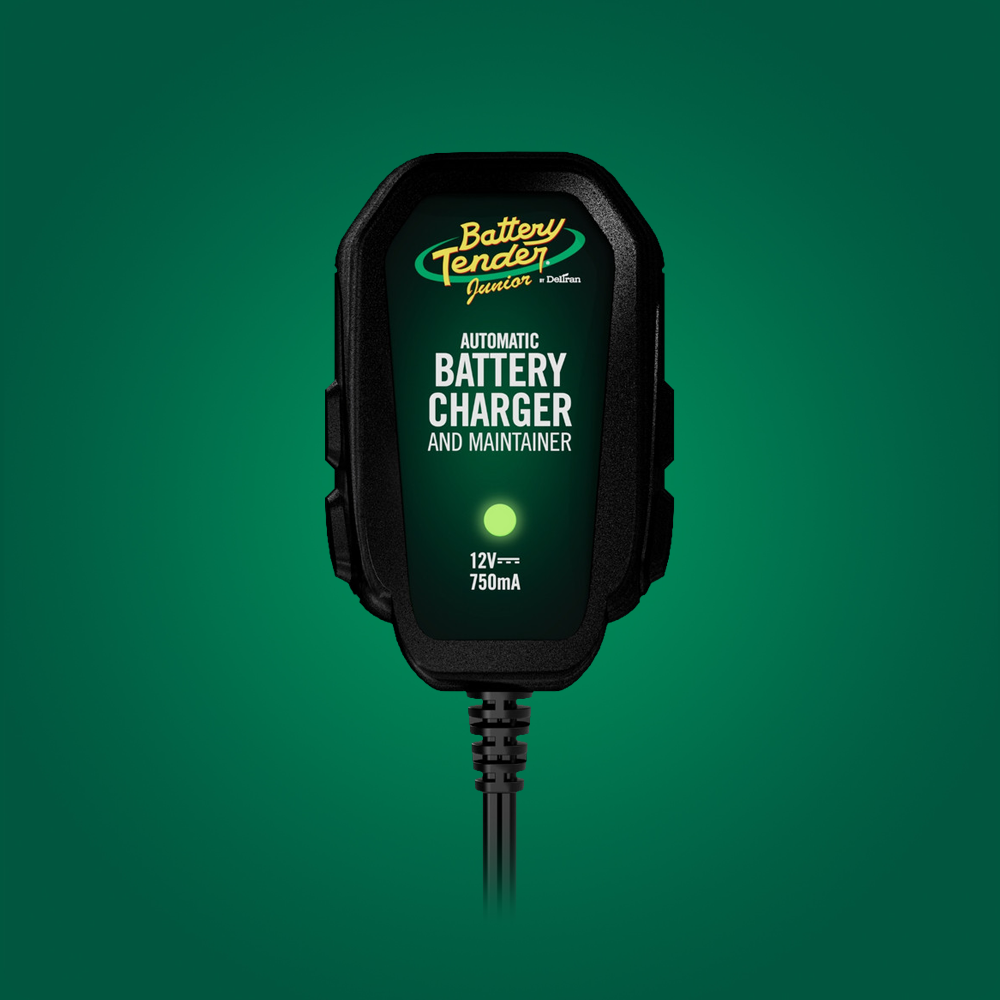
The Battery Tender Plus 1.25A is specifically suited for 12V auxiliary battery maintenance in EVs. At 1.25 amps, it safely maintains the small-capacity 12V batteries (typically 30–50 Ah AGM or lithium) found in modern EVs without risk of overcharging. ISM technology keeps the battery at optimal voltage indefinitely during extended parking, software updates, or seasonal storage.
Battery Tender Plus 1.25A 12V Smart Charger
Frequently Asked Questions
What plug type does a Level 1 EV charger use?
A Level 1 EV charger plugs into a standard 120V household outlet — either a NEMA 5-15 (15-amp) or NEMA 5-20 (20-amp). On the vehicle side, the connector is typically SAE J1772 or NACS (SAE J3400). No electrician or special wiring is required for Level 1 charging, making it the simplest and most accessible option for new EV owners.
Related guides: EV Charger 240V (2026) · EV Home Charging Setup: Everything First-Time EV Owners Need to Know · More EV charging guides