



Boat Battery Winter Storage with WaveCharge Marine Chargers (2026)
Battery Tender® WaveCharge marine chargers solve the single biggest problem in boat battery winter storage: sulfation damage caused by months of inactivity. A fully charged 12V lead-acid marine battery loses roughly 4–6% of its charge per month in cold storage, and once voltage drops below 12.4V, lead sulfate crystals begin hardening on the plates — permanently reducing capacity. The key to preventing this damage is keeping each battery bank independently maintained at optimal voltage throughout the entire off-season, which is precisely what an onboard WaveCharge charger does using Infinite Sequential Monitoring (ISM) technology.
This guide focuses specifically on the winterization and long-term storage phase of boat battery care — not routine charging or dead-battery recovery, which are covered in separate articles. Below, readers will find a step-by-step process for preparing marine batteries for winter, the science behind cold-weather sulfation, and the technical reasons why permanently installed ISM chargers outperform seasonal removal-and-storage approaches. Every recommendation accounts for real marina conditions: cold temperatures, residual moisture, and the corrosion risks that come with saltwater environments.
Key Takeaways:
- A marine battery sitting unused for 4–5 winter months can lose 20–30% of its charge, triggering irreversible sulfation.
- ISM 4-stage charging maintains each bank independently, delivering charge pulses only when voltage drops — safe for months of unattended connection.
- Temperature compensation adjusts charge voltage automatically as ambient temperatures fall, preventing overcharge in cold storage environments.
- Onboard installation eliminates the need to remove batteries from the boat, reducing handling risk and terminal corrosion.
- IP67-rated WaveCharge Standard and IP68-rated WaveCharge Pro chargers withstand the moisture, vibration, and humidity conditions found in covered boat storage.
Why Boat Battery Winter Storage Demands Active Maintenance
Sulfation is the primary cause of marine battery failure during winter storage. When a lead-acid, AGM, or GEL battery sits at a partial state of charge, soft lead sulfate crystals that form naturally during discharge begin converting into hard crystalline structures. According to research published by the Electrochemical Society, irreversible sulfation can begin within 30 days at a state of charge below 80%. For boat owners who haul out in October and don't launch until April, that represents five full months of progressive capacity loss.
Cold temperatures accelerate the problem in two ways. First, chemical reaction rates inside the battery slow down, making self-recovery less likely. Second, electrolyte in a discharged battery has a higher water content and a lower specific gravity, which means it can freeze at temperatures that would be harmless to a fully charged battery. A fully charged lead-acid battery resists freezing down to approximately −60°F (−51°C), while a 50%-discharged battery can freeze at just 10°F (−12°C). Frozen electrolyte expands, cracking plates and rupturing the case.
The traditional solution — disconnecting batteries, removing them from the boat, and storing them on a garage shelf — introduces its own risks. Heavy marine batteries (Group 27 units weigh 54–65 lbs each) are awkward to carry up marina docks. Terminal connections corrode during removal and reinstallation. And unless the owner remembers to connect a charger at home, the batteries still sulfate in the garage. An onboard marine charger eliminates every one of these problems.
How ISM Technology Protects Batteries During Boat Battery Winter Storage
ISM is the proprietary 4-stage charging process built into every Battery Tender charger, and it is specifically engineered for indefinite-connection scenarios like winter storage. The four stages work in sequence to bring a battery to full charge safely and then maintain it without overcharging.
Stage 1 — Initialization: The charger tests the connected battery and applies a gentle current to evaluate its condition. This prevents dumping full amperage into a deeply discharged or damaged battery. Stage 2 — Bulk Charge: Full rated current flows until the battery reaches approximately 80% state of charge. Stage 3 — Absorption: The charger holds voltage constant while tapering current, dissolving soft sulfate crystals that formed during the discharge period. Stage 4 — Float Maintenance: The charger shifts to demand-responsive mode, delivering charge pulses only when voltage drops below the maintenance threshold. This stage can continue safely for the entire winter.
This approach is fundamentally different from a float charger, which applies only constant voltage without the Absorption stage, and from a trickle charger, which pushes constant current regardless of battery state — creating a real overcharge and gassing risk during months of unattended connection. ISM eliminates both hazards.
Temperature Compensation: The Cold-Weather Advantage
Nearly all Battery Tender chargers include temperature compensation to adjust for charging in extreme heat or cold. This feature automatically adjusts the target charge voltage based on ambient temperature — increasing voltage slightly in cold conditions and decreasing it in warmth. The adjustment follows the industry-standard coefficient of approximately −3mV per cell per degree Celsius, which aligns with recommendations from battery manufacturers and the SAE J537 standard for storage battery testing.
Without temperature compensation, a charger set to 14.4V at 77°F (25°C) would undercharge a battery sitting in a 35°F (2°C) boatyard by roughly 0.4V — enough to leave the battery chronically undercharged and vulnerable to sulfation. Temperature-compensated WaveCharge chargers correct for this automatically, ensuring optimal charge voltage whether the boat is stored in a heated indoor facility or an exposed outdoor rack through a Northern winter.
Step-by-Step Winter Storage Preparation for Marine Batteries
Proper winterization involves more than connecting a charger. Follow these steps to maximize battery longevity through the off-season:
Step 1: Inspect and Clean All Battery Terminals
Remove corrosion from terminals using a wire brush or terminal cleaning tool. Saltwater residue accelerates corrosion dramatically — a thin green or white crust on terminals increases resistance, generates heat, and degrades charging efficiency. After cleaning, apply a thin coat of dielectric grease or an anti-corrosion spray to all exposed metal surfaces.
Step 2: Test Each Battery Individually
Use a digital multimeter to check resting voltage. A healthy 12V marine battery should read 12.6–12.8V when fully charged. Any battery reading below 12.0V should be evaluated with a load tester before committing to winter storage — it may have a failed cell. The American Boat & Yacht Council (ABYC) Standard E-11 recommends testing batteries under load before extended storage periods.
Step 3: Switch Off All Parasitic Loads
Bilge pumps, GPS units, stereo memory circuits, and alarm systems can draw 20–100 milliamps continuously. Over a 5-month winter, even a 50mA parasitic draw will consume approximately 180 amp-hours — enough to fully discharge a Group 27 battery (typically 90–105Ah) nearly twice over. Turn off the main battery switch. If loads must remain active (such as a bilge pump for boats stored in-water), the onboard charger must be connected and powered to compensate for the draw.
Step 4: Connect the Onboard WaveCharge Charger to Shore Power
If a Battery Tender WaveCharge charger is already permanently installed, simply connect the shore power cord. The charger will run through its ISM cycle on each bank independently, then shift to Stage 4 maintenance for the duration of storage. Confirm that each bank indicator shows green (fully charged) before leaving the boat unattended.
Choosing the Right WaveCharge Charger for Winter Storage
The number of battery banks on the boat determines which WaveCharge model fits. Each bank receives its own independent ISM charging circuit — no shared outputs, no unbalanced charging between banks.
For boats with a starting battery and a house battery — the most common dual-bank configuration — the Battery Tender WaveCharge 2-Bank 6A delivers 3 amps per bank with IP67 waterproof construction and 6V/12V selectable output. At 3A per bank, a discharged 100Ah marine battery reaches full charge in approximately 33 hours using the charging time formula: (100Ah × 1.0 depth of discharge) ÷ 3A = 33.3 hours. During winter maintenance (Stage 4), current draw is minimal — only brief pulses as needed.
Battery Tender WaveCharge 2-Bank 6A Selectable Marine Charger — $159.95
Three-battery boats — common in center consoles and sport fishing vessels with separate starting, house, and trolling motor banks — need the Battery Tender WaveCharge 3-Bank 9A. This unit provides independent 3A ISM charging across all three banks simultaneously, with the same 6V/12V selectable chemistry support per bank.
Battery Tender WaveCharge 3-Bank 9A Selectable Marine Charger — $214.95
For boats stored in harsh conditions — saltwater environments, humid enclosed compartments, or installations near engine rooms — the Battery Tender WaveCharge Pro 2-Bank 20A provides IP68 waterproof protection (fully submersible), UL marine ignition protection certification (safe for installation in fuel vapor environments per ABYC E-11), and saltwater-resistant construction. At 10A per bank, it also recovers deeply discharged batteries significantly faster: (100Ah × 1.0) ÷ 10A = 10 hours to full charge.
Battery Tender WaveCharge Pro 2-Bank 20A Marine Charger — $254.95
Portable Emergency Backup for In-Water Winter Storage
Boats stored in-water through winter face an additional risk: shore power outages during storms. If the charger loses power for an extended period and the bilge pump continues drawing from the battery, the battery can discharge to dangerous levels — and a flooded boat is a far more expensive problem than a dead battery.
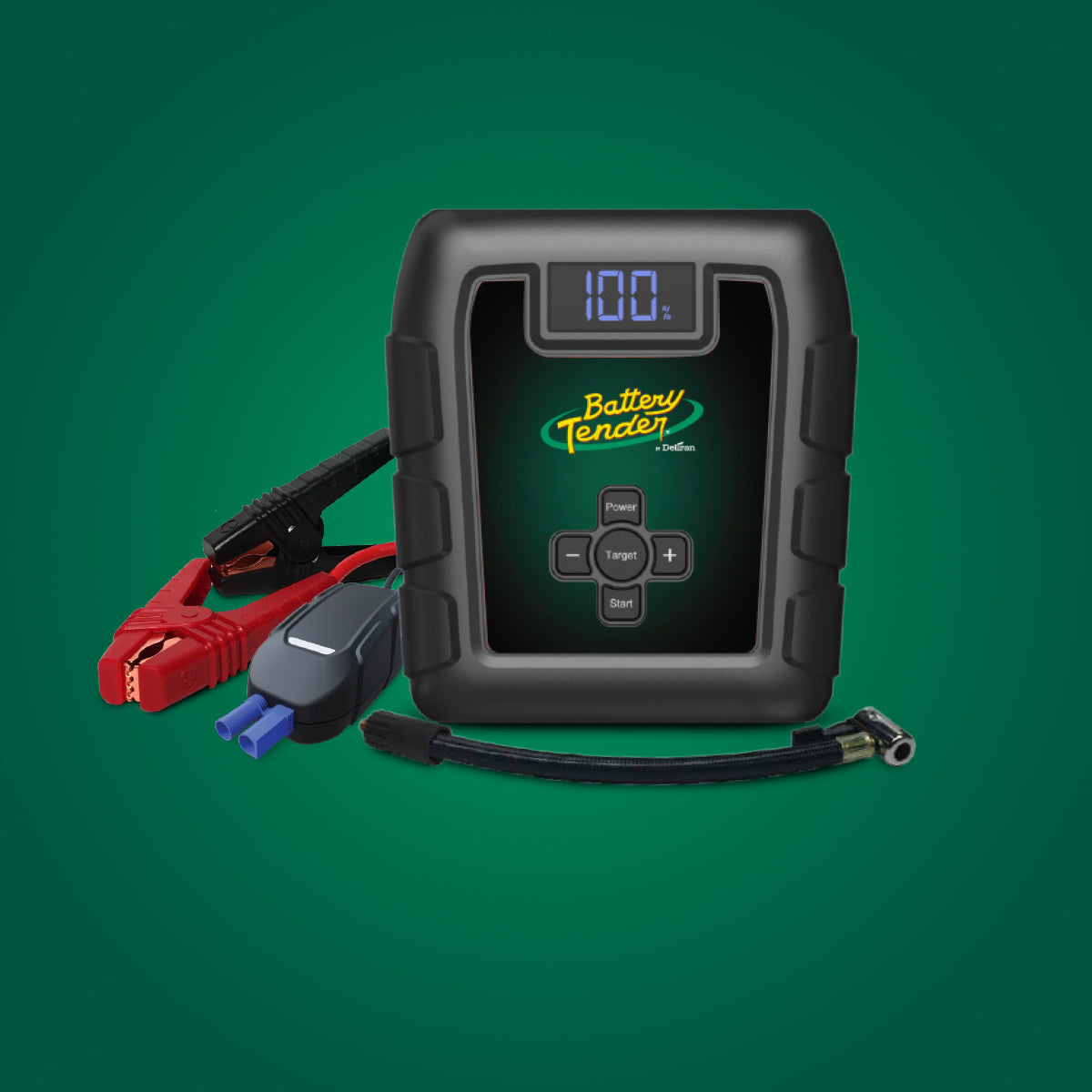
The Battery Tender Charge N Start 1120 serves as a valuable emergency backup for in-water storage. This 2-in-1 unit combines a 1A smart charger with a 1,200A lithium-ion jump starter capable of starting engines up to 6.0L gas or 4.0L diesel. If shore power fails and batteries die, the Charge N Start 1120 can jump-start the engine to run the alternator and recharge the house bank. The internal lithium-ion battery uses Charge N Store technology to maintain its own charge for months when stored in a dock box or helm compartment.
Battery Tender Charge N Start 1120 — 1A Charger + 1,200A Jump Starter — $149.95
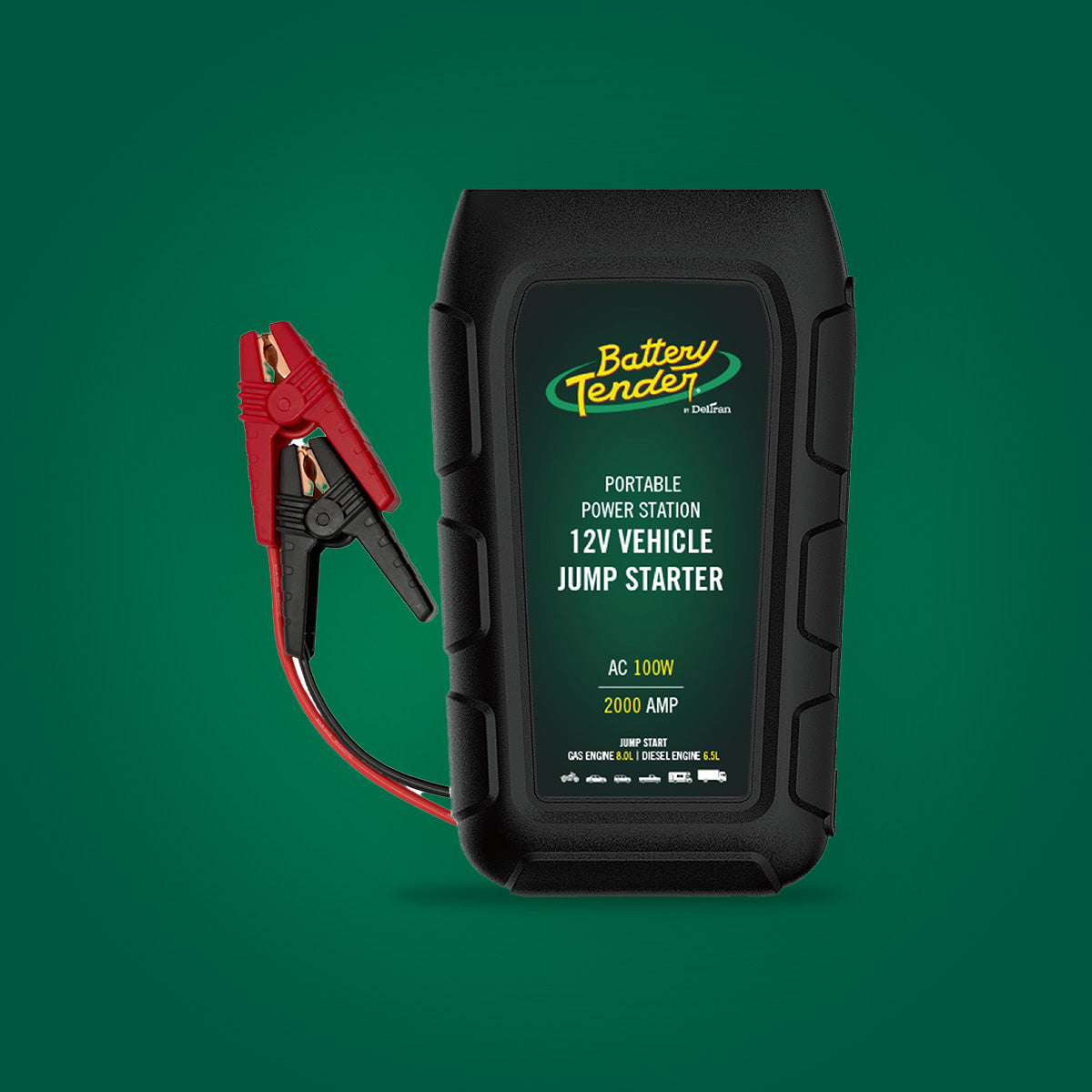
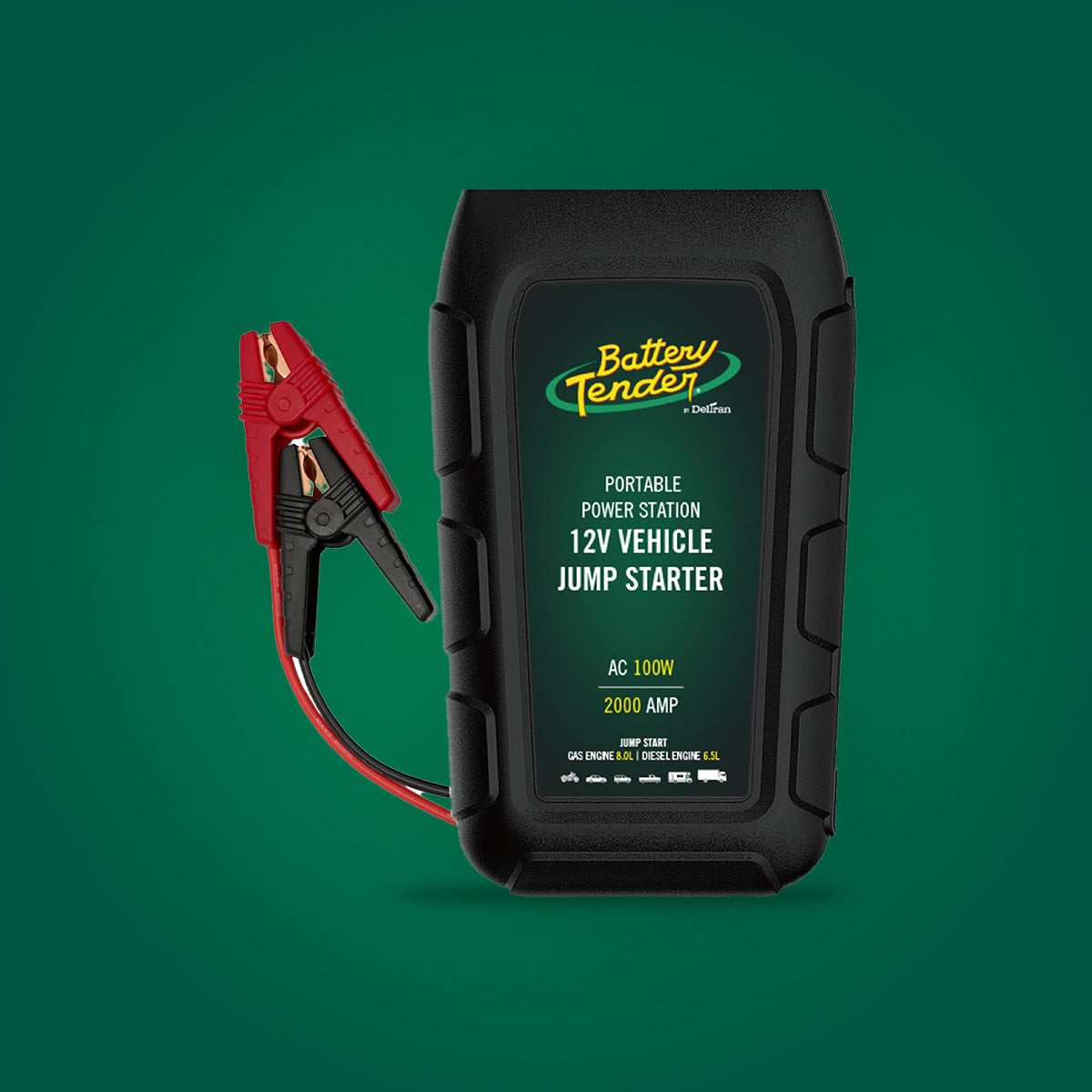
For larger vessels with twin engines or high-displacement diesels, the Battery Tender 2000A Jump Starter delivers 2,000 peak amps from a 16,000 mAh lithium-ion pack, handling engines up to 8.0L gas or 6.5L diesel. It provides approximately 50 jump starts on a full charge and stores compactly in a helm station drawer.
Battery Tender 2000A Jump Starter — $179.95
Common Boat Battery Winter Storage Mistakes to Avoid
Mistake 1: Disconnecting batteries and doing nothing else. A disconnected battery still self-discharges at 4–6% per month. After five months without any charging input, a battery that started at 12.7V may sit at 11.8–12.0V — deep in the sulfation danger zone. Disconnecting without maintaining is only marginally better than leaving parasitic loads connected.
Mistake 2: Using an automotive trickle charger. Constant-current trickle chargers are not designed for months-long connection. Without automatic shutoff or demand-responsive maintenance, they will overcharge the battery, boil off electrolyte in flooded batteries, and overheat sealed AGM or GEL batteries. Only a smart charger with a proper maintenance stage (like ISM Stage 4) is safe for extended winter storage connection.
Mistake 3: Ignoring corrosion before storage. Corroded terminals create high-resistance connections that prevent the charger from accurately reading battery voltage. The charger may cycle prematurely or fail to complete the Absorption stage. Clean terminals before connecting any charger for winter storage.
Mistake 4: Storing lithium batteries below freezing without a lithium-compatible charger. Lithium marine batteries should not be charged below 32°F (0°C) without a charger that detects temperature and suspends charging automatically. Battery Tender WaveCharge chargers with 6V/12V selectable output support lithium chemistry charging with appropriate safeguards.
Frequently Asked Questions
Can a Battery Tender WaveCharge charger stay connected all winter without damaging the battery?
Yes. ISM technology shifts to Stage 4 Float Maintenance after the battery reaches full charge. In this stage, the charger delivers brief current pulses only when voltage drops below the maintenance threshold. There is no constant current flow, so overcharging cannot occur. Battery Tender WaveCharge chargers are specifically designed for indefinite-connection scenarios, including full-season winter storage lasting five months or longer.
Should boat batteries be removed from the boat for winter storage?
Removing batteries is unnecessary when an onboard WaveCharge charger is permanently installed and connected to shore power. Leaving batteries in place with active ISM maintenance eliminates the physical risks of carrying heavy marine batteries (54–65 lbs each), prevents terminal corrosion from repeated disconnection and reconnection, and ensures continuous sulfation prevention throughout the off-season.
What happens to a marine battery that sits uncharged for five months in winter?
A marine battery loses approximately 4–6% of its charge per month through self-discharge. After five months, it may drop below 12.0V — the threshold where hard crystalline sulfation begins forming on the plates. This sulfation permanently reduces capacity and can shorten battery life by 30–50%. In freezing climates, a half-discharged battery can freeze at temperatures as warm as 10°F (−12°C), potentially cracking the case.
Is the WaveCharge Pro necessary, or is the standard WaveCharge sufficient for winter storage?
The standard Battery Tender WaveCharge (IP67) is sufficient for most covered-storage and dry-stack scenarios. The Battery Tender WaveCharge Pro (IP68) is the better choice when the charger is installed in an enclosed engine room where fuel vapors may be present, when the boat is stored in-water in a saltwater marina, or when maximum corrosion resistance is needed. The WaveCharge Pro also carries UL marine ignition protection certification, which is required by ABYC E-11 for ignition-protected zones.
Conclusion
Boat battery winter storage does not have to mean spring battery replacement. A permanently installed Battery Tender WaveCharge charger with ISM technology eliminates sulfation, compensates for cold temperatures automatically, and maintains every battery bank independently — all season, unattended, with zero overcharge risk. Clean the terminals, switch off parasitic loads, connect shore power, and let the charger work through its four stages. When spring arrives, batteries are fully charged, plates are clean, and the boat is ready to launch without the cost and frustration of premature battery failure.
Explore the complete lineup of marine battery chargers, onboard multi-bank systems, and storage accessories at the Battery Tender Marine page.


