


Golf Cart Battery Water: The Complete Maintenance and Charging Guide (2026)
Golf cart battery water is the single most important — and most neglected — maintenance factor that determines whether a flooded lead-acid battery bank lasts two years or seven. Every flooded golf cart battery relies on a precise electrolyte solution of approximately 35% sulfuric acid and 65% distilled water to facilitate the chemical reactions that store and release energy. When water levels drop below the tops of the lead plates, those exposed plates sulfate irreversibly, capacity shrinks permanently, and the entire bank degrades faster. Battery Tender® pioneered Infinite Sequential Monitoring (ISM) smart charging technology specifically to prevent the overcharging conditions that accelerate water loss in the first place.
Whether a golf cart fleet serves a residential community, a resort, or a single owner who drives 36 holes daily, understanding golf cart battery water management is non-negotiable. This guide covers the science behind electrolyte levels, step-by-step watering procedures, the critical relationship between charging and water consumption, and the equipment that makes the entire process safer and more efficient. Every golf cart battery bank deep-discharges daily — the most demanding use case in consumer battery applications — which makes correct watering and smart charging essential rather than optional.
Key Takeaways:- Always add distilled water after charging, never before — adding water to a discharged battery risks overflow during the charging expansion cycle.
- Water levels should cover the plates by approximately ¼ to ½ inch — overfilling causes acid dilution and corrosive overflow.
- Overcharging is the #1 cause of excessive water loss — ISM 4-stage charging from Battery Tender eliminates this risk.
- Check water levels every 15–30 charge cycles, or roughly every 2–4 weeks during peak golf season.
- Use only distilled or deionized water — tap water introduces minerals that permanently damage plates.
Why Does Golf Cart Battery Water Matter So Much?
Golf cart battery water matters because the electrolyte solution is the medium through which all electrochemical reactions occur. Inside every flooded lead-acid cell, lead dioxide positive plates and sponge lead negative plates interact with dilute sulfuric acid to produce electrical current. During discharge, both plates convert to lead sulfate while the acid weakens. During charging, the process reverses — but only if the plates remain fully submerged in electrolyte.
When water levels fall below the plate tops, the exposed lead oxidizes in air and develops hard crystalline sulfation that no charger can reverse. According to research published by the Battery Council International (BCI), improper watering is responsible for approximately 50% of premature flooded lead-acid battery failures. A typical 6-volt golf cart battery contains six cells, each requiring individual water level checks — meaning a 48V system with eight batteries demands inspection of 48 individual cells at every service interval.
The financial stakes are significant. A full set of eight 6-volt deep-cycle batteries for a 48V golf cart costs between $800 and $1,600 depending on brand and capacity. Proper watering combined with correct ISM charging can extend battery life from a typical 3–4 years to 5–7 years — potentially saving $1,500 or more over the ownership period. That return on investment makes a disciplined watering schedule one of the most cost-effective maintenance habits any golf cart owner can adopt.
When and How to Add Golf Cart Battery Water
The correct time to add water is after a full charge cycle is complete, not before. This is the most commonly violated rule in golf cart battery maintenance. During charging, the electrolyte expands as hydrogen and oxygen gases form through electrolysis. Adding water to a discharged or partially charged battery raises the fluid level too high, and when charging begins, the expanded electrolyte overflows through the vent caps. This overflow carries dilute sulfuric acid onto battery tops, cables, and trays — causing corrosion and reducing electrolyte concentration inside the cells.
The single exception to this rule occurs when plates are visibly exposed above the electrolyte. In that case, add just enough distilled water to barely cover the plates before charging. Then top off to the correct level after the charge cycle completes.
Step-by-Step Watering Procedure
- Complete a full charge cycle using a smart charger with ISM technology to ensure batteries reach 100% state of charge.
- Allow batteries to cool for 30–60 minutes. Electrolyte temperature affects volume — watering hot batteries leads to inaccurate levels.
- Remove each vent cap and inspect the electrolyte level visually or with a flashlight. The correct level is ¼ to ½ inch above the plate tops, or just touching the bottom of the fill well (the plastic step visible inside the cell opening).
- Add distilled water only using a battery watering jug, squeeze bottle, or an automatic watering system with float valves. Never use tap water, filtered water, spring water, or reverse-osmosis water unless certified to meet ASTM D1193 Type IV standards (≤5 µS/cm conductivity).
- Fill to the bottom of the fill well — not higher. Overfilling dilutes acid concentration, reduces specific gravity, and causes overflow during the next charge.
- Replace vent caps securely and wipe any spilled water from battery tops with a clean cloth.
- Record the date and any observations (e.g., cells requiring unusually high water volume, discolored electrolyte) in a maintenance log.
How Charging Affects Golf Cart Battery Water Loss
Charging is the primary driver of water consumption in flooded batteries. During the absorption and equalization stages of a charge cycle, voltage rises high enough to electrolyze water into hydrogen and oxygen gas — a process called gassing. This is normal and necessary: controlled gassing helps mix the electrolyte and prevent acid stratification, where heavier sulfuric acid sinks to the bottom of the cell while lighter water floats to the top. However, excessive gassing from overcharging wastes water at an accelerated rate.
A properly charged 225 Ah golf cart battery loses approximately 1–3 mL of water per cell per charge cycle under normal conditions. An overcharged battery can lose 5–10 mL per cell per cycle — three to five times the normal rate. Over 300 annual charge cycles typical for an active golf cart, that difference adds up to roughly 7–10 liters of excess water loss across a 48V bank. More critically, the repeated thermal stress from overcharging warps plates, sheds active material, and accelerates grid corrosion.
This is precisely why smart charging technology matters for golf cart applications. The ISM 4-stage process used by Battery Tender chargers transitions from Bulk (constant current) to Absorption (constant voltage with tapering current) and finally to Maintenance (demand-responsive float) automatically. The charger monitors battery voltage and current in real time, terminating the high-voltage absorption phase as soon as the battery is fully charged rather than continuing to push current that only generates heat and gas. The result is dramatically reduced water consumption and measurably longer battery life.
For 48V golf cart systems — the most common configuration in carts manufactured after 2008 — the Battery Tender PowerPlus 48V delivers 15 amps of ISM-controlled charging through an IP68-rated waterproof enclosure designed for permanent outdoor or under-seat mounting. The IP68 rating means the unit is sealed against dust ingress and continuous water immersion, making it ideal for golf carts stored outdoors or washed regularly.
Battery Tender PowerPlus 48V 15A IP68 Charger
Signs Your Golf Cart Battery Water Levels Are Wrong
Catching water level problems early prevents irreversible plate damage. Several warning signs indicate that electrolyte levels need immediate attention.
Reduced driving range is the most common first symptom. When plates are partially exposed, the active surface area participating in electrochemical reactions shrinks. A golf cart that normally covers 25–30 miles on a full charge may drop to 15–20 miles. Slow acceleration or hesitation on hills accompanies range loss because the battery bank cannot deliver full current with reduced plate engagement.
Corrosion on battery terminals and cables often indicates overfilling — electrolyte boils over during charging and deposits sulfuric acid residue on metal surfaces. White or greenish crystalline buildup around terminals increases resistance, reduces charging efficiency, and can eventually cause connection failure. A strong sulfur or rotten-egg smell during charging suggests excessive gassing, which points to either overcharging or abnormally low water levels forcing the charger to work harder.
Uneven voltage readings across batteries within the bank may reveal that one or more batteries have cells with critically low water. Using a multimeter to check individual battery voltage after a full charge can identify weak units. In a healthy 48V system with eight 6V batteries, each battery should read between 6.25V and 6.37V at rest. Any battery reading below 6.10V likely has damaged cells from water neglect or other degradation.
Choosing the Right Charger for Golf Cart Battery Water Conservation
Not all chargers treat golf cart batteries equally. Older transformer-based chargers and timer-controlled units deliver a fixed charge profile that does not adapt to the actual state of the battery. These units frequently overcharge batteries that are only partially depleted — the most common daily scenario for golf carts used for a single round — wasting water and generating unnecessary heat with every cycle.
The Battery Tender PowerPlus line addresses every common golf cart voltage configuration with a single industrial-grade platform. Each model uses the same IP68-sealed chassis, UL marine ignition protection certification, and ISM 4-stage charging algorithm, differing only in output voltage and current. For 36V systems found in older Club Car, E-Z-GO, and Yamaha carts, the Battery Tender PowerPlus 36V provides 18 amps of precisely regulated charging that minimizes water loss while fully recovering deeply discharged batteries overnight.
Battery Tender PowerPlus 36V 18A IP68 Charger
Communities and fleets operating 24V utility carts, industrial tugs, or older electric vehicles benefit from the Battery Tender PowerPlus 24V, which delivers 20 amps and shares the same rugged, permanently mountable design. All PowerPlus models support standard lead-acid, AGM, and GEL chemistries, ensuring compatibility regardless of battery brand or type installed in the cart.
Battery Tender PowerPlus 24V 20A IP68 Charger
For facilities managing multiple carts, estimating charge time helps schedule maintenance windows. Using the standard formula — (battery Ah × depth of discharge) ÷ charger amps = approximate hours — a 225 Ah battery bank discharged to 50% depth of discharge requires approximately (225 × 0.50) ÷ 15 = 7.5 hours on the PowerPlus 48V. This means an overnight charge easily restores full capacity while the ISM algorithm prevents the overcharge that would waste water.
Common Golf Cart Battery Water Mistakes to Avoid
Using tap water ranks as the most damaging mistake. Municipal tap water contains dissolved minerals — calcium, magnesium, chlorine, and iron — that deposit on plate surfaces and form insulating barriers. Even low mineral concentrations compound over hundreds of watering cycles. The BCI recommends distilled water with total dissolved solids (TDS) below 5 parts per million for all flooded battery applications.
Watering before charging causes overflow, acid dilution, and corrosion as described above. Ignoring individual cells is equally problematic — checking only the first and last batteries in a string while skipping the middle units allows hidden low-water conditions to destroy cells that are difficult to inspect visually. Every cell in every battery must be checked at each service interval.
Overfilling cells is nearly as destructive as underfilling. Excess water dilutes the sulfuric acid, lowering the specific gravity of the electrolyte below the 1.265 optimal range. Diluted electrolyte reduces voltage per cell, weakens cranking and sustained discharge capacity, and causes the charger to apply higher voltage for longer periods — which in turn causes more gassing and more water loss. The correct fill level is to the bottom of the fill well indicator, typically ¼ inch below the bottom of the vent tube.
Seasonal Golf Cart Battery Water Considerations
Water consumption varies with temperature and usage intensity. During summer months when ambient temperatures exceed 90°F (32°C), batteries operate hotter, electrolysis occurs faster, and water loss increases by 25–50% compared to spring and fall conditions. Checking water levels every two weeks rather than monthly is advisable during peak summer usage.
During winter storage in northern climates, water levels still require attention even when the cart is not in use. A fully charged flooded lead-acid battery can withstand temperatures down to approximately -75°F (-60°C) without freezing, but a discharged battery may freeze at 20°F (-7°C) because the electrolyte becomes mostly water as acid is consumed during discharge. Connecting a Battery Tender PowerPlus charger during storage ensures the ISM maintenance stage keeps the battery at full charge, preventing both sulfation and freeze risk. Verify water levels are correct before beginning storage, then check again monthly through the off-season since even maintenance charging produces trace gassing.
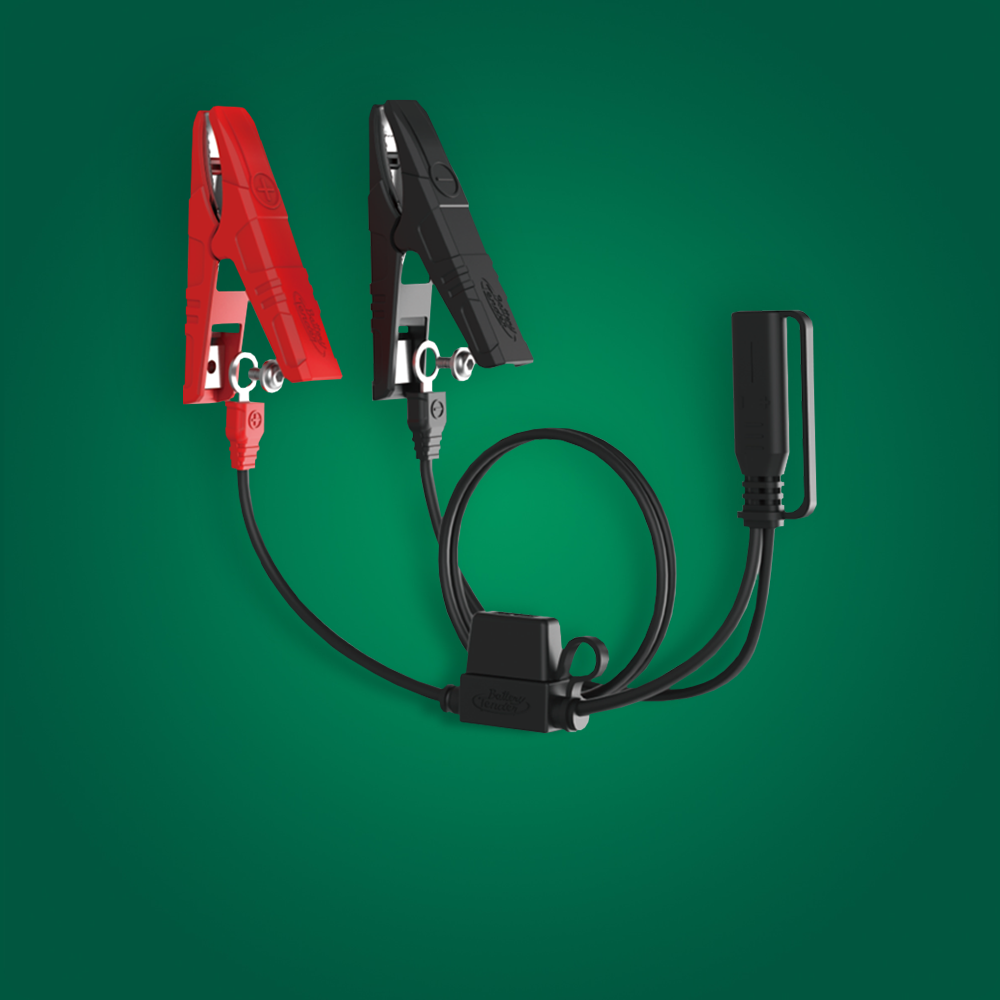
For golf cart owners who want to explore the full range of Battery Tender charging solutions, DC plug accessories simplify connections for popular cart models. These plug-and-play cables mate directly with the factory charge receptacle on E-Z-GO, Club Car, and Yamaha carts, eliminating the need to access individual battery terminals for routine charging.
Frequently Asked Questions
How often should you add water to golf cart batteries?
Check golf cart battery water levels every 15–30 charge cycles, which translates to roughly every 2–4 weeks during active use. In hot climates above 90°F, check every two weeks. Always inspect after a full charge cycle, and add only distilled water to the bottom of the fill well. New batteries may need less frequent watering until the plates fully form during initial cycling.
Can you use tap water in golf cart batteries?
No. Tap water contains dissolved minerals including calcium, magnesium, and chlorine that coat lead plates and cause permanent capacity loss. Only distilled or deionized water with total dissolved solids below 5 parts per million should be used. Distilled water is widely available at grocery stores and costs under $2 per gallon — a negligible expense compared to premature battery replacement.
Should you add water to golf cart batteries before or after charging?
Add water after charging, not before. Electrolyte expands during the charge cycle as gassing occurs. Filling before charging causes overflow, spilling dilute sulfuric acid onto battery tops and cables. The only exception is when plates are visibly exposed — add just enough water to barely cover them before charging, then top off to the correct level after the charge completes.
Does overcharging cause golf cart batteries to lose water faster?
Yes. Overcharging is the primary cause of accelerated water loss. Excessive voltage forces electrolysis at a higher rate, converting water into hydrogen and oxygen gas that escapes through vent caps. An overcharged battery can lose three to five times more water per cycle than a properly charged one. Using a charger with ISM 4-stage technology from Battery Tender prevents overcharging by automatically transitioning to maintenance mode when the battery reaches full charge.
Conclusion
Managing golf cart battery water is straightforward once the fundamentals are understood: use only distilled water, add it after charging, fill to the correct level, and maintain a consistent inspection schedule. The other half of the equation is preventing the overcharge conditions that waste water in the first place. Battery Tender PowerPlus chargers with ISM 4-stage technology address this directly, delivering precisely the charge each battery needs without the excess voltage that accelerates gassing and shortens battery life. Combined with disciplined watering, smart charging can extend a golf cart battery bank from a frustrating 3-year lifespan to a full 5–7 years of reliable service.
Explore the complete lineup of golf cart charging solutions — including PowerPlus chargers, DC plug accessories, and multi-bank fleet chargers — at the Battery Tender Golf Cart collection page.