



Trolling Motor Battery Charger: Smart Charging Guide for Anglers (2026)
A trolling motor battery charger must do more than push current into a deep cycle battery — it must restore capacity without causing heat damage, electrolyte loss, or sulfation that shortens battery life by 40–60%. Battery Tender® pioneered Infinite Sequential Monitoring (ISM) technology, a proprietary 4-stage charging process specifically designed to charge deep cycle batteries safely and completely. Unlike constant-current trickle chargers that keep pushing amperage regardless of battery state, ISM chargers continuously monitor voltage and adjust output through Initialization, Bulk Charge, Absorption, and Float Maintenance stages. The result is a trolling motor battery that reaches full capacity every time and lasts significantly longer.
Anglers depend on trolling motors for precise boat positioning, quiet approach, and hours of low-speed cruising across flats and structure. A dead or degraded trolling motor battery means a ruined fishing day — or worse, a safety risk when wind and current push a boat away from the ramp. This guide explains exactly how trolling motor batteries differ from cranking batteries, why standard chargers damage them, and which Battery Tender chargers match specific trolling motor setups. Every recommendation is backed by charging science and real-world application data relevant to the 2026 fishing season.
Key Takeaways:
- Trolling motor batteries are deep cycle batteries that require complete charge cycles — partial charging causes sulfation and premature failure.
- ISM 4-stage charging restores 100% state of charge safely, extending trolling motor battery life from 2–3 years to 5+ years.
- Charger amperage should equal 10–20% of battery amp-hour (Ah) capacity for optimal charge speed without heat damage.
- Battery Tender chargers with ISM can remain connected indefinitely between trips, maintaining batteries at peak readiness without overcharging.
Why Trolling Motor Batteries Need a Dedicated Charging Strategy
Trolling motor batteries are deep cycle batteries engineered to deliver sustained current over long periods, unlike cranking batteries that provide short, high-amperage bursts to start an engine. A typical trolling motor draws 20–50 amps continuously during operation, discharging the battery to 50% state of charge or deeper during an average 4–8 hour fishing trip. According to Battery Council International (BCI) guidelines, deep cycle batteries tolerate repeated deep discharges — but only when fully recharged between cycles using a proper deep cycle charging profile.
The critical difference lies in what happens after discharge. A trolling motor battery left at partial charge for even 48–72 hours begins forming lead sulfate crystals on its plates — a process called sulfation. The Electrical Research Association has documented that sulfation accounts for approximately 80% of lead-acid battery failures. Each incomplete charge cycle permanently converts a small percentage of active plate material into hardened sulfate, reducing capacity incrementally until the battery can no longer hold a useful charge.
A standard automotive battery charger compounds this problem. Most conventional chargers lack an Absorption stage, jumping straight from bulk charging to a float or shutoff mode. Deep cycle batteries require extended time at a precisely controlled constant voltage — typically 14.4–14.6V for flooded lead-acid, 14.1–14.4V for AGM — to dissolve surface sulfation and fully convert lead sulfate back to active material. Without this critical stage, even a charger that reads "100%" may leave the battery at only 80–85% true state of charge.
How ISM 4-Stage Charging Protects Your Trolling Motor Battery
ISM technology from Battery Tender addresses every failure mode that shortens trolling motor battery life. The 4-stage process works as follows:
Stage 1 — Initialization: The charger tests battery voltage and applies a gentle current to assess condition. If the battery is severely discharged (below 3V), the charger identifies it as potentially damaged and will not force current into a shorted or failed cell. This prevents the dangerous scenario of pumping amperage into a battery with an internal fault — a real risk on boats where batteries sit in hot, humid compartments.
Stage 2 — Bulk Charge: Full rated current flows into the battery at a constant rate until it reaches approximately 80% state of charge. For a trolling motor battery discharged to 50% after a fishing trip, this stage does the heavy lifting of capacity restoration.
Stage 3 — Absorption: This is the stage that separates ISM from inferior chargers. Voltage is held constant at the battery manufacturer's recommended absorption voltage while current gradually tapers. This extended constant-voltage period dissolves sulfate crystals that formed during discharge, restoring the battery to true 100% state of charge. The Absorption stage typically takes 2–4 hours for a deeply discharged trolling motor battery — time that trickle chargers and basic automotive chargers skip entirely.
Stage 4 — Float Maintenance: Once fully charged, the charger drops to a maintenance voltage and delivers demand-responsive charge pulses only when voltage drifts below a set threshold. The battery remains at full readiness without the electrolyte boil-off and plate corrosion caused by continuous trickle charging. This stage is why Battery Tender chargers are safe to leave connected indefinitely between fishing trips — whether that gap is 3 days or 3 months.
What Size Trolling Motor Battery Charger Do You Need?
The optimal charger amperage for a trolling motor battery equals 10–20% of the battery's amp-hour capacity. This range balances charge speed against heat generation, which is the primary cause of accelerated plate degradation. A charge rate exceeding 25% of Ah capacity generates excessive heat inside the battery, warping plates and accelerating grid corrosion — particularly damaging for AGM batteries commonly used in modern trolling motor installations.
Here is the charging time math for common trolling motor battery sizes at 50% depth of discharge:
| Battery Capacity | Depth of Discharge | Ah to Restore | Charger Amps | Approx. Charge Time |
|---|---|---|---|---|
| 50 Ah (24V system, small motor) | 50% | 25 Ah | 1.25A | 20 hours |
| 100 Ah (12V, single battery) | 50% | 50 Ah | 8A | 6.25 hours |
| 125 Ah (deep cycle group 31) | 50% | 62.5 Ah | 8A | 7.8 hours |
The formula is straightforward: (Battery Ah × depth of discharge) ÷ charger amps = approximate hours. For tournament anglers who need batteries ready by the next morning, an 8-amp charger restoring a 100 Ah battery from 50% discharge completes the bulk charge in roughly 6.25 hours — well within an overnight window. Weekend recreational anglers with 2–3 days between trips can use lower-amperage chargers that charge more gently and remain connected as maintainers.
Best Trolling Motor Battery Charger Options by Setup
Selecting the right charger depends on battery chemistry, capacity, number of batteries, and charging location (garage, dock, or onboard). The following Battery Tender models address the most common trolling motor configurations.
Single 12V Trolling Motor Battery — Large Deep Cycle (80–125 Ah)
For anglers running a single large Group 27 or Group 31 deep cycle battery, the Battery Tender 8A/2A Power Tender (SKU 022-1005-DL-WH) delivers the ideal combination of charge speed and battery protection. The selectable 8A mode restores a 100 Ah battery from 50% discharge in approximately 6.25 hours. The 2A mode provides gentler maintenance charging. IP65-rated weatherproofing means this charger handles dock-side installation, boat garages, and damp storage environments. It supports standard lead-acid, AGM, GEL, and lithium chemistries — covering every trolling motor battery type on the market in 2026. A dedicated 6A power supply mode also supports diagnostic work and onboard electronics.
Battery Tender 8A/2A Power Tender — 12V Selectable Battery Charger
Single 12V Trolling Motor Battery — Mid-Size Deep Cycle (14–80 Ah)
Smaller trolling motor setups using Group 24 batteries (70–85 Ah) or kayak trolling motors with compact batteries pair well with the Battery Tender Plus 1.25A. With built-in temperature compensation, this charger adjusts output voltage based on ambient conditions — critical for batteries stored in uninsulated garages or dock boxes where temperatures swing between 30°F and 100°F across seasons. The Plus charges a 70 Ah battery from 50% discharge in approximately 28 hours (35 Ah ÷ 1.25A), making it ideal for recreational anglers with multiple days between outings. The industry-leading 10-year warranty reflects the durability built into this charger.
Battery Tender Plus 1.25A 12V Battery Charger
Lithium Trolling Motor Batteries
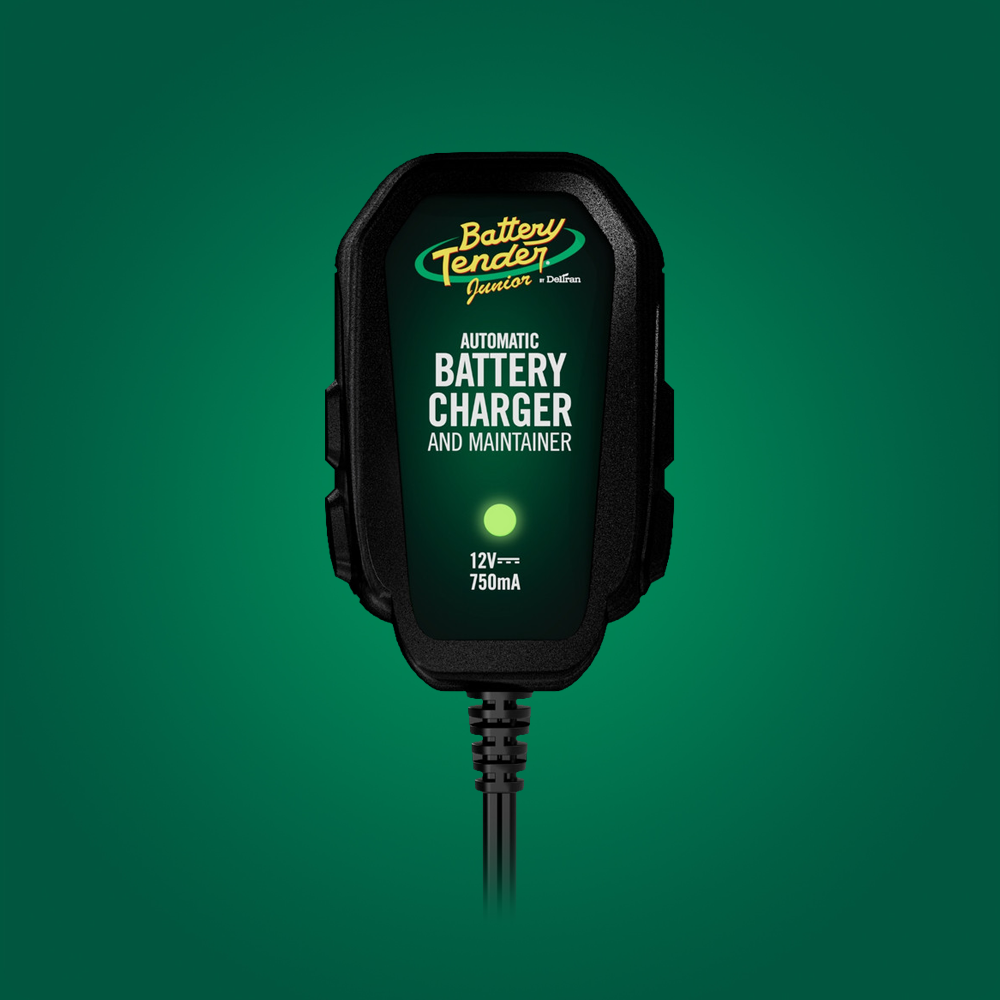
Lithium (LiFePO4) trolling motor batteries are now mainstream in the fishing community, offering 50% weight savings and 2,000+ cycle life compared to 300–500 cycles for lead-acid. Lithium batteries require chargers with specific voltage profiles — a standard lead-acid charger can overvolt lithium cells and trigger the battery management system (BMS) to disconnect. The Battery Tender Junior 1A Selectable features a dedicated lithium charging mode that uses the correct constant-current/constant-voltage profile for LiFePO4 chemistry. At 1A output, it charges a 50 Ah lithium trolling motor battery from 50% discharge in approximately 25 hours, making it best suited for light-duty trolling setups or kayak systems with smaller lithium packs.
Battery Tender Junior 1A Selectable — Lead-Acid and Lithium 12V Charger
Multi-Battery Trolling Motor Systems: 24V and 36V Configurations
Bass boats and larger fishing vessels commonly use 24V (two 12V batteries in series) or 36V (three 12V batteries in series) trolling motor systems to power high-thrust motors. Each individual 12V battery in the series string requires its own charger output — connecting a single 24V or 36V charger to the entire string risks uneven charging that degrades the weakest battery first and accelerates system failure.
Battery Tender multi-bank marine chargers solve this problem with independent ISM charging on every bank. The Battery Tender WaveCharge 3-Bank 9A delivers 3 amps per bank with full ISM 4-stage charging on each output, independently monitoring and adjusting for each battery. IP67 waterproofing allows permanent onboard installation in bilge compartments and under gunwale spaces. Each bank is selectable between 6V and 12V, accommodating mixed battery configurations. For a 36V trolling motor system with three 100 Ah batteries, each bank restores its battery from 50% discharge in approximately 16.7 hours (50 Ah ÷ 3A).
Battery Tender WaveCharge 3-Bank 9A Onboard Marine Battery Charger
Anglers who need faster recovery between tournament days should consider the Battery Tender WaveCharge Pro 3-Bank 30A, which delivers 10 amps per bank. Three 100 Ah batteries at 50% discharge recover in approximately 5 hours per bank (50 Ah ÷ 10A) — fully charged by midnight after a full day of competition. The IP68 rating on the WaveCharge Pro line withstands submersion, making it suitable for wet-ride boats and rough-water installations.
Battery Tender WaveCharge Pro 3-Bank 30A Onboard Marine Battery Charger
Trolling Motor Battery Maintenance Between Fishing Trips
The interval between fishing trips determines how much capacity a trolling motor battery loses to self-discharge. A fully charged lead-acid deep cycle battery self-discharges at 3–5% per month at room temperature. At summer garage temperatures of 90–100°F, that rate doubles to 6–10% per month. A battery left on the trailer from June through October without maintenance charging can drop below 75% state of charge — deep enough to initiate permanent sulfation.
Connecting a Battery Tender charger between trips eliminates self-discharge entirely. The ISM Float Maintenance stage applies demand-responsive charge pulses only when voltage drops below the maintenance threshold, keeping the battery at 100% state of charge without the electrolyte loss caused by continuous trickle charging. This is particularly important for AGM trolling motor batteries, where electrolyte is absorbed into fiberglass mats and cannot be replenished — any boil-off from overcharging is permanent capacity loss.
For off-season storage lasting 3–6 months, leave the Battery Tender charger connected to each trolling motor battery. Batteries maintained with ISM technology through winter storage emerge in spring at full capacity, ready for the first trip without the slow decline that forces premature replacement. Anglers who maintain batteries with ISM charging consistently report 5+ years of trolling motor battery life compared to the industry average of 2–3 years — a savings of $150–$400 per battery replacement cycle.
Emergency Power on the Water: Why Every Angler Needs a Jump Starter
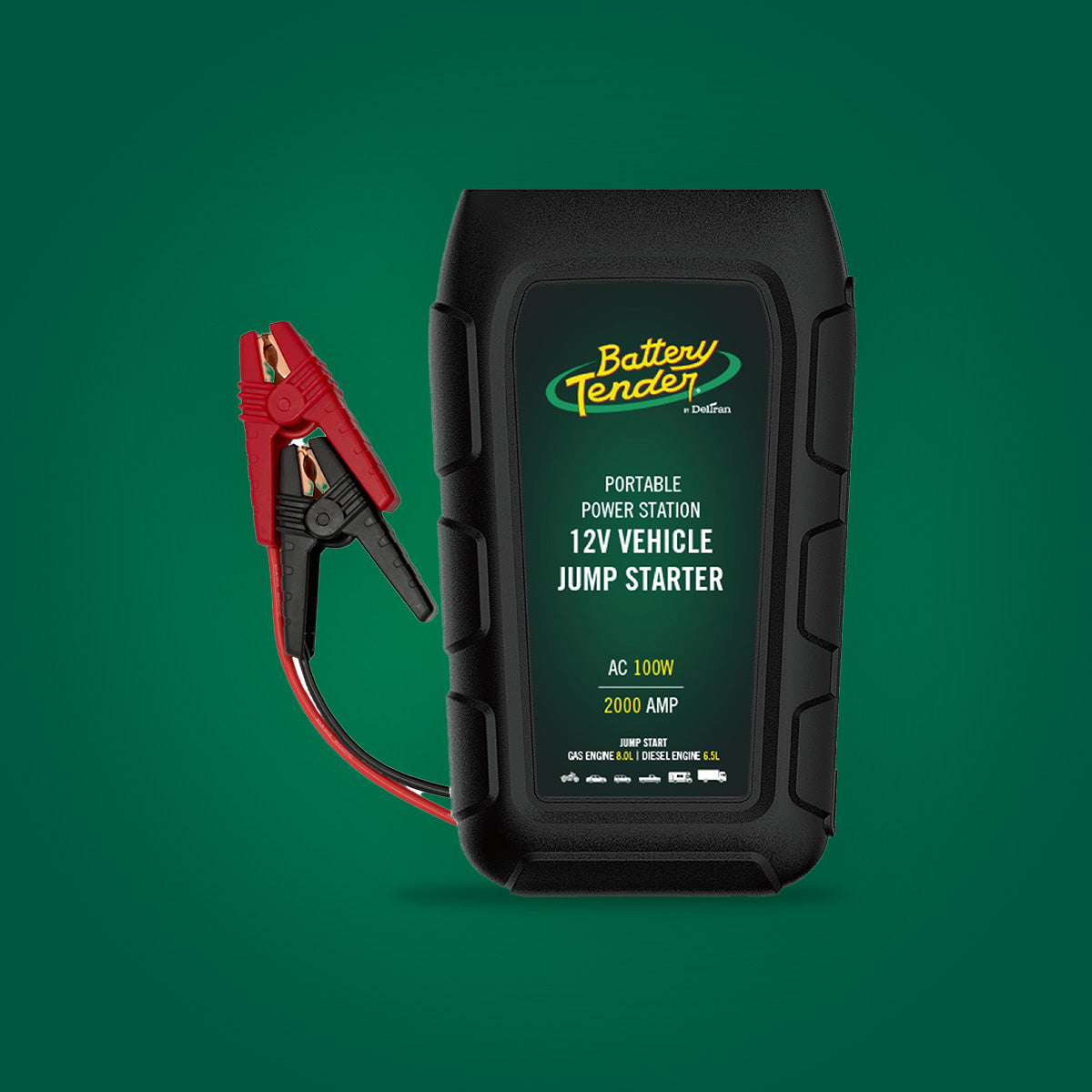
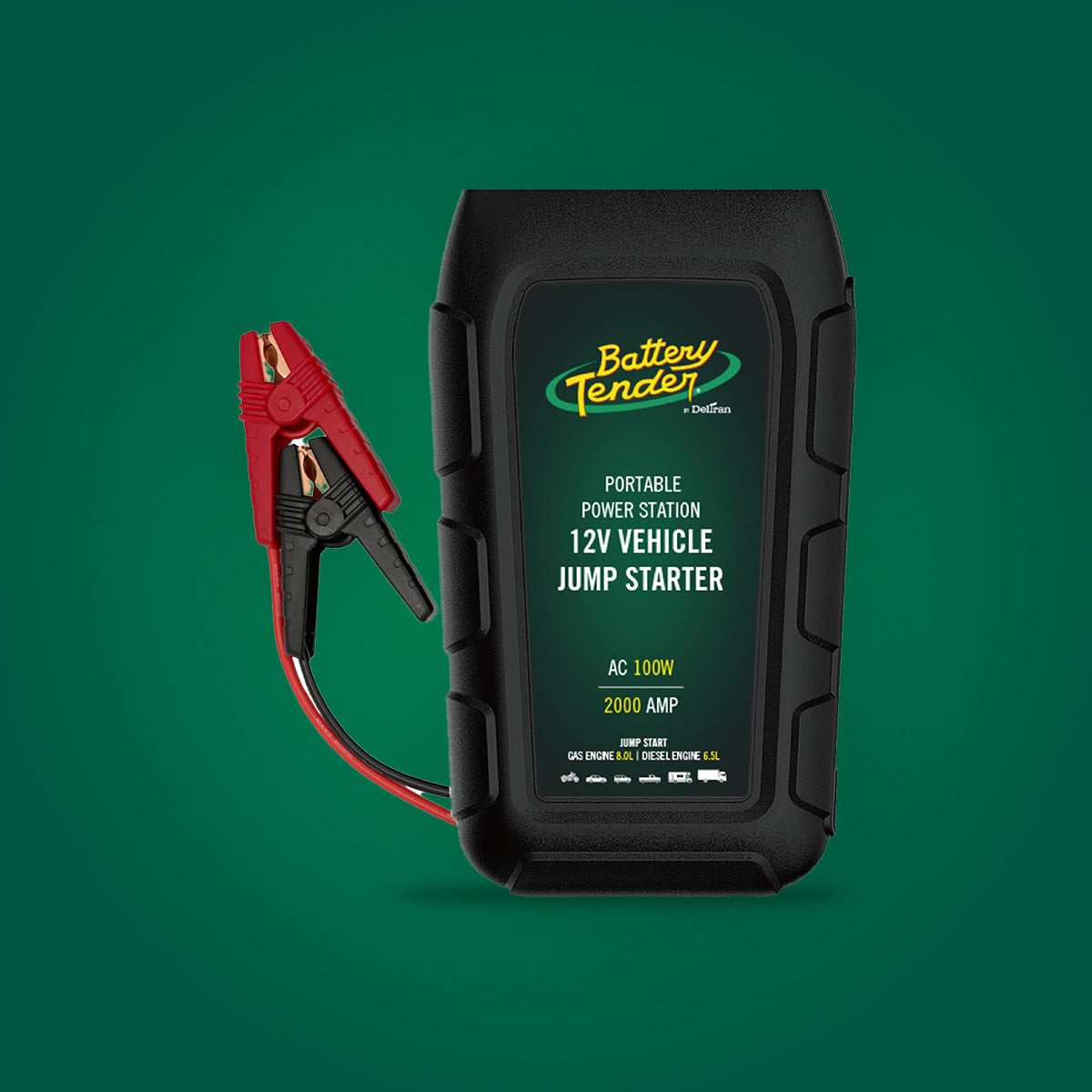
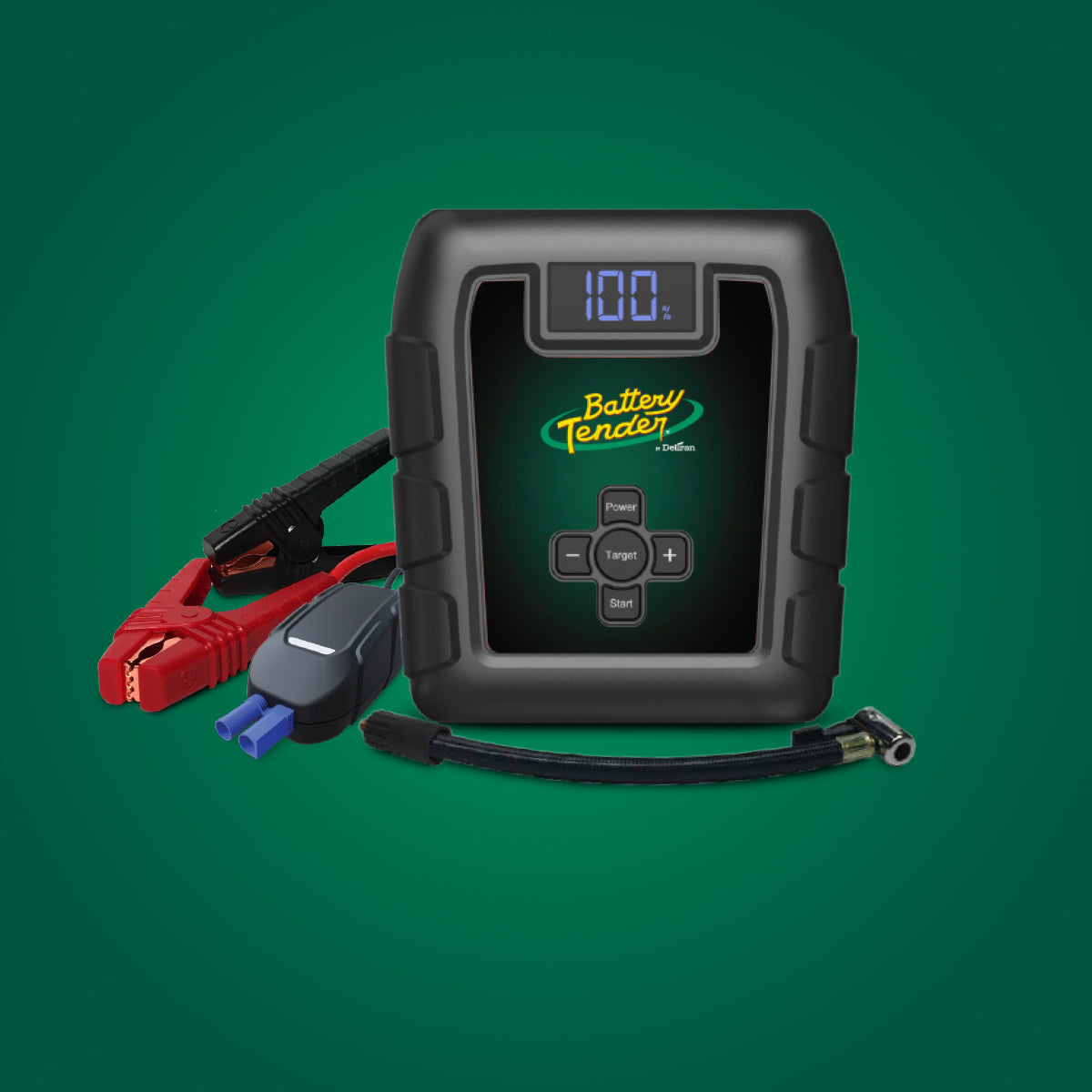
A dead cranking battery strands a boat on the water, regardless of trolling motor battery condition. Anglers who accidentally leave electronics running, or whose cranking batteries weaken from vibration damage over a long season, need a reliable jump-start option that fits in a tackle bag or console compartment. The Battery Tender 1500A Jump Starter packs 12,000 mAh and 1,500 peak amps into a portable unit capable of starting engines up to 7.0L gas and 5.5L diesel — covering virtually every outboard and inboard marine engine. It provides up to 40 starts per charge, includes USB ports for charging fish finders and phones, and weighs under 2 pounds.
Battery Tender 1500A Portable Jump Starter
For anglers who want a combination charger and emergency jump starter in a single unit, the Battery Tender Charge N Start 1120 offers 1A ISM charging for trolling motor battery maintenance plus 1,200 peak amps of jump-start capability for engines up to 6.0L gas and 4.0L diesel. The internal lithium-ion battery holds its charge for months using proprietary Charge N Store technology, meaning the jump-start function is ready even after sitting in a boat console through the off-season.
Battery Tender Charge N Start 1120 — 1A Charger + 1200A Jump Starter
Frequently Asked Questions
Can I leave a Battery Tender charger connected to my trolling motor battery all the time?
Yes. Battery Tender chargers use ISM technology that transitions to a Float Maintenance stage after the battery reaches


