




Deep Cycle Battery Charger for Golf Cart Applications — PowerPlus Guide (2026)
A deep cycle battery charger for golf cart use must handle daily deep discharges of 50–80% depth of discharge (DOD) — the most demanding charging scenario in the consumer battery world. Battery Tender® pioneered smart charging technology in 1989, and the Battery Tender PowerPlus line delivers IP68-rated, permanently mountable chargers specifically engineered for the high-cycle demands of golf cart battery packs. Unlike conventional chargers that apply a single-stage bulk charge, the PowerPlus uses Infinite Sequential Monitoring (ISM) 4-stage technology to recover capacity, dissolve sulfation, and maintain batteries indefinitely without overcharging.
Golf cart batteries face a unique challenge. A typical round of 18 holes draws 50–70 amps over 4–5 hours, depleting the battery bank to 20–50% state of charge. Without a charger designed for deep cycle recovery, sulfate crystals harden on the lead plates within 24–48 hours, permanently reducing capacity. This guide explains exactly how deep cycle charging works, how to match the right charger to a golf cart voltage system, and why ISM technology extends battery bank life by years compared to conventional charging methods.
Key Takeaways:- Golf cart batteries undergo 50–80% depth of discharge daily — requiring a charger with a true absorption stage to reverse sulfation
- ISM 4-stage charging (Initialization → Bulk → Absorption → Maintenance) is critical for deep cycle longevity
- Match charger voltage exactly to the cart system: 24V, 36V, or 48V
- IP68-rated chargers like the Battery Tender PowerPlus withstand permanent outdoor installation in cart bays and garages
- Proper charging can extend a deep cycle battery bank from 3 years to 6+ years of service life
Why Golf Carts Need a Dedicated Deep Cycle Battery Charger
Golf cart batteries are deep cycle by design, meaning they deliver sustained current over hours rather than the brief high-amperage burst a car starter battery provides. A single round of golf or a full day of neighborhood driving can discharge the battery bank to 20–50% state of charge. This repeated deep cycling creates a massive volume of lead sulfate crystals on the battery plates — crystals that a basic charger cannot fully dissolve.
Standard automotive chargers and basic trickle chargers lack the absorption stage necessary for deep cycle recovery. A trickle charger pushes constant current regardless of battery state, risking overcharge and electrolyte boil-off. A float charger applies constant voltage but never holds the elevated absorption voltage long enough to break down sulfate buildup. According to the Battery Council International (BCI), sulfation accounts for approximately 80% of premature lead-acid battery failures. For golf cart owners running 4, 6, or 8 batteries in series, one weak battery drags down the entire bank — making proper charging an investment that protects hundreds or thousands of dollars in battery replacement costs.
A purpose-built deep cycle battery charger for golf cart applications addresses these demands with higher charge voltages during absorption, temperature-responsive algorithms, and automatic maintenance modes that keep the bank topped off between rounds without human intervention.
How ISM 4-Stage Charging Protects Deep Cycle Golf Cart Batteries
ISM technology from Battery Tender delivers a precise 4-stage charging process that matches exactly what deep cycle batteries require after heavy discharge. Each stage serves a distinct electrochemical purpose.
Stage 1 — Initialization: The charger tests the battery bank, applying a gentle current to assess condition and determine whether the batteries can accept a full charge. This prevents dumping high current into a damaged or severely sulfated bank, which could cause thermal runaway in extreme cases.
Stage 2 — Bulk Charge (Constant Current): The charger delivers its full rated amperage — up to 15A for the Battery Tender PowerPlus 48V — until the battery bank reaches approximately 80% state of charge. For a 48V system with 150 Ah batteries discharged to 30% remaining capacity, the charging time formula applies: (150 Ah × 0.70 DOD) ÷ 15A = approximately 7 hours for the bulk phase.
Stage 3 — Absorption (Constant Voltage): This is the stage that separates a true deep cycle charger from everything else. The charger holds voltage constant at the elevated absorption setpoint while current gradually tapers. This extended high-voltage hold dissolves the soft lead sulfate crystals that formed during discharge, restoring plate surface area and recovering lost capacity. Without this stage, sulfation hardens within 48–72 hours and becomes irreversible.
Stage 4 — Maintenance (Float): Once fully charged, the charger drops to a maintenance voltage and delivers demand-responsive charge pulses only when voltage dips below the setpoint. This keeps the bank at 100% state of charge between uses without overcharging — critical for golf carts that may sit idle for days between rounds.
How to Match the Right Deep Cycle Battery Charger to a Golf Cart Voltage System
The single most important specification when selecting a deep cycle battery charger for golf cart use is matching the charger output voltage exactly to the cart system voltage. Golf carts operate at 24V, 36V, or 48V, depending on manufacturer, model year, and battery configuration. Installing a mismatched charger will either undercharge (reducing performance and accelerating sulfation) or overcharge (boiling electrolyte, warping plates, and creating hydrogen gas hazards).
48V Systems — Most Modern Golf Carts
The majority of golf carts manufactured after 2008 — including Club Car Precedent, E-Z-GO RXV/TXT, and Yamaha Drive — use 48V systems. These typically run six 8V batteries or four 12V batteries in series. The Battery Tender PowerPlus 48V delivers 15 amps of ISM-controlled charging through an IP68-sealed enclosure rated for permanent outdoor mounting. UL marine ignition protection certification means the unit is safe to install in enclosed cart bays where battery off-gassing could create combustible hydrogen concentrations.
For a 48V golf cart equipped with 150 Ah batteries at 50% DOD: (150 Ah × 0.50) ÷ 15A = 5 hours to full charge from the bulk phase alone, with an additional 1–2 hours in absorption for complete sulfate dissolution.
The Battery Tender PowerPlus 48V 15A is the recommended charger for most modern golf cart owners.
Battery Tender PowerPlus 48V 15A IP68 Charger — $379.95
36V Systems — Classic Club Car, E-Z-GO, and Yamaha
Older golf carts — particularly Club Car DS models (1995–2013), E-Z-GO TXT/Medalist, and Yamaha G19/G22/G29 — commonly use 36V systems configured with six 6V batteries in series. These packs demand a charger that understands the specific voltage thresholds of a 36V deep cycle bank. The Battery Tender PowerPlus 36V delivers 18 amps through the same IP68-sealed, permanently mountable chassis, with full ISM 4-stage capability and temperature compensation that adjusts charge voltage based on ambient conditions — essential for carts stored in unheated garages during winter or exposed to summer heat in the Sun Belt.
Battery Tender PowerPlus 36V 18A IP68 Charger — $359.95
24V Systems — Older and Industrial Utility Carts
Some older residential carts and many industrial/utility carts operate at 24V, typically using four 6V batteries or two 12V batteries in series. The Battery Tender PowerPlus 24V provides 20 amps of ISM charging — the highest amperage in the PowerPlus lineup — enabling rapid deep cycle recovery for carts used in warehouse, resort, or campus fleet operations where downtime must be minimized.
Battery Tender PowerPlus 24V 20A IP68 Charger — $359.95
Why IP68 Waterproofing Matters for Golf Cart Charger Installation
Golf cart chargers face environmental conditions that most consumer chargers never encounter. Carts are stored in open-air shelters, washed down with hoses, driven through rain, and parked in humid coastal climates. A charger rated below IP67 can allow moisture ingress through ventilation slots, corroding internal components and creating electrical hazards near battery banks that off-gas hydrogen during charging.
The Battery Tender PowerPlus line carries an IP68 rating — the highest waterproof designation available. IP68 means the enclosure withstands continuous immersion beyond 1 meter and is completely sealed against dust. Combined with UL marine ignition protection certification, the PowerPlus can be permanently mounted on the cart frame, under the seat, or on a garage wall near the charging station without concern for moisture, dust, or ignition risk from battery off-gassing.
How to Extend Deep Cycle Golf Cart Battery Life with Proper Charging Habits
Even with the best deep cycle battery charger, operator habits significantly impact battery bank longevity. Follow these practices to maximize the return on a golf cart battery investment.
Charge after every use. Never let a discharged battery bank sit overnight without connecting the charger. Sulfation begins forming within hours of discharge and hardens within 48–72 hours. ISM maintenance mode keeps the bank at 100% state of charge between uses, so there is no penalty for leaving the charger connected indefinitely.
Check water levels monthly (flooded lead-acid batteries only). Deep cycling consumes electrolyte through normal gassing. Add distilled water only after charging — never before — to prevent overflow during the absorption stage when electrolyte expands.
Avoid discharging below 20% state of charge. While deep cycle batteries tolerate heavy discharge, repeatedly dropping below 20% SOC accelerates plate degradation exponentially. Most golf cart battery manufacturers recommend maintaining DOD at 50–80% for optimal cycle life — a well-maintained 6V golf cart battery rated for 750 cycles at 50% DOD may deliver only 350 cycles at 80% DOD.
Clean terminals quarterly. Corroded terminals increase resistance, causing the charger to work harder, generate more heat, and potentially fail to reach full absorption voltage. A wire brush and baking soda solution eliminate corrosion in minutes.
DC Plug Accessories for Direct Golf Cart Charging
Battery Tender offers plug-and-play DC plug accessory cables that connect the PowerPlus charger directly to the cart charge port — eliminating the need to open the battery compartment for every charge session. These cables are available for all major golf cart brands and connector styles.
For 48V E-Z-GO TXT and RXV carts with the 3-pin triangle handle connector, the dedicated DC plug accessory (SKU 081-0205-EZ) provides a clean, permanent connection. For 48V Club Car DS and Precedent models (1995–2013), the compatible cable (SKU 081-0200-CC) matches the factory charge port. For 36V E-Z-GO Medalist and TXT carts, two options are available: the standard plug (SKU 081-0201-EZ) or the Crow Foot plug (SKU 081-0203-EZ), depending on the connector type installed on the cart.
Browse all DC plug accessories and golf cart charging solutions on the dedicated landing page:
Battery Tender Golf Cart Chargers and Accessories
Portable Emergency Power for Golf Carts on the Course
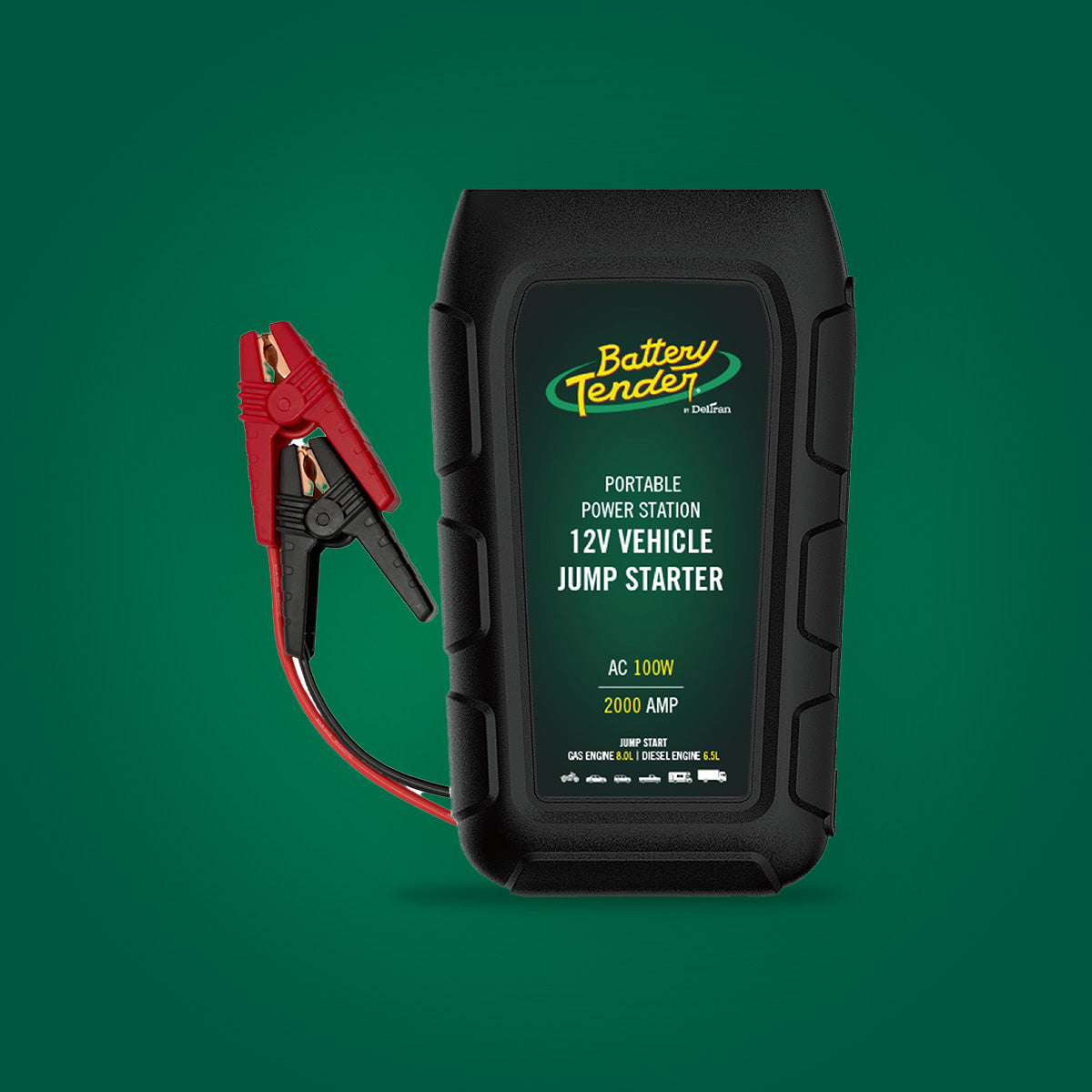
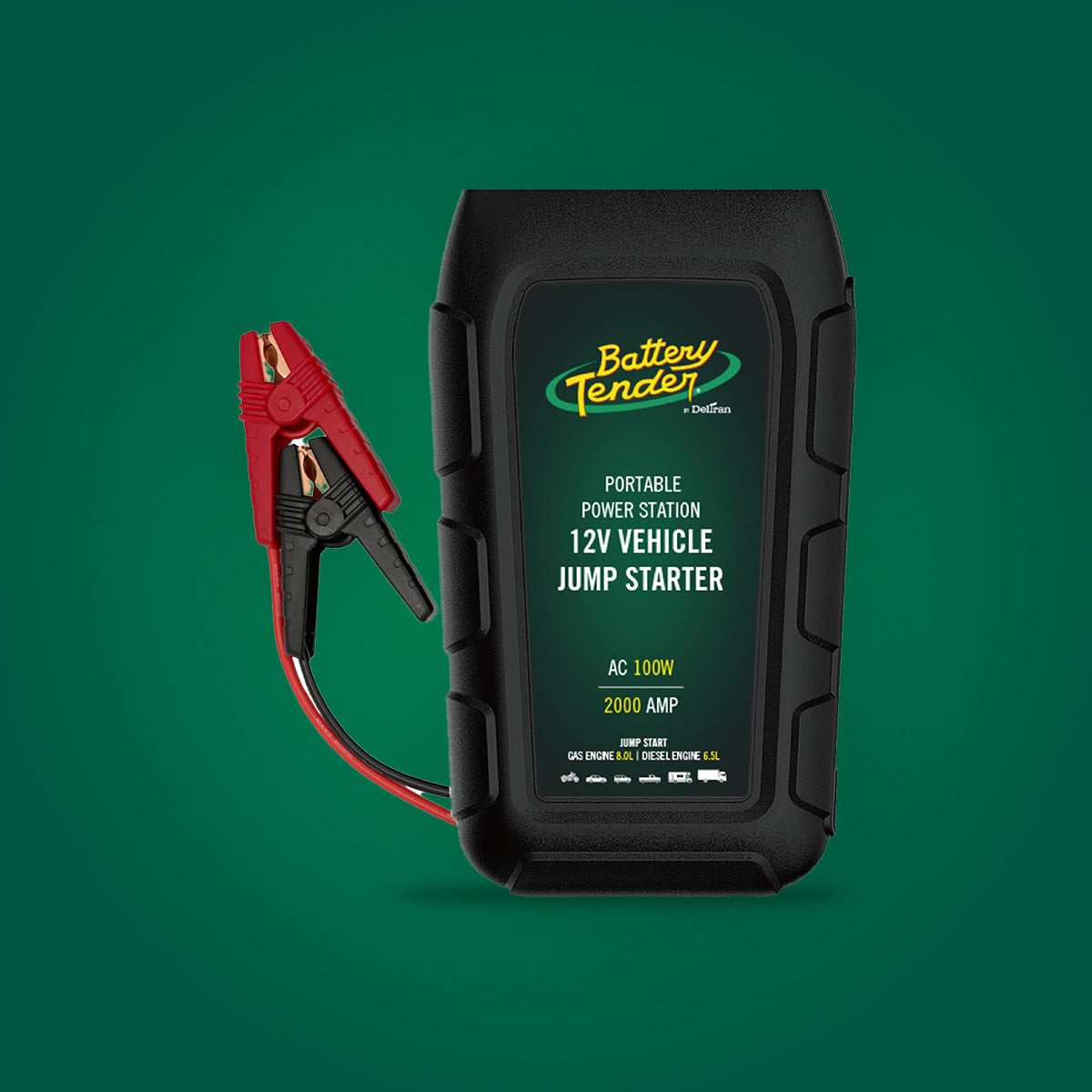
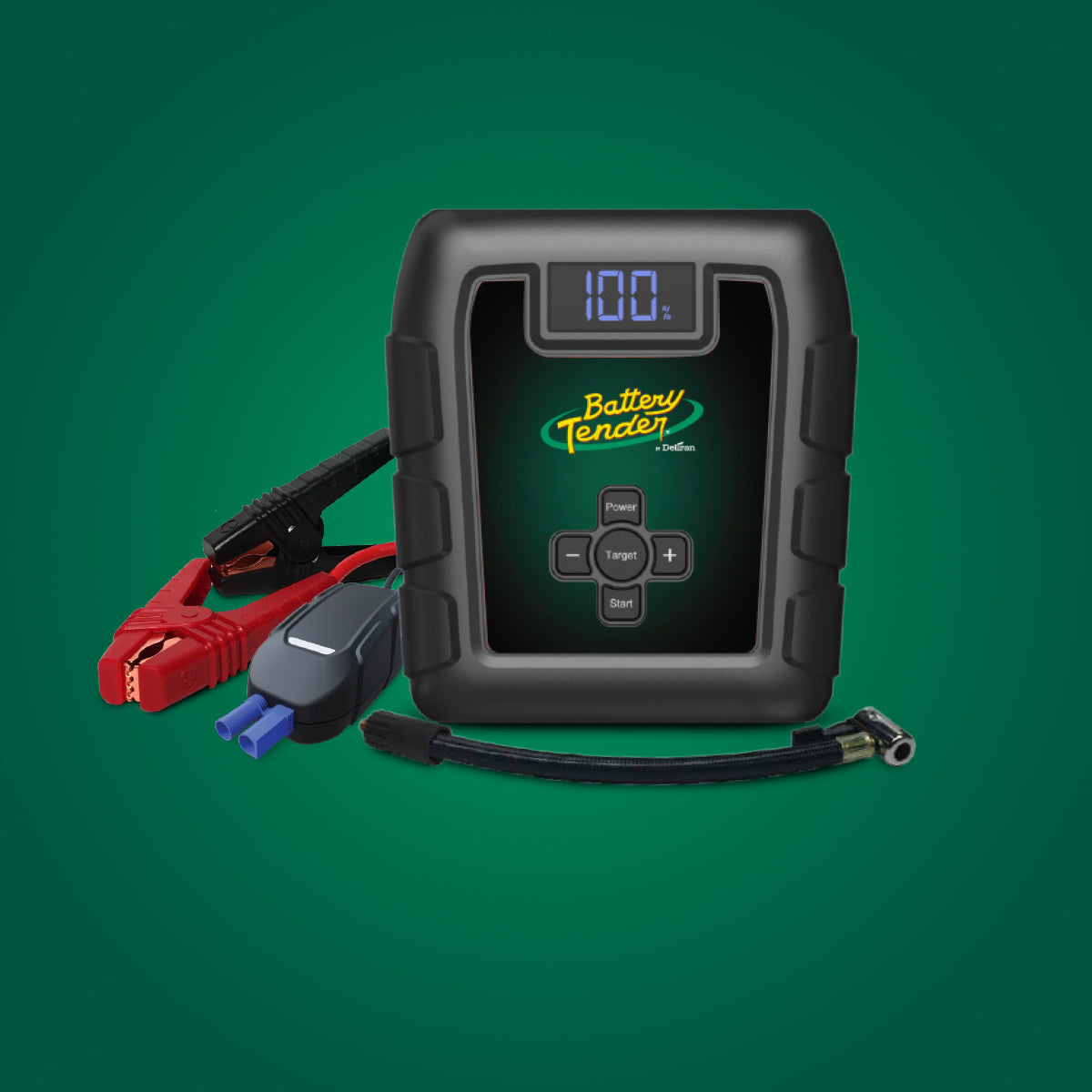
A dead golf cart battery mid-round creates a logistical problem — the cart must be towed back to the clubhouse. While a deep cycle charger handles daily recharging, a portable jump starter provides emergency starting power for the cart or any other 12V vehicle on the property. The Battery Tender Charge N Start 4120 combines a 4A ISM charger with a 1,200-amp lithium-ion jump starter capable of starting engines up to 6.0L gas or 4.0L diesel. The internal lithium-ion battery features proprietary Charge N Store technology for float maintenance of the internal pack and SafeGuard anti-backfeed circuit protection.
Battery Tender Charge N Start 4120 — 4A Charger + 1,200A Jump Starter — $179.95
For a compact option that fits in a golf bag pocket, the Battery Tender 600A Jump Starter provides 600 amps of starting power from a 6,400 mAh lithium-ion pack — enough to jump start small engines and charge USB devices on the course.
Battery Tender 600A Jump Starter — $114.95
Frequently Asked Questions
Can a regular car battery charger work as a deep cycle battery charger for a golf cart?
No. Most automotive chargers output 12V and lack the absorption stage required for deep cycle recovery. Golf carts operate at 24V, 36V, or 48V — connecting a 12V charger to a 48V battery bank will not charge the system at all. Even if the voltage matched, a charger without absorption-stage sulfate dissolution would shorten deep cycle battery life by 30–50% compared to a proper ISM charger like the Battery Tender PowerPlus.
How long does it take to charge a 48V golf cart battery bank from empty?
Using the charging time formula: (battery Ah × depth of discharge) ÷ charger amps = approximate hours. For a common 150 Ah battery bank at 80% DOD: (150 × 0.80) ÷ 15A = 8 hours for bulk charging, plus 1–2 hours for the absorption stage. Total charge time from near-empty to 100%: approximately 9–10 hours with the Battery Tender PowerPlus 48V.
Is it safe to leave a Battery Tender PowerPlus connected to a golf cart indefinitely?
Yes. ISM technology includes a demand-responsive maintenance stage that delivers charge pulses only when battery voltage drops below the maintenance setpoint. Unlike trickle chargers — which push constant current and can boil electrolyte — ISM charging is designed for indefinite connection. Temperature compensation adjusts voltage based on ambient temperature, preventing overcharge in hot environments or undercharge in cold storage.
What is the difference between IP67 and IP68 for a golf cart charger?
IP67 withstands temporary submersion up to 1 meter for 30 minutes. IP68 withstands continuous submersion beyond 1 meter at depths and durations specified by the manufacturer — a higher protection standard. For golf cart chargers mounted on carts or in wash-down environments, IP68 provides superior protection against pressurized water, sustained humidity, and dust ingress. The Battery Tender PowerPlus line carries the IP68 rating.
Conclusion
Selecting the right deep cycle battery charger for golf cart use is the single most impactful decision for battery bank longevity, performance, and total cost of ownership. The Battery Tender PowerPlus line — available in 24V, 36V, and 48V configurations — delivers ISM 4-stage charging through an IP68-sealed enclosure designed for permanent outdoor installation. With temperature compensation, UL marine ignition protection, and demand-responsive maintenance, the PowerPlus protects a golf cart battery investment year-round, whether the cart sees daily play or seasonal storage.
Explore the complete lineup of golf cart chargers, DC plug accessories, and portable power solutions on the Battery Tender golf cart page:
Battery Tender Golf Cart Chargers and Accessories
Last updated: 2026