


MPPT Solar Charge Controller: How to Choose and Size One (2026)
An mppt solar charge controller converts excess panel voltage into extra charging current, delivering roughly 10-30% more power to the battery than a basic PWM controller. It pays off most with panels above about 100W; smaller maintenance panels work well with a built-in controller.
The Battery Tender® brand builds solar maintainers and charge controllers, and one rule applies to every setup: match the controller to the panel and the battery, not the other way around. This guide explains how MPPT works, how to size a controller with simple math, and how to wire it correctly. It also covers when a small panel with a built-in controller is the smarter buy.
Key Takeaways
- MPPT controllers harvest 10-30% more energy than PWM, and the gain is largest in cold weather and with low batteries.
- Size the controller with: panel watts ÷ battery voltage × 1.25 = minimum controller amps.
- Panels under about 35W on a single 12V battery rarely need MPPT; a built-in controller is enough.
- Always connect the battery to the controller first and the panel second.
- Match the charge profile to the chemistry: lead-acid, AGM, gel, or lithium.
What Does an MPPT Solar Charge Controller Do?
An mppt solar charge controller tracks the Maximum Power Point of a solar panel and converts surplus voltage into additional current. A "12V" panel typically produces 17-18V at its working point, while a discharged 12V battery sits near 12-13V.
That voltage gap is wasted energy in a basic controller. MPPT (Maximum Power Point Tracking) uses a DC-to-DC converter to pull the panel at its ideal voltage and step it down to battery voltage. The power stays nearly the same, so the current rises.
A Worked Example
Take a 100W panel with a maximum power voltage (Vmp) of 18V and a current (Imp) of 5.56A. Charging a 13V battery:
- PWM: the panel is pulled down to battery voltage, so 5.56A × 13V = about 72W delivered.
- MPPT: 100W ÷ 13V = about 7.7A, or roughly 7.4A after 3-5% conversion loss. That is about 96W delivered.
That is a gain of about 33% in this scenario. Real-world gains usually land between 10% and 30% depending on temperature, panel voltage, and battery state of charge.
What a Controller Also Protects
Every controller prevents overcharging. An open-circuit panel can reach 21-22V, and a 12V lead-acid battery begins gassing near 14.7V. A controller limits voltage, tapers current as the battery fills, and blocks reverse current at night. Quality units also offer chemistry profiles and temperature compensation; confirm both on the datasheet before buying.
MPPT Solar Charge Controller vs. PWM: Which Fits Your Setup?
Choose an mppt solar charge controller when your panel array exceeds about 100W, your battery bank is 24V or higher, or you work in cold climates. Choose PWM or a built-in controller for small, low-cost, maintenance-level installations.
- MPPT is better when: panels are 100W or larger, the panel voltage is well above battery voltage, temperatures drop below 40°F, or you plan to expand later.
- PWM is better when: the panel is small (under 50W), budget is tight, and panel and battery voltages match closely.
Cold weather is MPPT's biggest advantage. Panel voltage rises as temperature falls, and MPPT converts that extra voltage into current. A PWM controller simply discards it.
Honest trade-off: MPPT costs more, and on a 5W-35W maintenance panel the extra harvest is under 1A. The money is better spent on the right panel size. For a deeper look at panel-based maintenance, see the portable solar battery charger complete guide.
How to Size an MPPT Solar Charge Controller
Size an mppt solar charge controller with this formula: panel watts ÷ battery voltage × 1.25 = minimum controller amps. The 1.25 factor covers cold-weather output spikes and brief sun intensity above rated conditions.
Example: 250W of panels on a 12V bank. 250 ÷ 12 = 20.8A, × 1.25 = 26A. A 30A controller fits. Also confirm the panel string's open-circuit voltage (Voc), adjusted for cold, stays below the controller's maximum input voltage.
| Application | Battery Bank | Panel Size | Recommended Controller |
|---|---|---|---|
| Motorcycle or ATV storage | 12V, 8-20Ah | 5W | Built-in controller |
| Car, truck, or boat starting battery | 12V, 40-100Ah | 17-35W | Built-in controller |
| Small cabin or trailer | 12V, 100Ah | 100W | 10-15A MPPT |
| RV or van house bank | 12V, 200Ah | 250W | 30A MPPT |
| Farm or shop equipment | 24V, 200Ah | 400W | 30A MPPT (24V) |
Estimating Charge Time
Use the standard formula: (battery Ah × depth of discharge) ÷ charging amps. A 100Ah battery at 50% discharge needs 50Ah. A 100W panel through MPPT delivers about 7.4A at peak. At 5 peak sun hours, that is roughly 37Ah per day, so a full recovery takes about 1.4 days. Cloud cover and panel angle can double that.
How to Wire and Install an MPPT Solar Charge Controller
Install an mppt solar charge controller by connecting the battery first, then the panel, and fusing both sides. The order matters because the controller reads battery voltage on startup to select 12V or 24V operation.
- Mount the controller. Choose a dry, ventilated spot close to the battery, ideally within 3 feet, to limit voltage drop.
- Cover the panels. Use an opaque cloth, or work at dusk, so the array produces no power while you connect it.
- Fuse the battery line. Place a fuse or breaker rated for the controller's maximum amps within 7 inches of the battery positive terminal.
- Connect the battery first. Wire battery positive and negative to the controller's battery terminals. The display should light.
- Select the battery profile. Choose flooded, AGM, gel, or lithium. A wrong profile is the most common cause of undercharging.
- Connect the panel second. Attach panel positive and negative, then uncover the panels.
- Verify. Confirm charging current on the display at midday. Expect 70-85% of the panel's rated watts as a typical real-world result.
Use wire gauge matched to current. For example, 10 AWG handles 30A over short runs. Follow NEC Article 690 guidance for permanent photovoltaic installations. Disconnect the panel before servicing any battery. Lead-acid batteries vent hydrogen, so avoid sparks nearby.
Which Battery Tender Solar Option Fits Your Battery?
Match the product to the job: panels with a built-in controller for maintenance, a standalone controller for larger arrays. The Battery Tender solar lineup covers both. Models with a built-in controller use 3-step charging and support lithium, lead-acid, AGM, and gel batteries on 12V systems.
Small Batteries and Remote Storage
A motorcycle, ATV, or lawn tractor battery in a shed with no outlet loses 1-3% of charge per week through self-discharge. The 5W panel replaces that loss on a 12V battery of 8-20Ah, and its handlebar mount suits parked bikes in sunlit areas.
Battery Tender 5 Watt Solar 12V Battery Charger with Handlebar Mount
For a car, truck, or boat starting battery of 40-100Ah, a larger panel is the better fit. The 35W model produces up to roughly 2A in full sun, which offsets parasitic drains from alarms and clocks. Its built-in solar controller prevents overcharging, so no separate mppt solar charge controller is needed. For more on this use case, read can a solar panel keep a car battery charged.
Battery Tender 35 Watt Mountable Solar 12V Battery Charger with Solar Controller
Larger Panels and Battery Banks
When you pair your own panels with a house bank, a standalone controller is required. The Battery Tender Solar Charge Controller suits builders who want a dedicated unit between the panel and a 12V battery, protecting against overcharge and reverse current. Check the datasheet for its current rating and input limits before sizing panels.
Battery Tender Solar Charge Controller
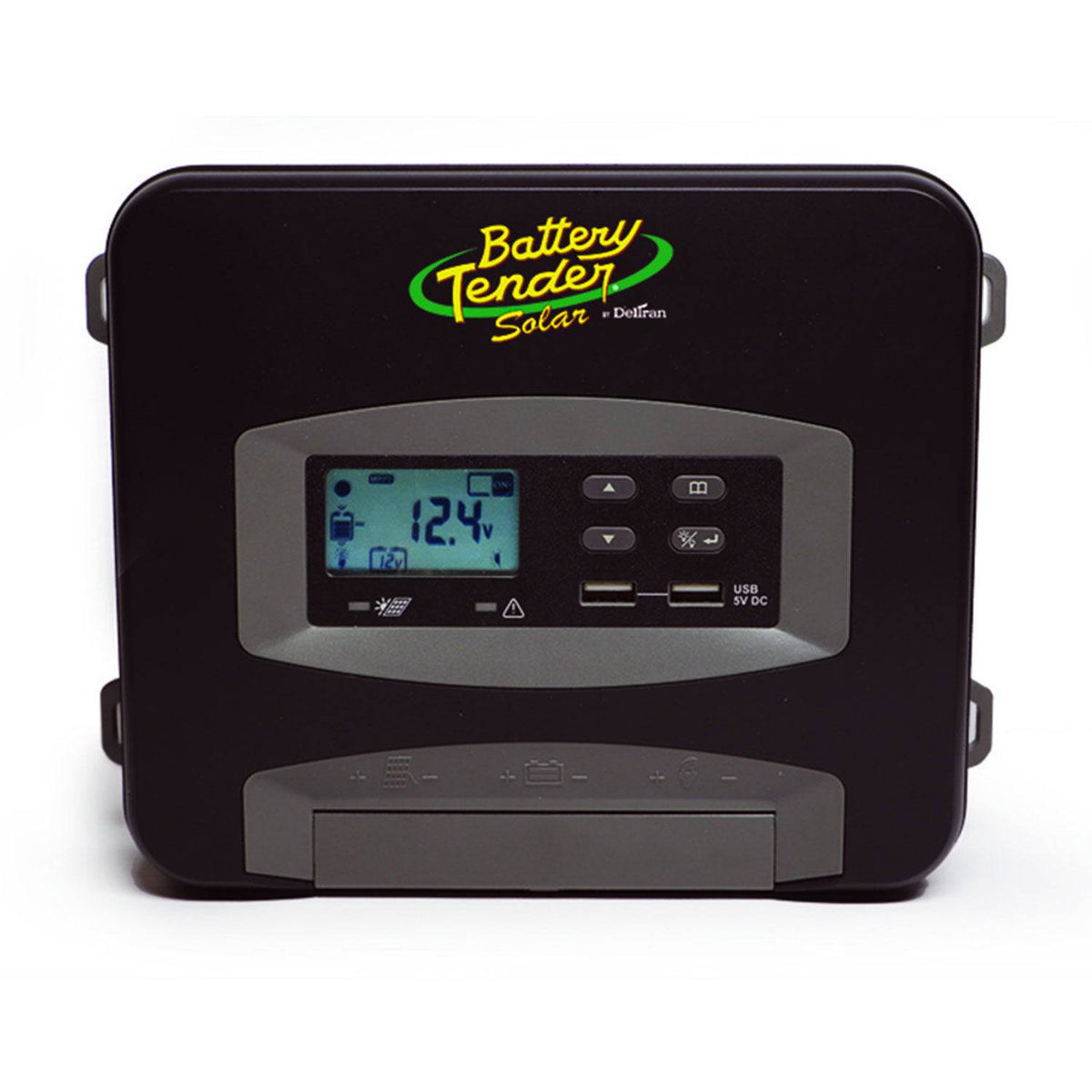
For RV, farm, or shop banks of 100-200Ah at 12V or 24V, the 30A MPPT unit is the right class. It supports 12V and 24V systems, handles about 360W at 12V or 720W at 24V by current rating, and gains the most in cold weather. Verify the array's voltage stays within the input limit.
Battery Tender 30 AMP, 24V/12V MPPT Solar Charge Controller
Backup for Cloudy Stretches
Solar output drops sharply during weeks of overcast, and a drained battery in a remote location needs a backup plan. The Battery Tender Charge N Start 1100 combines a 1A charger with a 1,000A jump starter (5.0L gas, 3.0L diesel). Its internal pack is lithium-ion, and the charger section handles standard, AGM, gel, and lithium 12V batteries. The Charge N Store feature maintains the internal pack between uses.
When AC power is available, Battery Tender chargers use Infinite Sequential Monitoring (ISM), a four-stage automatic process: Initialization, Bulk Charge, Absorption, and Float Maintenance. ISM lets a Battery Tender charger stay connected long-term, unlike conventional trickle chargers that keep pushing current into a full battery. Browse the full solar battery charger collection to compare panel sizes.
Frequently Asked Questions
Is an MPPT solar charge controller worth it?
An mppt solar charge controller is worth it for panels above about 100W, 24V systems, or cold climates, where it adds 10-30% more charging power. For a 5W-35W maintenance panel on one 12V battery, the gain is under 1A, so a panel with a built-in controller is the more practical choice.
What size MPPT solar charge controller do I need?
Divide total panel watts by battery voltage, then multiply by 1.25. For 250W on a 12V battery, that is 250 ÷ 12 × 1.25 = 26A, so a 30A controller fits. Also confirm the panel string's cold-weather open-circuit voltage stays below the controller's maximum input voltage rating.
Can an MPPT solar charge controller charge lithium batteries?
Yes, if the controller offers a lithium charge profile or adjustable voltage settings. Lithium batteries need a different absorption voltage than flooded lead-acid. Always select the correct chemistry in the controller settings, and never charge a lithium battery below freezing unless the battery's built-in protection allows it.
Can I connect a solar panel directly to a battery without a controller?
Only a tiny panel of about 1-5W on a large battery is sometimes run uncontrolled, and even that is risky. A typical 12V panel reaches 21-22V open circuit, which overcharges and damages a 12V battery. Use a controller or a panel with a built-in one.
Conclusion
An mppt solar charge controller delivers the most value on larger arrays, 24V systems, and cold-climate installations. For small maintenance jobs, a panel with a built-in controller is simpler and just as protective. Size by watts, volts, and the 1.25 factor, connect the battery first, and select the correct chemistry profile.
Next step: calculate your panel wattage and battery voltage, then compare options in the Battery Tender solar battery charger collection.