


ISM Charging Technology Deep Dive: 4 Stages Explained (2026)
This ISM charging technology deep dive answers one question: how does Infinite Sequential Monitoring (ISM) charge a battery without overcharging it? Every Battery Tender® charger runs a four-stage cycle (Initialization, Bulk, Absorption, Float Maintenance) that tests the battery first, then adapts current and voltage to its actual condition.
Many battery failures trace back to charging that ignores the battery's real state. Conventional trickle chargers push the same current whether the battery is at 40% or 100%, and that excess current overheats a full battery and boils off electrolyte. ISM monitors voltage continuously and changes its output at each stage. The sections below cover what happens in each stage, how ISM compares with other charger types, and how to match a charger to your battery.
Key Takeaways
- ISM is a four-stage process: Initialization, Bulk, Absorption, and Float Maintenance.
- ISM reads battery voltage continuously, so the charger can stay connected indefinitely without overcharging.
- Trickle chargers deliver constant current regardless of battery state; float chargers hold constant voltage but skip the Absorption stage.
- Sizing rule: (battery Ah × depth of discharge) ÷ charger amps = approximate charge hours.
- Nearly all Battery Tender chargers include temperature compensation.
ISM Charging Technology Deep Dive: The Four Stages in Detail
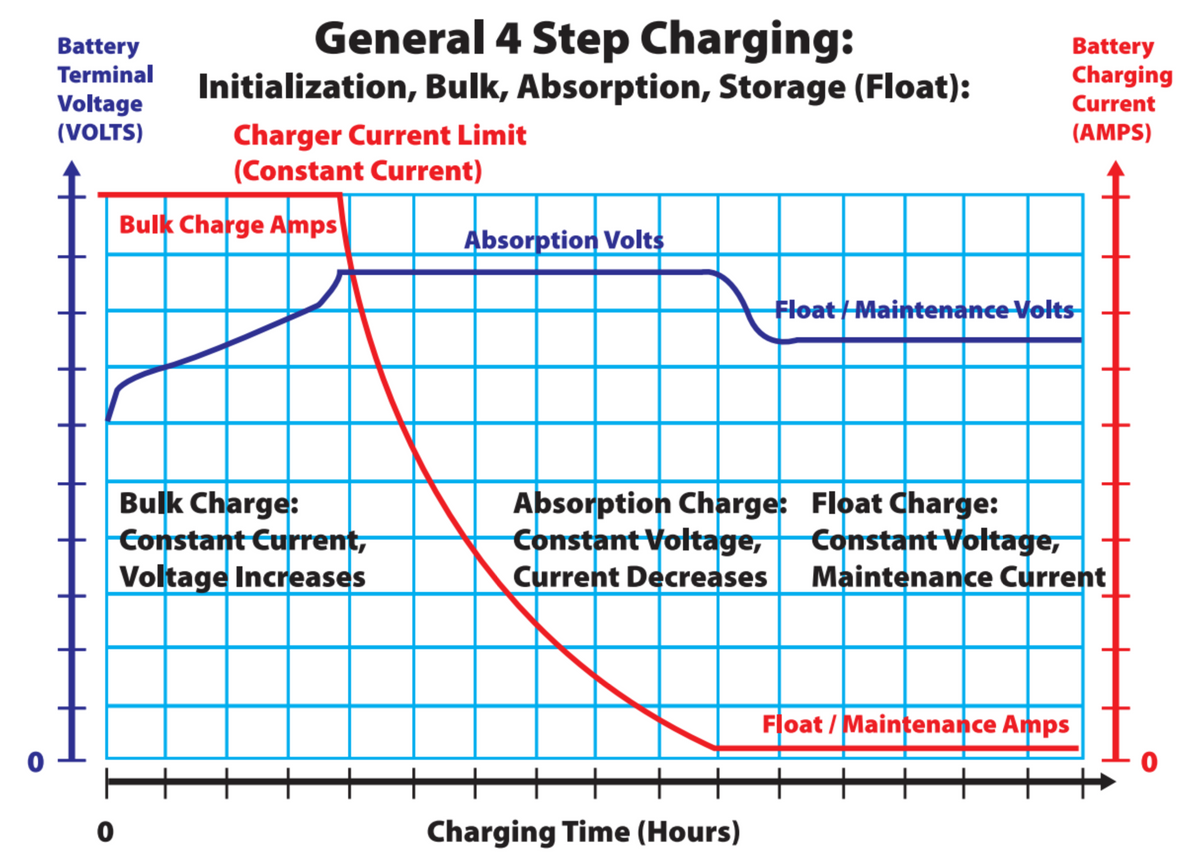
ISM moves a battery through four stages in sequence, and each stage ends only when the battery's voltage response says it should. The charger never runs on a timer alone.
Stage 1: Initialization
Initialization tests the battery before any real charging begins. The charger applies a gentle current and reads how the voltage responds, which tells it whether the battery is deeply discharged, healthy, or unresponsive.
This step is a safeguard. A deeply discharged battery gets a soft start instead of a full-current slam, which reduces heat and gassing.
Stage 2: Bulk (Constant Current)
Bulk charging delivers the charger's full rated current until the battery reaches roughly 80% state of charge. A 10A charger pushes close to 10A here, and voltage climbs steadily as the battery accepts energy.
Bulk restores most of the battery's capacity, and it does so faster than any other stage.
Stage 3: Absorption (Constant Voltage)
Absorption holds voltage constant, typically near 14.4V on a 12V lead-acid battery, while current tapers off. This stage fills the last 20% of capacity and works on lead sulfate crystals that formed while the battery sat discharged.
Cheaper chargers skip this stage or cut it short, which is why batteries on those chargers often read "full" at the terminals but deliver less capacity under load.
Stage 4: Float Maintenance
Float Maintenance keeps the battery at full charge without overcharging it. Voltage drops to roughly 13.2V, and the charger sends pulses only when battery voltage falls below its threshold, as in storage self-discharge.
This demand-responsive behavior makes ISM safe for indefinite connection. A battery can sit on the charger from October to April and come out at full charge.
Why Does Sulfation Shorten Battery Life?
Sulfation shortens battery life because lead sulfate crystals harden on the plates when a lead-acid battery sits below full charge, permanently reducing capacity. It is the leading cause of premature failure in seasonal vehicles.
Rested voltage tells you how exposed a battery is. A 12V lead-acid battery reads about 12.65V at 100%, 12.4V at 75%, 12.2V at 50%, and 12.0V at 25%. Below 12.4V, sulfation starts. A battery self-discharges roughly 3–5% per month at 77°F, and the rate climbs in warm garages. A bike or mower parked in August can be at 12.0V by November.
Warning signs of sulfation include:
- Slow cranking after the vehicle sat for several weeks
- Rested voltage that drops below 12.4V within days of a full charge
- Charger finishing much faster than expected, a sign of reduced capacity
- Battery age under three years with falling performance
The Absorption stage and continuous monitoring are what counter this. In seasonal-storage use, batteries kept on ISM maintenance routinely outlast the two to three years typical of batteries left to self-discharge.
ISM Charging Technology vs. Trickle and Float Chargers
ISM differs from trickle and float chargers because it adapts across four stages, while those chargers apply one fixed behavior. The table shows the practical difference.
| Feature | Trickle Charger | Float Charger | ISM Charger |
|---|---|---|---|
| Output method | Constant current | Constant voltage only | Four-stage, adaptive |
| Tests battery first | No | No | Yes (Initialization) |
| Absorption stage | No | No | Yes |
| Reacts to battery state | No | Partly | Continuously |
| Overcharge risk when left on | High | Low | None by design |
| Safe for months of storage | No | Usually | Yes |
A conventional trickle charger keeps pushing current after the battery is full. The excess turns into heat and gas, and water loss in flooded batteries follows. A float charger avoids that but charges slowly and never runs a true absorption phase, so it rarely recovers a battery that has started to sulfate.
ISM avoids both problems. It charges at full rate when the battery needs it, tapers as the battery fills, and then idles. The same principle protects standby equipment through months of idle time, as covered in this guide to Generac generator battery maintenance.
How to Size an ISM Charger to Your Battery
Size an ISM charger by dividing the amp-hours you need to replace by the charger's output. The formula is (battery Ah × depth of discharge) ÷ charger amps = approximate hours.
For example, a 60Ah car battery at 50% discharge needs 30Ah returned. On a 4A charger, that is 30 ÷ 4 = 7.5 hours. Add roughly 20% for Absorption tapering and real-world efficiency, for about 9 hours total.
| Application | Typical Battery | Recommended Charger | Example Recharge (50% discharged) |
|---|---|---|---|
| Motorcycle, ATV, lawn tractor | 10–30Ah | Battery Tender Junior 1A | 20Ah: 10Ah ÷ 1A = 10 hrs |
| Car, SUV, 6V/12V classic | 40–70Ah | Battery Tender Power Tender 4 Amp | 60Ah: 30Ah ÷ 4A = 7.5 hrs |
| Truck, RV, deep cycle, marine | 75–120Ah | Battery Tender Power Tender 10 Amp | 100Ah: 50Ah ÷ 10A = 5 hrs |
A charger a size up from the minimum is rarely a mistake, because ISM backs off as the battery fills. A charger that is too small is the real risk: a 1A unit on a 100Ah battery would take days to recover it.
Temperature Compensation
Temperature compensation adjusts charge voltage for ambient heat or cold, preventing undercharging in a freezing shed and overcharging in a hot garage. A Battery Tender Junior charger suits a garage with stable temperatures, but a charger with compensation is the better pick for an unheated or outdoor location.
Choosing the Right ISM Charger for Your Setup
The right ISM charger depends on battery size, chemistry, and where the vehicle is stored. These are the options that fit common situations.
For a 75–120Ah battery in a truck, RV, or deep cycle bank, the Battery Tender Power Tender 10 Amp model gives enough current to recover a drained battery overnight and selectable chemistry for flooded, AGM, GEL, or lithium. It also works well on house banks, similar to the setups in this trolling motor battery charging guide.
Battery Tender Power Tender 10 Amp Multi-Chemistry 12V Battery Charger and Maintainer
For a typical car or SUV battery of 40–70Ah, the Battery Tender Power Tender 4 Amp recovers a flat battery in a single day and is easy on a battery that only needs maintenance. It handles both 12V and 6V systems, which suits classic cars alongside modern vehicles.
Battery Tender Power Tender 4 Amp 12V/6V Battery Charger and Maintainer
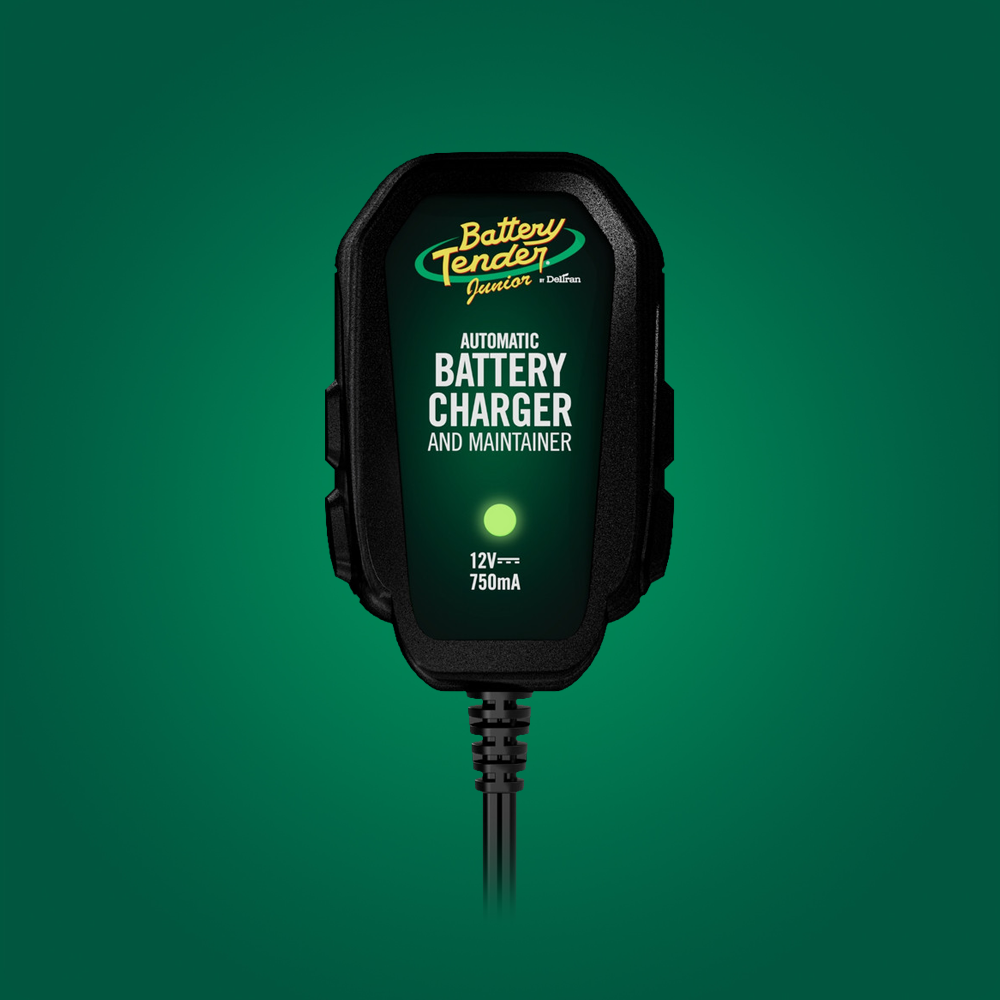
For small powersports and lawn batteries of 2–30Ah, a 1A charger is the right size. It maintains a motorcycle, ATV, or mower battery through winter without overpowering it.
Battery Tender Junior 12V 1 Amp Battery Charger
For riders who also want emergency starting, the Battery Tender Charge N Start 1100 bundle combines a 1A charger with a 1000A jump starter. The internal pack is lithium-ion, and Charge N Store keeps it topped up, while SafeGuard protects against backfeed. The charger section handles standard, AGM, GEL, and lithium 12V batteries.
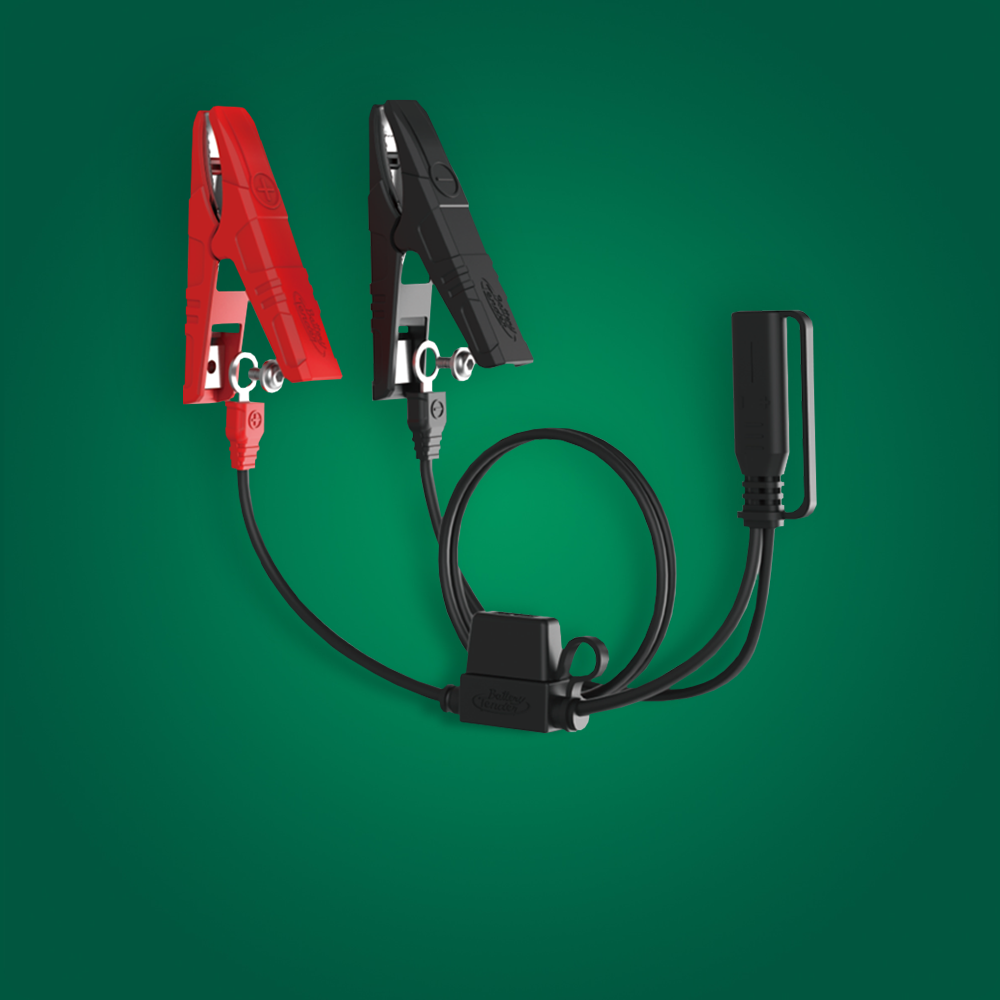
For setups that end in a 12V plug-style connection, this adapter converts the SAE quick-disconnect lead to a female cigarette-style socket.
Battery Tender Female Cigarette Adapter with Quick Disconnect
How to Put ISM Charging to Work: Step by Step
Connecting an ISM charger takes about five minutes and follows the same sequence every time.
- Check the battery. Look for cracks, bulging, or leaking electrolyte. Do not charge a damaged battery.
- Measure resting voltage. Note the reading. Below 12.4V means the battery needs a full ISM cycle.
- Connect the charger leads first. Attach red to positive and black to negative (or chassis ground) with the charger unplugged.
- Plug in the charger. ISM starts at Initialization automatically.
- Select chemistry if the charger offers it. Choose flooded, AGM, GEL, or lithium to match the battery.
- Leave it connected. When the charger reaches Float Maintenance, it holds the battery at full charge until you disconnect.
Install a permanent SAE quick-disconnect lead on any vehicle stored for more than two weeks. That makes each connection a plug-in action rather than a clamp-on job, and it makes regular maintenance far more likely to happen.
Charge in a ventilated area, keep the charger off the battery top, and never charge a frozen battery. Limits apply: ISM prevents overcharging and slows sulfation, but it cannot revive a battery with shorted cells or plates already heavily sulfated.
Frequently Asked Questions
What does ISM stand for in battery charging?
ISM stands for Infinite Sequential Monitoring, the proprietary four-stage charging process built into Battery Tender chargers. It runs Initialization, Bulk, Absorption, and Float Maintenance in order, reading battery voltage throughout. Because it adjusts to the battery's real state instead of a fixed output, it can stay connected indefinitely without overcharging.
Is ISM charging better than trickle charging?
Yes. A trickle charger delivers constant current regardless of battery state, so it keeps pushing energy into a full battery and risks overheating and water loss. ISM tests the battery, charges at full current, tapers through Absorption, and then sends maintenance pulses only when voltage drops. That makes it safer for long storage.
How long does an ISM charger take to charge a battery?
Use (battery Ah × depth of discharge) ÷ charger amps. A 60Ah battery that is 50% discharged needs 30Ah, so a 4A charger takes about 7.5 hours, plus roughly 20% for tapering and efficiency. A 10A charger on a 100Ah battery at 50% takes about five hours before Float Maintenance begins.
Can I leave an ISM charger connected all winter?
Yes. After the Absorption stage, the charger enters Float Maintenance and sends pulses only when voltage falls, so months of continuous connection are safe. Keep the charger in a dry, ventilated spot. For unheated spaces, choose a model with temperature compensation, such as the Battery Tender Plus.
Does ISM work with AGM and lithium batteries?
Yes, on chargers that offer chemistry selection. Models such as the Battery Tender Power Tender 10 Amp Multi-Chemistry and the Battery Tender Junior 1 Amp Multi-Chemistry let you choose the right profile for flooded, AGM, GEL, or lithium. Match the setting to the battery label before charging to ensure the correct voltage targets.
Conclusion
This ISM charging technology deep dive comes down to one point: a charger that tests, charges, absorbs, and then monitors protects a battery in ways constant-current designs cannot. Match the amperage to your battery with the sizing formula, confirm the chemistry setting, and leave the charger connected between uses.
Next step: measure your battery's resting voltage today, pick the charger size from the table above, and browse the full lineup of Battery Tender battery chargers.