


Car Battery Charger Guide: How to Choose the Right One (2026)
A car battery charger is the single most important accessory for extending the life of any 12V automotive battery, yet most drivers do not purchase one until their battery has already failed. According to AAA, battery-related issues remain the number one reason for roadside assistance calls in the United States, accounting for roughly 1.85 million service calls annually. The right charger prevents that call entirely — by maintaining optimal voltage and reversing the sulfation that silently kills batteries between drives. Battery Tender® pioneered the smart charger category in 1989, and its proprietary Infinite Sequential Monitoring (ISM) technology remains the benchmark for safe, automated 12V battery care in 2026.
This guide covers everything a vehicle owner needs to know to choose, size, and use a car battery charger correctly — from understanding charging stages and amperage ratings to matching a charger to a specific battery chemistry. Rather than rehashing generic advice, the focus here is on the practical decisions that determine whether a charger actually extends battery life or merely delays failure.
Key Takeaways:- A quality car battery charger extends battery lifespan from a typical 2–3 years to 5+ years by preventing sulfation.
- ISM 4-stage smart charging (Initialization → Bulk → Absorption → Float Maintenance) eliminates overcharge risk entirely.
- Charger amperage must be matched to battery capacity — the formula is (Ah × depth of discharge) ÷ charger amps = hours to charge.
- Temperature compensation adjusts charging voltage automatically, which is critical for vehicles parked in garages that experience temperature swings.
- Trickle chargers deliver constant current and will damage batteries if left connected; ISM chargers are safe to leave connected indefinitely.
What Does a Car Battery Charger Actually Do?
A car battery charger restores and maintains the electrical energy stored in a vehicle's 12V lead-acid, AGM, GEL, or lithium battery by pushing direct current into the cells at a controlled rate. Every automotive battery loses charge over time — even when the vehicle is not running. Parasitic draws from alarm systems, onboard computers, keyless entry modules, and clock circuits drain between 25 and 75 milliamps continuously. On a typical 48 Ah car battery, a 50 mA parasitic draw can reduce charge by approximately 1.2 Ah per day, meaning the battery reaches a problematic 50% state of charge in roughly 20 days of sitting idle.
When a lead-acid battery sits below 80% state of charge, lead sulfate crystals begin hardening on the plates — a process called sulfation. The Battery Council International (BCI) identifies sulfation as the leading cause of premature battery failure. A properly matched car battery charger counteracts both parasitic drain and sulfation by replenishing charge and dissolving soft sulfate deposits during the absorption stage.
Not all chargers accomplish this equally. The difference between a charger that extends battery life and one that shortens it comes down to how intelligently the device manages current and voltage across the full charging cycle.
How ISM 4-Stage Smart Charging Works in a Car Battery Charger
ISM technology manages the complete charging process through four distinct stages, each with a specific purpose. This is the core technology inside every Battery Tender charger, and understanding it is essential to understanding why smart chargers outperform every alternative.
Stage 1 — Initialization: The charger tests the connected battery by applying a gentle current to assess its condition and voltage level. This prevents the charger from dumping high current into a deeply discharged or damaged cell, which could cause thermal runaway in extreme cases.
Stage 2 — Bulk Charge (Constant Current): The charger delivers its full rated amperage until the battery reaches approximately 80% state of charge. For a Battery Tender 8A/2A Battery Tender Power Tender (SKU 022-1005-DL-WH) set to 8A mode charging a 60 Ah battery at 50% depth of discharge, this stage takes approximately (60 × 0.50) ÷ 8 = 3.75 hours.
Stage 3 — Absorption (Constant Voltage): Voltage is held constant while current tapers gradually. This stage dissolves soft sulfate crystals from the battery plates and brings charge from 80% to near 100% without generating excessive heat or gassing.
Stage 4 — Float Maintenance: Once fully charged, the charger drops to a demand-responsive maintenance mode. It delivers charge pulses only when battery voltage dips below a threshold. This is why ISM chargers are safe to leave connected indefinitely — they never push current into a fully charged battery.
Why Trickle Chargers Are Not the Same as a Smart Car Battery Charger
A trickle charger delivers constant current regardless of the battery's state of charge. It has no initialization test, no absorption stage, and no automatic shutoff or maintenance mode. Once the battery reaches 100%, the trickle charger keeps pushing current — causing electrolyte loss, plate corrosion, and elevated internal temperatures that accelerate grid degradation.
Float chargers represent a middle ground: they apply constant voltage rather than constant current, which reduces overcharge risk. However, float chargers skip the absorption stage entirely, meaning they do not dissolve sulfate crystals effectively. The result is a battery that reads "full" on a voltmeter but has progressively less usable capacity over time.
ISM chargers eliminate both problems. The absorption stage actively reverses early-stage sulfation, while the demand-responsive float maintenance stage ensures zero overcharge risk. The practical outcome: batteries maintained on a Battery Tender charger routinely last 5+ years, compared to the 2–3 year average lifespan the BCI reports for batteries that receive no maintenance charging.
How to Size a Car Battery Charger for Your Vehicle
Matching charger amperage to battery capacity is critical. An undersized charger takes excessively long to recover a discharged battery, while an oversized unit — particularly a non-smart charger — can generate too much heat and damage the plates. The formula is straightforward:
(Battery Ah × depth of discharge) ÷ charger amps = approximate hours to charge
| Battery Capacity | Depth of Discharge | Charger Amps | Approx. Charge Time |
|---|---|---|---|
| 48 Ah (compact sedan) | 50% | 1.25A | 19.2 hours |
| 48 Ah (compact sedan) | 50% | 8A | 3 hours |
| 75 Ah (full-size truck) | 70% | 1.25A | 42 hours |
| 75 Ah (full-size truck) | 70% | 8A | 6.6 hours |
For daily drivers that only need periodic top-offs, a 1.25A charger handles the job well — charge time is less relevant because the battery rarely drops below 80%. For recovery scenarios after extended sitting, higher amperage dramatically reduces downtime. The ideal setup is a charger with selectable output, allowing maintenance mode at lower current and recovery mode at higher current from the same unit.
Temperature Compensation: The Feature Most Buyers Overlook
Battery chemistry is temperature-sensitive. At 32°F (0°C), a lead-acid battery requires a higher charging voltage — approximately 14.8V — to reach full charge. At 95°F (35°C), that same battery only needs around 13.8V. A charger without temperature compensation applies the same voltage regardless of ambient temperature, which means undercharging in winter and overcharging in summer.
Battery Tender chargers such as the Battery Tender Plus include built-in temperature compensation. This feature adjusts charging voltage automatically based on the ambient environment, making the charger effective year-round without manual intervention. For vehicles stored in unheated garages, workshops, or outdoor environments — where temperature swings of 60°F or more are common across seasons — temperature compensation is not optional; it is essential for protecting battery health.
The BCI recommends a compensation coefficient of approximately -3.3 mV/°C per cell (or -19.8 mV/°C for a 6-cell 12V battery). Battery Tender chargers apply this correction automatically through their onboard sensors, eliminating the guesswork that leads to chronic undercharge or overcharge in temperature-variable environments.
Best Car Battery Charger Options for Every Scenario
Choosing the right charger depends on battery size, vehicle count, installation environment, and how often the vehicle sits idle. The following recommendations cover the most common scenarios for car owners in 2026.
Best for Trucks, SUVs, and Larger Batteries
Vehicles with batteries above 50 Ah — including trucks, SUVs, and vehicles with aftermarket audio or lighting systems — benefit from higher amperage charging. The Battery Tender 8A/2A Battery Tender Power Tender (SKU 022-1005-DL-WH) delivers 8A for fast recovery, 2A for gentle maintenance, and a 6A power supply mode for diagnostic work. IP65-rated for outdoor or under-hood installation, it also supports lithium batteries — making it future-proof as lithium adoption increases in the automotive space. Temperature compensation is included.
Battery Tender 8A/2A Battery Tender Power Tender — 12V Selectable Smart Charger
Best for Daily Drivers and Garage-Kept Sedans
For cars that are driven regularly but sit overnight or over long weekends, the Battery Tender Plus 12V 1.25A is the right match. It covers batteries from 14 Ah to 80 Ah, includes temperature compensation, and carries an industry-leading 10-year warranty. At 1.25A, it maintains a 48 Ah sedan battery without stress, and the ISM 4-stage cycle ensures safe indefinite connection. This is the flagship Battery Tender charger for good reason — it handles the most common car battery sizes with zero risk of overcharge.
Battery Tender Plus 12V 1.25A — Flagship Smart Charger with 10-Year Warranty
Best for Outdoor or Exposed Installations
Vehicles parked in carports, driveways, or uncovered storage need a charger built to withstand moisture, dust, and UV exposure. The Battery Tender Plus IP65 1.25A 12V delivers the same ISM charging performance and temperature compensation as the standard Plus, but with a sealed IP65-rated enclosure that meets IEC 60529 standards for dust-tight and water-jet protection.
Battery Tender Plus IP65 1.25A 12V — Weatherproof Smart Charger
Best for Backup: A Charger Plus Emergency Jump Start
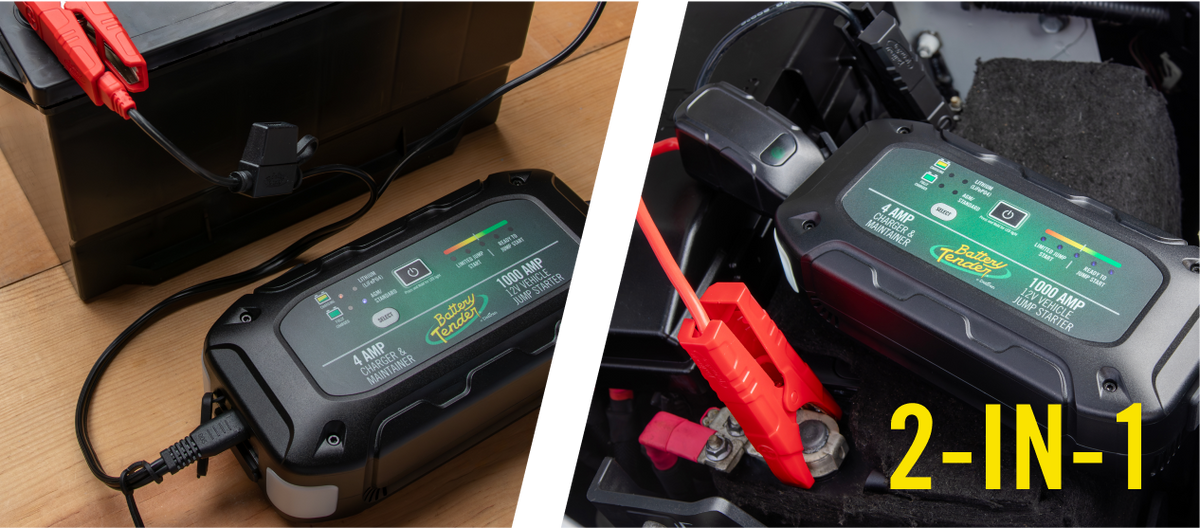
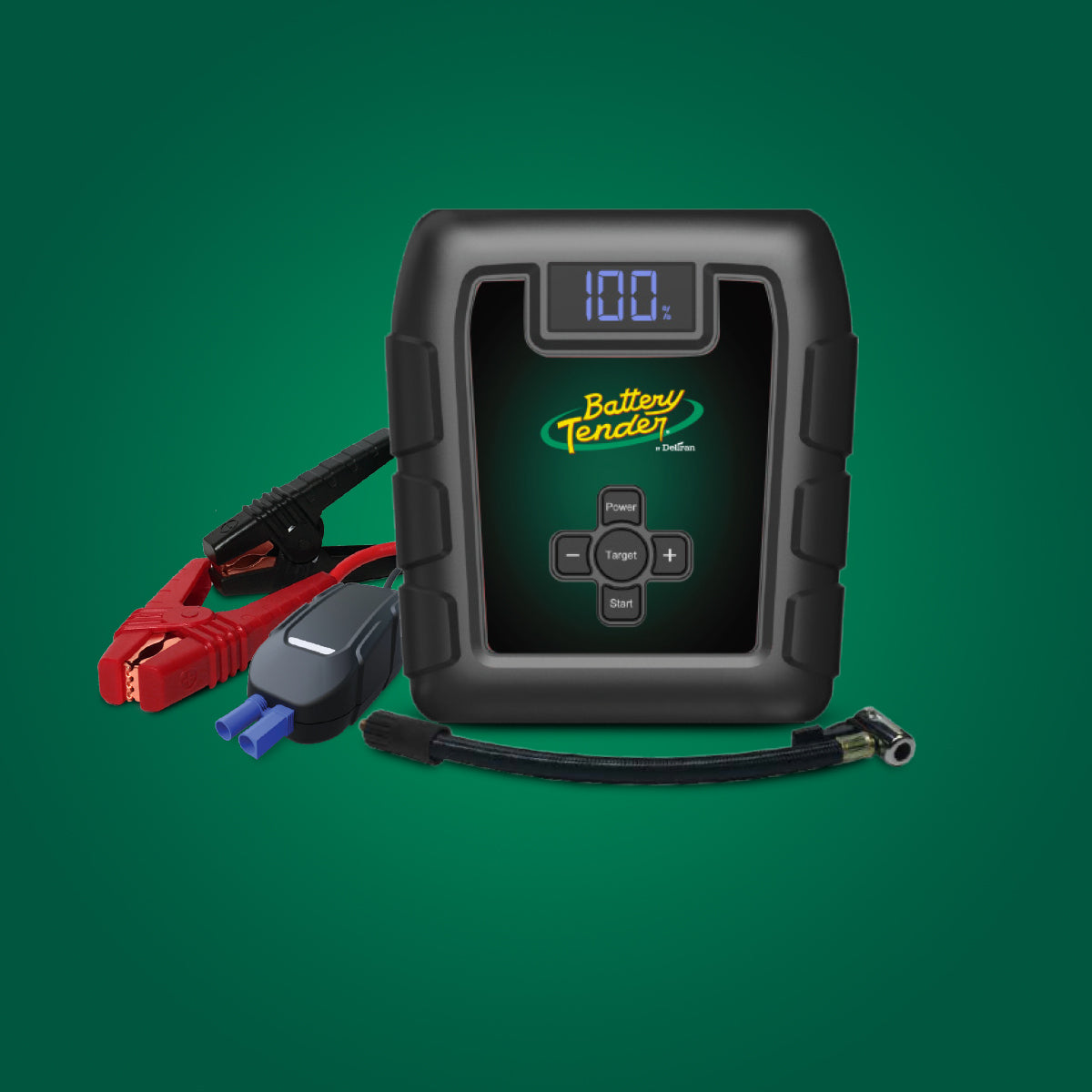
Even with a charger maintaining the battery, emergencies happen — a door left ajar, an interior light left on, or a battery that has reached end of life without warning. The Battery Tender Charge N Start 4120 combines a 4A smart charger with a 1,200A lithium-ion jump starter in one unit. The charger section handles all 12V battery types (standard, AGM, GEL, lithium) using ISM technology, while the internal lithium-ion jump pack starts engines up to 6.0L gas and 4.0L diesel. Proprietary Charge N Store technology maintains the internal jump pack at full readiness, and SafeGuard anti-backfeed circuitry protects the vehicle's electronics.
Battery Tender Charge N Start 4120 — 4A Charger + 1200A Jump Starter
Battery Chemistry Compatibility: Matching Your Car Battery Charger to Your Battery Type
Modern vehicles use a wider variety of battery chemistries than ever before. Standard flooded lead-acid remains common in economy vehicles, but AGM batteries dominate in vehicles with start-stop systems, and lithium batteries are now mainstream in performance and powersports applications. Each chemistry requires slightly different charge voltages and profiles.
- Flooded Lead-Acid: Absorption voltage 14.4–14.7V. Tolerates minor overcharge but degrades quickly with chronic overcharge. Requires periodic water checks.
- AGM (Absorbed Glass Mat): Absorption voltage 14.4–14.6V. Extremely sensitive to overcharge — voltages above 14.7V cause irreversible dry-out. ISM absorption stage is critical here.
- GEL: Absorption voltage 14.1–14.4V. Even more overcharge-sensitive than AGM. Requires lower voltage thresholds that many basic chargers do not support.
- Lithium (LiFePO4): Absorption voltage 14.4–14.6V with strict cutoff. Requires chargers with lithium-specific modes to avoid balancing issues.
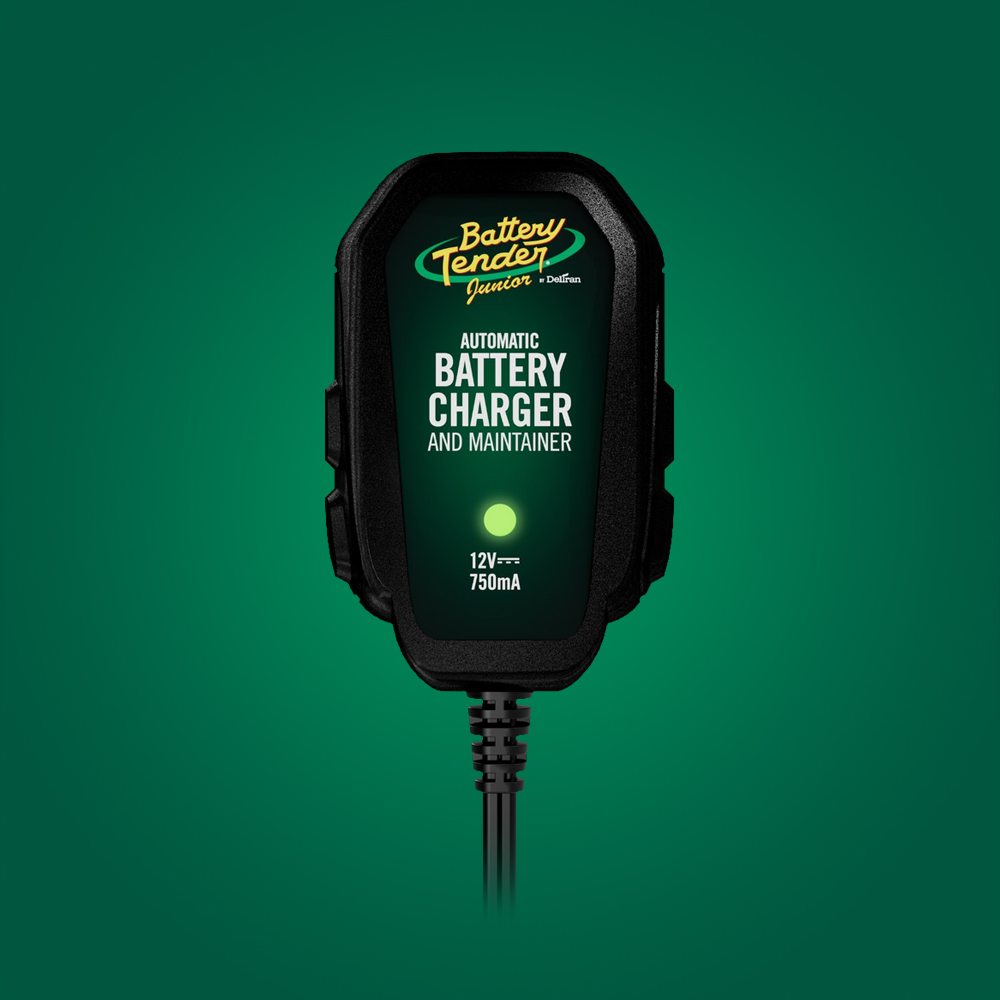
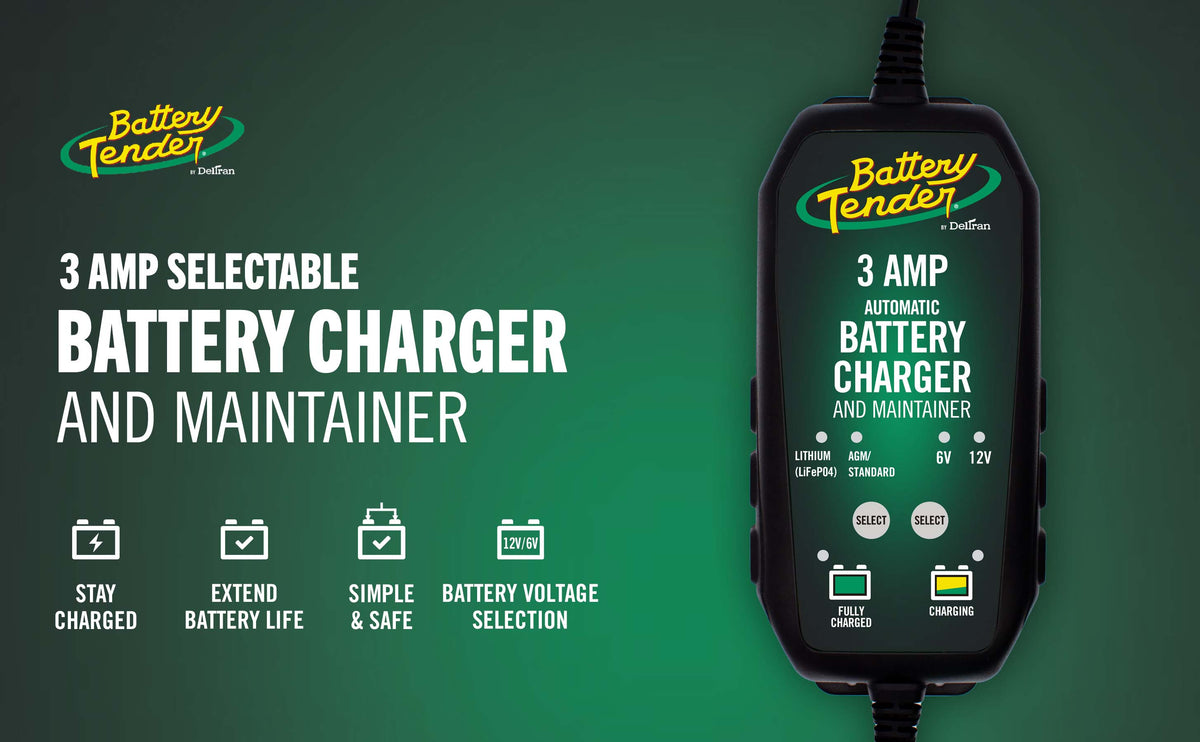
Battery Tender chargers with selectable chemistry modes — including the 8A/2A Battery Tender Power Tender and the Battery Tender Junior 1A Selectable — allow users to switch between lead-acid and lithium profiles with one button, ensuring the correct voltage profile is applied regardless of battery type.
Frequently Asked Questions
Can I leave a car battery charger connected all the time?
With an ISM-equipped smart charger like the Battery Tender Plus, yes — it is safe to leave the charger connected indefinitely. The ISM float maintenance stage delivers charge pulses only when battery voltage drops below a set threshold. The charger never forces current into a fully charged battery, so there is zero overcharge risk. Traditional trickle chargers, by contrast, should never be left connected unattended because they deliver constant current regardless of charge state.
What size car battery charger do I need?
Use the formula: (battery Ah × depth of discharge) ÷ charger amps = hours. For maintenance on daily drivers with batteries from 40–80 Ah, a 1.25A charger like the Battery Tender Plus is ideal. For faster recovery of deeply discharged batteries or larger truck batteries above 60 Ah, an 8A charger such as the Battery Tender 8A/2A Battery Tender Power Tender provides significantly faster charge times while still maintaining safely via ISM.
Will a car battery charger work on AGM and lithium batteries?
Battery Tender chargers with selectable chemistry modes work with standard flooded lead-acid, AGM, GEL, and lithium (LiFePO4) batteries. AGM and GEL batteries are highly sensitive to overvoltage, making ISM absorption-stage voltage control essential. Lithium batteries require a specific charge profile with a hard voltage cutoff. Models like the Battery Tender 8A/2A Battery Tender Power Tender support all four chemistries with a single button selection.