


Boat Marine Battery Maintenance Guide: Checks & Chargers (2026)
A solid boat marine battery maintenance guide comes down to four habits. Keep terminals clean and sealed against salt, check resting voltage monthly, keep every bank on a smart on-board charger, and mount that charger where heat, water, and fuel vapor cannot damage it. Follow those four habits and marine batteries reach their full service life instead of failing after a season or two.
Battery Tender® pioneered consumer smart charging in 1989, and the Battery Tender WaveCharge marine line carries that approach to permanent on-board installs. This guide covers the environmental hazards that make boats harder on batteries than cars, a maintenance schedule by interval, corrosion control, engine room installation rules, and charger sizing for the 2026 season.
Key Takeaways
- Check resting voltage monthly. A healthy 12V lead-acid battery rests at 12.6V to 12.8V; 12.4V means about 75% charge and 12.0V means about 25%.
- Salt, vibration, and heat cause most marine battery failures. Clean, tight, sealed connections and a hold-down that limits movement to 1 inch prevent most of them.
- Choose an IP68-rated, UL marine ignition-protected charger for any enclosed engine room or bilge where gasoline vapor can collect.
- Match charger output to bank count. A 100Ah battery at 50% discharge needs about 5 hours at 10A per bank but about 17 hours at 3A per bank.
- Pair a permanent charger with a portable jump starter so a dead start battery never strands the boat.
Why Does a Boat Battery Need More Maintenance Than a Car Battery?
A boat battery needs more attention because the marine environment attacks it from several directions at once while the boat sits idle for weeks. A car battery rarely faces more than one or two of these stresses.
- Saltwater and humidity: Salt spray creates conductive crusts on terminals. Those crusts leak current and corrode copper from the outside in.
- Vibration and pounding: Wave impact loosens connections and fatigues internal plates. Loose terminals raise resistance and generate heat.
- Fuel vapor: Gasoline vapor is heavier than air and settles in bilges. A single spark from a relay, switch, or charger can ignite it.
- Heat and long idle periods: Engine rooms can pass 120°F in summer. Lead-acid batteries self-discharge faster in heat, and a battery that sits below 50% charge (about 12.2V) starts to sulfate.
Boats also carry mixed loads: a starting battery, a deep-cycle house bank, and often a thruster or windlass battery. Each has different charging needs, so a single-output charger cannot serve them all well.
Boat Marine Battery Maintenance Guide: Schedule by Interval
The simplest way to follow a boat marine battery maintenance guide is to split tasks into monthly, pre-trip, and seasonal checks. Write the dates on the boat's log so nothing slips.
Monthly (In Season or Stored)
- Measure resting voltage with a multimeter after the battery has rested at least 4 hours. Record it.
- Inspect terminals for white or green crust and look for cracks or swelling in the case.
- On flooded batteries, check electrolyte level. Top off with distilled water only, and only after charging.
- Confirm the hold-down is tight. Under ABYC guidance, a battery should not move more than 1 inch in any direction.
Before Each Trip
- Confirm each bank reads at least 12.6V before leaving the dock.
- Run the engine room blower for at least 4 minutes before starting a gasoline inboard.
- Carry a portable jump starter in a dry cabin locker, not in the hot engine room.
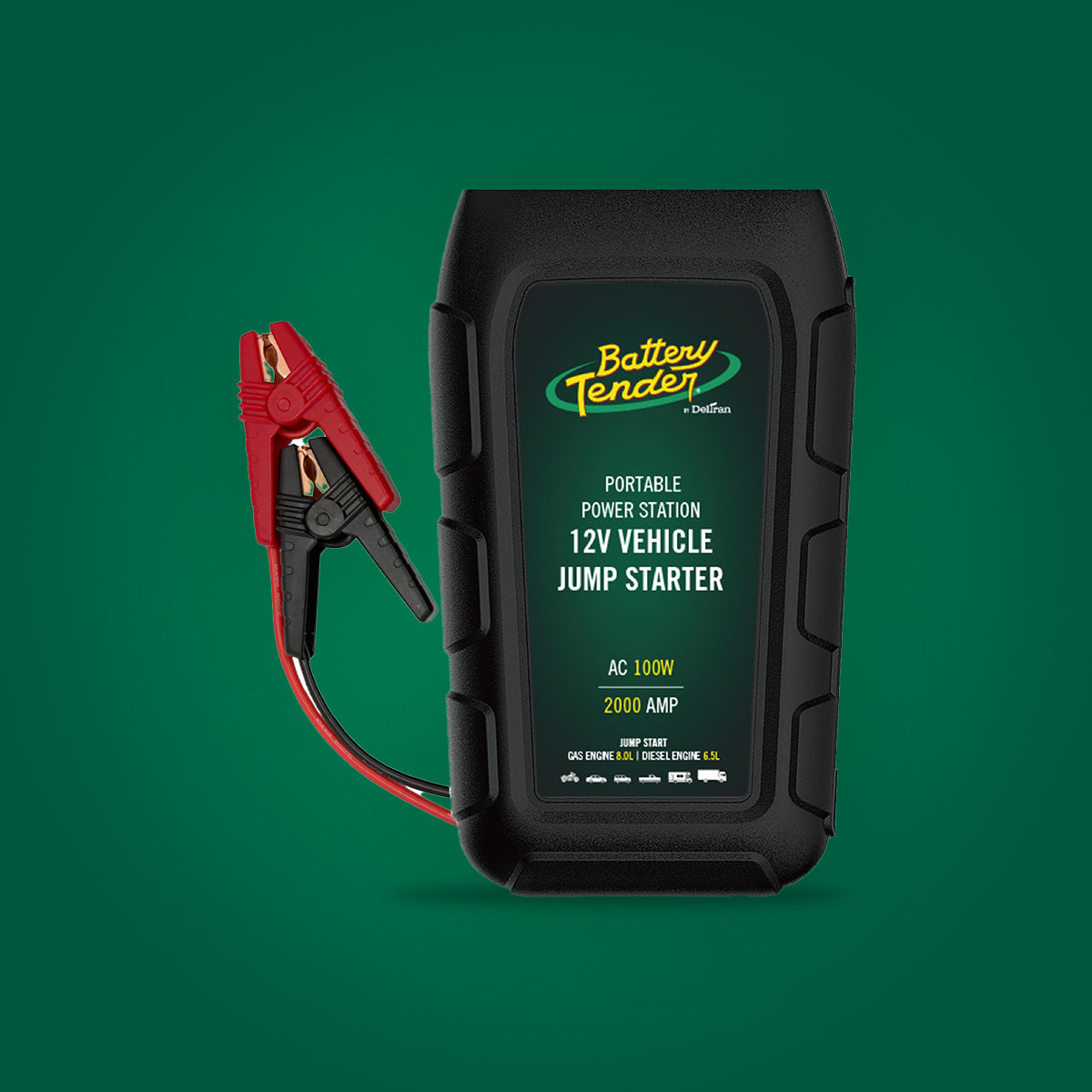
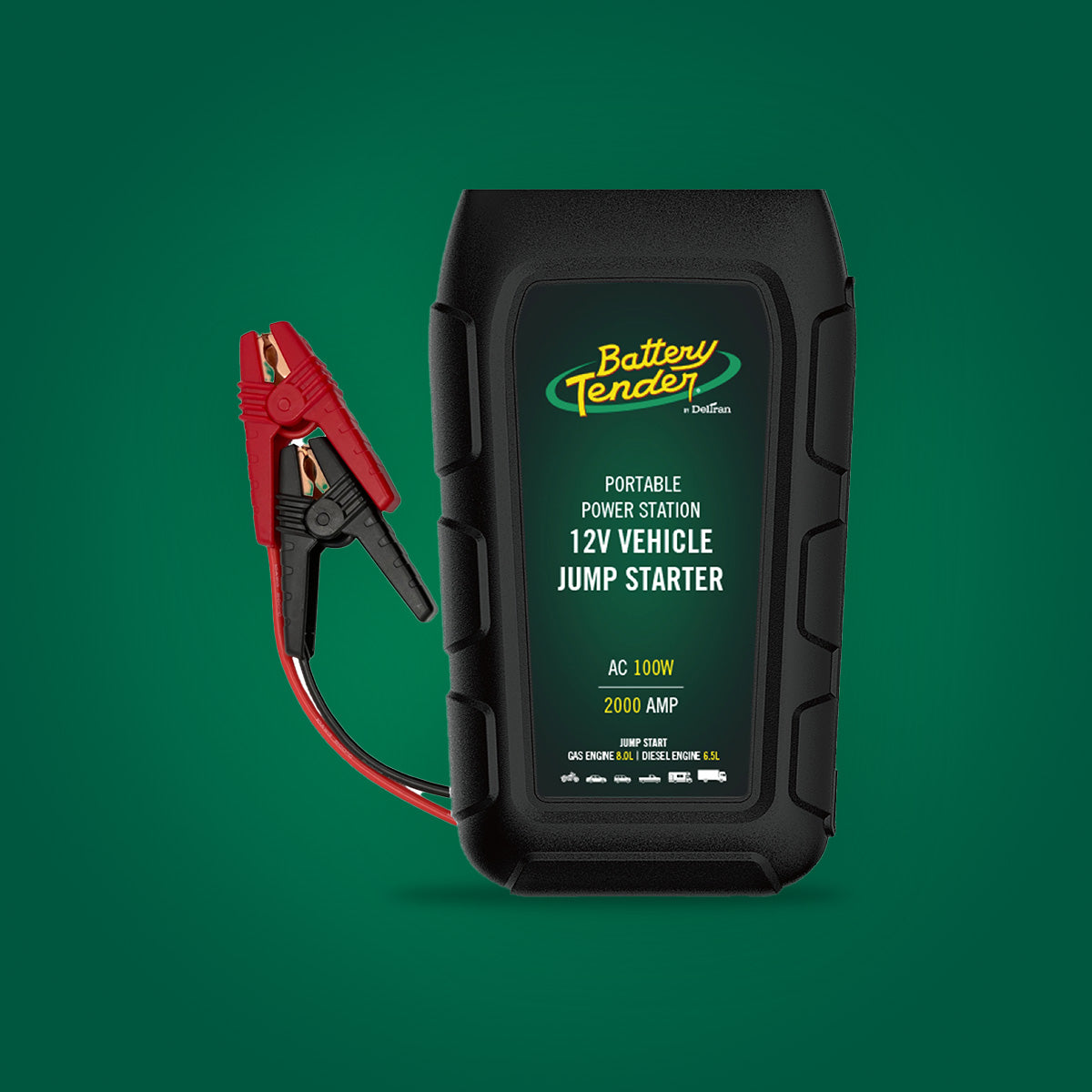
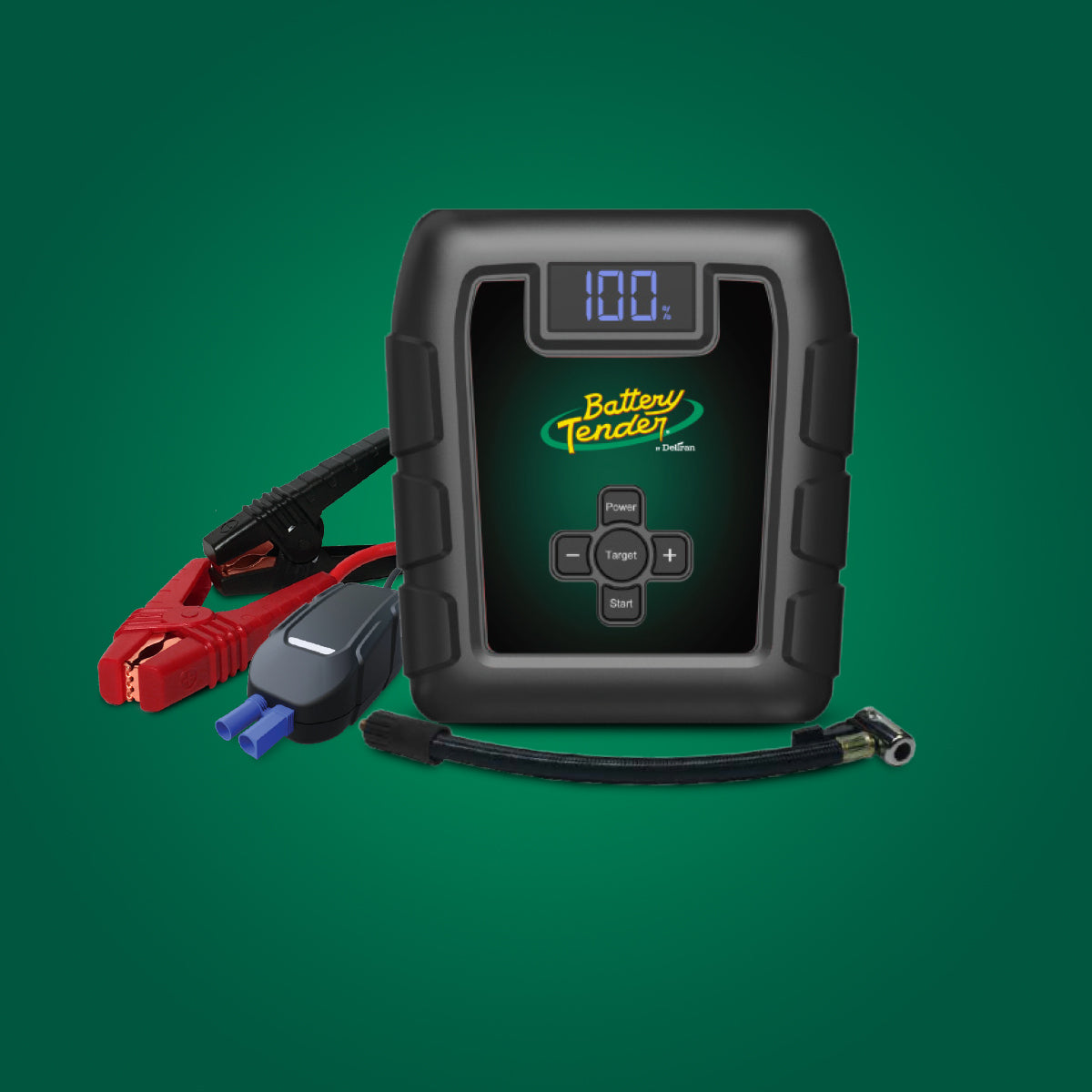
The Battery Tender Jump N Start 2000 Amp Lithium Jump Starter suits larger boats because its 16,000 mAh pack is rated for gas engines up to 8.0L and diesels up to 6.5L. That covers big V8 inboards and most diesel auxiliaries. It is an emergency tool, not a substitute for keeping banks charged.
Battery Tender Jump N Start 2000 Amp Lithium Jump Starter
Seasonal
- Load test every battery at the start of the season. Replace any that fail to hold voltage under load.
- Check cable lugs for green corrosion under the insulation. Replace cables with swollen or stiff sections.
- Verify voltage drop stays under 3% on critical circuits such as engine start and bilge pumps.
How Do You Stop Saltwater Corrosion on Battery Connections?
Stop corrosion by cleaning terminals, tightening connections, and sealing them with a protectant before salt can reach bare copper. Use tinned marine-grade copper cable and adhesive-lined heat shrink on every lug.
- Disconnect safely: Turn off the battery switch, then remove the negative cable first and the positive second.
- Neutralize crust: Brush a paste of baking soda and water onto terminals and lugs until fizzing stops.
- Scrub: Use a wire terminal brush on posts and lug interiors until the metal is bright.
- Rinse and dry: Wipe with a fresh-water-dampened cloth, then dry completely.
- Reconnect: Attach the positive first and the negative last. Tighten until the lug cannot rotate by hand.
- Seal: Coat terminals with dielectric grease or a terminal protectant spray.
Rinse the battery tray with fresh water each month as well. Salt film left in a tray can bridge terminals and slowly drain a battery that appears otherwise fine.
Engine Room Installation: Why Do IP68 and Ignition Protection Matter?
They matter because a charger mounted in an engine room faces water, salt, heat, and possible fuel vapor, and any spark source in that space must be designed not to ignite it. Automotive-style chargers are not built for that location.
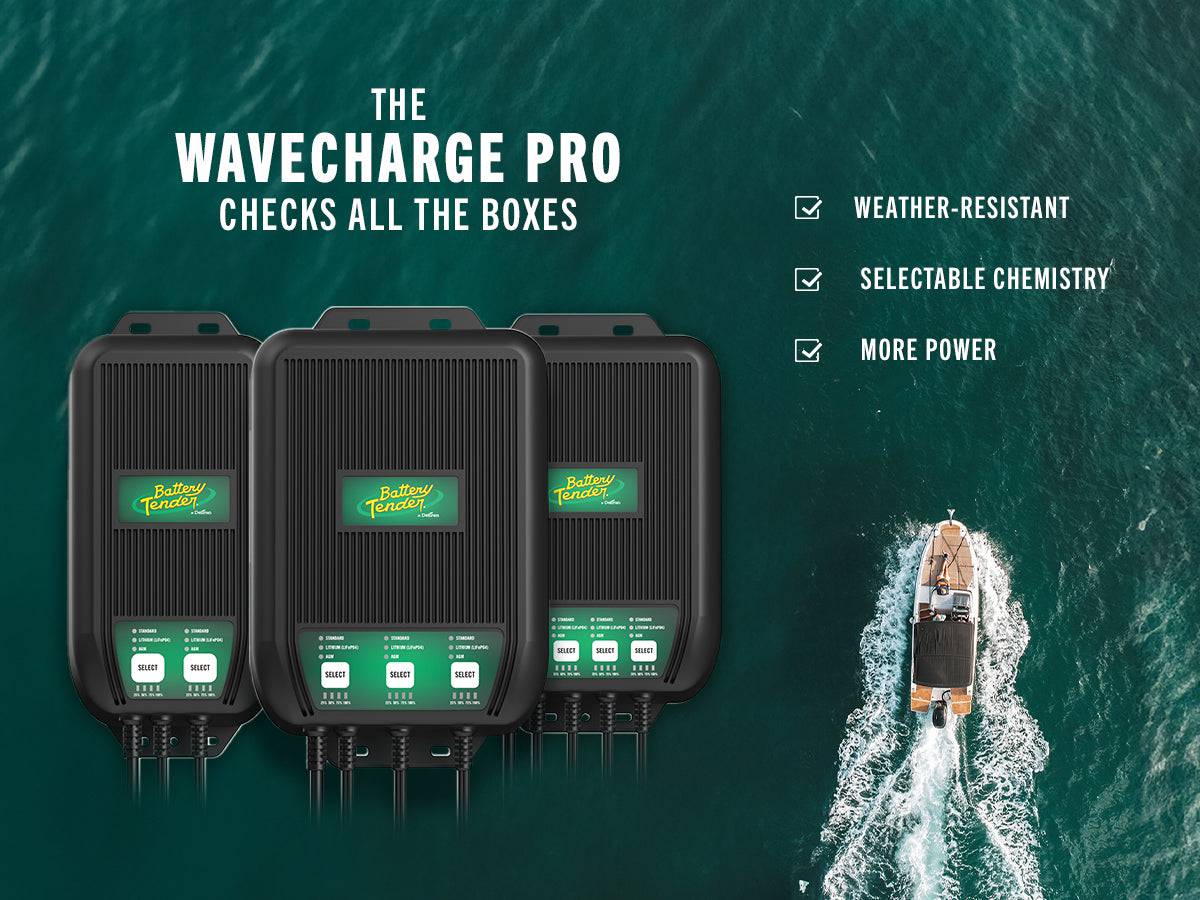
Battery Tender WaveCharge Pro chargers carry an IP68 rating, so they are protected against dust and continuous water immersion. They are also saltwater resistant and carry UL marine ignition protection, which is the qualification to look for when a charger will sit near a fuel system. Check the label and the product datasheet for the exact certification before installation.
Battery Tender WaveCharge smart chargers also include temperature compensation, which lowers charge voltage as heat rises. Compensation matters in engine rooms, where uncompensated charging boils electrolyte out of flooded batteries and shortens their life.
Mounting Rules That Protect the Charger
- Mount on a vertical surface above the highest expected bilge water line.
- Keep at least a hand's width of airflow around the case and stay clear of exhaust manifolds.
- Use fused, tinned copper output wiring and keep runs short to limit voltage drop.
- Secure all cables against vibration with clamps every 18 inches.
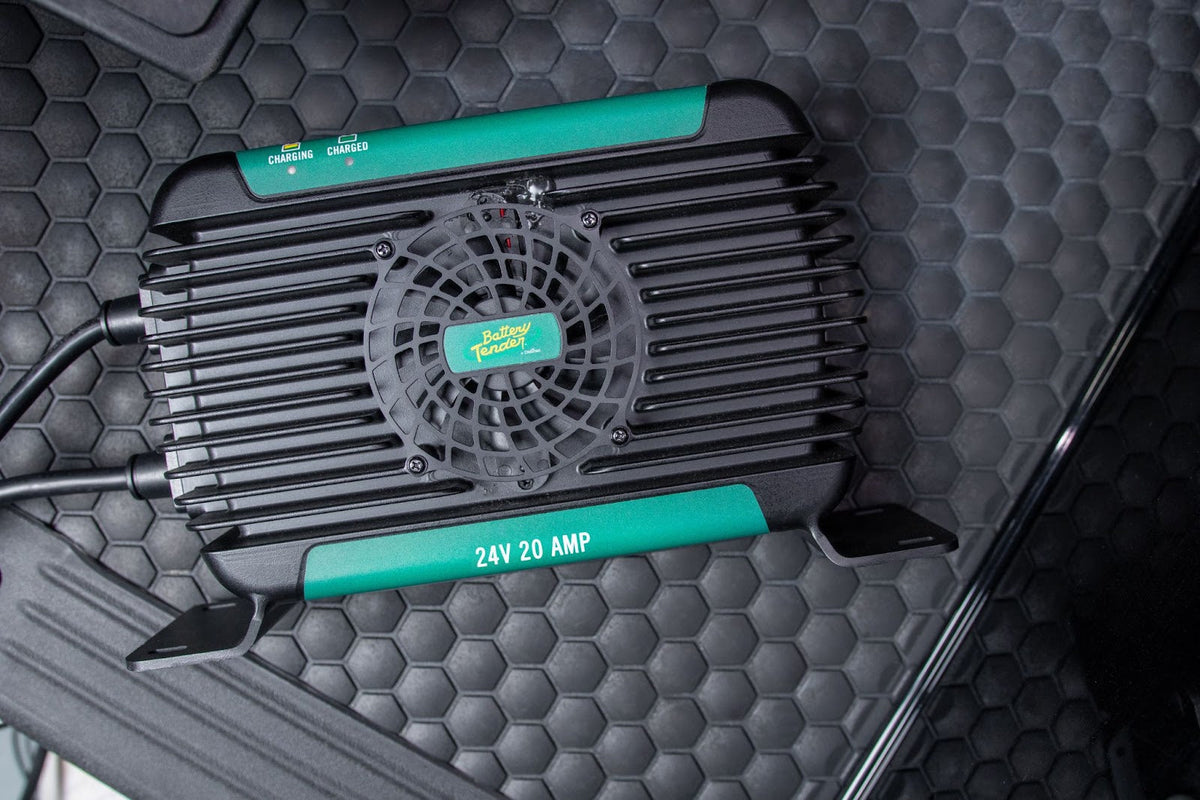
For a center console or twin-battery boat with 12V banks around 100Ah, the Battery Tender WaveCharge Pro 2-Bank 20 Amp unit delivers 10A per bank. That clears a 50% discharge of a 100Ah battery in about 5 hours (100Ah × 0.5 ÷ 10A), and the IP68 housing and ignition protection make it suitable for an engine room mount.
Battery Tender WaveCharge Pro 2-Bank 12V 20 Amp Battery Charger and Maintainer
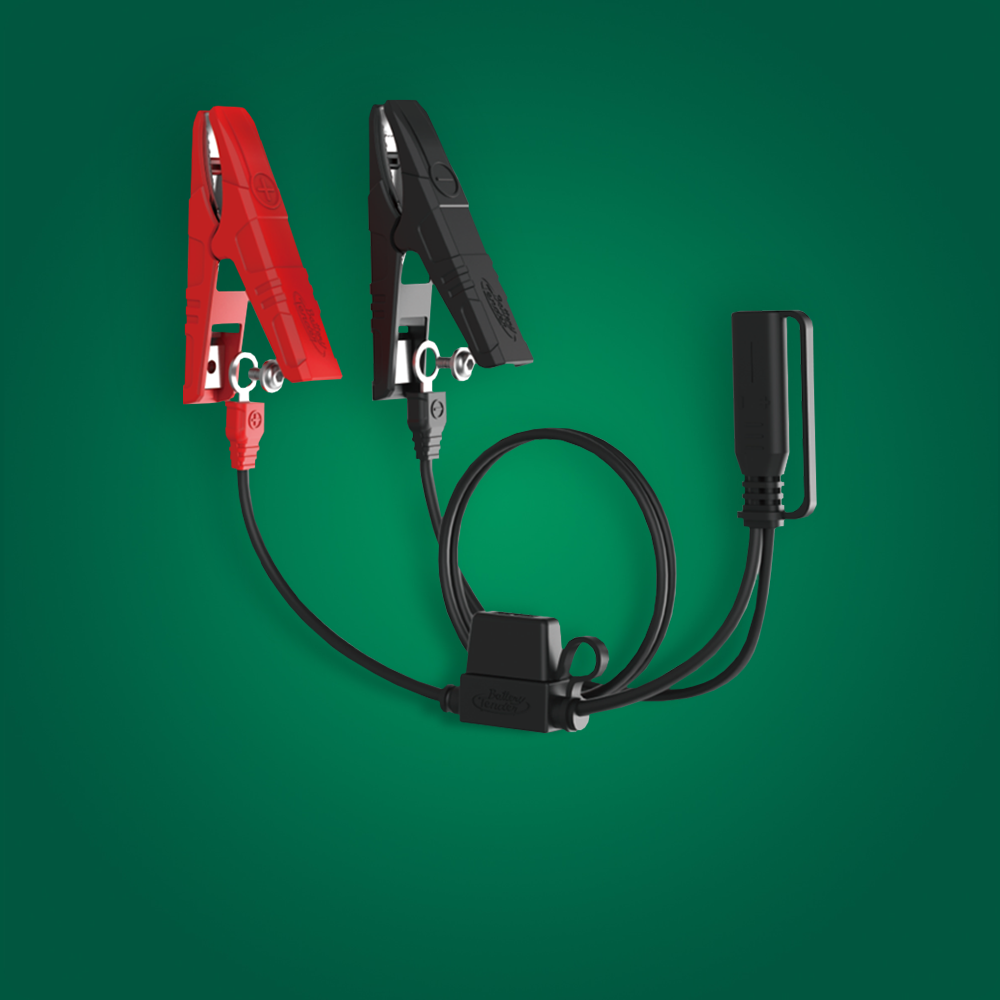
When the best mounting spot is far from the AC source, the Battery Tender WaveCharge 10ft Marine Extension Cable adds 10 feet of weatherproof 14-gauge reach. That lets the charger sit in a dry, ventilated spot while the shore connection stays accessible.
Battery Tender WaveCharge 10ft Marine Extension Cable
Sizing an On-Board Charger: Boat Marine Battery Maintenance Guide by Bank Count
Size the charger by counting banks, then dividing usable amp-hours by output per bank. Each bank should have its own output so a drained start battery does not share a charge profile with a full house bank.
Battery Tender WaveCharge chargers run Infinite Sequential Monitoring (ISM) independently on each bank. ISM is a 4-stage process: Initialization tests the battery, Bulk Charge delivers full current to about 80% charge, Absorption holds voltage while current tapers, and Float Maintenance sends pulses only when voltage drops. That makes continuous connection safe, unlike conventional trickle chargers that push constant current regardless of battery state.
| Boat Setup | Banks | Typical Batteries | Recommended Charger | Output Per Bank | Charge Math (50% Discharge) |
|---|---|---|---|---|---|
| Pontoon or fishing boat | 2 | 2 × 12V, 50–100Ah | Battery Tender WaveCharge Pro 2-Bank 20 Amp | 10A | 100Ah × 0.5 ÷ 10A ≈ 5 hours |
| Cruiser with start, house, thruster, windlass | 4 | 4 × 12V, 50–100Ah | Battery Tender WaveCharge 4-Bank 12 Amp | 3A | 100Ah × 0.5 ÷ 3A ≈ 17 hours |
| Offshore boat with large house banks | 4 | 4 × 12V, 100–300Ah | Battery Tender WaveCharge Pro 4-Bank 40 Amp | 10A | 200Ah × 0.5 ÷ 10A ≈ 10 hours |
Real charge times run 10% to 20% longer than the math suggests because Absorption tapers current. Treat the table as a planning tool.
When the 3A-Per-Bank Model Is the Right Call
The Battery Tender WaveCharge 4-Bank 12 Amp unit gives 3A to each of four banks. That suits boats that sit for weeks between trips, where the goal is keeping four batteries topped up rather than recharging them quickly. It carries an IP67 rating, so mount it in a dry location such as a helm console or cabin locker. For an enclosed gasoline engine room, step up to a Battery Tender WaveCharge Pro model.
Battery Tender WaveCharge 4-Bank 12V 12 Amp Battery Charger and Maintainer
When Big Banks Need Pro Output
Large house banks need faster recovery. The Battery Tender WaveCharge Pro 4-Bank 40 Amp unit delivers 10A to each of four banks, so a 200Ah bank at 50% discharge recovers in about 10 hours. It also carries IP68 protection and UL marine ignition protection for installation near engines and fuel systems. Before pairing it with a lithium bank, confirm on the product page that the charger supports your battery chemistry.
Battery Tender WaveCharge Pro 4-Bank 12V 40 Amp Battery Charger and Maintainer
Boats on moorings without shore power need a different strategy. The marine solar battery systems guide explains how panels and controllers keep banks charged off the grid. Smaller family boats with one or two batteries can start with the pontoon boat battery care guide.
Frequently Asked Questions
How often should boat batteries be checked?
Check resting voltage and terminals monthly, both in season and in storage. Add a full inspection before each trip and a load test at the start of every season. A monthly check catches voltage sag, loose lugs, and early corrosion before they leave you stranded on the water.
What voltage means a marine battery needs charging?
For a 12V lead-acid battery, a resting reading of 12.6V to 12.8V is full. At 12.4V the battery holds about 75%, and at 12.0V about 25%. Charge any battery that reads below 12.4V, and avoid letting it drop under 12.2V, where sulfation starts.
Can an on-board marine charger stay connected all season?
Yes, if it uses a 4-stage smart process such as ISM. After Absorption, the charger enters Float Maintenance and sends pulses only when voltage drops, so it cannot overcharge. Conventional trickle chargers that push constant current carry overcharge risk and should not stay connected for months.
Do I need an ignition-protected charger on a gasoline boat?
Yes, for any charger installed in an engine room, bilge, or other enclosed space where gasoline vapor can collect. UL marine ignition protection means the unit is designed not to ignite flammable vapor. Battery Tender WaveCharge Pro chargers carry that protection along with IP68 sealing.
Conclusion
A good boat marine battery maintenance guide is a routine, not a one-time project: monthly voltage checks, sealed connections, and a charger sized for the number of banks and rated for the space it occupies. Start tonight: measure each bank's resting voltage, count your banks, and match them to the table above. Then browse the Battery Tender marine battery charger collection to select the right model for your boat.