


Pontoon Boat Battery Care: The Complete Guide to Marine Charging
Pontoon boats have become the undisputed leaders in recreational boating growth — and for good reason. Today's pontoon platforms deliver a resort-like experience on the water, complete with Bluetooth stereo systems, LED lighting packages, live wells, fish finders, USB charging stations, and high-thrust trolling motors. But every one of those comfort features draws power, and that electrical demand places serious strain on your battery system. Proper pontoon boat battery care is no longer a casual afterthought — it is the difference between a reliable season on the water and a frustrating, expensive string of breakdowns. This guide covers everything you need to know about managing, charging, and protecting the batteries that keep your pontoon running at its best.
Why Pontoon Boats Demand a Different Approach to Battery Care
Unlike a simple fishing boat or a personal watercraft, a modern pontoon operates as a multi-system electrical platform. You may have a high-cranking outboard that demands a strong, fast burst of starting power while simultaneously running an onboard stereo, charging phones at three USB ports, powering navigation lights, and running a live well pump. Add a trolling motor and you introduce a completely separate, high-draw deep-cycle demand into the equation.
Each of these functions has different battery requirements. Starting batteries are optimized for short, powerful bursts of current. Deep-cycle batteries are built to discharge slowly over extended periods and recover through recharging. Mixing these roles — or failing to charge each battery type correctly — accelerates battery degradation, shortens service life, and increases the likelihood of being stranded on the water. Effective pontoon boat battery care means treating each battery in your system as the specialized tool it actually is.
Understanding Common Pontoon Battery Configurations
Before you can build a solid battery care routine, you need to understand how your pontoon is wired. Configuration varies significantly based on boat size, engine count, and accessory load.
- Single-battery systems: Found on smaller, entry-level pontoons with minimal electronics. A Group 24 or Group 27 starting battery handles engine cranking and light accessory use. These setups are increasingly common on compact day boats and entry-level models.
- Dual-battery systems: The most common configuration on mid-range pontoons. One dedicated starting battery handles the outboard motor. One deep-cycle or dual-purpose battery powers onboard accessories. A battery switch or automatic charging relay isolates the two banks to protect starting power.
- Three-battery systems: Standard on pontoons equipped with a trolling motor. The third battery — typically a dedicated deep-cycle AGM or lithium iron phosphate unit — powers the trolling motor exclusively. This configuration requires a three-bank charger to maintain all batteries independently and simultaneously.
- 24V and 36V trolling motor systems: Larger tri-toon models and serious fishing platforms often run two or three deep-cycle batteries wired in series to power a 24V or 36V trolling motor. These high-voltage systems demand careful, balanced charging to prevent individual cell degradation.
Identifying your configuration accurately is the essential first step in choosing the right charging equipment and building a maintenance routine that actually protects your investment.
Choosing the Best Charger for Your Pontoon Boat Battery Care Routine
The single most impactful decision in pontoon boat battery care is selecting the correct charger for your specific configuration. A charger that is too small, too simple, or mismatched to your battery types will not maintain your system properly — no matter how often you plug it in. Here is how to match the right Battery Tender® charger to your pontoon setup.
Single-Battery Pontoons: Battery Tender® Weather Resistant 800
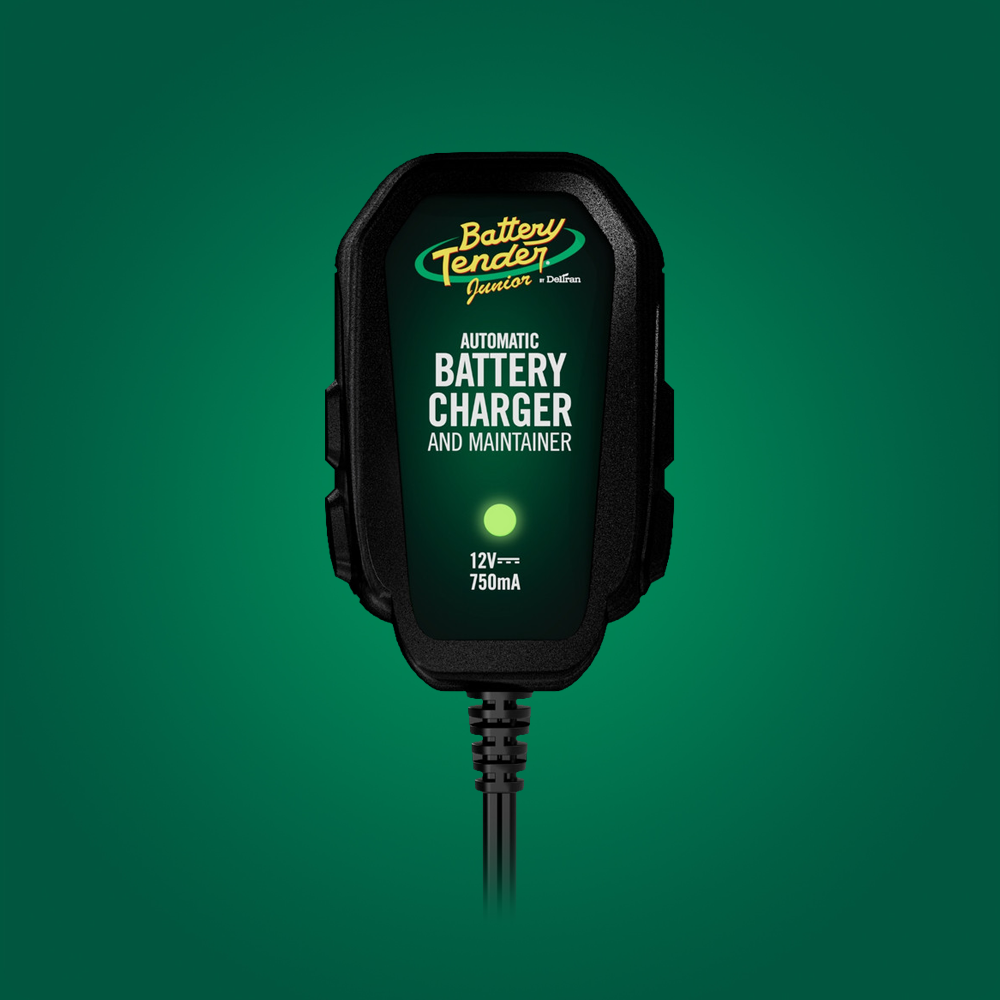
If your pontoon runs a single starting battery with minimal accessory load, the Battery Tender® Weather Resistant 800 is the ideal starting point. This compact, weather-resistant 12V charger delivers reliable multi-stage charging and automatic float maintenance in a durable package built to handle the humidity and splash exposure common in marine environments. It keeps a single battery at peak charge between outings without overcharging — a straightforward, dependable solution for straightforward setups.
Dual-Battery Pontoons: Battery Tender® PowerTender or WaveCharge 2-Bank
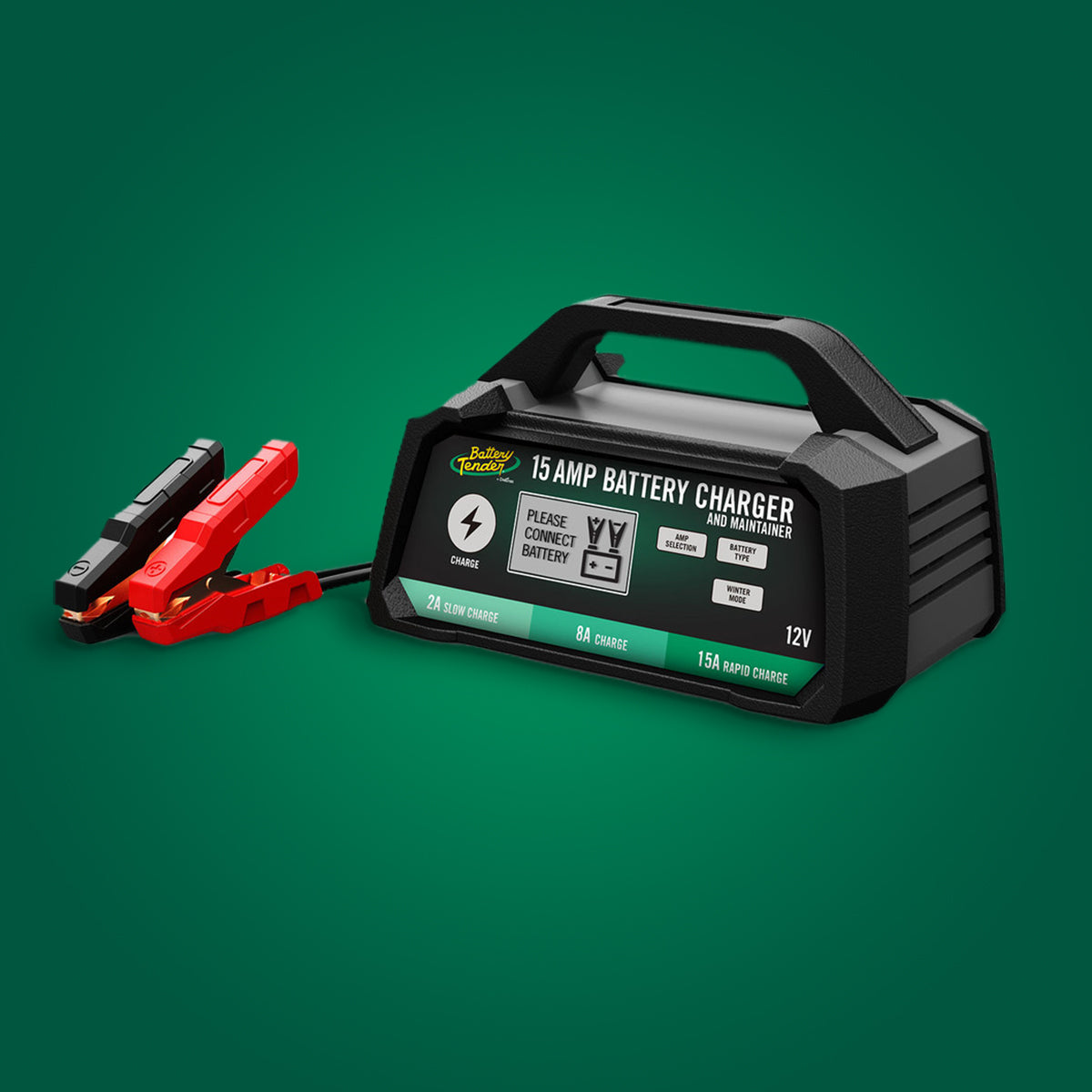
For pontoons with a larger starting battery and a single accessory or small trolling motor battery, the Battery Tender® PowerTender 5 AMP 12V/24V offers a meaningful upgrade. Its selectable 12V and 24V operation makes it a versatile choice for pontoons where the trolling motor bank runs at 24V, and its 5-amp output handles larger capacity batteries more efficiently than a standard 800mA unit.
If your dual-battery setup requires truly independent simultaneous charging of two separate 12V batteries, the Battery Tender® WaveCharge 2-Bank 5 AMP Marine Battery Charger delivers dedicated 2.5-amp maintenance charging to each battery independently. Both banks operate without interfering with each other, ensuring your starting battery and accessory battery are always maintained at their individual optimal states.
Three-Battery Pontoons With Trolling Motors: Battery Tender® WaveCharge 3-Bank
For three-battery pontoon systems — the most common configuration on fishing and leisure pontoons alike — the Battery Tender® WaveCharge 3-Bank 9 AMP Marine Battery Charger is the definitive solution. Each of the three independent charging banks delivers 3 amps of Intelligent Selectable Mode (ISM) charging, with selectable 6V or 12V operation per bank. Because each bank operates independently, the charger can maintain a starting battery, an accessory deep-cycle battery, and a dedicated trolling motor battery simultaneously — all in their optimal charging states — without any bank interfering with another.
All Battery Tender® WaveCharge units are fully waterproof and marine-rated, meaning they are built to withstand the humidity, splash, and vibration conditions that invalidate the warranty on a standard automotive charger the moment it contacts salt air. Key features to confirm when selecting any marine battery charger include: independent multi-bank operation, compatibility with AGM and lithium battery chemistries, automatic float maintenance mode, reverse polarity protection, and a waterproof enclosure rating appropriate for permanent onboard installation.
The Ultimate Battery Upgrade: Lithium Iron Phosphate for Pontoon Boats
If you are serious about maximizing performance, reducing weight, and extending the service life of your pontoon battery system, lithium iron phosphate (LiFePO4) batteries represent the most significant upgrade available. The performance gap between a quality lithium battery and a traditional AGM or flooded lead-acid unit is substantial — and for pontoon owners who spend serious time on the water, that gap translates directly into a better, more reliable experience.
Here is what makes lithium the ultimate choice for pontoon boat battery care:
- Weight savings: Lithium batteries weigh 50 to 70 percent less than equivalent lead-acid batteries. On a pontoon running two or three deep-cycle batteries for a trolling motor bank, that reduction can mean 60 to 90 pounds removed from the stern — a meaningful improvement in fuel efficiency, trim, and handling.
- Deeper discharge capability: Lithium batteries can be safely discharged to 80 to 100 percent of their rated capacity without damage, compared to the 50 percent safe discharge threshold of lead-acid and AGM batteries. In practical terms, a 100Ah lithium battery delivers significantly more usable energy than a 100Ah AGM.
- Faster recharge: Lithium batteries accept charge much more rapidly than lead-acid chemistries, meaning your trolling motor bank can be substantially recharged during a short shore power stop rather than requiring an overnight cycle.
- Longer cycle life: Quality lithium iron phosphate batteries are rated for 2,000 to 4,000 charge cycles or more — several times the cycle life of even premium AGM batteries. Over the life of the battery, the higher upfront cost typically delivers a lower total cost of ownership.
- No sulfation: Unlike lead-acid chemistries, lithium batteries do not sulfate when left in a partially discharged state. This makes them far more forgiving if a charging connection is missed between outings.
The critical requirement for any lithium upgrade is charger compatibility. Lithium iron phosphate batteries require a dedicated lithium charging profile — a standard lead-acid or AGM charge algorithm will not charge them correctly and can shorten their service life. The Battery Tender® WaveCharge series and PowerTender lineup both support selectable lithium charging modes, making them fully compatible with a lithium upgrade across single, dual, and three-bank pontoon configurations. Always confirm lithium mode compatibility before connecting any charger to a LiFePO4 battery bank.
For pontoon owners running a trolling motor bank, replacing two or three AGM deep-cycle batteries with lithium iron phosphate equivalents is the single highest-impact upgrade available — more usable power, less weight, faster recharge, and a service life that outlasts multiple AGM replacement cycles.
Trolling Motor Battery Care: The Most Overlooked Priority
Among all the batteries on a pontoon, the trolling motor battery is the one most commonly neglected — and the one that suffers most from that neglect. Trolling motors draw significant sustained current, regularly cycling batteries down to 50 percent capacity or lower during a full day on the water. What many pontoon owners do not realize is that lead-acid and AGM deep-cycle batteries begin accumulating sulfation damage within hours of sitting in a deeply discharged state.
Sulfation occurs when lead sulfate crystals form on battery plates that remain discharged. In the short term, sulfation reduces available capacity. Over repeated cycles of discharging and delayed recharging, sulfation becomes permanent — and no charger can reverse advanced crystalline sulfation. The result is a battery that can no longer hold a meaningful charge, typically well before its rated service life. This is one of the most compelling practical arguments for upgrading your trolling motor bank to lithium iron phosphate: LiFePO4 chemistry is immune to sulfation entirely.
Whether you are running AGM or lithium, the solution is the same: connect your trolling motor battery to a quality charger immediately after every outing. Do not wait until the night before your next trip. Do not leave it disconnected in a storage compartment for two weeks. The Battery Tender® WaveCharge 3-Bank charger handles this automatically when left connected — it charges depleted batteries back to full capacity and then transitions to a float maintenance mode that holds them there indefinitely without overcharging.
For pontoons running a 24V or 36V trolling motor system with series-wired batteries, ensure that each individual battery in the series is charged and equalized independently. Unbalanced charging in a series bank causes the weakest battery to drag down the performance of the entire bank and accelerates its failure.
On-Water Emergency Preparedness: Jump Starting Your Pontoon
Even with a diligent charging routine, emergencies happen. A dome light left on overnight, a bilge pump that ran unexpectedly, or a battery nearing end-of-life can leave you with a dead starting battery when you need to head home. On a pontoon with an isolated dual-battery system, you cannot simply connect jumper cables to your deep-cycle accessory bank — and flagging down another boater for a jump start is not always practical.
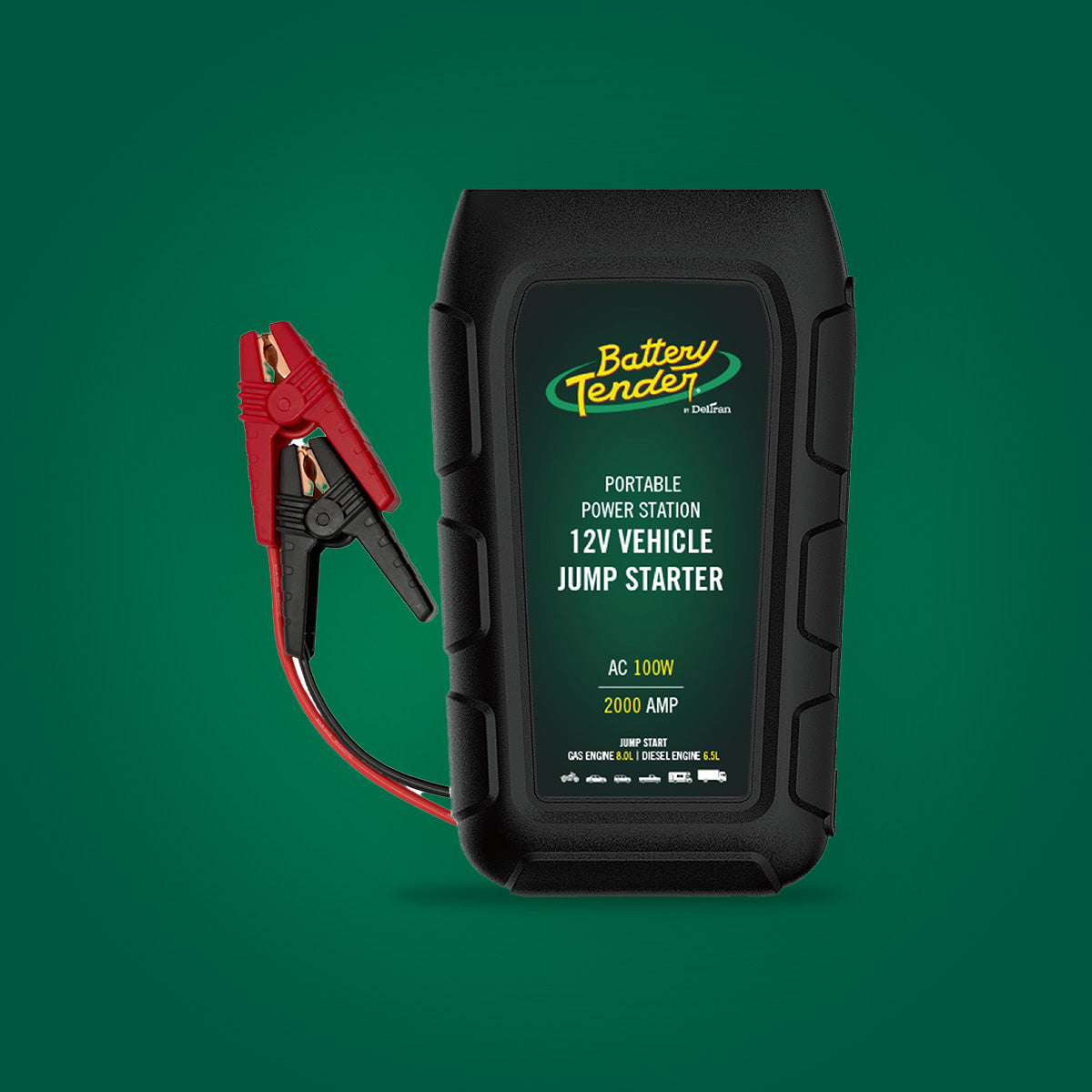
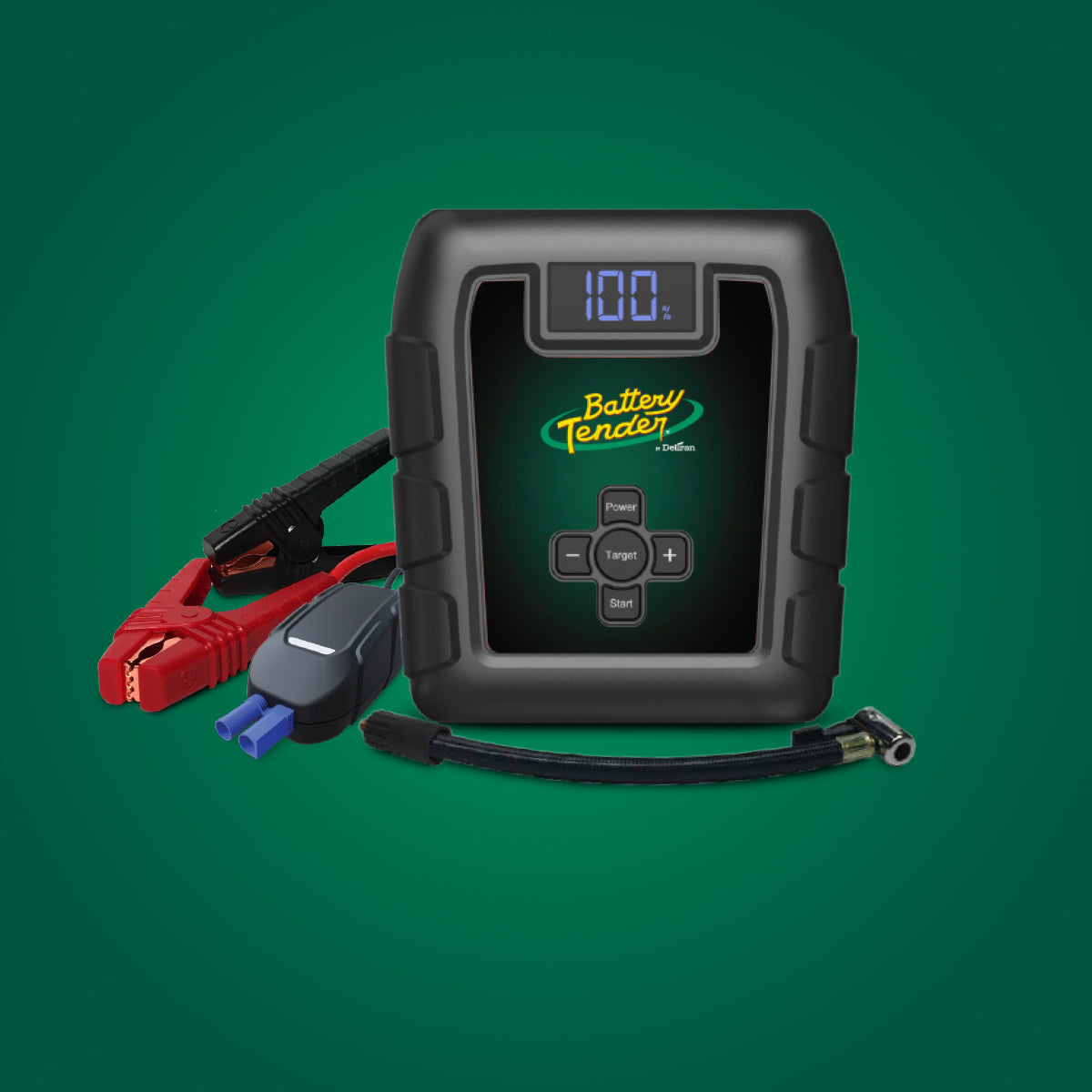
The practical solution is to carry a dedicated portable jump starter onboard. The Battery Tender® 1500 AMP Lithium Jump Starter fits comfortably in a pontoon storage compartment and delivers more than enough cranking power to start virtually any outboard motor — including large-displacement V6 and V8 engines — multiple times on a single charge. Its lithium-ion construction means it holds a charge for months without requiring regular top-offs, making it a reliable piece of emergency equipment rather than another battery to maintain.
Keep it charged at home between seasons and store it in a dry, cool compartment during use. Treat it as standard safety equipment, alongside your flares and fire extinguisher.
Seasonal Storage and Winterization Best Practices
The majority of pontoon boats are operated seasonally — heavily used from spring through fall, then stored for months over winter. That extended storage period is where battery neglect causes the most damage. A battery left disconnected and uncharged over a six-month winter will self-discharge, sulfate, and often fail to recover fully in spring. Across three or four seasons, improper winter storage routinely destroys battery banks that should have lasted a decade.
The most effective winterization strategy is also the simplest: leave your multi-bank charger permanently installed on the boat and connected to shore power at your storage location. The Battery Tender® marine charging lineup is engineered for exactly this use case. Once your batteries reach full charge, the charger transitions automatically to float maintenance mode — delivering only enough charge to offset natural self-discharge without ever overcharging. Your batteries stay at peak capacity all winter, and when spring arrives, you are ready to launch immediately. Lithium iron phosphate batteries are particularly well-suited to this approach, as their extremely low self-discharge rate means they require minimal maintenance input to hold a full charge through the off-season.
If shore power is not available at your storage location, remove the batteries from the boat, store them in a cool, dry indoor location above freezing, and connect them individually to a quality maintenance charger through the winter. Never store lead-acid or AGM batteries directly on a concrete floor — use a wooden shelf or plastic battery box, and check charge levels monthly. Lithium iron phosphate batteries can be stored at a 50 percent state of charge for extended periods without damage, though connecting them to a compatible maintenance charger remains the best practice.
Complete your winterization checklist with these additional battery-specific steps:
- Clean all battery terminals with a wire brush and apply dielectric grease to prevent corrosion buildup
- Inspect battery cables for fraying, cracking, or corrosion at crimp points
- Check that all battery hold-downs are secure and properly cushioned against vibration damage
- Record battery installation dates and test each battery's cold cranking amps against its rated specification — batteries more than three to four years old approaching end-of-life should be replaced before the new season, not after a breakdown
Battery Chemistry Compatibility: AGM, Lithium, and Wet Cell
Modern pontoon batteries span three primary chemistries, and pontoon boat battery care varies meaningfully between them. Flooded lead-acid (wet cell) batteries are the least expensive but require periodic water level maintenance and are sensitive to orientation. AGM (Absorbent Glass Mat) batteries offer superior vibration resistance, spill-proof construction, and faster recharge acceptance — making them the preferred choice for most marine applications and a strong upgrade over flooded lead-acid in any pontoon environment. Lithium iron phosphate (LiFePO4) batteries represent the premium tier: significantly lighter, with a much longer cycle life, deeper usable discharge, and zero sulfation risk — but they require chargers with dedicated lithium charging profiles.
Before connecting any charger, confirm that its chemistry settings match the batteries installed in your pontoon. The Battery Tender® WaveCharge series supports multiple chemistry modes, ensuring that AGM and lithium batteries receive the precise charge profiles they require rather than a generic algorithm that can shorten their service life. Never use a standard lead-acid charge profile on a lithium battery, and never use a lithium profile on an AGM — chemistry matching is a non-negotiable step in proper pontoon boat battery care.
FAQ: Pontoon Boat Battery Care
How often should I charge my pontoon boat batteries?
Connect your batteries to a quality charger after every outing, regardless of how long you were on the water. If your pontoon is stored between uses, a permanent maintenance charger connected to shore power ensures batteries never sit in a partially discharged state. Consistent charging after each use is the single most effective habit in long-term pontoon boat battery care.
Which Battery Tender® charger is right for my pontoon?
The right charger depends on your battery configuration. The Weather Resistant 800 suits single-battery entry-level pontoons. The PowerTender 5 AMP 12V/24V is a strong upgrade for larger starter batteries or small 24V trolling motor setups. The WaveCharge 2-Bank covers dual-battery pontoons, and the WaveCharge 3-Bank is the right choice for any pontoon running a dedicated trolling motor battery alongside a starting battery and accessory bank. All WaveCharge units support lithium charging modes for pontoon owners who have upgraded to LiFePO4 batteries.
Are lithium batteries worth the upgrade on a pontoon boat?
For most pontoon owners — especially those running a trolling motor — yes, lithium iron phosphate batteries are a compelling upgrade. The weight savings alone are significant on a multi-battery trolling motor bank, and the combination of deeper usable capacity, faster recharge, longer cycle life, and immunity to sulfation makes them the highest-performance option available. The upfront cost is higher than AGM, but the total cost of ownership over multiple seasons is typically lower. Just confirm that your charger supports a dedicated lithium charging profile before making the switch.
Can I use a standard automotive charger on my pontoon batteries?
Standard automotive chargers are not designed for marine environments and typically lack the multi-stage charging algorithms that AGM and deep-cycle batteries require. Using an automotive charger risks overcharging, inadequate maintenance charging, and — in humid marine environments — potential safety hazards from non-waterproof components. Always use a charger rated for marine use, and always confirm lithium compatibility if your pontoon runs LiFePO4 batteries.
How long do pontoon boat batteries typically last?
With proper charging and maintenance, quality AGM deep-cycle batteries should last five to seven years in a marine application. Lithium iron phosphate batteries can last ten years or more under similar conditions, with cycle life ratings of 2,000 to 4,000 cycles. Batteries of any chemistry that are routinely left discharged, improperly charged, or stored without maintenance often fail within two to three seasons — well short of their potential service life.
What is the best battery for a pontoon trolling motor?
A lithium iron phosphate deep-cycle battery is the ultimate choice for a pontoon trolling motor — offering greater usable capacity, less weight, faster recharge, and a far longer service life than AGM alternatives. For pontoon owners who prefer AGM, a quality deep-cycle AGM sized appropriately for the trolling motor's thrust rating and typical hours of use remains a strong, reliable option. Either way, pair it with a dedicated multi-stage charger such as the Battery Tender® WaveCharge 3-Bank to ensure the correct charging profile is applied.