




Solar Charging Integration for Boats: The Complete Marine Guide
Solar charging integration for boats represents one of the most meaningful upgrades a boat owner can make—transforming battery management from a constant, anxiety-driven chore into a largely automated, self-regulating system. Where a vessel without solar depends entirely on engine alternator output and shore power connections, a properly designed solar array can replenish 30–70% of daily electrical consumption directly from sunlight. Done right, solar extends battery life, reduces engine hours, and grants genuine energy independence at anchor. Done wrong, it produces undercharged batteries, overworked controllers, and expensive frustration. This guide covers every critical decision point: panel sizing, charge controller selection, system integration, and the specific Battery Tender® products engineered to make a marine solar installation reliable and effective for years.
Why Solar Power Changes Everything for Boat Battery Management
A typical cruising or recreational powerboat draws continuous loads from lighting, refrigeration, bilge pumps, navigation electronics, VHF radios, and entertainment systems. Even at anchor with the engine off, a boat with a modest refrigerator can consume 50–100 Ah per day. Without a renewable charging source, that deficit accumulates rapidly—draining house bank capacity, forcing engine starts solely for charging, and cycling lead-acid or lithium batteries through deep discharges that accelerate degradation.
A well-sized solar array interrupts that cycle entirely. By continuously topping off the battery bank throughout daylight hours, solar keeps state-of-charge high, reduces the depth and frequency of discharges, and minimizes the load placed on the alternator and shore power charger. For boats that sit unattended for weeks or months, even a small solar maintenance panel is the difference between a battery that starts the engine on arrival and one that requires a jump or replacement.
Understanding Your Energy Budget Before Sizing Panels
Every successful solar installation begins with an honest energy budget. Before selecting a single panel or controller, document your boat's daily electrical consumption by listing every load—its wattage and estimated daily run time. Multiply watts by hours to get watt-hours per device, then total everything. Add 20% as a safety margin to account for inefficiencies, parasitic draws, and unexpected usage spikes.
As a reliable rule of thumb for marine conditions, one watt of solar panel capacity produces approximately 4–5 watt-hours per day under average sunlight exposure. A 100-watt panel therefore delivers roughly 400–500 Wh per day, or approximately 33–42 Ah at 12V. That math changes your sizing question: if your boat consumes 80 Ah per day, you need approximately 200 watts of panel capacity to achieve reliable replenishment—more if your cruising grounds are frequently overcast, less if you consistently operate in high-solar latitudes.
Available mounting surface, panel orientation, and shading from rigging or superstructure all affect real-world production. In marine environments, partial shading from a boom or mast can reduce output disproportionately—a factor that directly influences charge controller selection, as discussed below.
Matching Panel Size to Battery Bank and Use Case
Not every boat needs a 200-watt rooftop array. The right panel size depends entirely on battery bank capacity, daily consumption, and how the boat is used. Battery Tender® offers a scaled range of marine solar panels designed to match each scenario precisely.
For small batteries, single-battery systems, or boats that need maintenance charging during storage, compact solar chargers deliver the trickle current necessary to offset self-discharge without risk of overcharge. The Battery Tender 5 Watt Solar Charger is purpose-built for this role—providing enough daily energy to keep a starting battery or small house battery at full charge through weeks of inactivity. For slightly higher maintenance loads or small electronics that run occasionally at the dock, the Battery Tender 17 Watt Solar Charger steps up the output while remaining compact and simple to deploy. The Battery Tender 35 Watt Solar Charger extends the range further, delivering approximately 2 amps in full sun and shipping with an integrated charge controller—making it a complete, ready-to-install solution for single-battery maintenance on larger vessels or small boats with modest daily loads.
When battery banks grow larger—100 Ah and above—or when daily consumption demands genuine replenishment rather than just maintenance, the calculation changes. At this scale, panels of 100 watts or larger paired with a dedicated solar charge controller provide the current volume and regulation sophistication that larger banks require. Attempting to maintain a 200 Ah house bank with a 35-watt panel is an exercise in futility; the panel simply cannot produce enough current to meaningfully offset real consumption. Match the panel capacity to the load, and match the controller to the panel.
Charge Controller Selection: PWM vs. MPPT for Marine Systems
Any solar installation beyond a small maintenance panel requires a charge controller to regulate voltage and current into the battery bank. Connecting a solar panel directly to a battery without a controller risks overcharge, battery damage, and potential fire—particularly on a vessel where monitoring is intermittent. The choice between PWM (Pulse Width Modulation) and MPPT (Maximum Power Point Tracking) controllers is one of the most consequential decisions in a marine solar system.
PWM controllers are simpler, less expensive, and appropriate for small, straightforward installations where the panel voltage closely matches the battery voltage. They work by connecting the panel directly to the battery and reducing current via rapid switching once the battery approaches full charge. Effective, but inherently limited in energy extraction.
MPPT controllers are technically superior for any installation where maximizing energy harvest matters. An MPPT controller continuously tracks the panel's maximum power point—the voltage-current combination that produces peak wattage—and converts that power to the voltage needed by the battery. In practical terms, MPPT controllers recover 15–30% more energy than PWM units, with the advantage widening under partial shading, cooler temperatures, and in situations where panel voltage significantly exceeds battery voltage. For a marine installation running 100-watt or larger panels on a battery bank that needs genuine replenishment, MPPT pays for itself quickly.
The Battery Tender 30 Amp MPPT Solar Charge Controller delivers sophisticated maximum power point tracking with compatibility across 12V, 24V, 36V, and 48V battery systems—making it appropriate for everything from a 12V single-bank powerboat to a 24V or 48V sailboat with a large house bank. With 30 amps of output capacity, it can manage up to approximately 400 watts of panel input on a 12V system, providing substantial headroom for array expansion. Its multi-stage charging algorithm ensures batteries receive the correct charge profile throughout the cycle—bulk, absorption, and float—protecting battery chemistry and maximizing service life.
Integrating Solar with Shore Power and Alternator Charging
A common misconception in marine solar integration is that solar replaces shore power and alternator charging. In practice, the three sources are complementary and each fills a distinct role in a well-designed charging ecosystem.
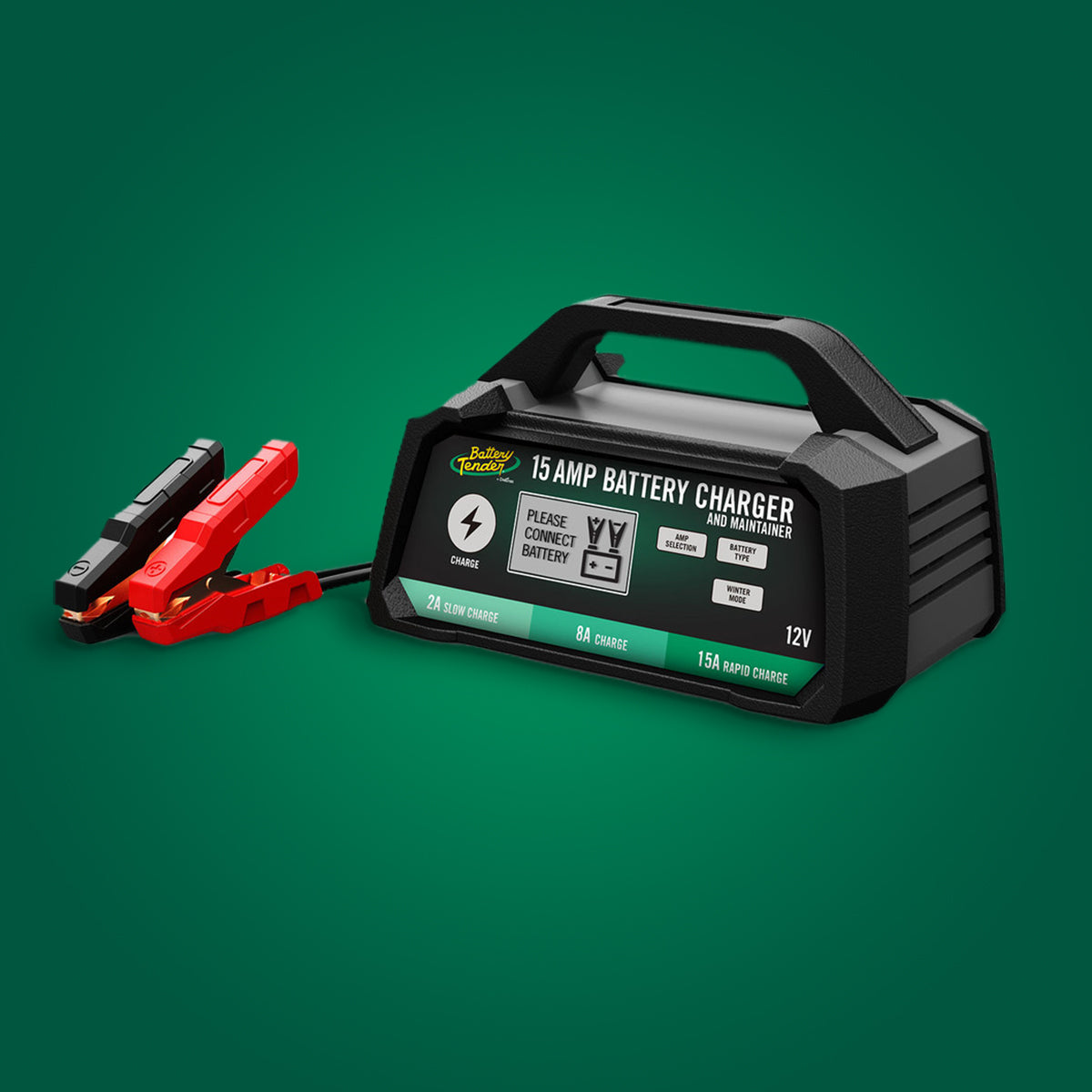
Shore power charging handles the heavy lifting when the vessel is at the dock. A quality marine multi-stage charger brings all batteries to full charge through a complete charge cycle, conditioning batteries and ensuring they start each passage at 100% state-of-charge. Battery Tender® WaveCharge marine chargers are engineered specifically for this role, delivering multi-bank charging capability with battery-type-specific charge algorithms for flooded, AGM, gel, and lithium chemistries.
The alternator contributes during engine operation—motoring into harbor, running the engine for passage, or powering up for an hour at anchor. Modern high-output alternators with external regulators can deliver substantial current, but relying on alternator charging exclusively means engine hours and fuel consumption that serve no propulsive purpose.
Solar fills the gaps: the hours at anchor between engine runs, the days on a mooring between passages, the weeks a boat sits in a slip. By continuously maintaining state-of-charge during these intervals, solar reduces the total work required from the shore charger and alternator, extends battery cycle life, and eliminates the dead-battery scenarios that ruin departure mornings.
The key to successful integration is ensuring that charge sources do not conflict. A quality solar charge controller includes battery voltage sensing and will reduce or suspend output when a shore charger has already brought the bank to full charge—preventing the overcharge scenarios that damage batteries. Systems with battery monitors and automatic source switching provide the most seamless integration, but even a well-chosen controller and charger operating independently will coexist without conflict in most installations.
Marine Solar Panel Mounting and Installation Best Practices
Marine environments are among the most demanding on earth for electrical equipment. Salt spray, UV radiation, vibration, thermal cycling, and the occasional physical impact from sheets, halyards, and crew combine to test every component in a solar installation. Panel selection and mounting approach significantly affect long-term reliability.
Rigid monocrystalline panels mounted on welded aluminum frames offer the best combination of efficiency, durability, and longevity. Monocrystalline cells produce more watts per square foot than polycrystalline alternatives—critical when mounting space is limited, as it almost always is on a boat. Marine-grade panels use tempered glass surfaces, sealed junction boxes rated for moisture exposure, and UV-stable frame materials that resist corrosion in saltwater environments.
Mounting location affects both production and practicality. Hardtop bimini frames, stern arches, and pilothouse roofs provide excellent solar exposure on most vessels. Flush deck mounting can work on powerboats with wide, unobstructed deck space. On sailboats, the boom's shadow sweeping across deck-mounted panels throughout the day can significantly reduce production—a factor that often favors stern arch mounting, which keeps panels clear of the rig. Tilted mounting that angles panels toward the sun increases production but creates windage and potential impact hazards that must be evaluated against the gain.
Wiring quality is equally critical. Use marine-grade tinned-copper wire sized appropriately for the current load and run length—undersized wire creates voltage drop that reduces system performance and creates heat. Waterproof all connections with heat-shrink terminals or proper marine connectors, and route cables to avoid chafe points. Install an appropriately rated fuse or circuit breaker as close to the battery as practical.
Seasonal and Storage Considerations for Marine Solar Systems
For boats that operate seasonally, solar charging during lay-up periods is one of the highest-return applications of the technology. A battery that sits disconnected for four to six months will self-discharge to a damaging level—particularly in warmer climates where self-discharge rates increase. Sulfation on lead-acid batteries begins within weeks of falling below 12.4V and accelerates as voltage continues to drop, permanently reducing capacity.
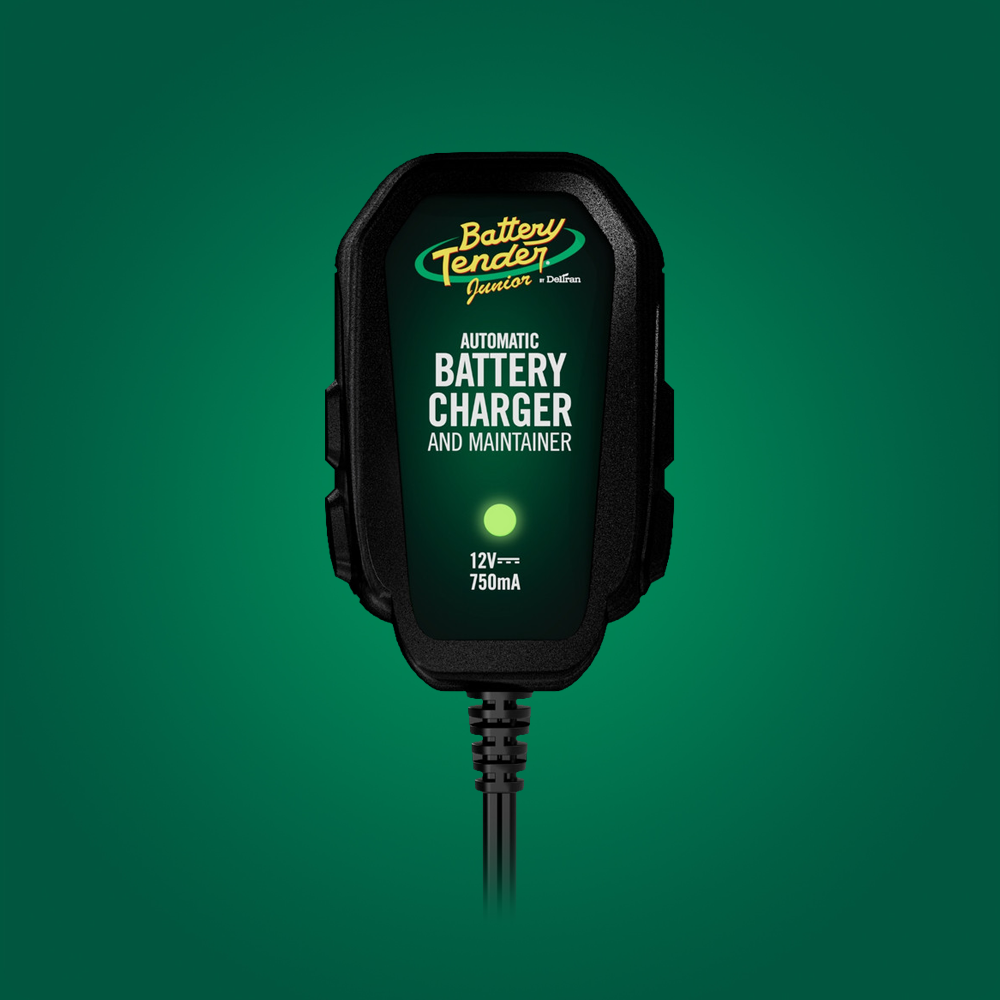
A Battery Tender 5 Watt or 17 Watt solar charger connected during storage continuously offsets self-discharge, maintaining the battery at or near full charge without any intervention required. The investment in a small maintenance panel is a fraction of the cost of replacing batteries prematurely—and eliminates the inconvenience of periodic manual charging throughout the off-season.
For boats stored outdoors with panels exposed to winter conditions, verify that panel and controller specifications include the temperature ranges present in your storage location. Quality panels and controllers operate reliably across the temperature extremes encountered in most North American climates, and solar panels actually produce more voltage in cold conditions—a characteristic that MPPT controllers leverage particularly well.
Frequently Asked Questions About Solar Charging Integration for Boats
How many watts of solar do I need for a typical cruising boat?
For a cruising sailboat or powerboat with refrigeration, lighting, and navigation electronics consuming 60–100 Ah per day, a minimum of 150–300 watts of solar panel capacity is appropriate for meaningful replenishment. Boats with larger loads or lower solar exposure may need more. Always calculate your actual energy budget before sizing—guessing leads to undersized systems that disappoint and oversized arrays that waste mounting space and budget.
Can I connect multiple solar panels to one charge controller?
Yes, multiple panels can be wired in series, parallel, or series-parallel combinations depending on the controller's voltage and current limits. The Battery Tender 30 Amp MPPT Solar Charge Controller accommodates up to approximately 400 watts on a 12V system. Always verify that your combined panel array does not exceed the controller's maximum input voltage or current ratings before wiring.
Will solar damage my batteries if I'm away from the boat for weeks?
A properly installed solar system with a quality charge controller will not damage batteries during extended absence. The charge controller monitors battery voltage and reduces output to a maintenance float level once the bank reaches full charge, preventing overcharge regardless of how long the boat sits unattended.
Do I need solar if I have a shore power charger?
Shore power charging is excellent when available, but solar provides value that shore power cannot—energy independence at anchor, continuous maintenance during storage, and reduced load on the shore charger and alternator. The two systems complement each other and are most effective when used together.
What is the difference between a solar charger and a solar charge controller?
A solar charger—such as the Battery Tender 5W, 17W, or 35W solar chargers—combines a panel with an integrated regulation circuit designed for small battery maintenance applications. A solar charge controller is a standalone device designed to manage power from larger, separately mounted panels into larger battery banks. For small batteries and maintenance charging, an integrated solar charger is convenient and complete. For larger systems with 100W or greater panel arrays, a dedicated charge controller paired with separate panels provides the capacity and control sophistication the system requires.
Conclusion
Solar charging integration for boats is not a single product purchase—it is a system design decision that pays dividends across the entire life of the vessel. The right combination of properly sized panels, an appropriately matched charge controller, and a quality marine shore power charger creates an autonomous, self-regulating power ecosystem that keeps batteries healthy, eliminates unnecessary engine hours, and provides genuine energy independence wherever the boat travels. Battery Tender® offers the complete range of components needed to build that system correctly: from compact 5W and 17W solar chargers for storage and maintenance, to the 35W solar charger for small-boat daily use, to 100-watt-plus panel arrays managed by the 30 Amp MPPT Solar Charge Controller for serious house bank replenishment. Start with an honest energy budget, match your components to your actual needs, and install everything to marine-grade standards—the result is a boat that is always ready to go, regardless of how long it has been sitting at the dock.