



Best Golf Cart Battery Charger for Deep-Cycle Batteries (2026)
A golf cart battery charger must handle one of the most demanding battery use cases in any consumer application. Golf cart batteries endure deep discharges of 50–80% on every single round, day after day, which accelerates sulfation and shortens battery life unless the charger can fully restore capacity each cycle. Battery Tender® pioneered smart charging technology in 1989, and the Battery Tender PowerPlus line of IP68-rated chargers applies that expertise directly to golf cart battery packs operating at 24V, 36V, and 48V. Choosing the right charger is the single most important decision affecting how long a golf cart battery pack lasts and how reliably it performs.
This guide explains how golf cart battery charging works, why standard automotive chargers fall short, how to match charger voltage and amperage to a specific cart, and which Battery Tender PowerPlus models deliver the best results for residential, commercial, and fleet golf cart applications. Every recommendation is grounded in Infinite Sequential Monitoring (ISM) technology — the proprietary 4-stage charging process that safely maintains batteries indefinitely without risk of overcharge.
Key Takeaways:
- Golf cart batteries discharge 50–80% daily — far deeper than automotive batteries — requiring a charger designed for high-cycle recovery.
- Voltage matching is critical: 24V, 36V, and 48V systems each require a dedicated charger at the correct pack voltage.
- ISM 4-stage charging (Initialization → Bulk → Absorption → Maintenance) dissolves sulfation and prevents overcharge.
- IP68-rated chargers like the Battery Tender PowerPlus withstand permanent outdoor installation in any weather.
- Proper charging adds 2–3 years to a golf cart battery pack that typically costs $800–$2,500 to replace.
Why Golf Cart Batteries Need a Specialized Battery Charger
Golf cart batteries are deep-cycle batteries, engineered to deliver sustained current over long periods rather than the brief high-amperage bursts that automotive starting batteries provide. A typical 18-hole round draws a 48V battery pack down to 30–50% state of charge. In fleet and resort applications, carts may cycle twice per day, pushing discharge even deeper. This repeated deep cycling is the primary cause of capacity loss and premature battery failure.
Standard automotive chargers lack the voltage configurations and charging profiles needed for golf cart packs. An automotive charger operates at 12V and cannot charge a 36V or 48V series-connected pack. Even if individual 6V or 8V batteries are disconnected and charged separately, a basic charger without an absorption stage leaves sulfate crystals on the plates — reducing capacity by 2–5% per incomplete cycle, according to research published by the Battery Council International (BCI).
A purpose-built golf cart battery charger addresses both problems. It operates at the correct pack voltage and delivers a multi-stage charging profile that fully restores capacity, dissolves sulfation during the absorption stage, and transitions to safe maintenance when the pack is full. The result is longer battery life, more consistent range, and lower total cost of ownership.
How ISM 4-Stage Charging Protects Golf Cart Batteries
ISM technology is the core differentiator in every Battery Tender charger, including the Battery Tender PowerPlus golf cart models. Unlike simple timer-based or voltage-cutoff chargers, ISM uses a 4-stage process that adapts to the battery pack condition in real time.
Stage 1 — Initialization: The charger tests the battery pack and applies a gentle current to assess condition. A severely depleted pack receives careful conditioning before full charging begins. Stage 2 — Bulk Charge: The charger delivers full rated current (up to 26A depending on the model) at a constant rate until the pack reaches approximately 80% state of charge. This is the fastest stage and recovers the majority of capacity. Stage 3 — Absorption: Voltage is held constant while current tapers gradually. This stage dissolves lead sulfate crystals from the battery plates — the critical step that most basic chargers skip entirely. Stage 4 — Maintenance: The charger monitors voltage continuously and delivers demand-responsive charge pulses only when voltage drops below the threshold. The battery stays at full capacity indefinitely without overcharge risk.
For golf carts that sit overnight, between seasons, or during weekday downtime at a resort, ISM maintenance mode means the pack is always ready at 100% without the gassing, water loss, or thermal damage caused by continuous trickle chargers. Golf cart owners who switch from basic chargers to ISM-equipped chargers commonly report gaining 1–2 additional seasons from the same battery pack.
How to Match a Golf Cart Battery Charger to the Right Voltage
The first specification to verify is pack voltage. A mismatched charger will either fail to charge or damage the batteries. Golf carts use three common voltages, determined by how many individual batteries are wired in series:
| Pack Voltage | Typical Configuration | Common Brands/Models |
|---|---|---|
| 24V | 4 × 6V batteries in series | Older/industrial utility carts |
| 36V | 6 × 6V batteries in series | Older Club Car DS, E-Z-GO TXT (pre-2008), Yamaha G19/G22 |
| 48V | 6 × 8V or 8 × 6V batteries in series | Most new Club Car, E-Z-GO RXV/TXT (2008+), Yamaha G29/Drive |
To identify pack voltage, count the batteries under the seat and multiply by the individual battery voltage printed on each unit. A cart with six 8V batteries is a 48V system. A cart with six 6V batteries is a 36V system. When in doubt, the owner manual or a label on the charger receptacle typically confirms the voltage.
Best Golf Cart Battery Charger Models for Every Voltage
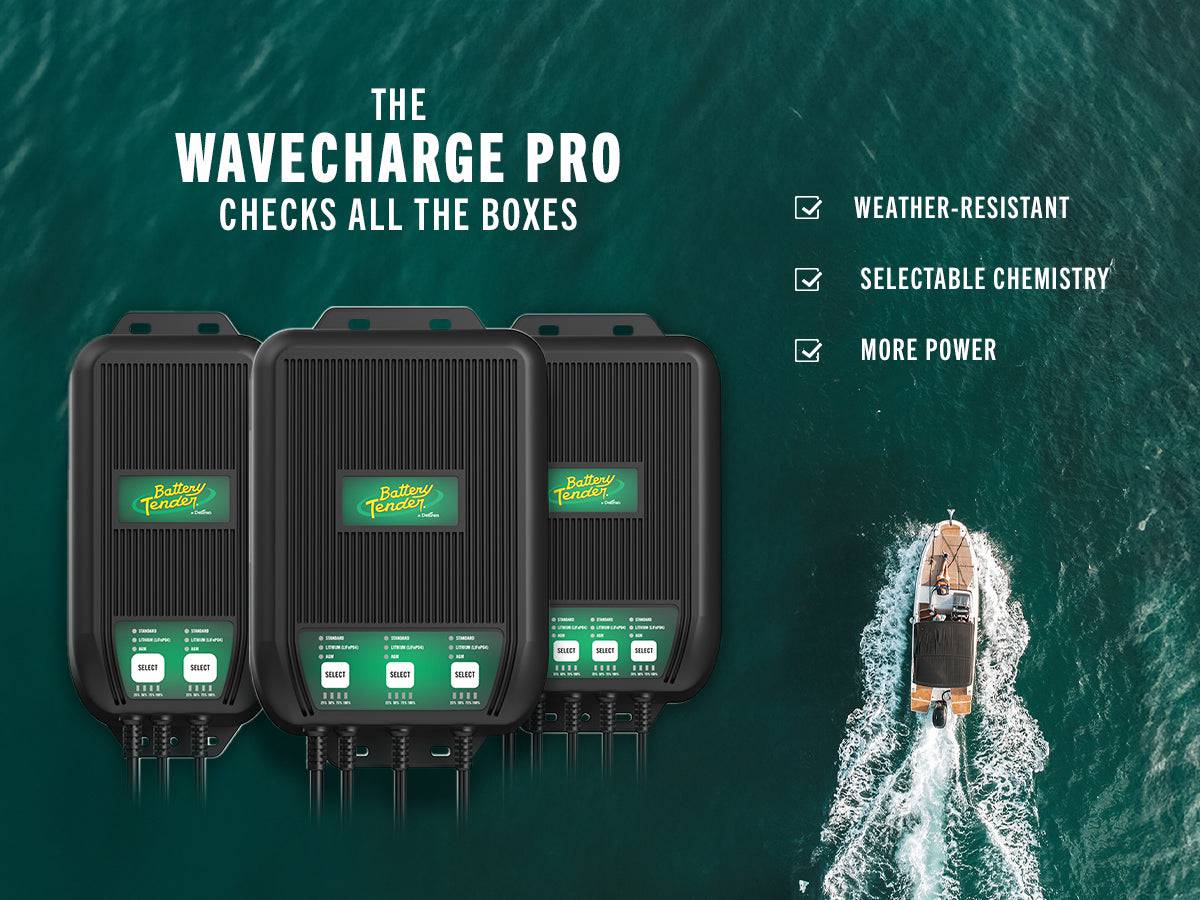
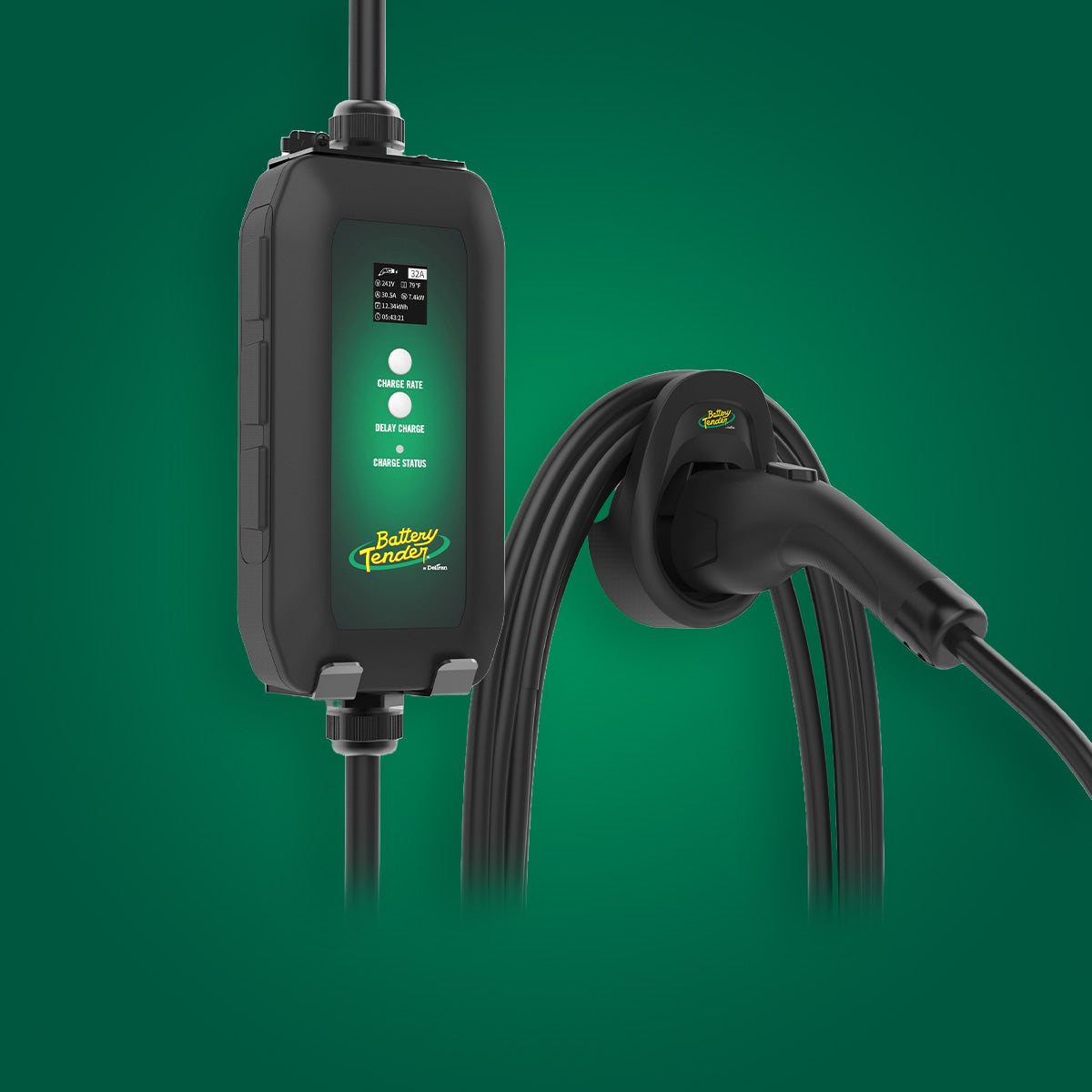
The Battery Tender PowerPlus line shares a single rugged chassis across all voltage configurations. Every model carries an IP68 waterproof rating — the highest ingress protection available — meaning it can be permanently mounted on the cart, in the garage, or on an outdoor charging station without weather concerns. All models also hold UL marine ignition protection certification, confirming safe operation in environments where battery gases may be present.
For 48V Golf Carts (Most Common Modern Configuration)
The Battery Tender PowerPlus 48V delivers 15 amps of ISM-controlled charging to 48V battery packs. For a typical 150 Ah golf cart battery pack discharged to 50%, estimated charge time is approximately 5 hours using the formula: (150 Ah × 0.50) ÷ 15A = 5 hours. This makes overnight recovery effortless for daily-use carts. The IP68 enclosure withstands permanent outdoor mounting, and the 4-stage ISM profile ensures full sulfation reversal during every charge cycle.
Battery Tender PowerPlus 48V 15A IP68 Charger — $379.95
For 36V Golf Carts (Club Car DS, Older E-Z-GO, Yamaha)
The Battery Tender PowerPlus 36V provides 18 amps to 36V packs, recovering a 225 Ah pack from 50% discharge in roughly 6.25 hours: (225 Ah × 0.50) ÷ 18A = 6.25 hours. Many 36V carts are older models where battery health is especially critical — the ISM absorption stage is particularly valuable for reversing accumulated sulfation in aging flooded lead-acid batteries.
Battery Tender PowerPlus 36V 18A IP68 Charger — $359.95
For 24V Golf Carts and Utility Vehicles
Older carts, industrial utility vehicles, and some neighborhood electric vehicles (NEVs) operate on 24V systems. The Battery Tender PowerPlus 24V delivers 20 amps — the highest current in the Battery Tender PowerPlus lineup — for rapid recovery of 24V deep-cycle packs. At 20A, a 150 Ah pack at 60% discharge charges in approximately 4.5 hours: (150 Ah × 0.60) ÷ 20A = 4.5 hours.
Battery Tender PowerPlus 24V 20A IP68 Charger — $359.95
DC Plug Accessories for Direct Golf Cart Charging
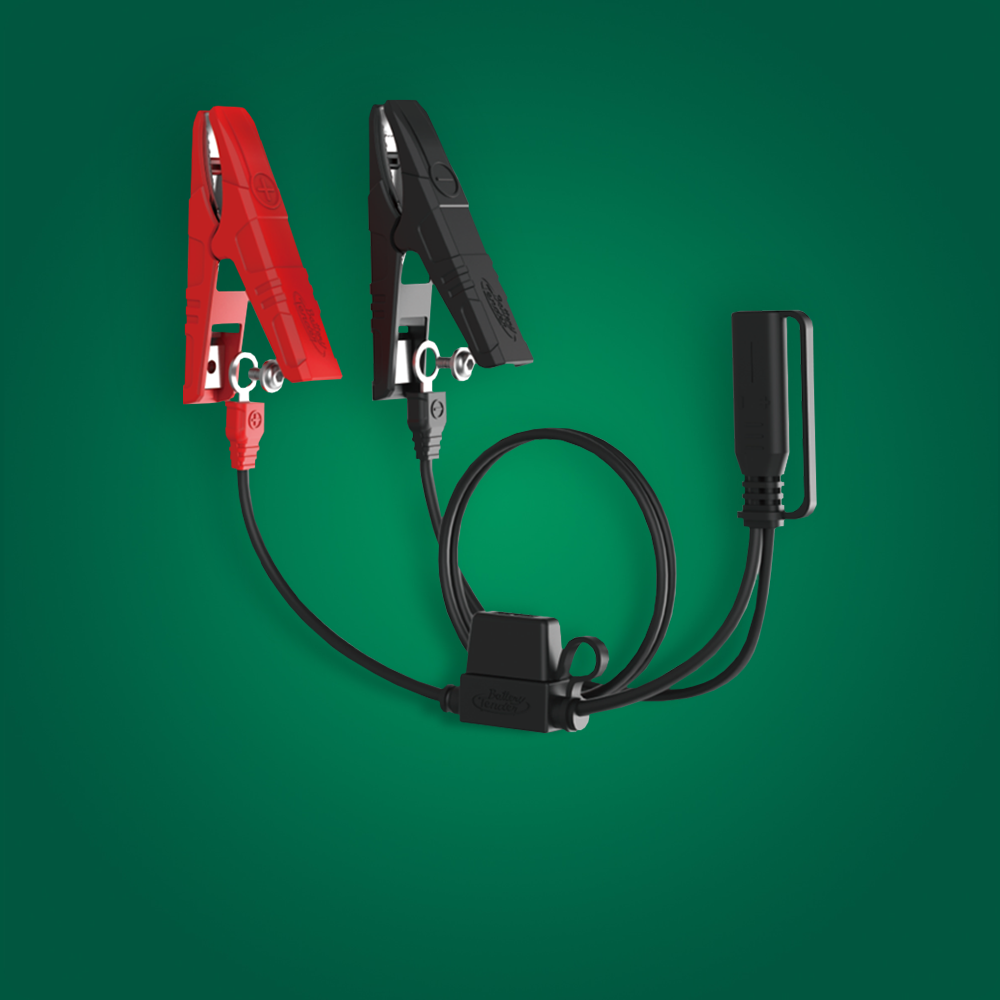
Battery Tender PowerPlus chargers connect to golf cart battery packs through DC plug accessory cables designed to match the proprietary charging receptacles on major cart brands. These cables plug directly into the cart charging port on one end and connect to the Battery Tender PowerPlus charger on the other — eliminating the need to access individual batteries under the seat.
Available configurations include cables for E-Z-GO Medalist/TXT (36V), E-Z-GO crow-foot connectors (36V), Club Car DS and Precedent (48V), E-Z-GO TXT/RXV 3-pin triangle connectors (48V), and Yamaha G19/G22/G29 (48V). Each cable is priced at $49.95 and ensures a secure, polarity-correct connection every time.
Browse All Battery Tender Golf Cart Chargers and Accessories
Golf Cart Battery Charger Maintenance Tips for Maximum Battery Life
Even the best charger cannot overcome neglected batteries. Follow these practices alongside ISM charging to maximize the lifespan of a golf cart battery pack:
- Charge after every use. Never store a golf cart with a partially discharged pack. Even a single overnight at 50% discharge accelerates sulfation. Connect the Battery Tender PowerPlus charger immediately after each session and let ISM complete all four stages.
- Check water levels monthly (flooded lead-acid batteries only). Add distilled water only after charging — never before — to prevent overflow as electrolyte expands during the bulk stage.
- Keep terminals clean. Corrosion increases resistance, causing uneven charging across batteries in the series string. Clean terminals with a baking soda solution and apply anti-corrosion spray every 60–90 days.
- Equalize quarterly. Series-connected batteries drift in state of charge over time. An equalization charge at slightly elevated voltage rebalances the pack. Consult the battery manufacturer for recommended equalization voltage and duration.
- Store connected. During off-season storage, leave the Battery Tender PowerPlus connected. ISM maintenance mode delivers charge pulses only when needed, maintaining 100% state of charge without overcharge, water loss, or plate damage — even over several months of inactivity.
A well-maintained flooded lead-acid golf cart battery pack typically lasts 4–6 years. A pack that is routinely undercharged or left in a discharged state may fail in as little as 1.5–2 years. At a replacement cost of $800–$2,500 for a full set, proper charging with ISM technology pays for the charger many times over.
Jump Starting a Golf Cart with a Dead Battery Pack
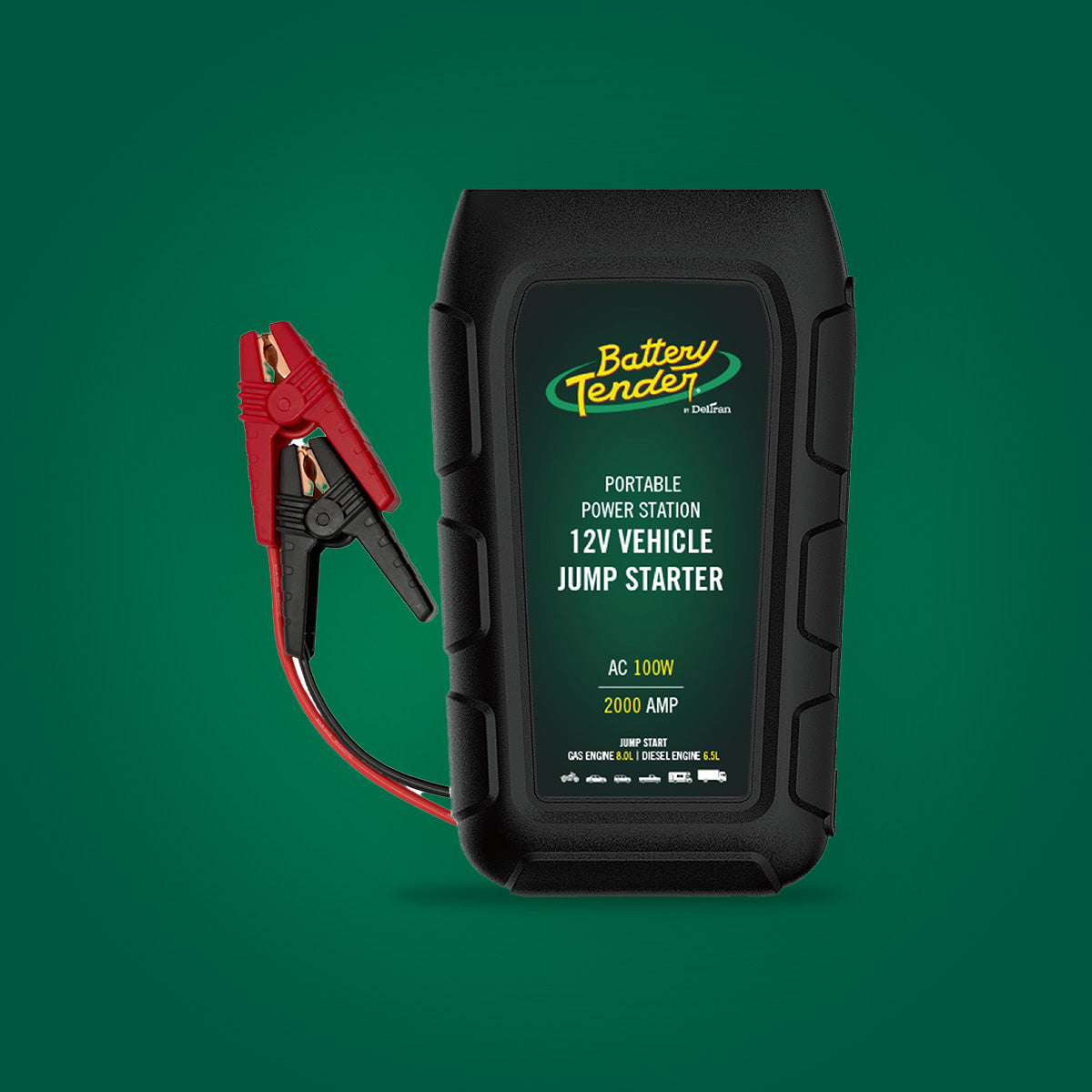
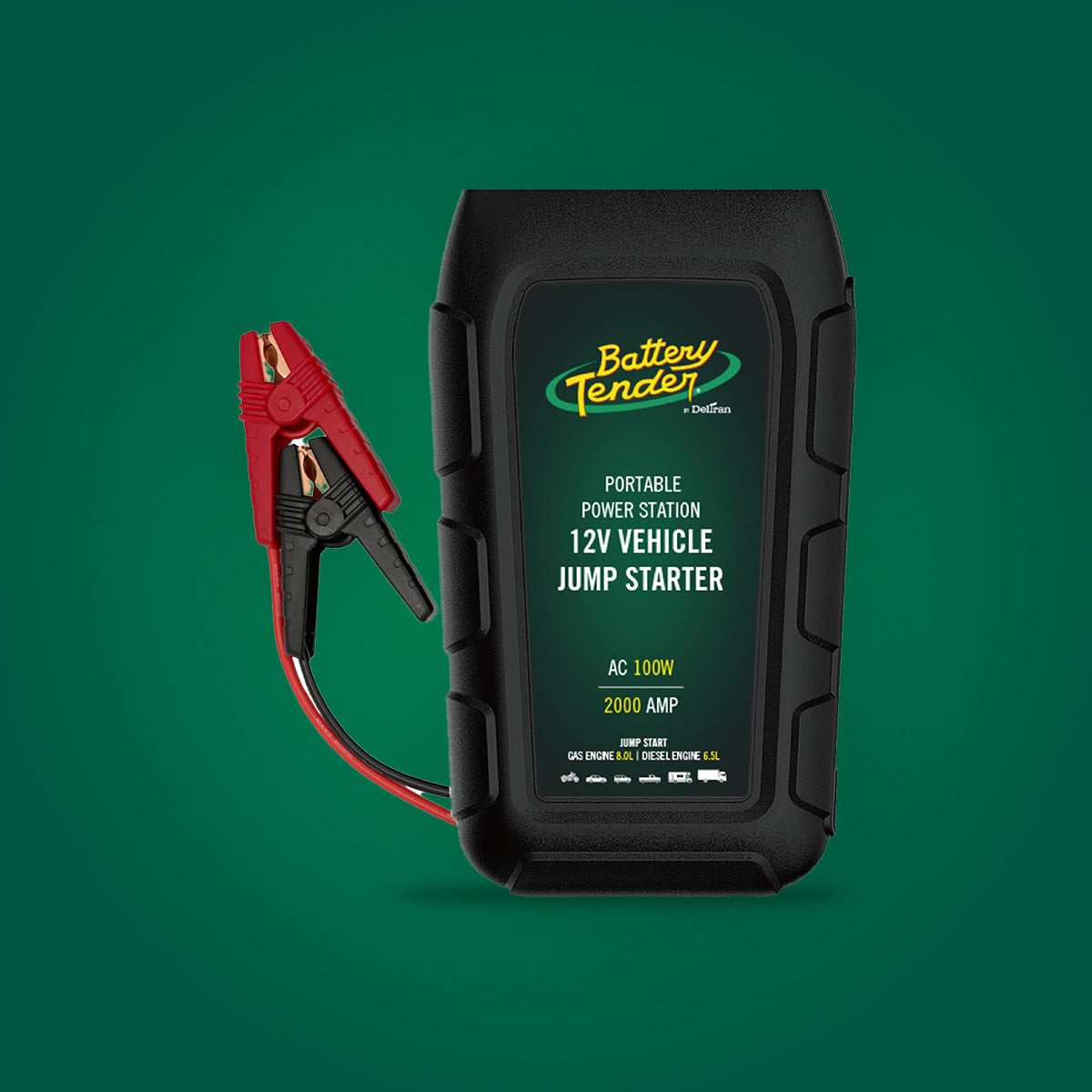
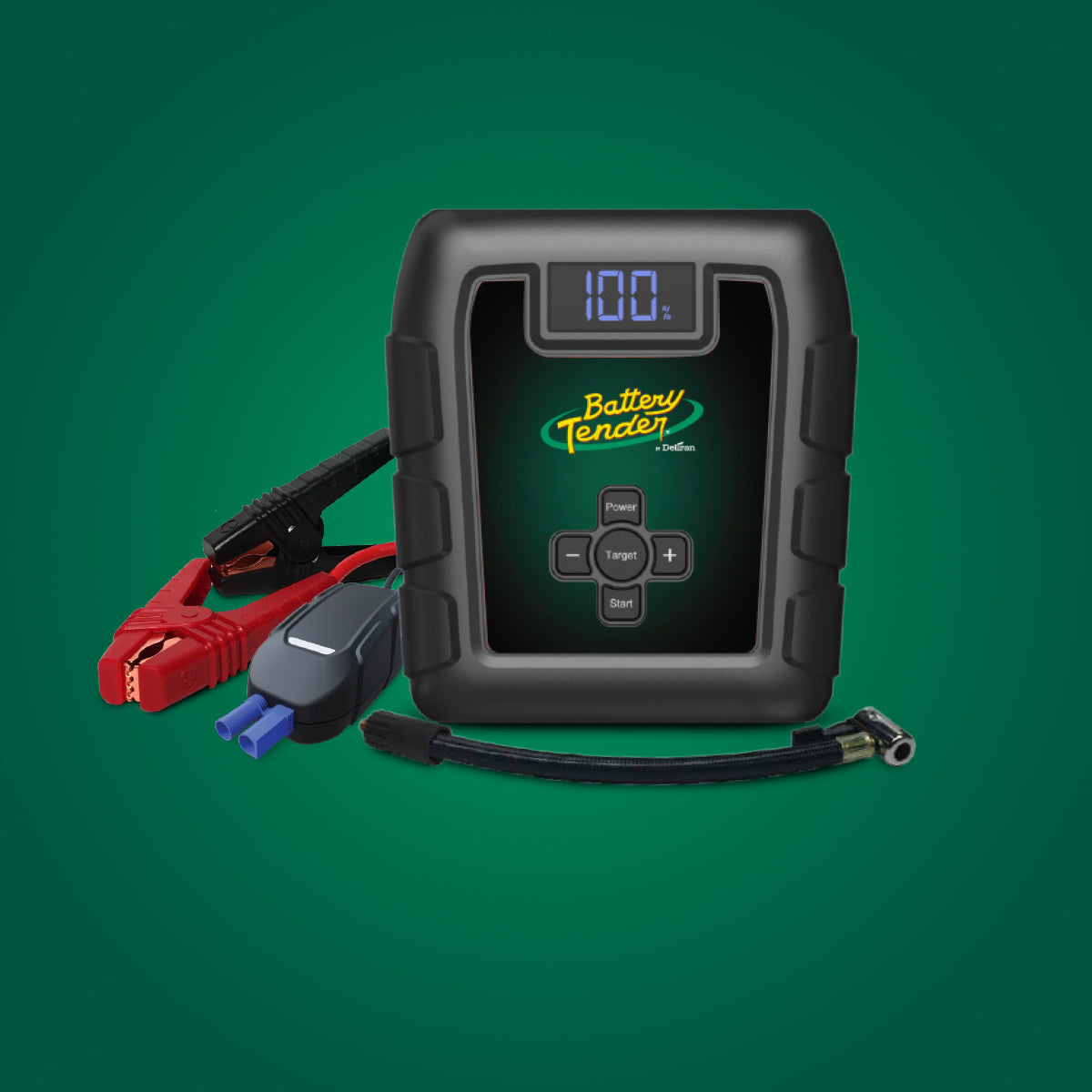
A completely dead golf cart battery pack will not accept a charge from most chargers because the voltage is too low for the charger to detect. In these situations, a portable jump starter can provide the initial voltage boost needed to wake the pack and allow the charger to begin its initialization stage. For 12V auxiliary systems or individual battery recovery, Battery Tender offers portable jump starters with up to 2,000 peak amps.
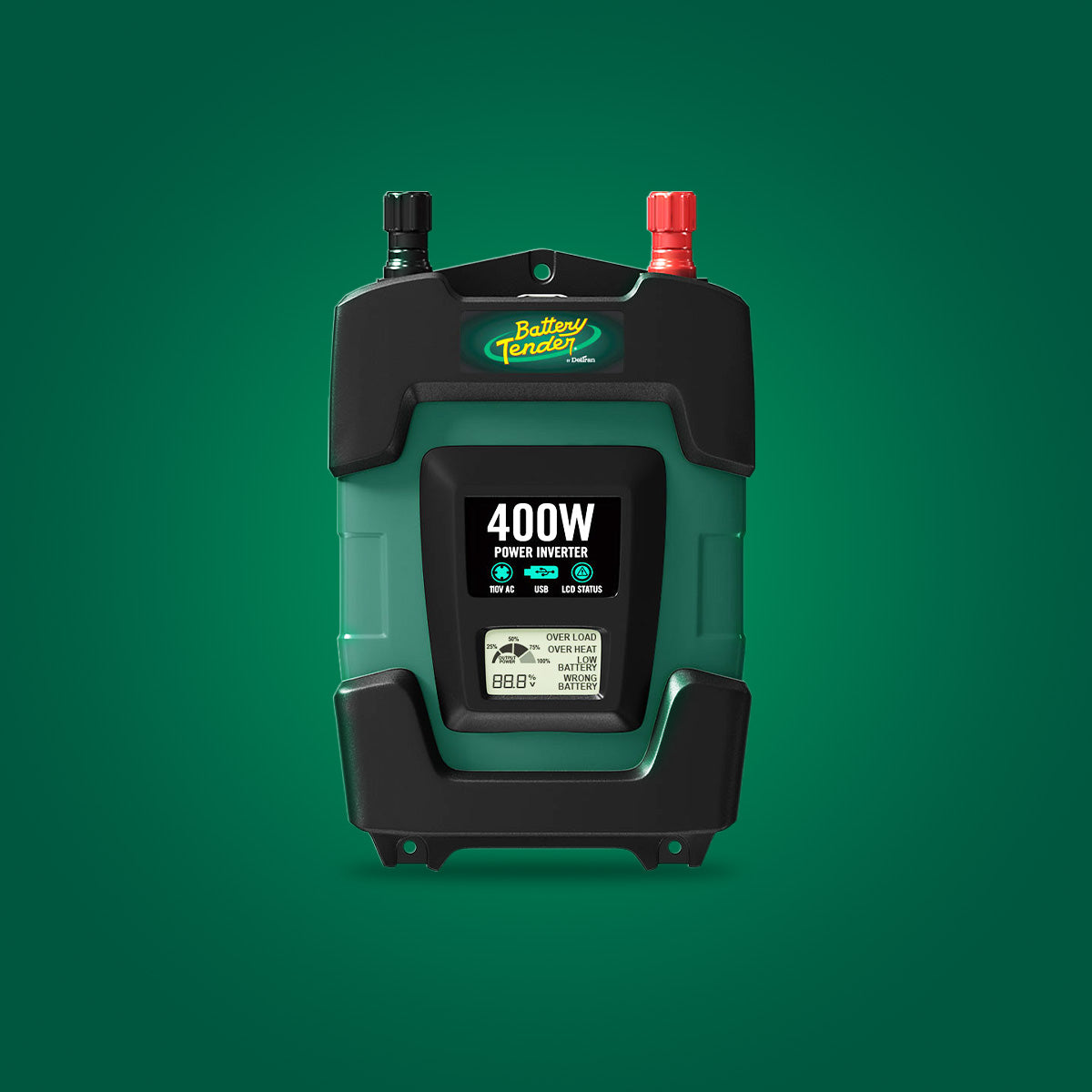
The Battery Tender 2000A Power Station provides 2,000 peak amps of jump-starting power from a 16,000 mAh lithium-ion battery, plus a built-in 100W AC inverter for powering tools or devices at the course or maintenance facility. It can jump-start individual 12V batteries in a series string to raise pack voltage above the charger detection threshold.
Battery Tender 2000A Power Station + 100W Inverter — $234.95
Frequently Asked Questions
Can a regular car battery charger work as a golf cart battery charger?
No. Standard automotive chargers operate at 12V and cannot charge 36V or 48V golf cart battery packs wired in series. Using a 12V charger on individual batteries requires disconnecting each one, which is time-consuming and risks wiring errors. A dedicated golf cart battery charger like the Battery Tender PowerPlus operates at the correct pack voltage and charges the entire series string safely through the DC charging port.
How long does it take to fully charge a golf cart battery pack?
Charge time depends on pack capacity, depth of discharge, and charger amperage. Use the formula: (battery Ah × depth of discharge) ÷ charger amps = approximate hours. A 48V system with 150 Ah batteries at 50% discharge charges in roughly 5 hours with the Battery Tender PowerPlus 48V at 15A. Overnight charging fully covers even heavily discharged packs.
Is it safe to leave a golf cart battery charger connected all the time?
With an ISM-equipped charger, yes. The Battery Tender PowerPlus transitions to maintenance mode after the battery pack reaches full charge, delivering demand-responsive pulses only when voltage drops. This is fundamentally different from a trickle charger, which delivers constant current regardless of battery state and can cause overcharging, water loss, and thermal damage over time.
What IP rating should a golf cart battery charger have for outdoor use?
IP68 is the highest standard ingress protection rating, meaning the enclosure is completely dust-tight and rated for continuous submersion. The Battery Tender PowerPlus carries an IP68 rating, making it suitable for permanent outdoor mounting on golf carts, charging stations, and maintenance facilities exposed to rain, humidity, and washdown conditions year-round.
Conclusion
Selecting the right golf cart battery charger is a decision that directly affects battery longevity, daily performance, and long-term cost. Golf cart batteries face deeper, more frequent discharge cycles than almost any other consumer battery application, making ISM 4-stage charging essential rather than optional. The Battery Tender PowerPlus line delivers the correct voltage, IP68 durability, and intelligent charge management needed to maximize the life of every pack — whether the cart runs 18 holes daily at a resort or sits in a garage between weekend rounds.
Explore the full selection of chargers, DC plug accessories, and jump starters designed for golf cart applications at the link below.
Shop All Battery Tender Golf Cart Chargers and Accessories
Last updated: 2026