

RV Battery Bank Guide: Sizing, Wiring & Maintenance (2026)
An RV battery bank is the collection of batteries wired together to power house systems — lights, refrigerators, water pumps, and USB outlets — independently from the chassis starting battery. Sizing a bank correctly, wiring it safely, and maintaining it with smart charging technology determines whether a weekend getaway starts with reliable power or a frustrating scramble for hookups. Battery Tender® chargers use proprietary Infinite Sequential Monitoring (ISM) technology to keep RV battery banks at full capacity during storage, between trips, and throughout the camping season — without risk of overcharging.
RV owners invest anywhere from $50,000 to $500,000 in their rigs, yet a neglected battery bank can turn a dream trip into a roadside headache. This guide covers the fundamentals that every RV owner needs: how to calculate the right bank size for actual power consumption, how series and parallel wiring configurations affect voltage and capacity, which battery chemistries suit different RV lifestyles, and how ISM charging protects that investment during the weeks or months between adventures. Whether upgrading an existing setup or building a new RV battery bank from scratch, these principles apply to every class of motorhome, travel trailer, and fifth wheel on the road in 2026.
Key Takeaways:
- Most RV house battery banks range from 100 Ah to 400 Ah at 12V, sized to match daily power consumption.
- Series wiring increases voltage (e.g., two 6V batteries → 12V); parallel wiring increases amp-hour capacity at the same voltage.
- Lead-acid batteries should only be discharged to 50% depth of discharge (DOD); lithium batteries safely reach 80–100% DOD.
- ISM 4-stage charging from Battery Tender prevents sulfation and is safe for permanent, indefinite connection to an RV battery bank.
- Matching charger amperage to bank size ensures full recovery between trips — typically within 8 to 24 hours.
What Is an RV Battery Bank and Why Does Sizing Matter?
An RV battery bank consists of two or more batteries connected together to supply 12-volt DC power to all house systems — everything except the engine starter. The bank is separate from the chassis battery and typically lives in a dedicated compartment or under a dinette bench. Proper sizing ensures enough stored energy to run appliances, lights, and electronics for a full day (or longer) without shore power or a generator.
Undersized banks force owners into constant generator use or campground dependency. Oversized banks waste money and add unnecessary weight. The goal is to match capacity to real-world power consumption with an appropriate safety margin. According to the Recreation Vehicle Industry Association (RVIA), approximately 72% of RV owners camp at least partially off-grid, making battery bank sizing a practical concern rather than a theoretical exercise.
The formula for calculating minimum bank size is straightforward: Total daily amp-hours consumed ÷ maximum depth of discharge = minimum bank capacity. For a lead-acid bank powering 100 Ah of daily consumption at a safe 50% DOD, the minimum bank is 200 Ah. For lithium at 80% DOD, the same consumption requires only 125 Ah — a significant weight and space advantage.
How to Calculate Your RV Battery Bank Capacity
Calculating the correct RV battery bank capacity starts with an honest power audit. List every 12V appliance and device, note its amp draw, and estimate daily hours of use. Multiply amps by hours to get amp-hours (Ah) per device, then total everything.
| Appliance | Amps (12V DC) | Hours/Day | Ah/Day |
|---|---|---|---|
| LED Lights (6 fixtures) | 1.5 | 5 | 7.5 |
| Water Pump | 4.0 | 0.5 | 2.0 |
| 12V Refrigerator | 5.0 | 12 | 60.0 |
| Furnace Fan | 3.5 | 4 | 14.0 |
| Phone/Tablet Charging | 1.0 | 3 | 3.0 |
| Vent Fan | 2.5 | 6 | 15.0 |
| Total | — | — | 101.5 |
This example RV consumes approximately 101.5 Ah per day. For a lead-acid bank at 50% DOD, the minimum capacity is 203 Ah. Adding a 15–20% buffer for inefficiencies and aging brings the target to roughly 230–240 Ah. That translates to two 6V 225 Ah golf cart batteries wired in series, or two 12V 120 Ah batteries wired in parallel — both common and proven RV configurations.
RV owners running inverters for AC appliances (coffee makers, CPAP machines, laptops) should add inverter conversion losses of 10–15% to the total. A 600-watt coffee maker running for 10 minutes draws approximately 50 watts from the battery after inverter losses — about 4.8 Ah from a 12V bank.
Series vs. Parallel: How to Wire an RV Battery Bank
Series wiring connects the positive terminal of one battery to the negative terminal of the next. This increases voltage while keeping amp-hour capacity the same. Two 6V 225 Ah batteries wired in series produce a 12V 225 Ah bank — the most popular configuration in travel trailers and fifth wheels because 6V deep-cycle batteries typically offer more charge cycles than their 12V counterparts.
Parallel wiring connects positive to positive and negative to negative. This keeps voltage the same while adding amp-hour capacity. Two 12V 100 Ah batteries wired in parallel produce a 12V 200 Ah bank. Parallel configurations are common in motorhomes with limited vertical space.
Series-parallel combinations achieve both goals. Four 6V 225 Ah batteries — two pairs wired in series, then the pairs connected in parallel — produce a 12V 450 Ah bank. This configuration maximizes capacity in Class A motorhomes and large fifth wheels. All batteries in a bank should be identical: same brand, same chemistry, same age, and same amp-hour rating. Mismatched batteries create imbalances that accelerate degradation and reduce usable capacity.
For RV owners using 6V battery pairs, the Battery Tender Plus 6V/12V Selectable charger delivers 1.25 amps at either voltage, making it ideal for maintaining individual 6V batteries or the completed 12V bank. The selectable voltage switch eliminates the need for separate chargers.
Battery Tender Plus 6V/12V 1.25A Selectable Charger — $84.95
Battery Chemistry Options for Your RV Battery Bank
Three battery chemistries dominate RV house banks in 2026: flooded lead-acid, AGM (Absorbed Glass Mat), and lithium iron phosphate (LiFePO4). Each has distinct charging requirements, lifespan characteristics, and cost profiles that affect which charger and maintenance approach works best.
Flooded Lead-Acid
The most affordable option at $100–$200 per 6V battery. Flooded batteries require periodic water level checks and produce hydrogen gas during charging, demanding adequate ventilation. Typical cycle life: 300–500 cycles at 50% DOD. These batteries tolerate the standard lead-acid charging profile delivered by Battery Tender ISM technology without any special settings.
AGM (Absorbed Glass Mat)
Sealed, maintenance-free, and vibration-resistant. AGM batteries cost $200–$400 per unit and deliver 400–800 cycles at 50% DOD. No water checks, no gas venting, and better performance in cold weather. AGM batteries require slightly lower absorption voltage than flooded types — Battery Tender chargers with ISM accommodate this automatically through voltage regulation during the absorption stage.
Lithium Iron Phosphate (LiFePO4)
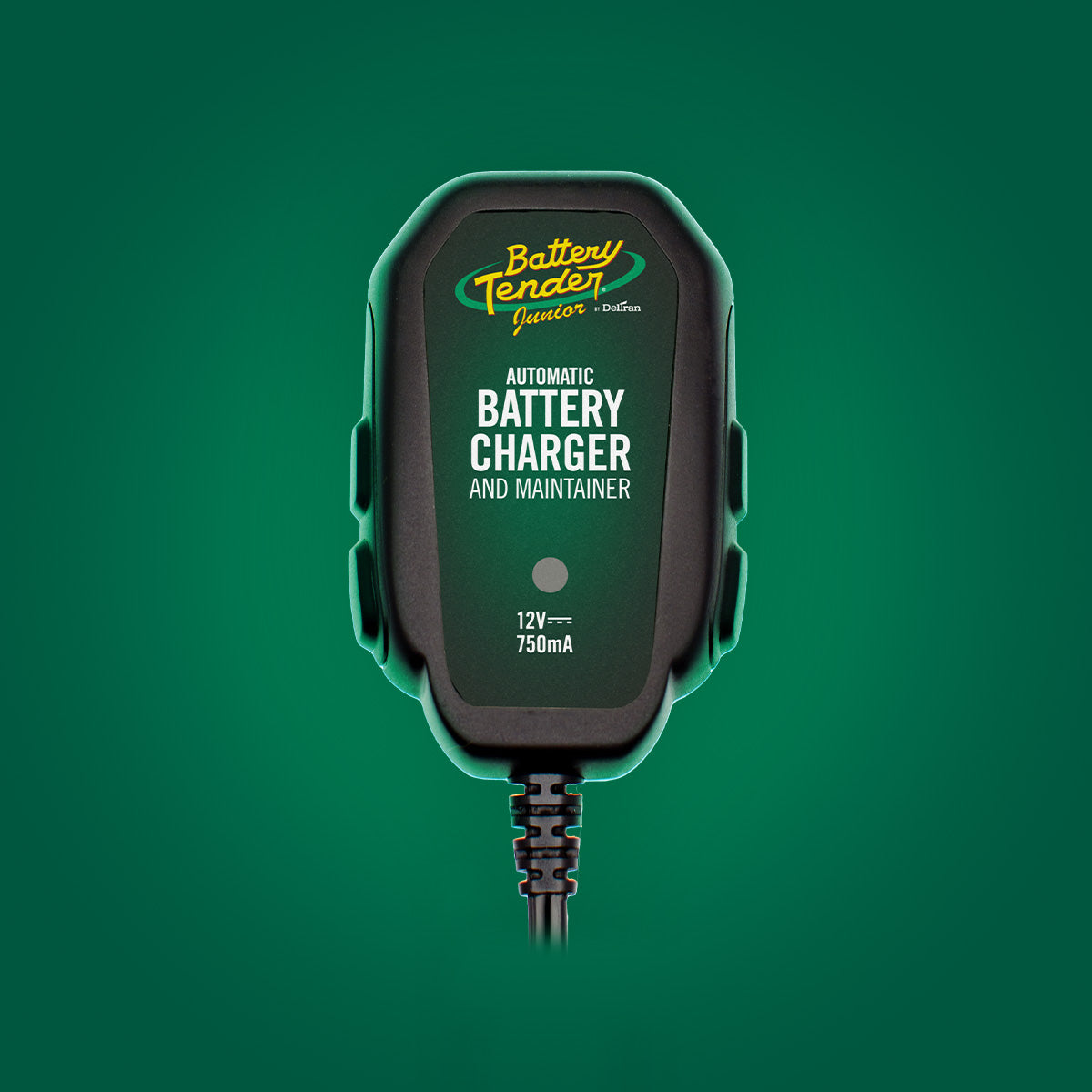
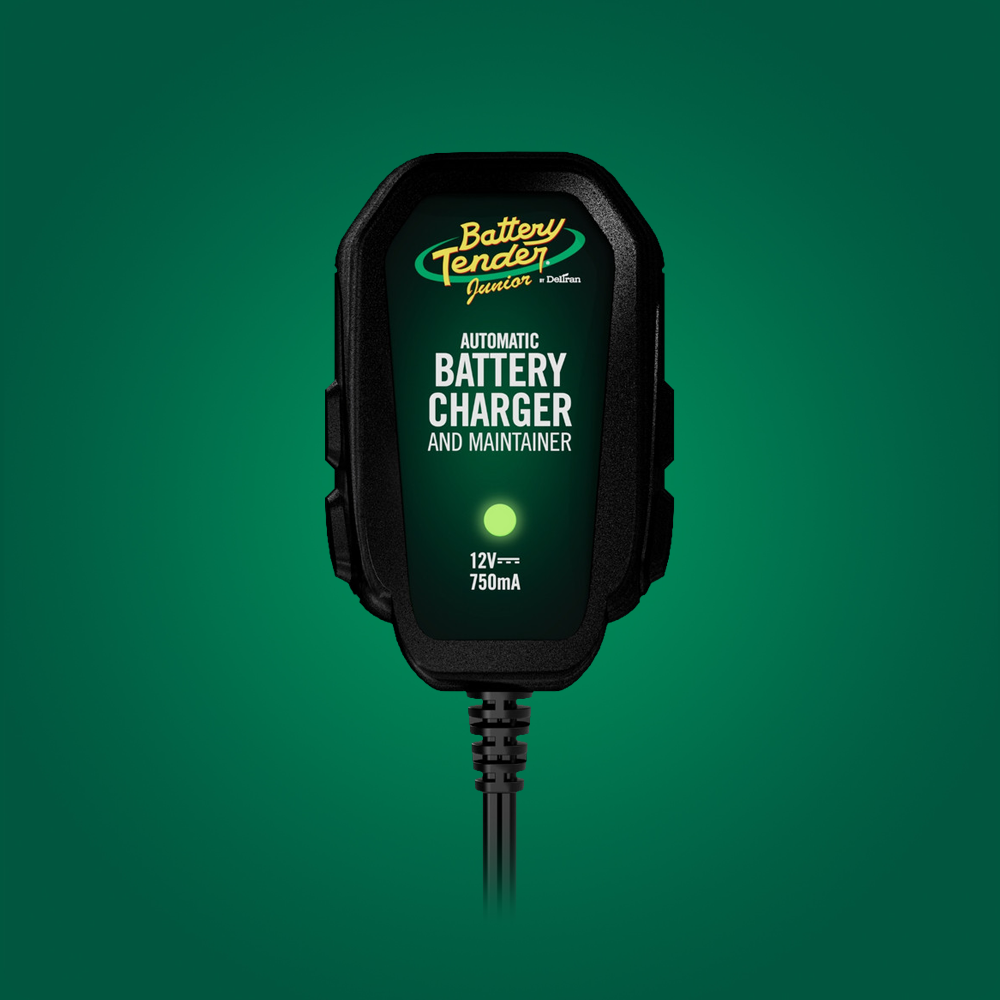
Lithium batteries have moved from niche to mainstream in the RV market. At $800–$1,200 per 100 Ah unit, the upfront cost is higher, but lithium delivers 2,000–5,000 cycles at 80% DOD, weighs 60% less than equivalent lead-acid, and provides flat voltage output until nearly depleted. Battery Tender chargers with selectable chemistry — including the Battery Tender Junior 1A Selectable — support lithium charging profiles to match manufacturer specifications.
How ISM Charging Protects Your RV Battery Bank
ISM charging protects an RV battery bank through four automatic stages that respond to real-time battery condition. Unlike float chargers that apply constant voltage or trickle chargers that deliver constant current regardless of state, ISM adjusts output dynamically — making it safe for indefinite connection during storage or between trips.
During Initialization, the charger tests battery condition and applies gentle current. Bulk Charge delivers full rated amperage until the bank reaches approximately 80% state of charge. Absorption holds voltage constant while tapering current, which dissolves sulfate crystals that form on lead plates during discharge — the primary cause of premature battery failure. Finally, Maintenance delivers demand-responsive charge pulses only when voltage drops below a set threshold, preventing both undercharging and overcharging.
For banks in the 100–200 Ah range, the Battery Tender Plus 12V 1.25A provides reliable maintenance charging that fully recovers a moderately discharged bank overnight. Using the charging time formula — (200 Ah × 0.5 discharge) ÷ 1.25 amps = 80 hours for a full deep recovery — the Plus charger works best for top-off maintenance rather than deep-cycle recovery on larger banks.
Battery Tender Plus 12V 1.25A Charger — $64.95
Matching Charger Amperage to RV Battery Bank Size
Charger amperage should match bank capacity to ensure full recovery within a reasonable timeframe. The general guideline: a charger should deliver at least 10% of the bank's amp-hour rating for efficient charging. A 200 Ah bank benefits from a charger delivering at least 2 amps; a 400 Ah bank needs 4–8 amps for practical between-trip recovery.
For RV owners with banks between 100 Ah and 200 Ah, the Battery Tender 8A/2A Power Tender (SKU 022-1005-DL-WH) offers the flexibility of selectable charge rates. At 8 amps, a 200 Ah bank discharged to 50% recovers in approximately 12.5 hours: (200 Ah × 0.5) ÷ 8A = 12.5 hours. At 2 amps, the same charger provides gentle maintenance for smaller batteries or topped-off banks. The unit also includes a 6-amp power supply mode for diagnostic and service work — particularly useful for RV technicians troubleshooting 12V systems.
Battery Tender 8A/2A Power Tender (SKU 022-1005-DL-WH) — $109.95
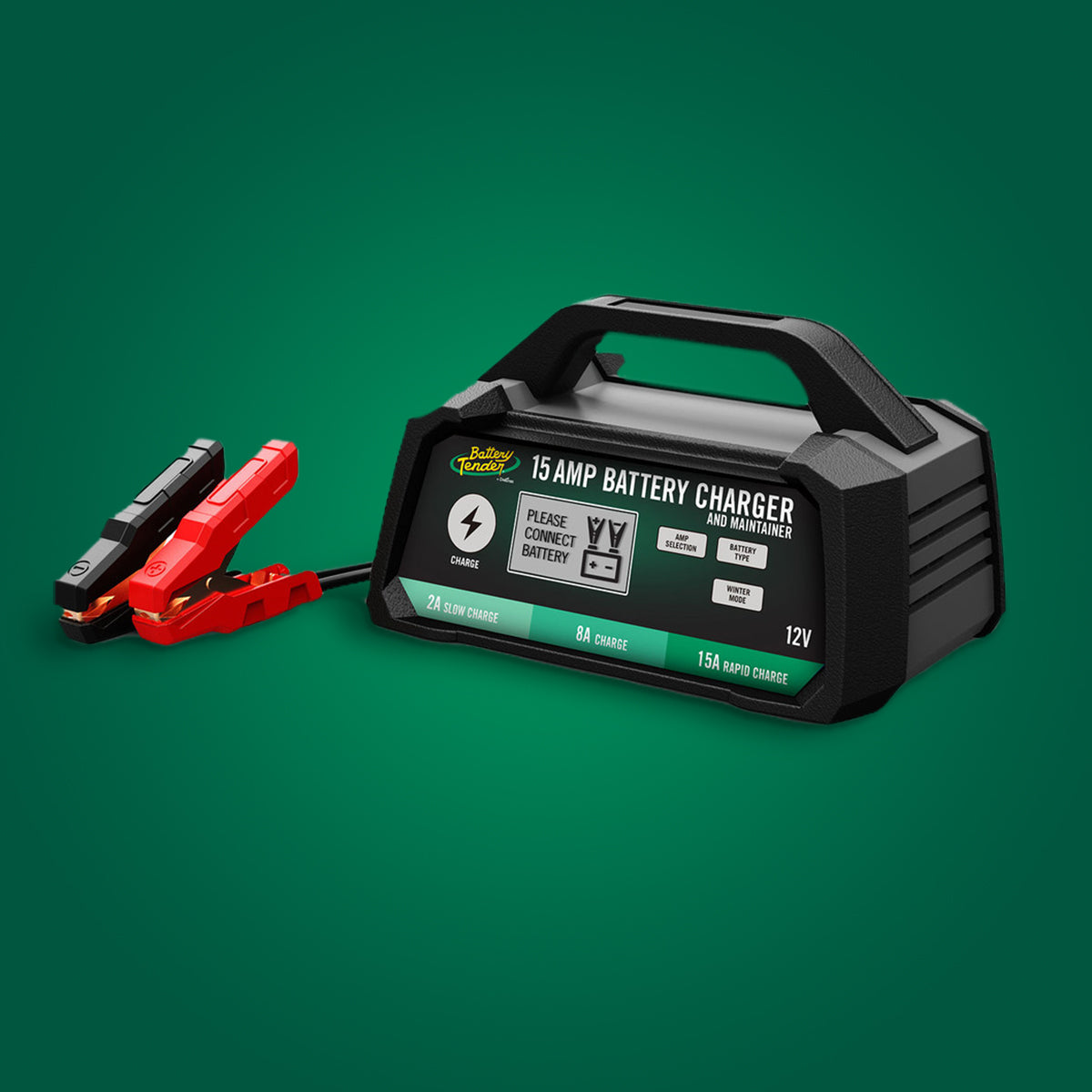
For large motorhome banks exceeding 200 Ah — common in Class A rigs with four or more batteries — the Battery Tender 15A/8A/2A Power Tender delivers the highest single-output charge rate in the Battery Tender lineup. At 15 amps, a 400 Ah bank at 50% DOD recovers in approximately 13.3 hours: (400 Ah × 0.5) ÷ 15A = 13.3 hours. The triple-selectable amperage and LCD display provide precise control and real-time charging status, and temperature compensation adjusts voltage output automatically based on ambient conditions.
Battery Tender 15A/8A/2A Power Tender — $149.95
RV Battery Bank Maintenance Between Trips
The weeks between camping trips are when most RV battery bank damage occurs. A fully charged lead-acid battery self-discharges at approximately 3–5% per month at 77°F (25°C). Over a two-month gap between trips, a 200 Ah bank can lose 12–20 Ah — enough to trigger sulfation on the lead plates. Sulfation hardens over time, permanently reducing capacity if not reversed during the absorption stage of a smart charging cycle.
Connecting a Battery Tender charger to the house bank between trips eliminates self-discharge losses entirely. The ISM maintenance stage monitors voltage continuously and delivers charge pulses only when the bank drops below optimal levels. This is fundamentally different from a trickle charger, which applies constant current regardless of battery state and risks boiling electrolyte in flooded batteries or swelling sealed AGM cells.
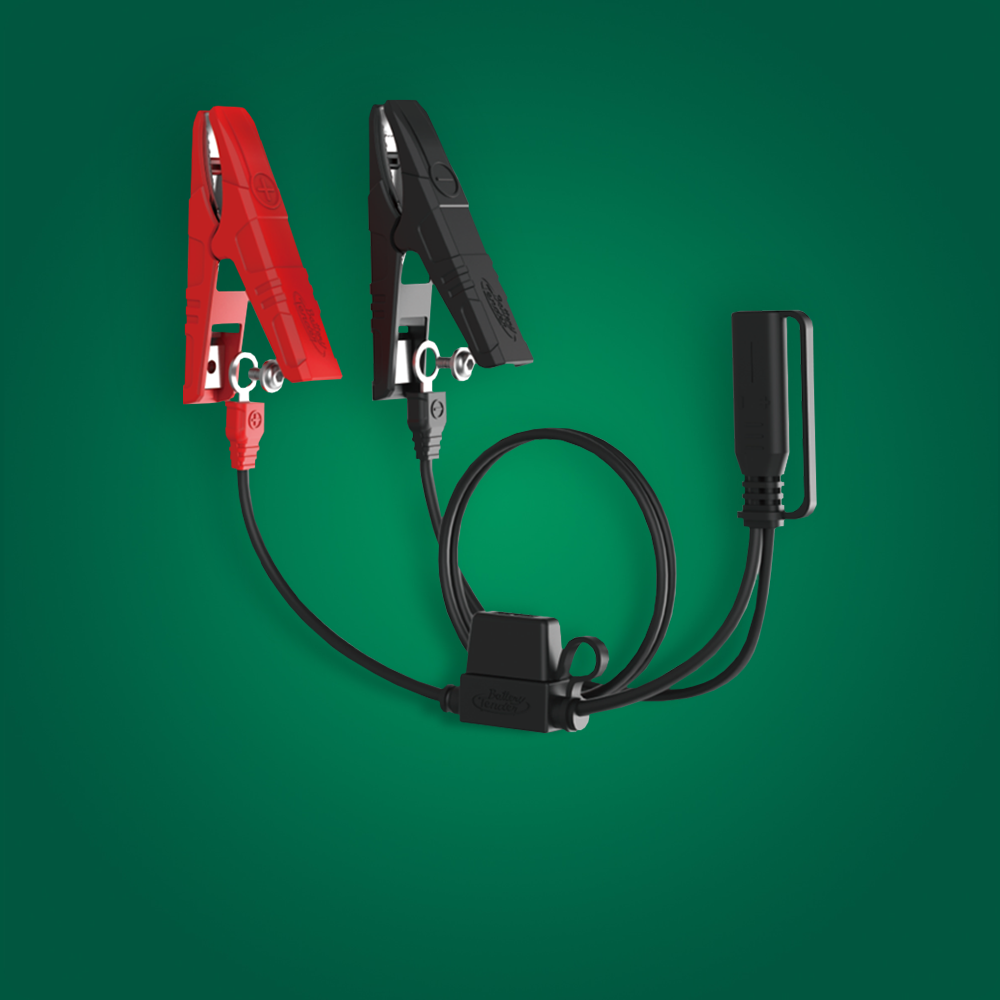
Practical maintenance steps for between-trip care include: inspecting terminal connections for corrosion, verifying electrolyte levels in flooded batteries, cleaning battery tops to prevent parasitic discharge through surface grime, and ensuring the disconnect switch isolates house batteries from parasitic draws. A Battery Tender charger connected to the bank via permanent ring terminal harness simplifies the process — plug in upon return, unplug before departure.
Emergency Starting Power for RV Chassis Batteries
While the house battery bank powers living systems, the chassis starting battery is equally critical — and equally vulnerable to discharge during storage. Many RV owners focus exclusively on house batteries and discover a dead starting battery when it matters most. The Battery Tender Charge N Start 4120 addresses both concerns in a single device: a 4-amp ISM charger maintains the chassis battery between trips, while a built-in 1,200-amp lithium-ion jump starter handles emergency starts for engines up to 6.0L gas or 4.0L diesel.
The Charge N Start 4120 internal battery uses proprietary Charge N Store technology to maintain its own lithium-ion jump-start pack at full readiness. SafeGuard circuitry prevents backfeed that could damage vehicle electronics during the jump-start process. At $179.95, the unit serves as both a permanent charger and a portable emergency tool.
Battery Tender Charge N Start 4120 — 4A Charger + 1,200A Jump Starter — $179.95
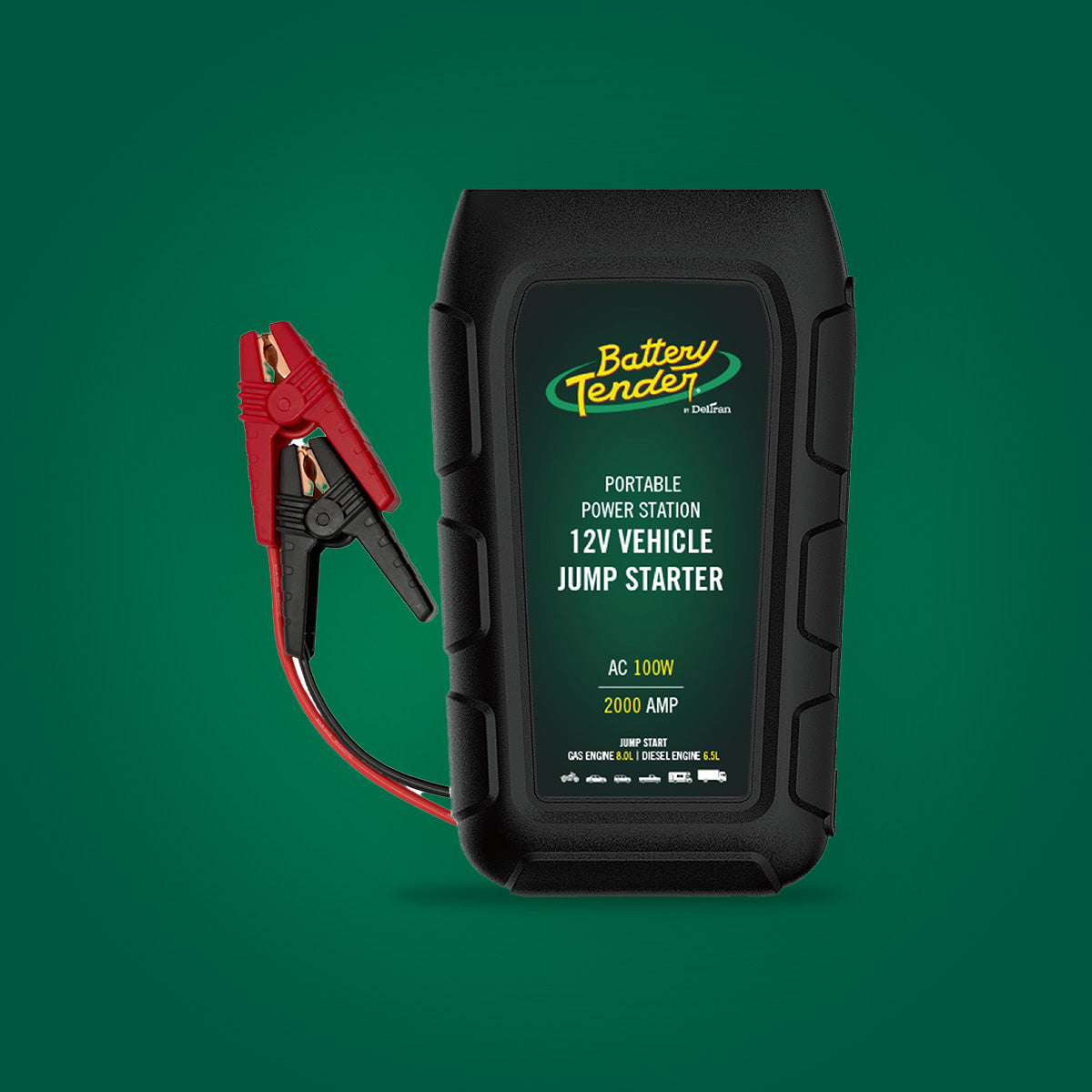
For owners who prefer a dedicated portable jump starter, the Battery