

Motorcycle Battery Maintainer Guide: Year-Round Care (2026)
A motorcycle battery maintainer is a smart charging device that monitors battery voltage and delivers precise charge pulses to keep a motorcycle battery at full capacity without overcharging. Battery Tender® pioneered this category in 1989 with Infinite Sequential Monitoring (ISM) technology — a proprietary 4-stage process that automatically transitions between initialization, bulk charging, absorption, and maintenance to keep batteries healthy during weeks or months of inactivity. Unlike trickle chargers that push constant current regardless of battery state, a true motorcycle battery maintainer adjusts output in real time, making indefinite connection both safe and beneficial.
Most riders understand that winter storage kills batteries. But what many overlook is that battery degradation happens year-round — during weekday commute gaps, vacation absences, or even multi-day rain stretches when the bike stays parked. A typical motorcycle battery rated at 12–20 Ah can lose 1–3% of its charge per day through natural self-discharge and parasitic draw from clocks, alarms, and ECU memory. This article explains the science behind continuous maintenance charging, walks through how ISM technology differs from older charging methods, and identifies which Battery Tender motorcycle battery maintainer matches specific riding patterns and battery chemistries.
Why Every Motorcycle Needs a Battery Maintainer — Not Just Seasonal Riders
The conventional wisdom says a motorcycle battery maintainer is only necessary during winter storage. That assumption costs riders hundreds of dollars in premature battery replacements. Lead-acid and AGM motorcycle batteries begin sulfating — forming hardened lead sulfate crystals on internal plates — within 72 hours of falling below full charge. According to research published by the IEEE, sulfation accounts for approximately 80% of lead-acid battery failures. A battery that sits at 12.4V instead of a full 12.8V is already partially sulfated.
Daily riders are not immune. A motorcycle parked Monday through Friday while the owner commutes by car can lose enough voltage by Saturday morning to crank slowly. Parasitic drain from factory-installed immobilizers, GPS trackers, and Bluetooth modules draws 5–30 mA continuously. On a 14 Ah sportbike battery, a 20 mA parasitic load consumes roughly 2.4 Ah over five days — about 17% of total capacity. A motorcycle battery maintainer connected in the garage between rides prevents this incremental damage entirely.
Riders who store bikes seasonally face an even steeper penalty. A motorcycle parked from November through April — roughly 150 days — without a maintainer will almost certainly require a new battery by spring. The math is straightforward: even at a conservative 1% daily self-discharge, a 14 Ah battery loses its entire usable capacity in under three months. Deep discharge below 10.5V causes irreversible plate damage that no charger can reverse.
How ISM Technology Makes a Motorcycle Battery Maintainer Safe for Indefinite Connection
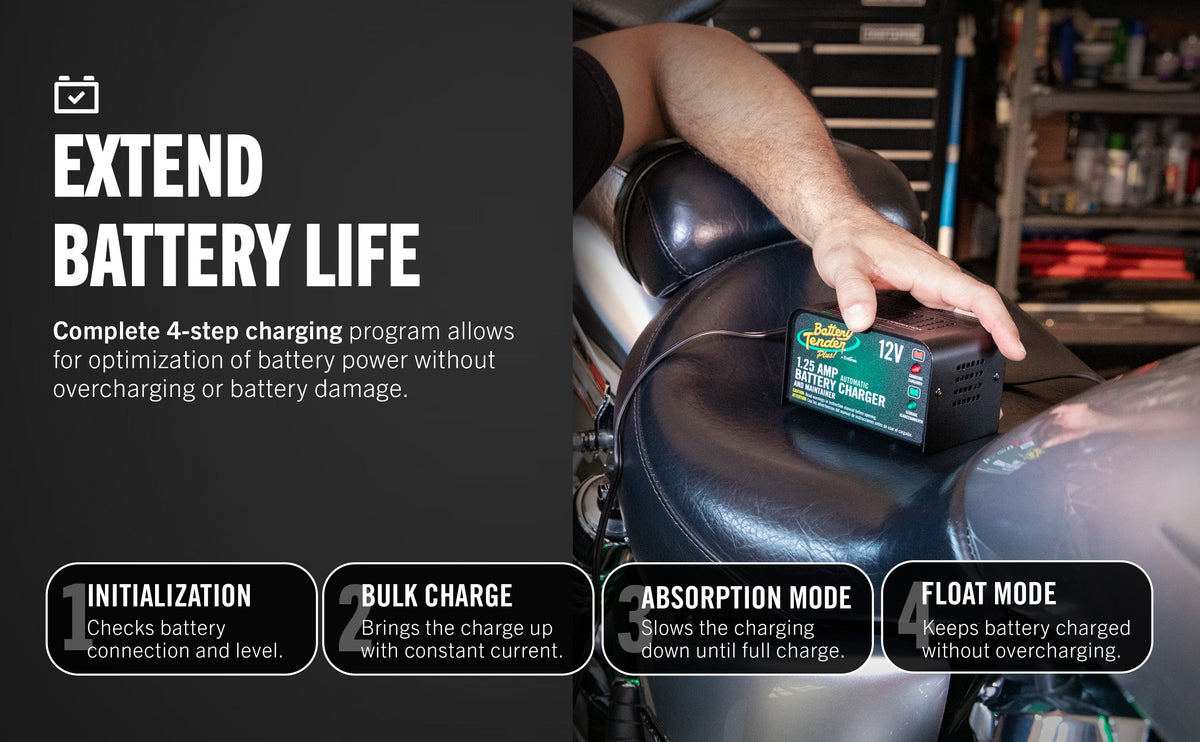
ISM technology is what separates a modern smart motorcycle battery maintainer from outdated trickle chargers. The ISM process operates in four automatic stages that require zero rider intervention once connected.
Stage 1 — Initialization: The charger tests the battery with a gentle current to assess condition and confirm the battery can accept a charge. If the battery is too deeply discharged or shorted, the charger will not proceed — preventing potential safety hazards. Stage 2 — Bulk Charge: Full rated current flows until the battery reaches approximately 80% state of charge. For a 750 mA maintainer on a 14 Ah battery at 50% depth of discharge, this stage takes roughly (14 × 0.5) ÷ 0.75 = 9.3 hours. Stage 3 — Absorption: Voltage holds constant while current tapers gradually. This stage dissolves soft sulfate crystals that formed during discharge, restoring plate surface area. Stage 4 — Maintenance: The charger delivers demand-responsive pulses only when voltage drops below a set threshold. Current consumption drops to near zero between pulses, eliminating overcharge risk entirely.
This 4-stage ISM cycle repeats automatically and indefinitely. A trickle charger, by contrast, delivers constant current regardless of battery state — cooking electrolyte, accelerating grid corrosion, and shortening battery life. A float charger holds constant voltage but lacks the absorption stage, meaning it charges more slowly and cannot effectively reverse sulfation. ISM combines the best attributes of both methods while eliminating the drawbacks of each.
Choosing the Right Motorcycle Battery Maintainer by Battery Size and Chemistry
Matching charger output to battery capacity is critical. An undersized charger takes excessively long to recover a depleted battery. An oversized charger — while less of a concern with ISM technology — still represents unnecessary expense. The general guideline: select a charger rated at 5–15% of battery Ah capacity.
For riders running lithium (LiFePO4) batteries, chemistry selection matters. Lithium motorcycle batteries require a specific charge profile with a lower absorption voltage (typically 14.4V versus 14.6–14.8V for lead-acid). Connecting a lead-acid-only charger to a lithium battery can trigger the battery management system (BMS) to shut down — or worse, cause cell damage. The Battery Tender Junior 1A Selectable handles both chemistries with a single switch.
The Battery Tender Junior 1A Selectable delivers 1 amp of output and supports both standard lead-acid/AGM and lithium LiFePO4 batteries. At 1A, it recovers a fully depleted 14 Ah motorcycle battery in approximately 14 hours — practical for overnight garage charging. The selectable chemistry switch makes this the most versatile option for riders who own multiple bikes or plan to upgrade to lithium.
Battery Tender Junior 1A Selectable — $52.95
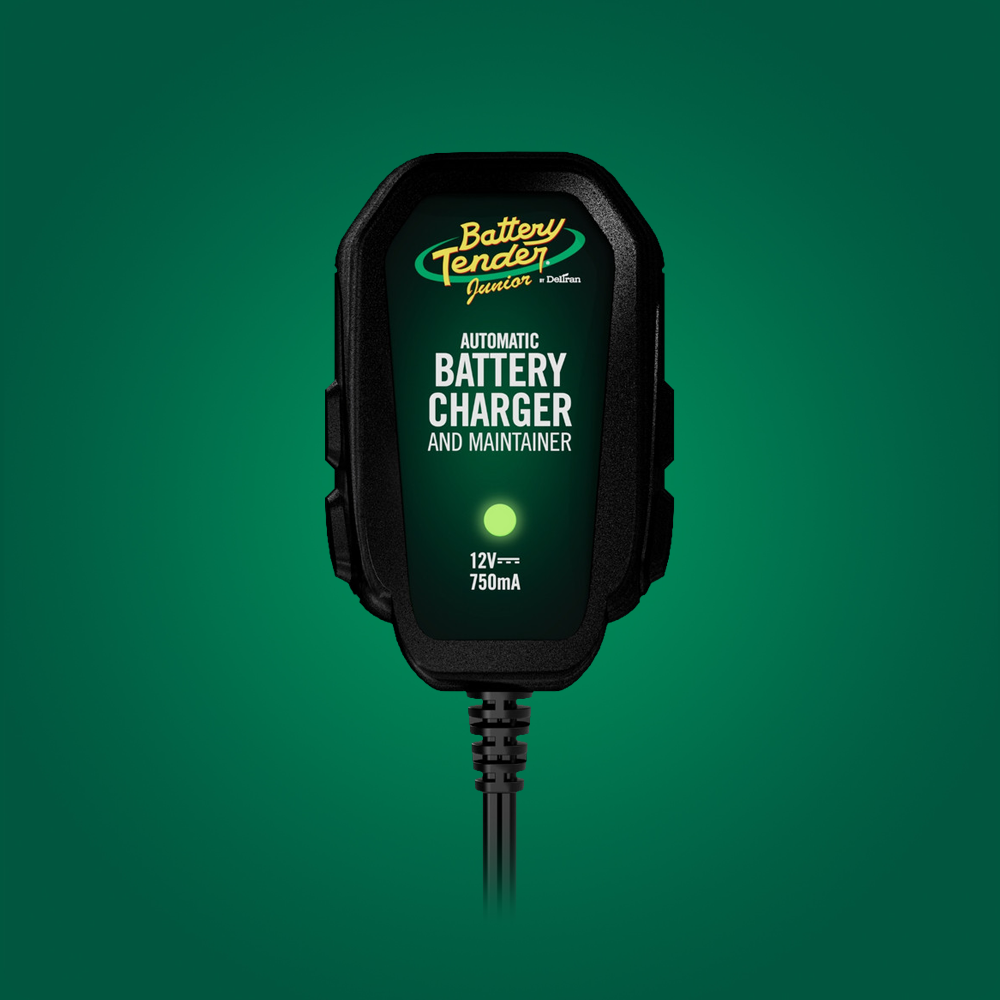
For riders with standard lead-acid or AGM batteries in the 2–30 Ah range who do not need lithium compatibility, the Battery Tender Junior 750mA provides reliable ISM maintenance at a lower price point. At 750 mA, it fully recovers a 14 Ah battery from 50% discharge in roughly (14 × 0.5) ÷ 0.75 = 9.3 hours. The compact design fits easily on garage shelves or inside saddlebags for travel.
Battery Tender Junior 750mA — $44.95
When a Motorcycle Battery Maintainer Alone Is Not Enough
A maintainer prevents problems — but it cannot always solve them. Batteries that have sat fully discharged for weeks may be too far gone for a standard 750 mA or 1A unit to recover efficiently. Touring motorcycles with dual batteries, heated gear circuits, or high-draw audio systems may benefit from a faster recovery charger. And every rider, regardless of maintenance habits, can encounter a dead battery in the field where no outlet is available.
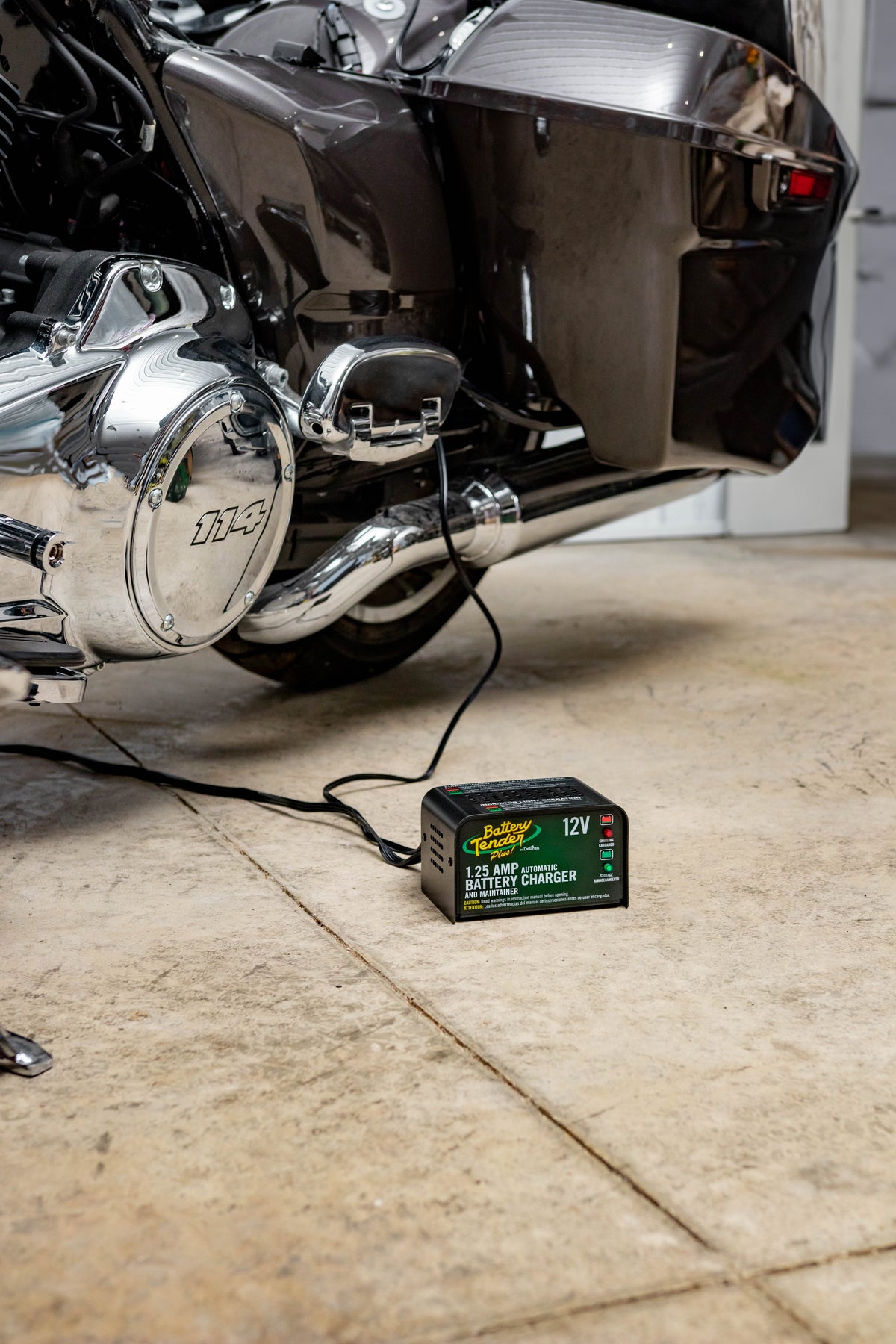
The Battery Tender Plus 1.25A offers 67% more charging current than the Battery Tender Junior 750mA, reducing recovery time significantly. For a 20 Ah touring bike battery at 50% discharge, the Battery Tender Plus completes bulk charging in approximately (20 × 0.5) ÷ 1.25 = 8 hours versus 13.3 hours with the Battery Tender Junior. The Battery Tender Plus also includes temperature compensation — automatically adjusting charge voltage based on ambient temperature — which is essential for unheated garages where winter temperatures fluctuate, making it the superior choice for cold-climate storage.
Battery Tender Plus 12V 1.25A — $64.95
For field emergencies, the Battery Tender Charge N Start 1100 combines a 1A ISM charger with a 1,000-amp lithium-ion jump starter in a single portable unit. The internal lithium-ion battery can jump-start engines up to 5.0L gas or 3.0L diesel — more than sufficient for any motorcycle. The 1A charger section charges all 12V battery types including standard, AGM, GEL, and lithium. Proprietary Charge N Store technology maintains the internal jump-start pack at full readiness, while SafeGuard circuitry prevents backfeed that could damage vehicle electronics.
Battery Tender Charge N Start 1100 — $139.95
How to Install a Motorcycle Battery Maintainer for Permanent Quick-Connect Use
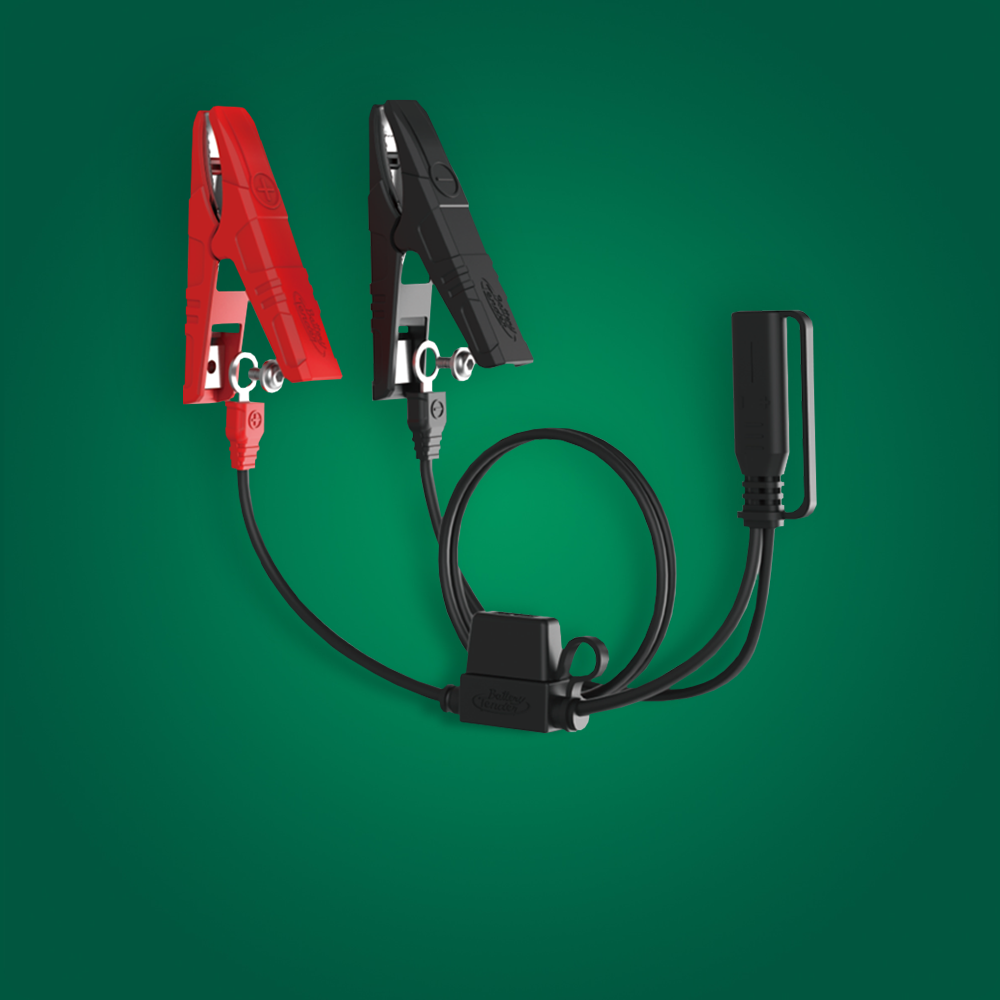
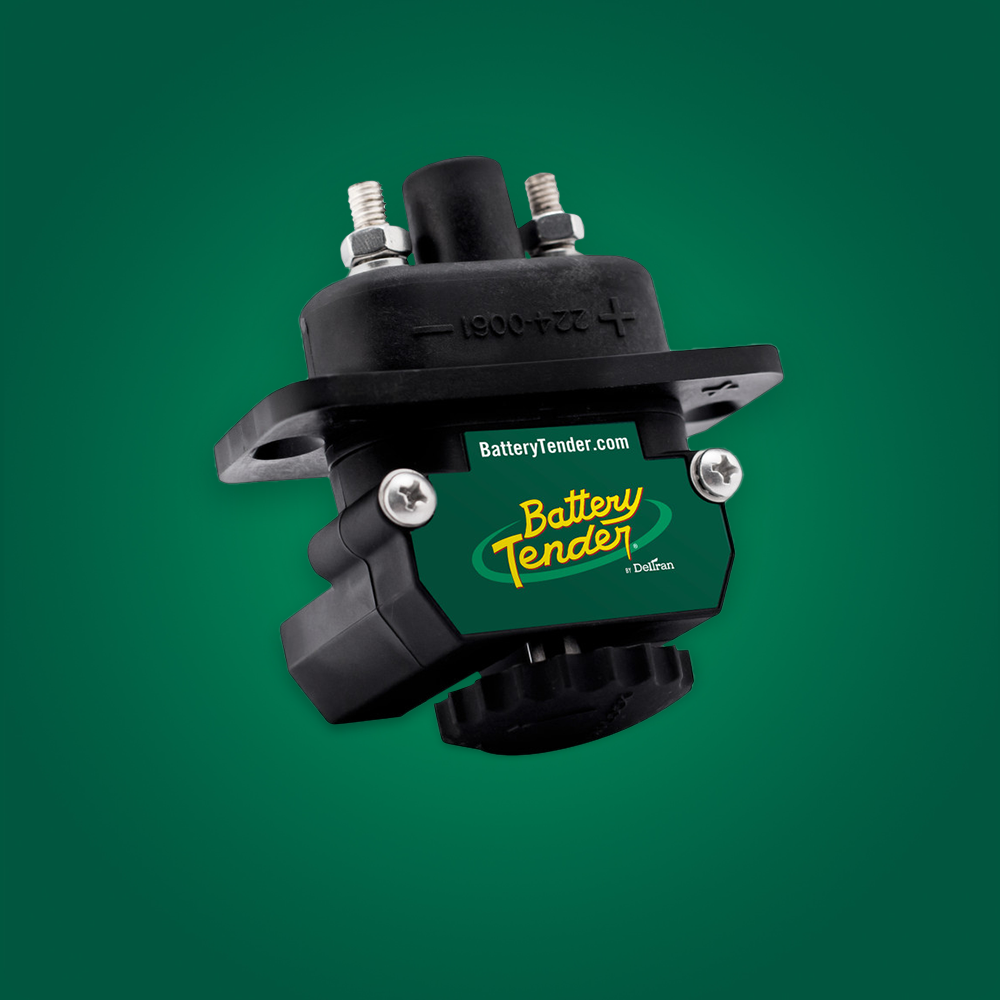
The most effective maintenance setup eliminates the hassle of removing panels or disconnecting terminals every time the bike is parked. A permanent ring terminal harness, included with every Battery Tender charger, bolts directly to the motorcycle battery posts and routes a quick-disconnect SAE plug to an accessible location on the frame.
Step 1: Mount the Ring Terminals
Disconnect the negative battery cable first (standard safety practice per SAE J1211). Attach the red ring terminal to the positive (+) post and the black ring terminal to the negative (−) post. Torque to manufacturer specifications — typically 50–70 in-lbs for M6 motorcycle battery bolts.
Step 2: Route the Quick-Disconnect Cable
Route the SAE connector away from exhaust pipes, drive chains, and moving components. Many riders tuck the plug under the seat or route it through the frame to a discreet exit point near the tail section. Use zip ties to secure excess cable length — never allow slack to contact hot engine parts.
Step 3: Connect and Forget
Plug the Battery Tender charger output into the SAE connector. The ISM process begins automatically — no buttons to press, no settings to adjust. The charger LED indicator shows charge status: red during bulk/absorption stages, green when maintenance mode is active. Reconnect the negative battery cable if it was fully removed.
Common Motorcycle Battery Maintainer Mistakes That Shorten Battery Life
Mistake 1: Waiting until spring to connect. By the time a rider realizes the battery is dead in March, sulfation has been hardening for months. Connect the motorcycle battery maintainer the same day the bike goes into storage — not weeks later.
Mistake 2: Using an automotive charger on a motorcycle battery. A 10A automotive charger can overheat a 12 Ah motorcycle battery, boiling electrolyte and warping internal plates. The SAE International standard J537 recommends charge rates not exceeding 25% of battery Ah capacity for maintenance purposes. For a 12 Ah battery, that ceiling is 3A — well within Battery Tender Junior and Plus output ranges.
Mistake 3: Confusing a trickle charger with a maintainer. A trickle charger delivers constant current with no automatic shutoff or voltage monitoring. Left connected for weeks, it will overcharge the battery, evaporate electrolyte in flooded cells, and cause thermal runaway risk in sealed AGM units. ISM-equipped Battery Tender chargers are designed for indefinite connection because Stage 4 maintenance only delivers current on demand.
Mistake 4: Using a lead-acid charger on a lithium battery. LiFePO4 motorcycle batteries require different charge termination voltage. Always use a selectable-chemistry unit like the Battery Tender Junior 1A Selectable when charging lithium batteries. Using the wrong profile risks BMS lockout or permanent cell damage.
Frequently Asked Questions
Can a motorcycle battery maintainer overcharge the battery if left connected for months?
No, Battery Tender chargers with ISM technology cannot overcharge when left connected indefinitely. The 4-stage ISM process transitions to maintenance mode after reaching full charge, delivering current only when voltage drops below a set threshold. This demand-responsive design means near-zero current flows between pulses, making months-long connection safe for all supported battery types.
What size motorcycle battery maintainer do I need for a sportbike versus a touring motorcycle?
Most sportbikes use 7–14 Ah batteries, making the Battery Tender Junior 750mA or Battery Tender Junior 1A Selectable ideal. Touring motorcycles with 18–30 Ah batteries benefit from the Battery Tender Plus 1.25A, which provides faster recovery and includes temperature compensation for unheated garages. Match charger output to 5–15% of battery Ah capacity for optimal results.
Can I use the same motorcycle battery maintainer on my lithium LiFePO4 battery?
Only if the maintainer supports lithium chemistry. The Battery Tender Junior 1A Selectable includes a lead-acid/lithium switch that adjusts charge voltage to the correct LiFePO4 profile. The standard Battery Tender Junior 750mA is designed for lead-acid and AGM batteries only. Always verify chemistry compatibility before connecting any charger to a lithium motorcycle battery.
Should I disconnect the motorcycle battery before connecting a maintainer?
Disconnecting is not required with Battery Tender chargers but offers advantages. Leaving the battery connected to the motorcycle allows parasitic loads (clock, alarm, ECU memory) to continue drawing power, which the maintainer compensates for automatically. Disconnecting eliminates parasitic drain entirely, reducing charger workload. Either approach is safe with ISM-equipped chargers.
Conclusion
A motorcycle battery maintainer is not a seasonal accessory — it is year-round insurance against the sulfation, self-discharge, and parasitic drain that silently destroy motorcycle batteries between rides. Whether the bike sits for five days or five months, ISM technology from Battery Tender keeps the battery at full readiness with zero risk of overcharge. The Battery Tender Junior 1A Selectable covers both lead-acid and lithium chemistries, and the Battery Tender Junior 750mA provides proven reliability for traditional batteries. The Battery Tender Plus 1.25A delivers faster recovery with temperature compensation for cold garages, and the Battery Tender Charge N Start 1100 adds roadside jump-start capability for complete coverage.
Explore the full lineup of motorcycle battery maintainers and chargers at the Battery Tender Powersports page.