



Yes, a solar panel can keep a car battery charged — but only when paired with an intelligent charge controller that prevents overcharging. A raw solar panel connected directly to a 12V battery will continue pushing voltage after the battery reaches full charge, generating excess heat and potentially boiling electrolytes. Battery Tender® solar chargers solve this problem by integrating smart charging logic that monitors battery voltage, delivers current only when needed, and stops automatically when the battery is full. For vehicles parked in driveways, stored in open lots, or kept at remote properties with no electrical outlet, a solar maintainer is the most practical way to prevent the slow parasitic drain that kills batteries during weeks or months of inactivity.
Modern vehicles draw 25–75 milliamps continuously from the battery — even when parked and locked — to power alarm systems, keyless entry modules, onboard computers, and clock circuits. A fully charged 12V car battery holding roughly 48 amp-hours can be drawn down to a dangerously low state of charge within 30–60 days of sitting idle. A properly sized solar maintainer replaces that parasitic draw with free energy from sunlight, keeping voltage above the critical 12.4V threshold where sulfation damage begins. This guide explains exactly how a solar panel keeps a car battery charged, how to size the panel correctly, and which Battery Tender solar products deliver the best results for different storage scenarios.
Key Takeaways:
- A solar panel can keep a car battery charged during long-term storage — but it must include a charge controller to prevent overcharging.
- Parasitic drain from modern vehicle electronics can flatten a battery in 30–60 days without supplemental charging.
- Battery Tender solar maintainers use 3-step intelligent charging to safely maintain 12V batteries indefinitely.
- Panel wattage should be matched to battery size and average sunlight hours — 5W to 17W covers most passenger vehicles.
- Solar maintainers work with lead-acid, AGM, GEL, and lithium 12V batteries.
Why Does a Car Battery Die During Storage?
Every modern vehicle contains electronic modules that draw power continuously, even with the ignition off and all doors closed. The body control module, anti-theft system, tire pressure monitoring system, and key fob receiver all require standby current. Typical parasitic draw for a modern passenger vehicle ranges from 25 to 75 milliamps. Some luxury vehicles with advanced infotainment and telematics systems can draw 85 milliamps or more.
At 50 milliamps of continuous drain, a typical 48Ah car battery loses approximately 1.2 amp-hours per day — or 36 amp-hours over 30 days. That represents a 75% depth of discharge, which pushes a standard lead-acid battery well below the 12.4V threshold where lead sulfate crystals begin hardening on the plates. This sulfation process is the single largest cause of premature battery failure, and it accelerates dramatically once voltage drops below 12.2V. A battery that sat at 12.0V for 90 days may never recover full capacity, even after recharging.
Traditional solutions — disconnecting the battery or using an AC-powered charger — each have significant drawbacks. Disconnecting the battery resets stored radio presets, seat memory positions, adaptive transmission settings, and may trigger anti-theft lockouts on some vehicles. An AC-powered smart charger requires proximity to an electrical outlet, which eliminates airport parking lots, rural storage properties, boat ramps, and outdoor driveways. A solar panel paired with intelligent charging logic eliminates both problems entirely.
How Does a Solar Panel Keep a Car Battery Charged?
A solar panel keeps a car battery charged by converting sunlight into DC electrical current that flows into the battery, replacing the energy lost to parasitic drain. Photovoltaic cells in the panel generate voltage whenever exposed to light — even on overcast days — though output is proportional to solar intensity. A 5W panel in direct sunlight produces approximately 300 milliamps at 17V open-circuit voltage, which a charge controller steps down to the appropriate charging voltage for a 12V battery system.
The charge controller is the critical component that separates a safe solar maintainer from a raw panel that can damage batteries. Without a controller, a solar panel will continue forcing current into a fully charged battery, raising terminal voltage above 14.8V and causing electrolyte gassing in flooded batteries or thermal runaway risk in sealed AGM and lithium batteries. Battery Tender solar maintainers include integrated charge control circuitry that monitors battery voltage continuously, transitions between charging stages automatically, and disconnects charging current when the battery reaches full charge.
Battery Tender solar products use a 3-step charging process: bulk charge delivers maximum available solar current until the battery approaches approximately 80% state of charge, absorption holds voltage constant while tapering current to dissolve surface sulfation, and float maintenance delivers only enough current to offset parasitic drain. This intelligent process mirrors the proven Infinite Sequential Monitoring (ISM) technology found in Battery Tender plug-in chargers — adapted specifically for solar input variability.
How to Size a Solar Panel to Keep a Car Battery Charged
Sizing a solar maintainer correctly requires matching panel wattage to the vehicle parasitic draw and available sunlight hours. The formula is straightforward: daily energy needed (watt-hours) ÷ average peak sun hours = minimum panel wattage. For a vehicle drawing 50 milliamps at an average system resting voltage of 12.6V, the daily energy consumption is 0.05A × 12.6V × 24 hours = 15.12 watt-hours (or 1.2 Ah/day). Accounting for a nominal 13.8V charging voltage requirement, the charger must generate at least 16.56 watt-hours per day.
However, real-world conditions reduce effective solar output by 20–30% due to panel angle, cloud cover, dust accumulation, and seasonal variation. While a 5W panel theoretically covers a 25–35 mA draw in ideal sunlight, real-world factors like atmospheric haze, seasonal sun angles, and glass attenuation mean a 10W to 17W panel is required to reliably maintain a modern passenger vehicle without falling into a net deficit.
The Battery Tender 5W Solar Panel produces enough current to maintain batteries on motorcycles, ATVs, and standard passenger vehicles with typical parasitic loads. For vehicles stored in partially shaded locations, or for dual-battery trucks and larger battery banks, the Battery Tender 17W Mountable Solar Panel with Controller (SKU: 021-1173) delivers significantly higher output — approximately 1 amp in full sun — with a built-in charge controller that prevents overcharging on lead-acid, AGM, GEL, and lithium 12V batteries.
For more details on the 5W Solar Panel, visit the product page:
Battery Tender 5W Solar 12V Battery Charger
Which Solar Panel Keeps a Car Battery Charged Best? Comparing Wattage Options
Battery Tender offers a complete range of solar maintainers designed for different vehicle sizes and storage conditions. Choosing the right wattage depends on battery capacity, parasitic draw, geographic location, and whether the panel will be permanently mounted or used as a portable solution.
| Panel | Output | Best For | Controller |
|---|---|---|---|
| Battery Tender 5W | ~300mA | Cars, motorcycles, ATVs | Integrated |
| Battery Tender 17W Mountable | ~1A | Trucks, RVs, boats, dual batteries | Built-in |
| Battery Tender 35W Mountable | ~2A | Large battery banks, partial shade | External (sold separately) |
The Battery Tender 17W Mountable Solar Panel with Controller is the most versatile option for keeping a car battery charged in long-term outdoor storage. Its waterproof construction withstands rain, snow, and UV exposure, and the built-in charge controller eliminates the need to purchase a separate unit. The panel mounts permanently to a vehicle roof, trailer, or storage structure and connects directly to the battery through the included ring terminal harness.
Explore the complete range of Battery Tender solar charging solutions:
Battery Tender 17W Mountable Solar 12V Battery Charger with Controller
Step-by-Step: How to Install a Solar Panel to Keep a Car Battery Charged
Installing a Battery Tender solar maintainer takes less than 10 minutes and requires no tools beyond the included hardware. Follow these steps for a safe, effective installation:
- Choose a mounting location. Place the panel on the vehicle roof or an external surface with direct sunlight. If placed behind a windshield, you would need to account for a 15% to 30% loss in power output caused by automotive glass and solar tinting. Avoid locations shaded by trees, buildings, or adjacent vehicles during peak sun hours (10 AM – 2 PM).
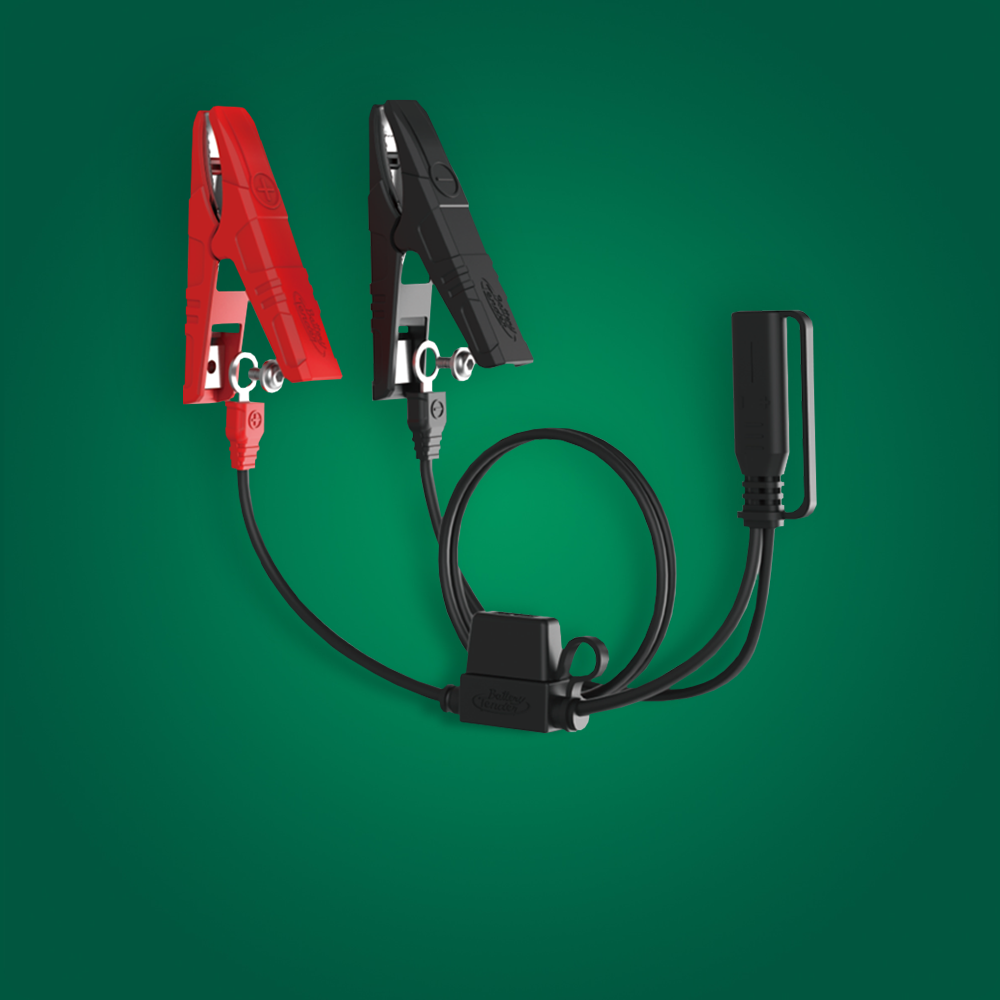
- Connect the ring terminal harness. Attach the included ring terminals to the battery posts — red to positive (+), black to negative (−). Route the cable through the engine bay to the panel location, keeping it away from moving parts and exhaust components.
- Plug the panel into the harness. Battery Tender solar panels use SAE-style quick-disconnect connectors that snap together securely and disconnect instantly when the vehicle needs to be moved.
- Verify charging status. The indicator LED on the charge controller will illuminate to confirm current is flowing to the battery. Green indicates maintenance mode (battery is full); amber indicates active charging.
- Walk away. The built-in charge controller manages all voltage regulation automatically. No monitoring, no timer, no risk of overcharging. The panel can remain connected indefinitely when wired directly to the battery terminals.
NOTE: If connecting via an OBD-II adapter, ensure the vehicle's gateway module is not kept awake by external voltage sensing, which can elevate parasitic draw to over 150 mA.
For vehicles stored indoors or in garages with skylights, a longer extension cable allows the panel to be placed outside while the vehicle remains sheltered. The cable routing through a window gap or garage door seal requires minimal clearance.
Solar Panel vs. Plug-In Charger: When to Use Each
Solar maintainers and plug-in smart chargers serve complementary roles in battery care. A solar panel is the superior choice when no AC outlet is available — outdoor storage lots, remote cabins, farm equipment parked in fields, boats on trailers, and airport long-term parking. Solar panels also excel for indefinite seasonal storage where the vehicle may sit for 3–6 months between uses.
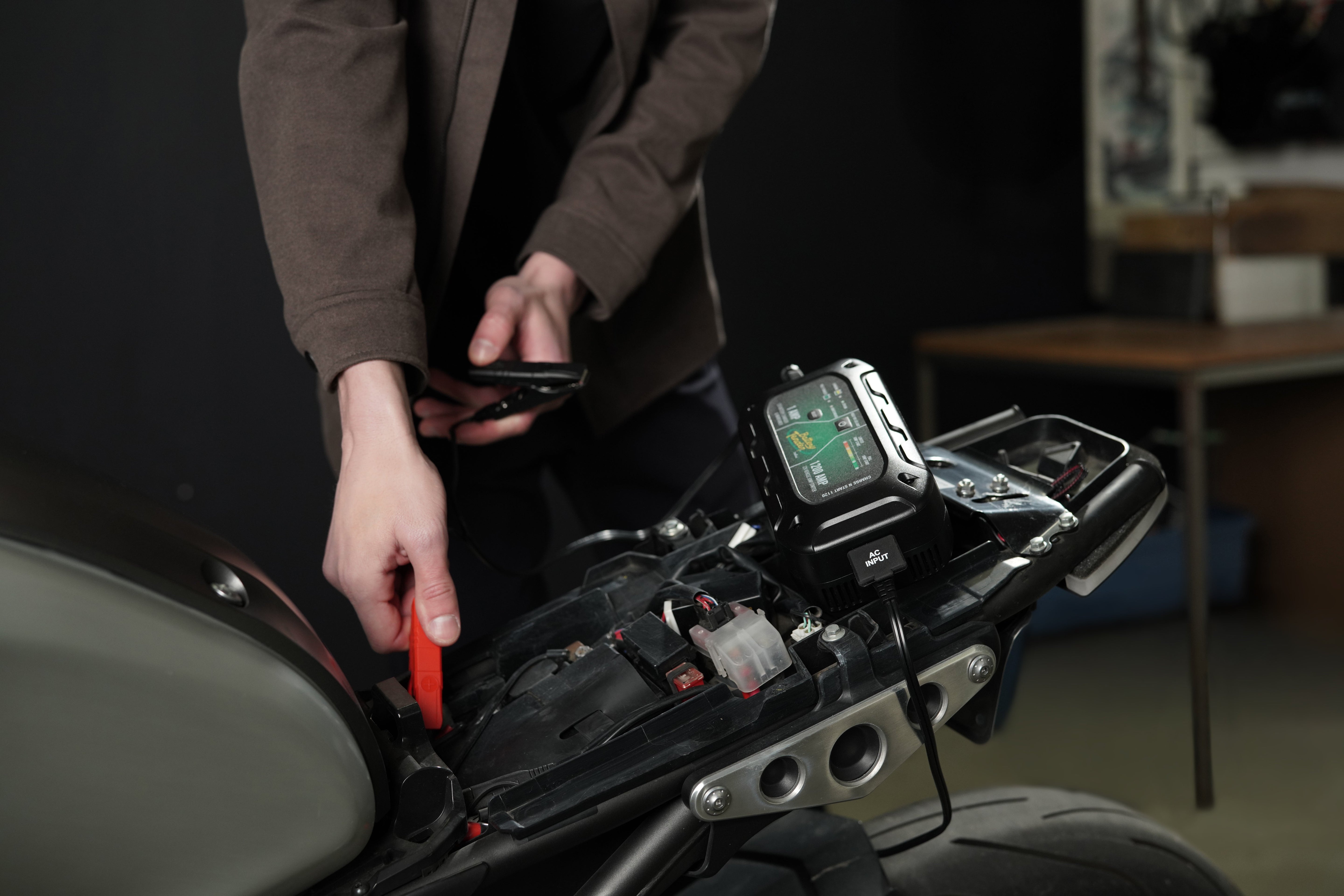
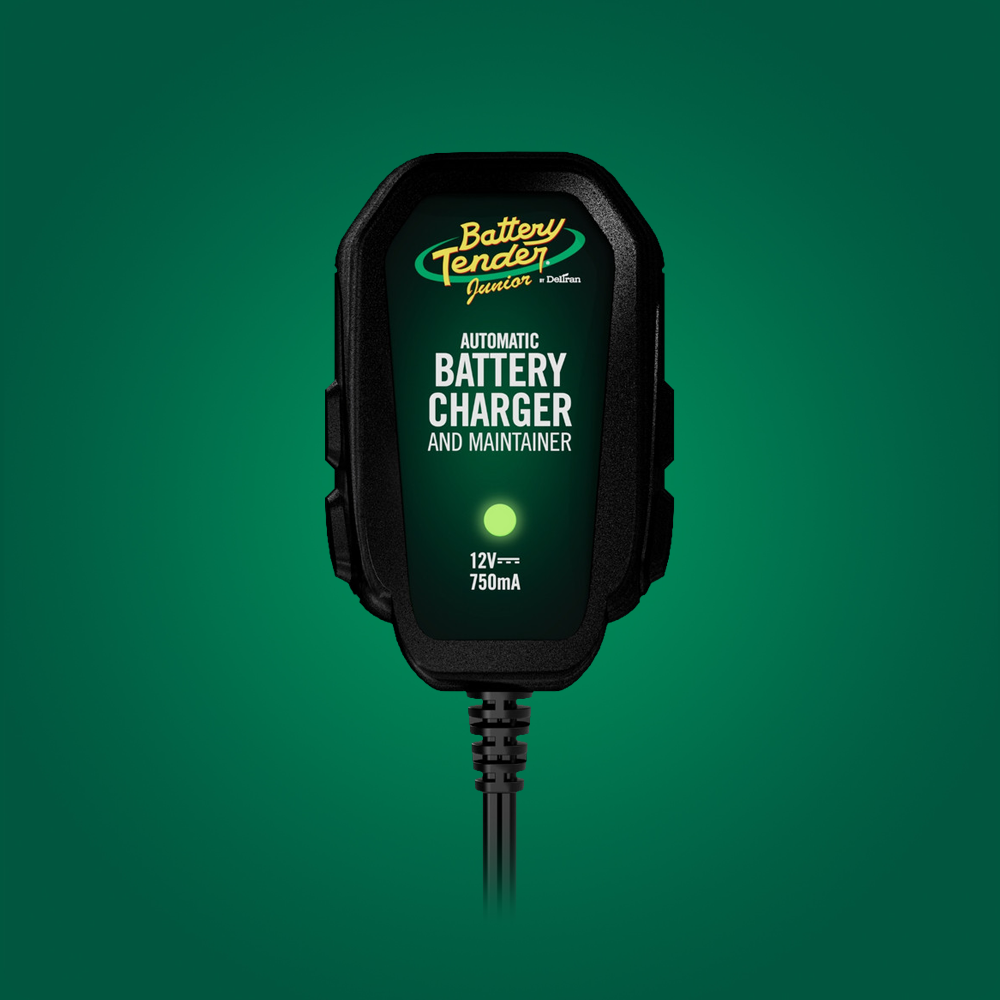
Plug-in chargers are better suited for recovering deeply discharged batteries, charging at higher amperage for faster recovery, and garage-based maintenance where reliable AC power is available. The Battery Tender Junior 1A Selectable is an excellent garage-based option that supports both lead-acid and lithium 12V batteries. For vehicles that split time between a garage and outdoor storage, pairing a Battery Tender Junior for garage charging with a 5W solar panel for outdoor maintenance covers both scenarios.
Battery Tender Junior 1A Selectable Battery Charger
For situations where a battery has already discharged significantly and needs immediate recovery in a remote location, the Battery Tender Charge N Start 1100 combines a 1A onboard charger with a 1,000-amp jump starter in a single portable unit. The lithium-ion internal battery holds its charge for months using proprietary Charge N Store technology, making it an ideal complement to a solar maintenance system.
Battery Tender Charge N Start 1100 — 1A Charger + 1,000A Jump Starter
Common Mistakes When Using a Solar Panel to Keep a Car Battery Charged
The most dangerous mistake is connecting a raw solar panel directly to a battery without a charge controller. An unregulated 17W panel can push open-circuit voltage above 21V — far exceeding the 14.4–14.7V absorption voltage that a 12V battery requires. This causes electrolyte boil-off in flooded batteries, outgassing in sealed AGM batteries, and potential thermal events in lithium batteries. Every Battery Tender solar product includes integrated charge control circuitry that prevents this scenario entirely.
Other common errors include undersizing the panel for the battery and parasitic load, placing the panel in a partially shaded location where output drops by 50–80%, and using panels without blocking diodes that allow the battery to discharge back through the panel at night. Battery Tender solar maintainers include reverse-current protection as a standard feature, ensuring that stored energy flows in only one direction — from the panel to the battery.
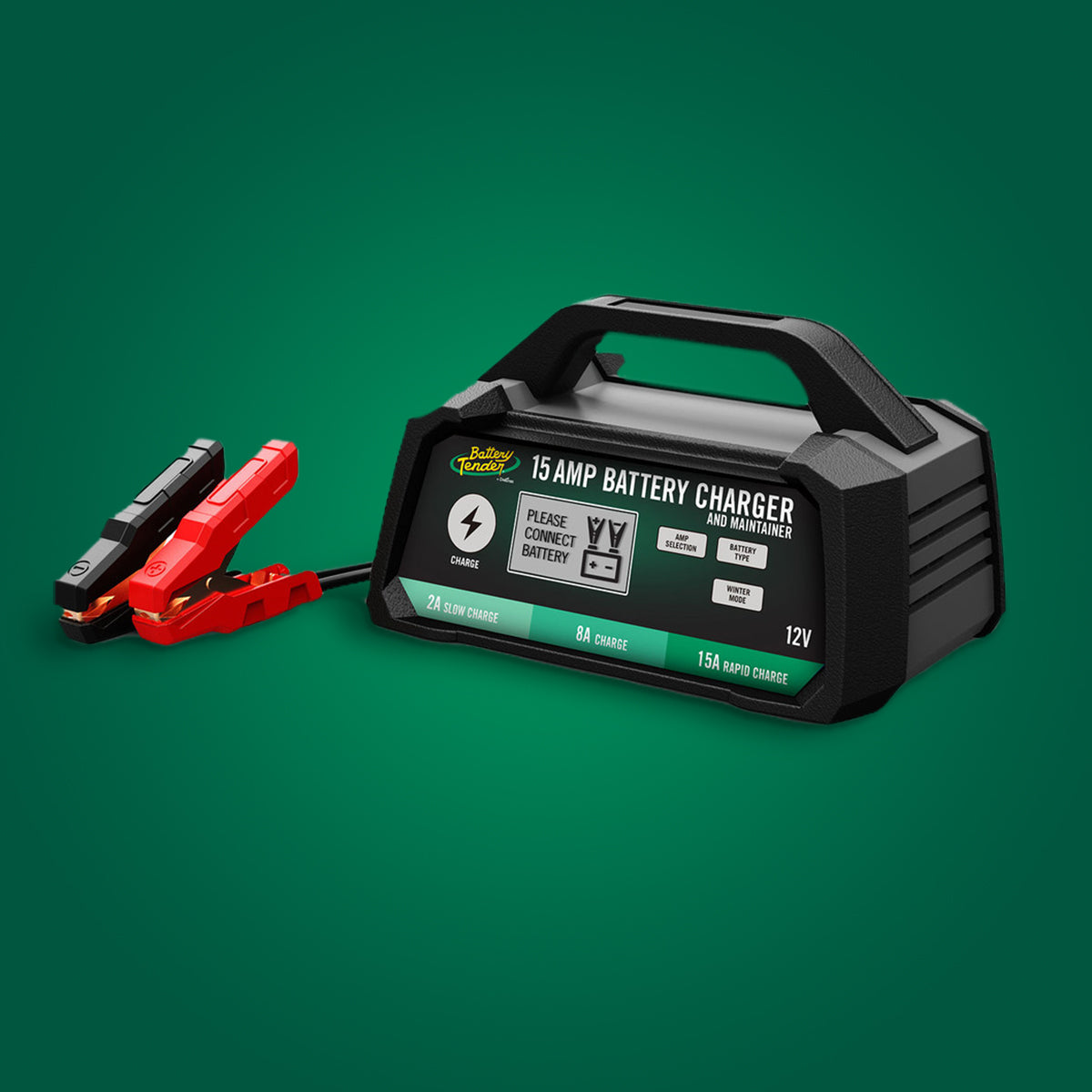
Finally, some users assume that a solar panel can recover a deeply discharged battery. Solar maintainers are designed for maintenance charging — keeping a healthy battery at full charge. A battery that has dropped below 12.0V should be recharged using an AC-powered smart charger, as 12.0V represents a ~50% depth of discharge and severe sulfation risk. At 10.5V, a lead-acid battery is completely discharged (zero state of charge) and may suffer permanent cell damage. In these cases, use a higher amperage charger like the Battery Tender Plus 1.25A or the Battery Tender 3 AMP Power Tender to recover safely before transitioning to solar maintenance.
Frequently Asked Questions
Can a solar panel overcharge a car battery?
A raw solar panel without a charge controller can overcharge a battery by pushing voltage above safe limits. Battery Tender solar maintainers include integrated charge controllers that automatically stop charging when the battery reaches full voltage, then resume only when voltage drops below a set threshold. This makes indefinite connection safe for lead-acid, AGM, GEL, and lithium 12V batteries.
What size solar panel do I need to keep a car battery charged?
A 5W solar panel is sufficient for most passenger cars with standard parasitic draws of 25–50 milliamps in locations receiving at least 4 hours of daily sunlight. Larger vehicles, dual-battery setups, or partially shaded locations benefit from a 17W panel. The Battery Tender 17W Mountable Solar Panel with built-in controller delivers approximately 1 amp in full sun, providing a substantial margin for high-drain vehicles.
Do solar battery maintainers work in winter or cloudy weather?
Solar panels generate reduced output on cloudy days — typically 10–25% of rated capacity — and produce less energy during shorter winter daylight hours. A properly sized panel still provides enough current to offset parasitic drain in most conditions. In northern climates with extended overcast periods, upsizing from a 5W to a 17W panel compensates for reduced solar intensity and keeps the battery above the 12.4V sulfation threshold.
Can I leave a Battery Tender solar panel connected to my car battery permanently?
Yes. Battery Tender solar maintainers are designed for permanent, unattended connection. The integrated charge controller prevents overcharging, and built-in reverse-current protection prevents the battery from discharging back through the panel at night. The waterproof panel construction withstands rain, snow, and UV exposure year-round, making true set-and-forget maintenance possible without any electrical outlet.
Conclusion
A solar panel can absolutely keep a car battery charged during long-term storage — provided it includes intelligent charge control that prevents overcharging and protects against reverse current at night. Battery Tender solar maintainers deliver exactly this capability in a weatherproof, set-and-forget package that works anywhere sunlight reaches, with no electrical outlet required. From the compact 5W panel for standard passenger cars to the powerful 17W mountable unit with built-in controller for trucks, RVs, and boats, there is a Battery Tender solar solution for every storage scenario and every 12V battery chemistry.
Explore the full lineup of Battery Tender solar charging products to find the right panel for keeping batteries charged, healthy, and ready to start:
Battery Tender Solar Battery Chargers — Complete Collection
Last updated: June 2026