

Best Car Jump Starter with Air Compressor: Buying Guide (2026)
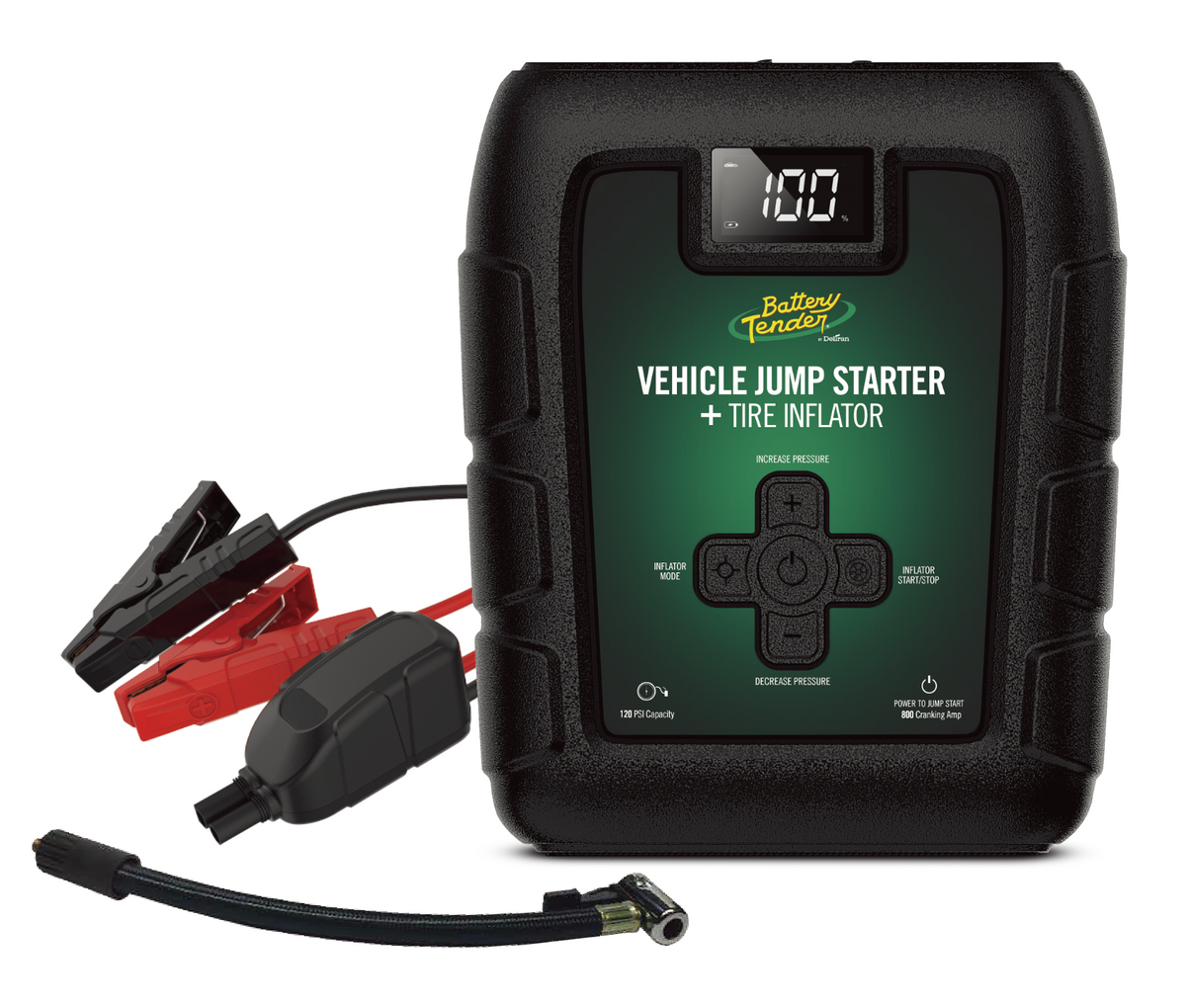
The best car jump starter with air compressor is a lithium pack sized to your engine, with spark-proof clamps, reverse polarity protection, and an inflator rated near 140 PSI. For engines up to 4.0L gas or 2.0L diesel, the Battery Tender® Jump N Start 800 Amp Jump Starter and Tire Inflator covers both jobs.
This guide skips the generic spec roundup. It shows how to weigh compressor features against starting power, where an all-in-one pack falls short, and how to build a kit so the pack rarely has to start anything. Read it before you buy, because the wrong amp rating or the wrong inflator spec leaves you stranded in exactly the situation the pack was meant to solve.
Key Takeaways
- Size the pack to the engine first: 600A for powersports, 800A to 1,200A for passenger vehicles, 1,500A to 2,000A for large gas engines and diesels.
- Check the inflator's maximum PSI, hose reach, and automatic shutoff. Most passenger tires need only 32 to 36 PSI.
- An inflator draws from the same lithium cell that starts the engine, so recharge the pack after every inflation session.
- Battery Tender Charge N Start combines a smart charger and a lithium jump starter, but it has no air compressor. Pair it with a separate inflator.
- A maintainer and a battery tester prevent most dead-battery calls in the first place.
What Makes the Best Car Jump Starter with Air Compressor?
The best unit is the one that starts your engine reliably first and inflates a tire second. The air compressor is a convenience feature. The starting amps decide whether the pack works at all.
Lithium packs have become the standard for this job. They are compact, deliver high peak current, and hold a charge for months between uses. Look for three built-in protections on any pack you consider: spark-proof clamps, reverse polarity protection, and short circuit protection. These stop sparks and damage if the clamps are connected backward or touch each other.
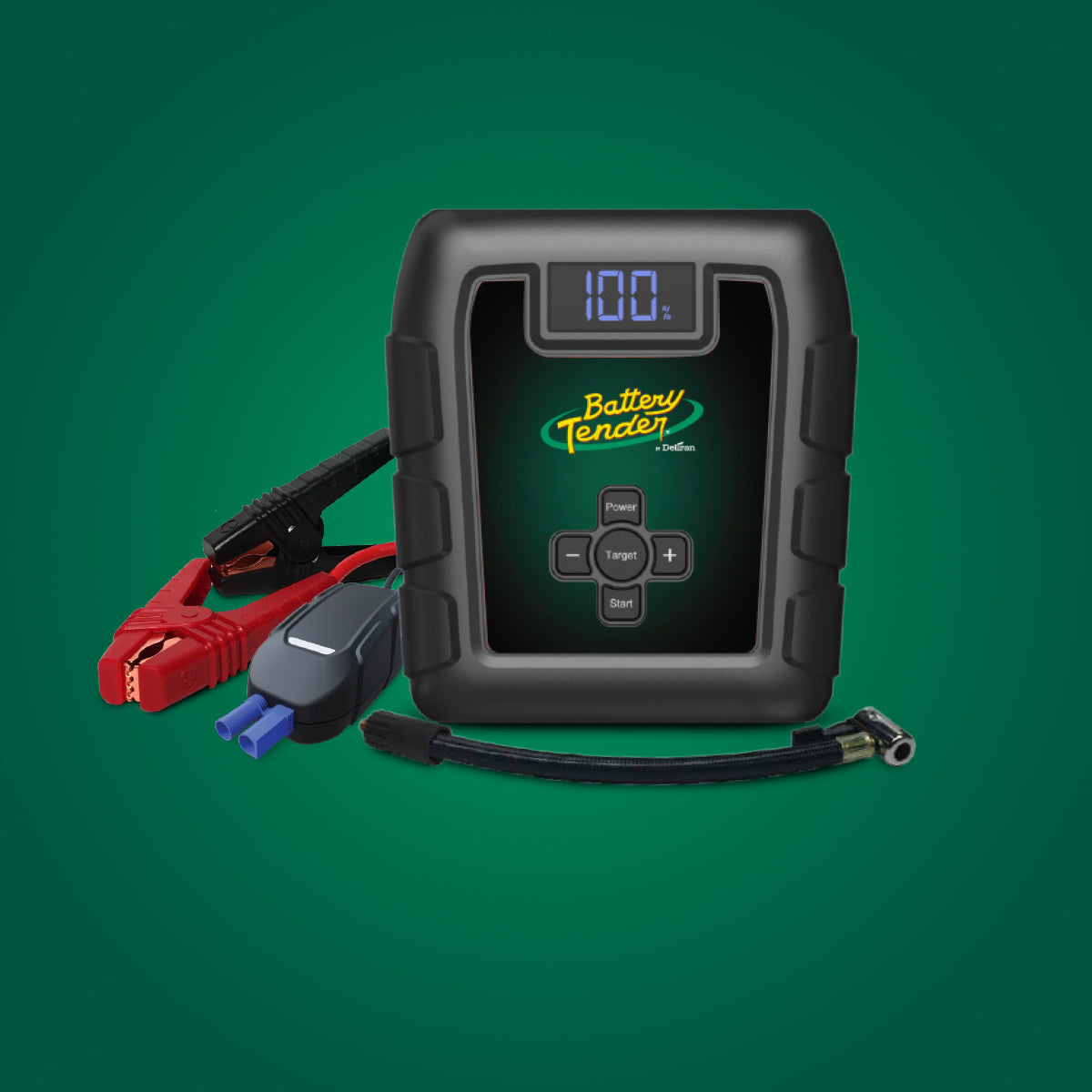
The compressor adds a second set of specs. A tire emergency is a different problem from a dead battery, and one compact case that handles both saves trunk space. The Battery Tender Jump N Start 800 Amp Jump Starter and Tire Inflator pairs 800A of starting power with a 140 PSI inflator. It starts engines up to 4.0L gas or 2.0L diesel, which covers most compact cars, sedans, and crossovers.
How to Size the Best Car Jump Starter with Air Compressor for Your Engine
Match peak amps to engine displacement and fuel type: bigger engines and diesels need more current. An undersized pack may click, stall, or shut down on overload without ever turning the engine over.
The table below uses the manufacturer-rated engine sizes for each Battery Tender pack.
| Vehicle / Engine | Recommended Peak Amps | Battery Tender Option | Rated Engine Size |
|---|---|---|---|
| Motorcycles, ATVs, small engines | 600A | Battery Tender Jump N Start 600 Amp Lithium Jump Starter | 4.0L gas / 2.0L diesel |
| Compact cars, sedans, crossovers (with inflator) | 800A | Battery Tender Jump N Start 800 Amp Jump Starter and Tire Inflator | 4.0L gas / 2.0L diesel |
| Powersports and compact cars (jump plus charge) | 1,000A | Battery Tender Charge N Start 1100 | 5.0L gas / 3.0L diesel |
| Mid-size cars, SUVs, boats | 1,200A | Battery Tender Charge N Start 1120 | 6.0L gas / 4.0L diesel |
| Trucks, RVs, daily heavy use | 1,200A plus 4A charger | Battery Tender Charge N Start 4120 | 6.0L gas / 4.0L diesel |
| Large gas engines | 1,500A | Battery Tender Jump N Start 1500 Amp Lithium Jump Starter | 7.0L gas / 5.5L diesel |
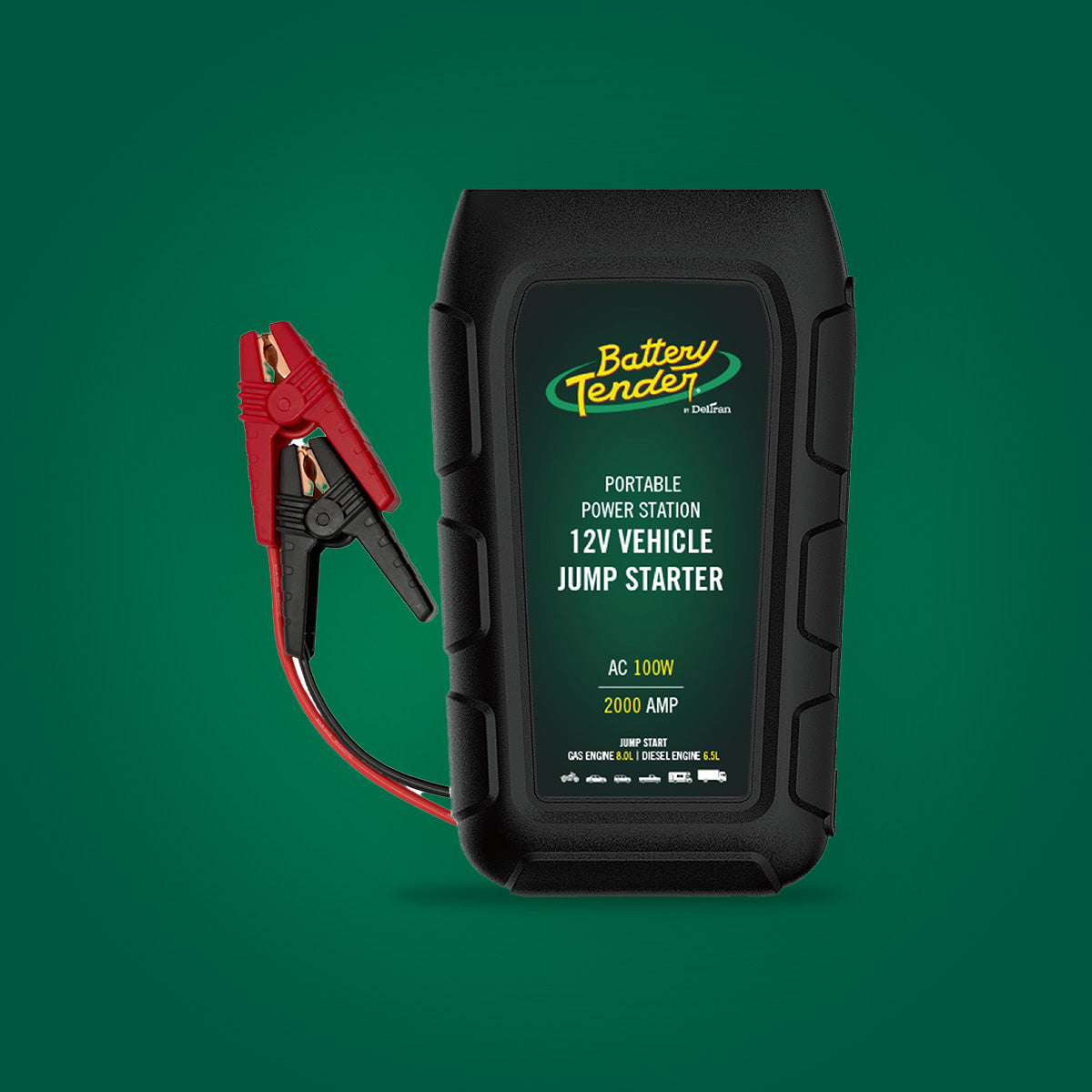
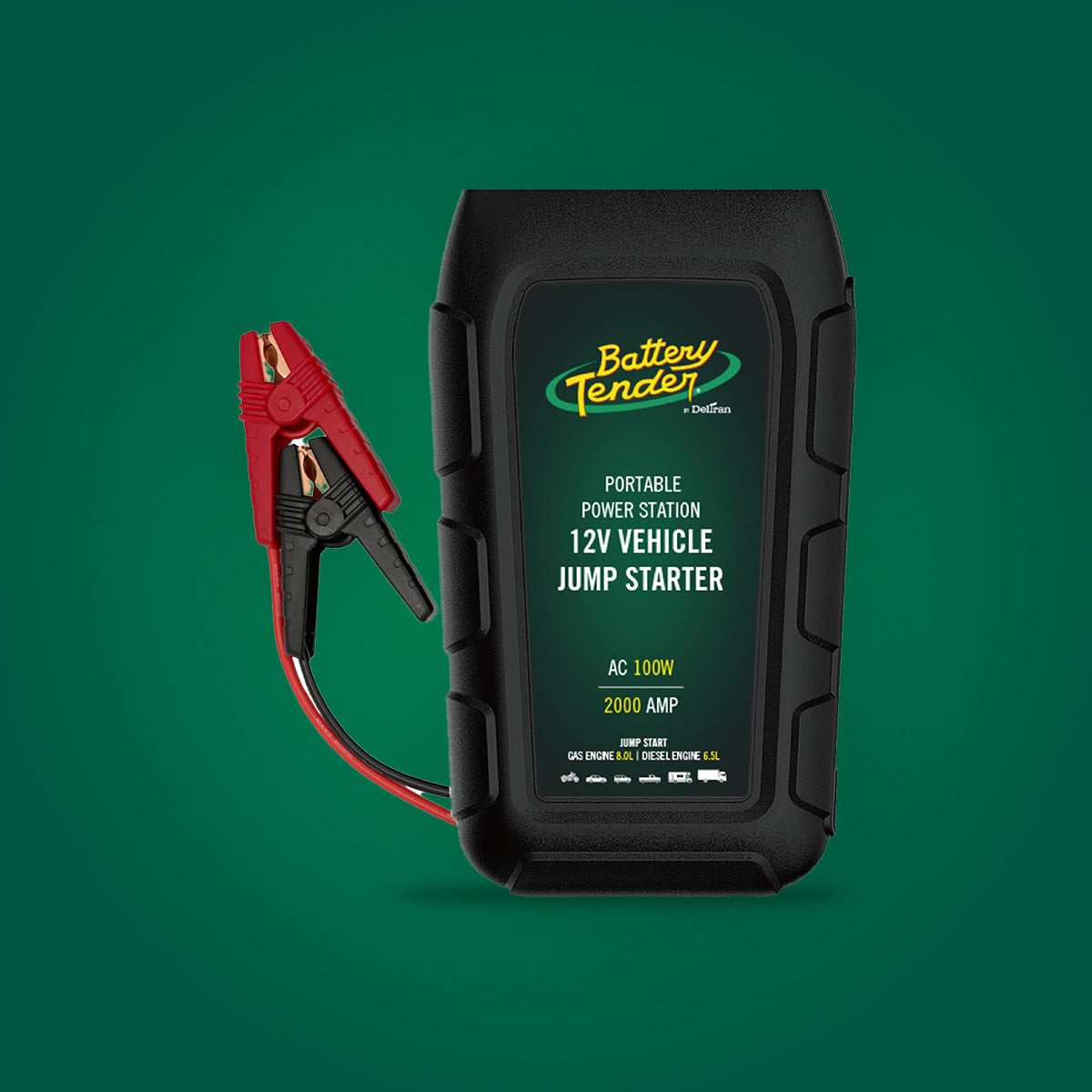
| Heavy diesels | 2,000A | Battery Tender Jump N Start 2000 Amp Lithium Jump Starter | 8.0L gas / 6.5L diesel |
Buy one size up if you drive in freezing climates. Cold thickens engine oil and cuts battery output, so an engine near the pack's limit starts poorly at 0°F. For a deeper side-by-side of each rating, see the portable jump starter comparison covering 600A, 800A, 1500A, and 2000A.
Air Compressor Specs, Trade-Offs, and Safe Use
A good built-in compressor reaches every tire, shuts off at your target pressure, and does not leave the pack too weak to start the engine. Check the specs below before you commit to any combination unit.
Specs to Check Before You Buy
- Maximum PSI: Passenger tires run 32 to 36 PSI, so a rating near 140 PSI leaves plenty of headroom, including for light-truck and trailer tires.
- Hose length: The hose must reach the farthest tire from where the pack sits. Test this with the pack on the ground, not on the hood.
- Digital gauge and auto shutoff: Set the pressure from the door-jamb placard and let the inflator stop itself.
- Duty cycle: Small inflators need cooldown time between runs. Read the manufacturer's run-time limits.
- Replaceable parts: A replaceable hose extends the life of the unit after years of use.
Trade-Offs to Accept
An all-in-one case is bigger and heavier than a compressor-free pack of the same amp rating. The inflator also runs from the same lithium cell that starts the engine. An inflation session lowers the energy left for a jump, so recharge the pack afterward. Keep a separate pressure gauge as well, because built-in gauges drift. A plug-in 12V compressor inflates faster than a pack-based inflator, but it cannot start an engine.
How to Use the Pack: Step-by-Step
- Check the pack's charge indicator before you begin. Recharge it first if the indicator is low.
- Turn off the ignition, lights, and accessories in the dead vehicle.
- Connect the red clamp to the positive terminal, then the black clamp to the negative terminal or bare engine metal, per the vehicle manual.
- Switch the pack on and confirm the clamps show a correct connection.
- Start the engine. If it does not start within a few seconds, wait one minute and try again.
- Remove the black clamp first, then the red clamp. Recharge the pack before you store it.
For tire inflation, thread the hose onto the valve, set the target PSI from the door-jamb placard, start the inflator, and let it stop on its own. Then check the result with a separate gauge. If the battery was completely flat, the dead battery recovery guide explains the extra steps.
Why Battery Tender Charge N Start Is the Smart Upgrade
Battery Tender Charge N Start combines a smart battery charger and a lithium-ion jump starter in one unit. It fixes both the emergency and the cause. A standalone jump pack only gets you started, while a Battery Tender Charge N Start unit also charges the battery that failed and keeps its own internal pack topped off through its Charge N Store function.
The charger section charges standard, AGM, GEL, and lithium 12V batteries. SafeGuard anti-backfeed protection adds circuit safety. The internal pack is lithium-ion, not lead-acid, so it stays light and holds its charge. The trade-off is plain: Battery Tender Charge N Start has no air compressor. Drivers who want tire inflation can keep a compact 12V inflator in the trunk or use an inflator-equipped pack in a second vehicle.
The Battery Tender Charge N Start 4120 suits trucks, RVs, and any vehicle with a large battery. Its 4A charger recovers a depleted 60Ah battery about twice as fast as a 2A unit: at 50% discharge, 60Ah × 0.5 ÷ 4A is about 7.5 hours. The 1,200A jump rating covers engines up to 6.0L gas or 4.0L diesel. For a full walkthrough of the Battery Tender Charge N Start family, see the Battery Tender Charge N Start complete guide.
Battery Tender Charge N Start 4120 — 4 Amp Battery Charger & 1200 Amp Jump StarterPrevent the Jump: Maintainers and Testers That Complete the Kit
The best car jump starter with air compressor still treats the symptom, and a smart maintainer treats the cause. A battery that sits for weeks loses charge on its own and sulfates, which is why a vehicle that was fine in October will not start in January.
Battery Tender chargers use Infinite Sequential Monitoring (ISM), a four-stage automatic process: Initialization, Bulk Charge, Absorption, and Float Maintenance. During Float Maintenance, ISM watches battery voltage and adds charge only when it drops, so the charger can stay safely connected indefinitely. Many Battery Tender models also include temperature compensation, which adjusts output for hot and cold storage spaces. Check the product page to confirm the feature on your model.
Match the maintainer to the battery. The table below uses the standard charging-time formula: battery Ah × depth of discharge ÷ charger amps.
| Battery Situation | Charger | Approximate Time (50% discharged) |
|---|---|---|
| 50Ah car battery, long-term storage | Battery Tender Plus 2 Amp | 50 × 0.5 ÷ 2 = 12.5 hours |
| 100Ah truck or RV battery | Battery Tender Power Tender 15/8/2 at 15A | 100 × 0.5 ÷ 15 = about 3.3 hours (plus taper time) |
| Four 20Ah powersports batteries | Battery Tender 4-Bank 1.25 Amp | 20 × 0.5 ÷ 1.25 = 8 hours per bank |
For a single car or classic stored for the season, the Battery Tender Plus 6V/12V 2 Amp charger is the right size. It charges a typical 50Ah car battery overnight and then holds it at full charge, and its 6V setting also suits older classics.
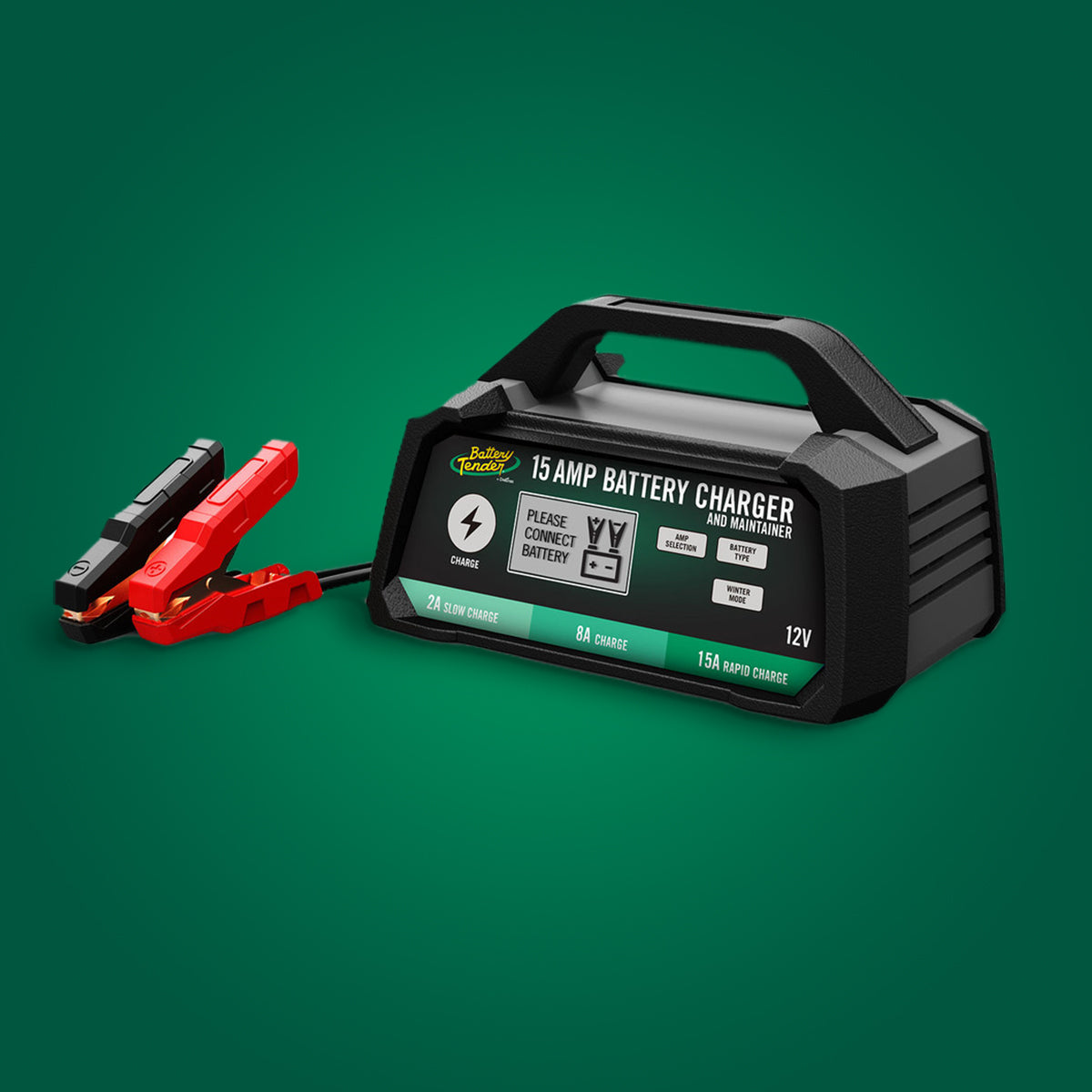
Battery Tender Plus 6V/12V 2 Amp Battery Charger and MaintainerTrucks, RVs, and farm vehicles with 100Ah or larger batteries need more output. The Battery Tender Power Tender 15/8/2 Amp charger offers three selectable rates and an LCD display. Use 15A for fast recovery of a deeply discharged battery, 8A for routine charging, and 2A for maintenance, which lets one charger serve a large truck battery today and a small battery later.
Battery Tender Power Tender 15/8/2 Amp 12V Battery Charger and MaintainerHouseholds with several vehicles can charge them all from one outlet. The Battery Tender 4-Bank 12V 1.25 Amp charger serves four batteries, such as a daily car, a truck, a motorcycle, and a mower. Each bank is rated at 1.25A, which suits maintenance rather than rapid recovery.
Battery Tender 4-Bank 12V 1.25 Amp Battery Charger and MaintainerFinally, test before you guess. A slow crank can mean a weak battery, a bad connection, or a failing alternator, and each one needs a different fix. The Battery Tender 12V / 6V battery tester gives a quick health reading in the driveway, so you know whether to recharge, replace, or look deeper.
Battery Tender 12V / 6V Battery TesterFrequently Asked Questions
Is a jump starter with an air compressor worth it?
Yes, if you want one case in the trunk for the two most common roadside problems: a dead battery and a low tire. It saves space and covers both emergencies. The trade-off is a slightly larger pack, and the inflator uses the same stored energy that starts your engine.
What amp rating do I need for a car jump starter with air compressor?
Match amps to engine size. An 800A pack with an inflator starts engines up to 4.0L gas or 2.0L diesel, which covers most compact cars and crossovers. Larger gas engines need 1,200A to 1,500A, and heavy diesels need 2,000A. Buy one size up in cold climates for extra margin.
Does Battery Tender Charge N Start include an air compressor?
No. Battery Tender Charge N Start combines a smart battery charger with a lithium-ion jump starter, but it has no air compressor. Its advantage is that it charges the failed battery and starts the engine from one unit. Add a separate compact 12V inflator or an inflator-equipped pack for tire emergencies.
How often should I recharge a lithium jump starter?
Lithium packs hold a charge for months, but check the indicator about every three months and top it off after every use. Recharge immediately after using the inflator, since air compression drains stored energy. Store the pack indoors when possible, because extreme heat and deep cold shorten the cell life.
Can using the air compressor drain the pack so it will not start my car?
It can. Each inflation session takes energy from the same lithium cell that provides starting current. Short top-offs of a few PSI use little, but inflating a flat tire uses much more. Check the charge indicator afterward and recharge before you drive if the level looks low.
Conclusion
The best car jump starter with air compressor matches your engine first: 600A for powersports, 800A to 1,200A for passenger vehicles, and 1,500A to 2,000A for large gas engines and diesels. Then it adds an inflator with enough PSI, a reachable hose, and automatic shutoff. For the strongest setup, choose Battery Tender Charge N Start for the charge-and-jump pairing, use a Battery Tender maintainer to keep the starting battery healthy, and keep a compact inflator in the trunk.
Your next step: confirm your engine size and battery Ah, then compare the full Battery Tender jump starter lineup to pick the pack that fits.