



Best Battery Charger for Car: How to Choose the Right Smart Charger (2026)
Selecting the right battery charger for car use requires matching charger amperage to battery size, understanding chemistry compatibility, and choosing technology that prevents overcharging. Battery Tender® pioneered smart charging in 1989, introducing Infinite Sequential Monitoring (ISM) — a proprietary 4-stage process that automatically adjusts charging current based on real-time battery condition, making indefinite connection safe and eliminating the overcharge risk inherent in older trickle chargers.
Yet many car owners still rely on outdated constant-current chargers or simply replace batteries every two to three years without realizing a modern smart charger can extend battery lifespan to five years or more. This guide explains exactly how to evaluate amperage requirements, why chemistry-specific charging matters, how ISM technology works at each stage, and which Battery Tender charger fits specific automotive scenarios — from daily drivers to multi-vehicle households. Every recommendation includes the math behind charging time so buyers can make data-driven decisions rather than guessing.
Why Every Car Owner Needs a Dedicated Battery Charger for Car Maintenance
A dedicated battery charger for car use is essential because modern vehicles place constant parasitic electrical loads on the battery even when parked. Keyless entry receivers, alarm systems, onboard computers, and telematics modules collectively draw 25–75 milliamps continuously. According to data from the Battery Council International (BCI), a standard 60 Ah automotive battery sitting at a 50-milliamp parasitic draw will reach a 50% state of charge in approximately 25 days — a threshold where sulfation begins forming on the lead plates and permanently reducing capacity.
Sulfation is the single largest cause of premature battery failure. When lead-acid batteries sit below 80% state of charge, lead sulfate crystals harden on the plates, reducing the active surface area available for chemical reactions. The BCI estimates that sulfation accounts for approximately 80% of lead-acid battery failures. A smart charger counteracts this process by maintaining voltage above the sulfation threshold — typically 12.4V or higher for a 12V battery — through demand-responsive maintenance pulses.
The financial case is straightforward. The average automotive battery costs $150–$250 installed. If a smart charger extends battery life from the typical 2–3 year replacement cycle to 5+ years, the charger pays for itself on the first avoided replacement and saves hundreds over a decade of vehicle ownership.
How to Match Charger Amperage to Your Car Battery Size
The most important specification when choosing a battery charger for car applications is amperage output relative to battery capacity. The charging time formula is simple: (Battery Ah × depth of discharge) ÷ charger amps = approximate hours. This calculation determines whether a charger will recover a depleted battery in a reasonable timeframe.
Consider a common scenario: a 65 Ah automotive battery at 50% state of charge connected to a 1.25A charger. The math is (65 × 0.50) ÷ 1.25 = 26 hours. That same battery connected to an 8A charger recovers in (65 × 0.50) ÷ 8 = approximately 4 hours. Both are acceptable — the lower-amperage charger works perfectly for overnight or multi-day maintenance, while the higher-amperage unit handles urgent recovery situations.
Amperage Guidelines by Vehicle Type
- Compact cars (40–55 Ah batteries): 1.25A–4A chargers provide effective maintenance and overnight recovery
- Midsize sedans and SUVs (55–75 Ah batteries): 2A–8A chargers balance recovery speed with safe charging rates
- Full-size trucks and large SUVs (75–100+ Ah batteries): 8A–15A chargers deliver the current needed for timely recovery of larger batteries
- Multi-battery or dual-battery setups: Multi-bank chargers with independent ISM circuits per bank
A general rule from SAE International (formerly the Society of Automotive Engineers) recommends charging at no more than 10–13% of a battery's Ah rating for optimal longevity. For a 65 Ah battery, that means a maximum sustained charge rate of 6.5–8.5A — making an 8A charger an ideal match for most passenger vehicles.
The Battery Tender 8A/2A Power Tender (SKU 022-1005-DL-WH) addresses this range precisely. It offers selectable 8A rapid recovery and 2A maintenance modes, plus a 6A power supply mode for diagnostics — all in an IP65-rated enclosure suitable for garage or outdoor installation. The unit supports standard lead-acid, AGM, GEL, and lithium chemistries, covering virtually every 12V automotive battery on the market.
Battery Tender 8A/2A Power Tender — IP65 12V Selectable Smart Charger
Understanding Battery Chemistry: Why Your Battery Charger for Car Use Must Match Your Battery Type
Not all 12V car batteries charge the same way. The four common chemistries in automotive use — flooded lead-acid, AGM (Absorbed Glass Mat), GEL, and lithium iron phosphate (LiFePO4) — each require different voltage profiles during the absorption and float stages. Applying the wrong profile damages the battery internally, often without visible symptoms until the battery fails completely.
Flooded lead-acid batteries accept the highest absorption voltage (14.4–14.8V) and can tolerate modest gassing during the final charge stages. AGM batteries require a tightly controlled absorption voltage of 14.4–14.6V because the sealed construction cannot vent excess gas without potential casing damage. GEL batteries demand even lower absorption voltages (14.1–14.4V) to prevent the formation of permanent voids in the gel electrolyte. Lithium LiFePO4 batteries require a flat 14.4–14.6V charge profile with no float stage — they must be disconnected or held at resting voltage once full.
A chemistry-selectable charger eliminates guesswork. Battery Tender chargers with selectable chemistry settings automatically apply the correct voltage profile for each type, including lithium-specific algorithms that omit the traditional float stage. This is especially important as lithium batteries become increasingly common in modern vehicles, particularly in start-stop systems and performance applications.
How ISM 4-Stage Charging Protects Your Car Battery
ISM charging is what separates a modern smart charger from a basic trickle charger. The ISM process consists of four distinct stages, each performing a specific function:
- Initialization: The charger tests the battery by applying a gentle current to assess condition, voltage level, and internal resistance. If the battery is too deeply discharged or has an internal short, the charger identifies the fault and will not proceed — preventing damage and safety hazards.
- Bulk Charge (Constant Current): Full rated amperage flows into the battery until it reaches approximately 80% state of charge. This stage does the heavy lifting of recovery, efficiently converting electrical energy into stored chemical energy on the lead plates.
- Absorption (Constant Voltage): The charger holds voltage constant while gradually tapering current. This stage dissolves soft sulfate crystals that formed during discharge, restoring plate surface area. Absorption typically accounts for 20–30% of total charge time but is critical for reaching true full charge.
- Float Maintenance: Once fully charged, the charger drops to a maintenance voltage and delivers demand-responsive charge pulses only when battery voltage drops below a set threshold. The battery is never subjected to continuous current — eliminating overcharge risk entirely.
Traditional trickle chargers deliver constant current regardless of battery state. Connect a fully charged battery to a trickle charger, and it continues pushing current — causing electrolyte boil-off in flooded batteries and potentially dangerous thermal runaway in sealed AGM or lithium cells. ISM technology monitors battery voltage continuously and responds accordingly, which is why Battery Tender chargers are safe to leave connected indefinitely.
Nearly all Battery Tender chargers include temperature compensation to adjust for charging in extreme heat or cold. It adjusts charging voltage based on ambient temperature. Cold batteries require slightly higher voltage to reach full charge, while hot batteries need lower voltage to prevent gassing. Temperature compensation adds a measurable margin of safety in garages, carports, and outdoor installations where temperatures fluctuate seasonally.
Choosing a Battery Charger for Car Owners With Multiple Vehicles
Households with two or more vehicles face a unique challenge: maintaining multiple batteries simultaneously without purchasing separate chargers for each. Multi-bank chargers solve this problem by providing independent ISM charging circuits on each output, meaning every connected battery receives the exact charging stage it needs regardless of what the other batteries are doing.
The Battery Tender 2-Bank 1.25A charger maintains two 12V batteries simultaneously with fully independent ISM circuits. Each bank delivers 1.25A and progresses through all four ISM stages independently — one bank could be in Bulk Charge while the other is in Float Maintenance. This is ideal for a daily driver and weekend vehicle, or a car and motorcycle sharing garage space.
Battery Tender 2-Bank 1.25A 12V Charger — Maintain Two Vehicles Simultaneously
For single-vehicle owners who want the most proven charger in automotive history, the Battery Tender Plus 12V 1.25A remains the benchmark. It covers batteries from 14–80 Ah, includes temperature compensation, and carries an industry-best 10-year warranty — a direct reflection of the engineering confidence behind ISM technology. For outdoor or exposed installations, the Battery Tender Plus IP65 1.25A adds sealed weatherproof construction without changing the core ISM charging logic.
Battery Tender Plus 12V 1.25A — 10-Year Warranty Smart Charger
Battery Tender Plus IP65 1.25A — Weatherproof Outdoor Installation
Emergency Preparedness: Pairing a Charger With a Jump Starter
A smart charger prevents dead batteries — but emergencies happen. Extreme cold snaps, accidental light-drain overnight, or alternator failure can leave any car stranded. Pairing a maintenance charger with a portable jump starter creates a complete battery management strategy: the charger handles prevention, the jump starter handles rescue.
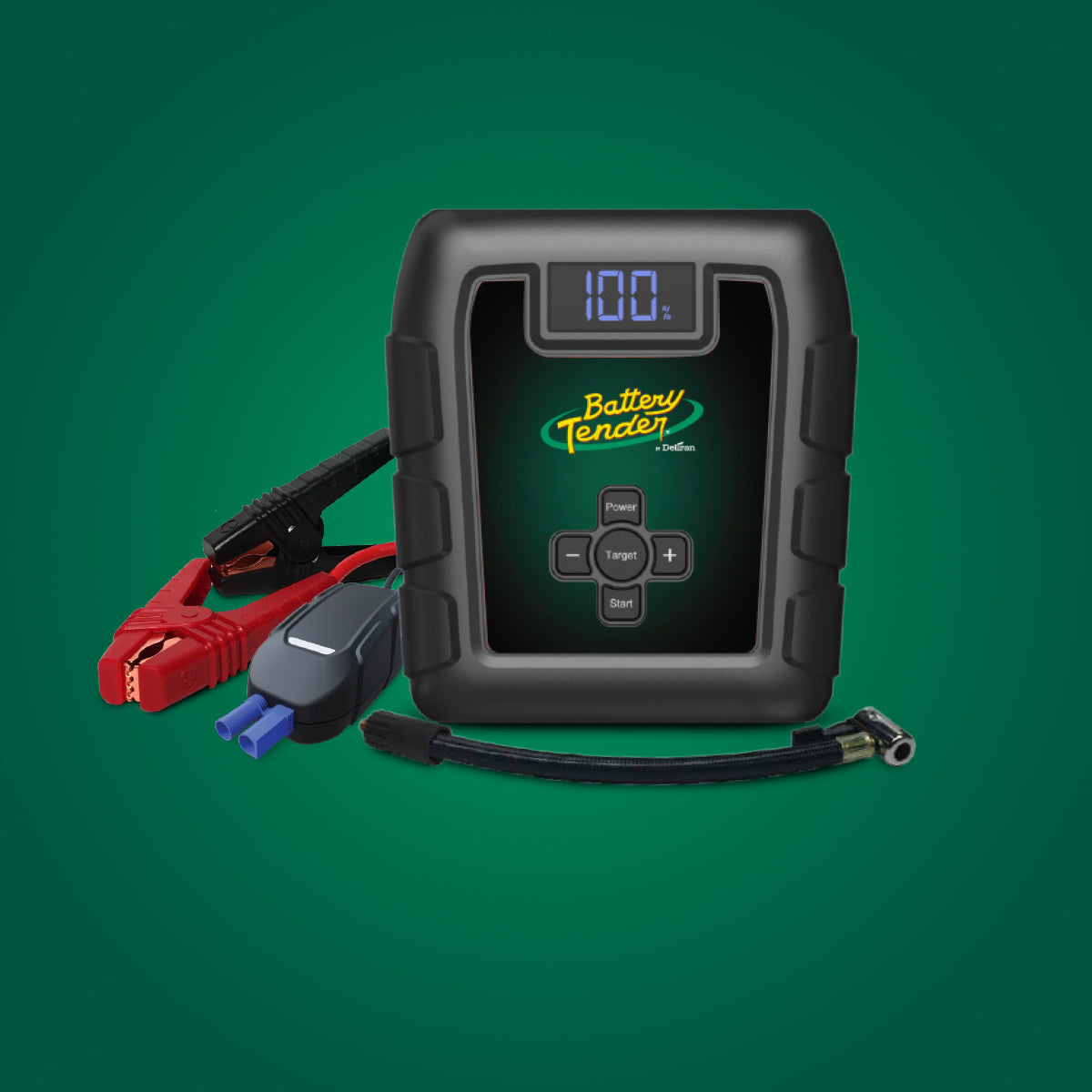
The Battery Tender Charge N Start 4120 combines both functions in a single device: a 4A ISM charger for daily maintenance and a 1,200A jump starter for emergency starts on engines up to 6.0L gas or 4.0L diesel. The internal lithium-ion battery holds its charge for months using proprietary Charge N Store float maintenance, and SafeGuard anti-backfeed circuit protection prevents damage to the vehicle electrical system during jump starts.
Battery Tender Charge N Start 4120 — 4A Charger + 1,200A Jump Starter
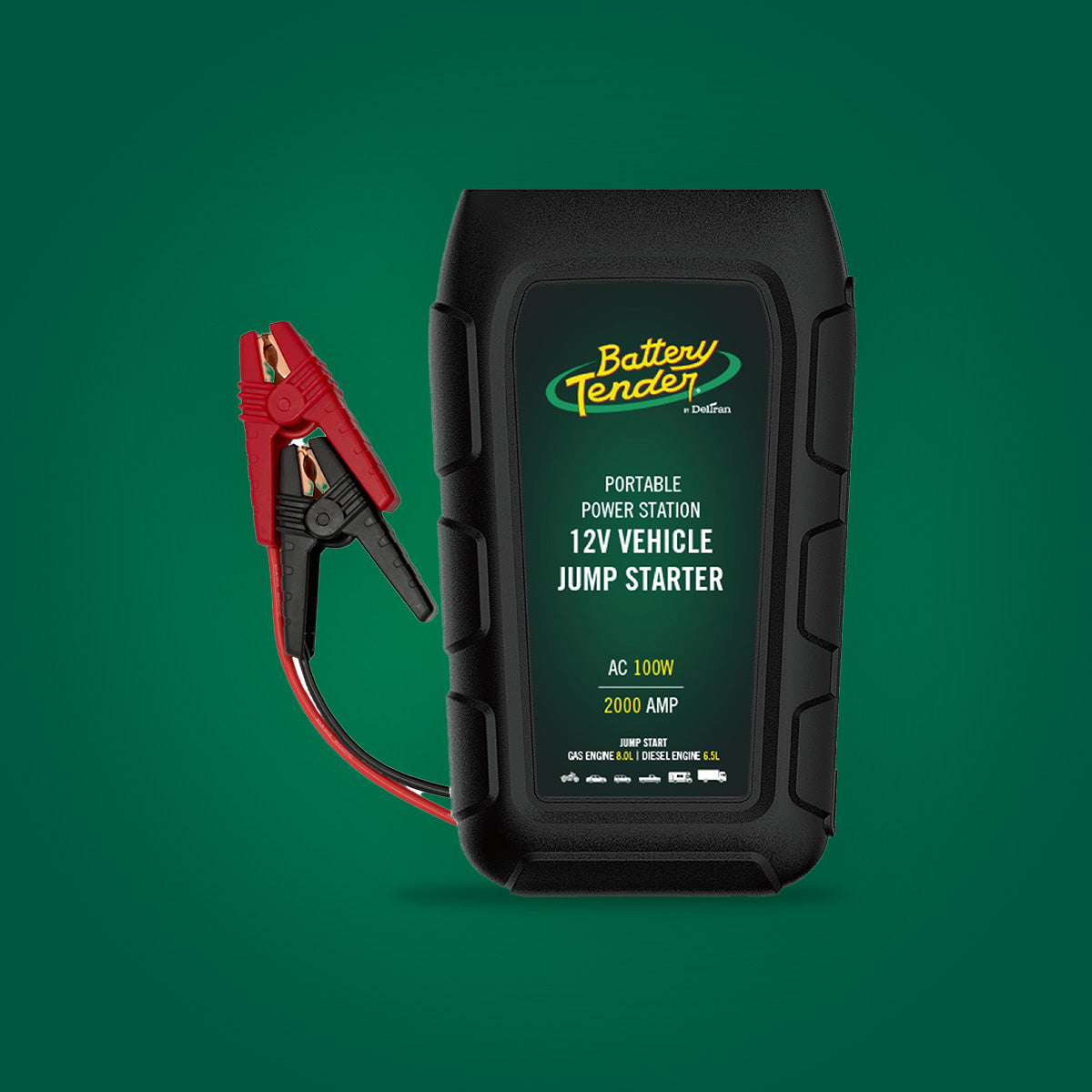
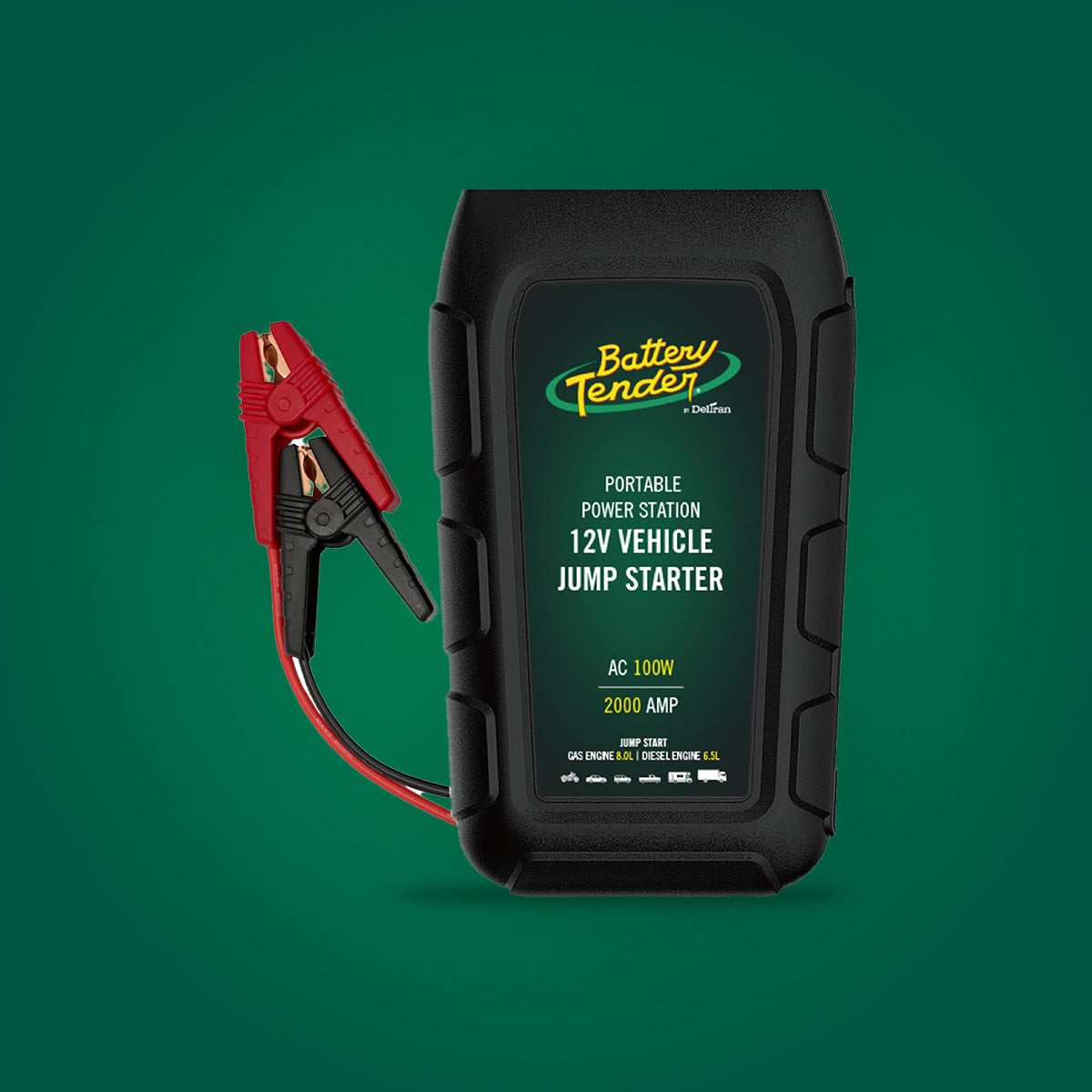
For drivers who want a standalone jump starter to keep in the trunk, the Battery Tender 1500A Jump Starter delivers 1,500 peak amps from a 12,000 mAh lithium-ion pack, capable of starting engines up to 7.0L gas or 5.5L diesel — covering the vast majority of passenger cars, SUVs, and light trucks. At $152.95, it provides reliable emergency starting power for up to 40 starts per charge.
Battery Tender 1500A Jump Starter — Portable Emergency Starting Power
Installation Best Practices for Permanent Car Battery Charger Setups
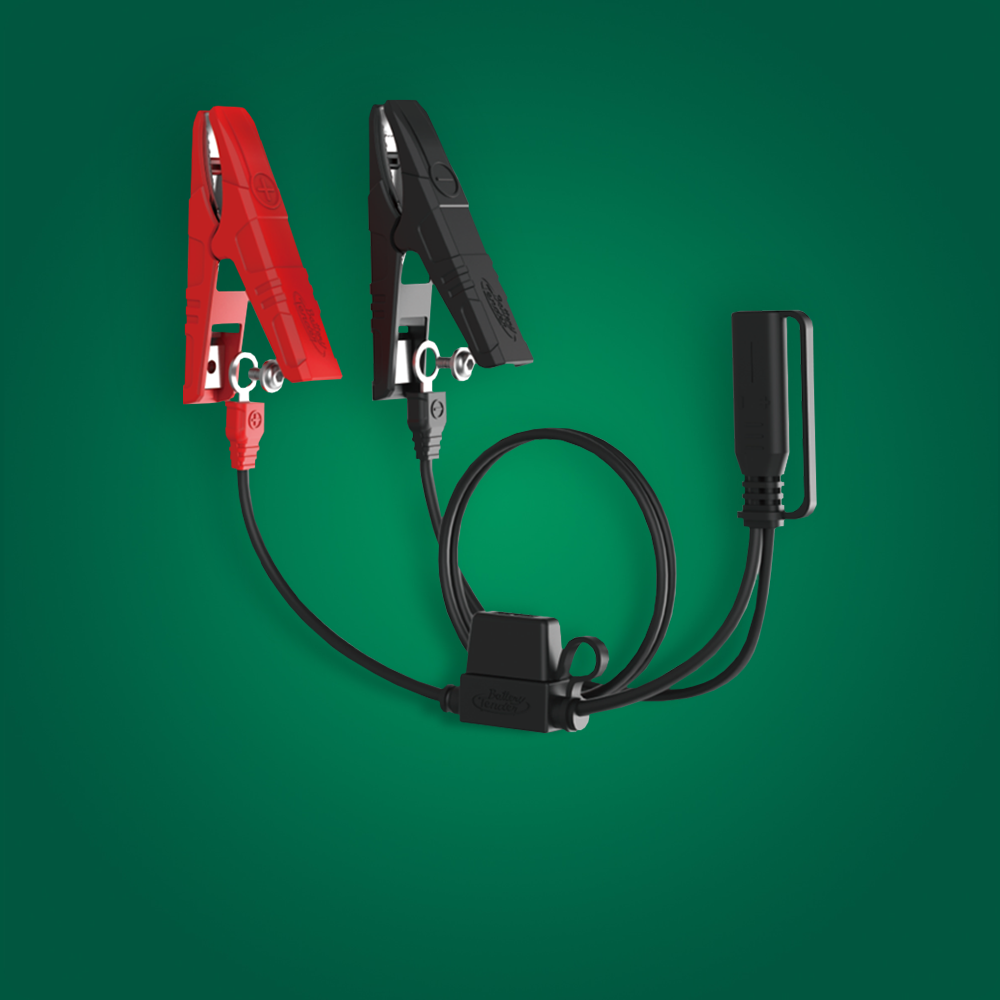
The most effective way to use a smart charger is a permanent installation with quick-connect ring terminals attached to the battery posts. Battery Tender chargers ship with ring terminal harnesses that bolt directly to the battery terminals and route a SAE connector to an accessible location — the fender well, near the grille, or through a gap in the hood seal. When parking, simply plug in the charger connector. No hood opening, no clamp fumbling, no exposed terminals.
For outdoor or carport installations, choose an IP65-rated charger like the Battery Tender 8A/2A Power Tender (SKU 022-1005-DL-WH). IP65 certification means complete dust exclusion and protection against water jets from any direction — sufficient for exposed garage walls, boat dock power posts, and uncovered parking structures. Mount the charger vertically with adequate ventilation clearance (minimum 6 inches on all sides per NEC Article 480 guidance for battery charging equipment) and route cables away from heat sources and sharp edges.
Always connect the ring terminal harness with the charger unplugged. Red lead to positive terminal, black lead to negative terminal or chassis ground point. Verify polarity before plugging in — all Battery Tender chargers include reverse-polarity protection that prevents connection in the wrong orientation, but establishing correct polarity at installation avoids nuisance fault alerts.
Frequently Asked Questions
Can I leave a battery charger connected to my car battery all the time?
Yes — if the charger uses ISM technology. Battery Tender chargers monitor battery voltage continuously during the Float Maintenance stage and deliver charge pulses only when voltage drops below a set threshold. Unlike constant-current trickle chargers, ISM chargers never overcharge and are designed for indefinite connection. This is the safest approach to long-term battery maintenance.
What size battery charger do I need for a car?
Most passenger cars use 40–80 Ah batteries. A charger rated between 1.25A and 8A covers this range effectively. Use the formula: (battery Ah × depth of discharge) ÷ charger amps = hours to charge. For example, a 65 Ah battery at 50% discharge recovers in about 4 hours at 8A or 26 hours at 1.25A. Higher amperage means faster recovery; lower amperage is gentler on battery chemistry.
Will a battery charger for car use work on AGM and lithium batteries?
Only if the charger supports selectable chemistry modes. AGM batteries require lower absorption voltages than flooded lead-acid, and lithium LiFePO4 batteries need a completely different charge profile with no float stage. Battery Tender chargers with chemistry selection — such as the Battery Tender 8A/2A Power Tender — automatically apply the correct voltage profile for standard, AGM, GEL, and lithium batteries.
What is the difference between a battery charger and a battery maintainer?
A battery charger restores a depleted battery to full charge. A battery maintainer keeps an already-charged battery at optimal voltage over weeks or months. Battery Tender chargers with ISM technology perform both functions: the Bulk and Absorption stages charge the battery, and the Float Maintenance stage maintains it indefinitely. There is no need to purchase separate devices for charging and maintaining.
Conclusion
Choosing the right battery charger for car use comes down to three decisions: matching charger amperage to battery capacity, ensuring chemistry compatibility, and selecting ISM smart charging technology that prevents overcharging and sulfation. Whether maintaining a single daily driver with the Battery Tender Plus or managing a multi-vehicle garage with a 2-Bank or 8A/2A Power Tender, ISM 4-stage charging extends battery life well beyond the typical 2–3 year replacement cycle — saving money and eliminating the inconvenience of unexpected dead batteries.
Explore the full lineup of smart chargers, maintainers, and jump starters to find the right fit for every vehicle in the garage.
Browse All Battery Tender Smart Chargers and Maintainers
Last updated: June 2026