





Portable Solar Battery Charger: The Complete Guide to Off-Grid Battery Maintenance (2026)
A portable solar battery charger converts sunlight into regulated electrical current that maintains 12V batteries in vehicles, boats, and equipment stored far from any electrical outlet. Battery Tender® solar chargers go beyond raw solar panels by incorporating intelligent charge control technology that prevents overcharging, monitors voltage continuously, and delivers only the current a battery needs — making them a true set-and-forget solution for remote storage scenarios. Unlike bare photovoltaic panels wired directly to a battery, these purpose-built solar maintainers regulate output so batteries stay topped off safely for weeks or months at a time.
Whether a classic car sits in an unheated barn, a fishing boat rests on a trailer through winter, or a farm tractor waits in an open-sided equipment shed, batteries self-discharge at approximately 1–3% per month under ideal conditions — and faster in heat. A portable solar battery charger eliminates that slow drain without running extension cords or installing electrical service. This guide covers the technology behind intelligent solar charging, the specifications that matter, and how to choose the right panel wattage for any application.
Key Takeaways:
- Portable solar battery chargers maintain 12V batteries indefinitely without an AC outlet.
- Built-in charge controllers separate intelligent solar chargers from unregulated panels that risk overcharging.
- Panel wattage determines charge current: 5W ≈ 0.3A, 17W ≈ 1.0A, 35W ≈ 2.0A.
- Battery Tender solar products are compatible with lead-acid, AGM, GEL, and lithium 12V batteries.
- Mounting options include suction cups, grommets, and permanent surface mounts for long-term deployment.
What Is a Portable Solar Battery Charger and How Does It Work?
A portable solar battery charger is a self-contained photovoltaic panel paired with charging circuitry that converts sunlight into DC current matched to a 12V battery. The panel generates electricity whenever sunlight strikes its surface, and the integrated controller regulates that electricity so the battery receives a safe, steady maintenance charge. Most quality units connect via SAE or ring terminal connectors for quick attachment and removal.
The critical distinction between a solar battery charger and a bare solar panel lies in regulation. An unregulated panel can push voltage above 18V in direct sunlight, which risks boiling electrolyte in flooded lead-acid batteries and damaging AGM or lithium cells. Intelligent solar chargers from Battery Tender include built-in charge controllers that cap voltage output and taper current as the battery reaches full charge — mimicking the behavior of a plug-in smart charger but powered entirely by the sun.
According to the U.S. Department of Energy, even a moderately sized solar panel in most North American locations receives an average of 4–5 peak sun hours per day annually. A 17W panel producing approximately 1.0A during those peak hours delivers enough energy to offset self-discharge in batteries up to 100Ah — maintaining full readiness without any connection to the electrical grid.
Why Use a Portable Solar Battery Charger Instead of a Plug-In Charger?
Plug-in chargers require proximity to an AC outlet. Many storage scenarios — remote boat docks, open-air equipment yards, agricultural buildings without wiring, off-grid cabins — simply have no available electricity. A portable solar battery charger eliminates that dependency entirely, requiring only exposure to sunlight.
Beyond convenience, solar maintenance reduces ongoing electricity costs. The National Renewable Energy Laboratory (NREL) estimates that maintaining a single vehicle battery on grid power costs approximately $3–$8 per year, depending on local utility rates and charger efficiency. A solar charger has zero operating cost after purchase. For fleets, farms, or collections with multiple batteries, those savings scale meaningfully over time.
Solar chargers also provide an important safety advantage in environments where running extension cords creates tripping hazards, fire risks, or code violations. According to the Electrical Safety Foundation International (ESFI), extension cord misuse contributes to approximately 3,300 residential fires annually in the United States. Eliminating the cord eliminates the risk.
How to Choose the Right Portable Solar Battery Charger Wattage
Panel wattage directly determines how much charging current reaches the battery. Higher-wattage panels produce more current and can maintain larger batteries or offset heavier parasitic loads from alarms, GPS trackers, or bilge pump standby circuits. The formula is straightforward: panel watts ÷ system voltage (nominally 17.5V open-circuit for a 12V panel) = approximate maximum amps.
| Panel Wattage | Approx. Current Output | Best For |
|---|---|---|
| 5W | ~0.3A | Motorcycles, ATVs, small batteries under 30Ah |
| 17W | ~1.0A | Cars, boats, tractors, batteries 30–100Ah |
| 35W | ~2.0A | RVs, dual-battery setups, batteries 100Ah+ |
For most single-battery maintenance applications — a stored car, a seasonally docked boat, or a parked farm vehicle — a 17W panel provides the ideal balance of output and portability. The Battery Tender 17W Mountable Solar Charger includes a built-in charge controller that manages 3-step charging and prevents overcharge, making it suitable for lead-acid, AGM, GEL, and lithium 12V batteries. Its waterproof panel design handles rain, snow, and UV exposure without degradation.
Battery Tender 17W Mountable Solar 12V Battery Charger
Where to Use a Portable Solar Battery Charger: Top Applications
Marine and dock storage. Boats stored on trailers or at remote docks frequently sit for weeks between use. A solar panel mounted on the gunwale or placed on the dash maintains the cranking battery and prevents the sulfation that degrades lead-acid cells during inactivity. The American Boat and Yacht Council (ABYC) E-11 standard recommends maintaining batteries above 12.4V to prevent sulfate crystal formation — exactly the voltage range a regulated solar charger targets.
Agricultural and farm equipment. Tractors, combines, UTVs, and irrigation pump engines often sit idle for months between seasons. These vehicles are typically stored in pole barns or open sheds with no electrical outlets. A solar charger mounted on the hood or roof of the cab keeps the battery ready for the first start of the season. For smaller equipment batteries, the Battery Tender 5W Solar Panel provides enough output to offset self-discharge on batteries up to 30Ah.
Battery Tender 5W Solar 12V Battery Charger
Classic car and vehicle collections. Collectors storing multiple vehicles in garages or warehouses benefit from solar panels placed inside windshields where they receive indirect light. Even reduced sunlight through glass generates enough current to maintain a battery that has no parasitic loads. For larger installations with multiple batteries or higher-wattage panels, a dedicated charge controller allows precise management of solar input.
RV and camper off-season storage. Recreational vehicles often have house batteries and chassis batteries that both need maintenance during storage. A 35W panel paired with the Battery Tender 30A MPPT Solar Charge Controller handles higher-capacity battery banks while maximizing energy harvest in partial shade or cloudy conditions. MPPT (Maximum Power Point Tracking) controllers extract up to 30% more energy from a panel compared to basic PWM controllers, according to the International Electrotechnical Commission (IEC) 62509 standard guidelines.
Battery Tender 30A MPPT Solar Charge Controller
How to Install a Portable Solar Battery Charger: Step-by-Step
Installation requires no special tools or electrical knowledge and takes approximately 10–15 minutes for most vehicles.
- Select a mounting location. Choose a spot that receives maximum direct sunlight for the longest portion of the day. South-facing surfaces in the Northern Hemisphere are optimal. Dashboard placement behind a windshield works but reduces output by approximately 30–40% due to glass filtering UV wavelengths.
- Secure the panel. Use the included mounting grommets for permanent installation on flat surfaces, or suction cups for temporary windshield placement. Ensure the panel angle faces the sun as directly as possible — a tilt of 30–45° from horizontal matches most latitudes in the continental United States.
- Route the output cable. Run the SAE-connector cable from the panel through a door jamb, hood gap, or ventilation opening to the engine compartment. Avoid pinching the cable in tight seals.
- Connect to the battery. Attach the ring terminal connector directly to the battery posts (positive to positive, negative to negative). Alternatively, use an SAE quick-disconnect harness for tool-free attachment and removal.
- Verify connection. The charge indicator LED on the panel or controller should illuminate, confirming current flow. On Battery Tender solar chargers, a green LED indicates the battery is receiving charge.
Once installed, no further action is required. The built-in charge controller manages all charging stages automatically, reducing current as the battery reaches full voltage and resuming charging when voltage drops — a genuine set-and-forget system.
Intelligent Charging vs. Raw Solar Panels: Why the Controller Matters
A bare solar panel connected directly to a battery is essentially an unregulated trickle charger — it pushes whatever current and voltage the sun produces at any given moment. On bright days, open-circuit voltage from a nominal "12V" panel can reach 21V or higher, far exceeding the 14.4–14.7V absorption voltage that most 12V batteries require. Sustained overvoltage causes electrolyte loss in flooded batteries, thermal runaway risk in lithium cells, and accelerated plate corrosion in AGM batteries.
Battery Tender solar chargers include built-in charge controllers that cap output voltage and manage charging in distinct stages. The Battery Tender 17W model, for example, employs 3-step charging: bulk charge at maximum panel output until the battery reaches approximately 80% state of charge, absorption at a constant voltage with tapering current, and float maintenance at a reduced voltage to hold the battery without overcharging. This mirrors the behavior of Infinite Sequential Monitoring (ISM) technology found in Battery Tender plug-in chargers — adapted for solar input variability.
For larger solar installations — 35W panels or multi-panel arrays — an external controller provides additional regulation and system protection. The Battery Tender PWM Solar Controller handles basic installations efficiently, while the 30A MPPT controller maximizes harvest from larger panels by continuously adjusting the electrical operating point to extract peak power regardless of temperature, cloud cover, or panel age.
Battery Tender PWM Solar Charge Controller
What If the Battery Is Already Dead? Pairing Solar with a Jump Starter
Solar chargers are maintenance devices — they prevent discharge, but they cannot recover a deeply discharged or dead battery quickly. A 17W panel producing 1.0A would require approximately 50 hours of peak sunlight to recharge a 50Ah battery from completely dead (50Ah × 100% DOD ÷ 1.0A = 50 hours), which translates to roughly 10–12 calendar days. For batteries that have already reached a critically low state, a portable jump starter provides immediate cranking power while the solar charger resumes long-term maintenance afterward.
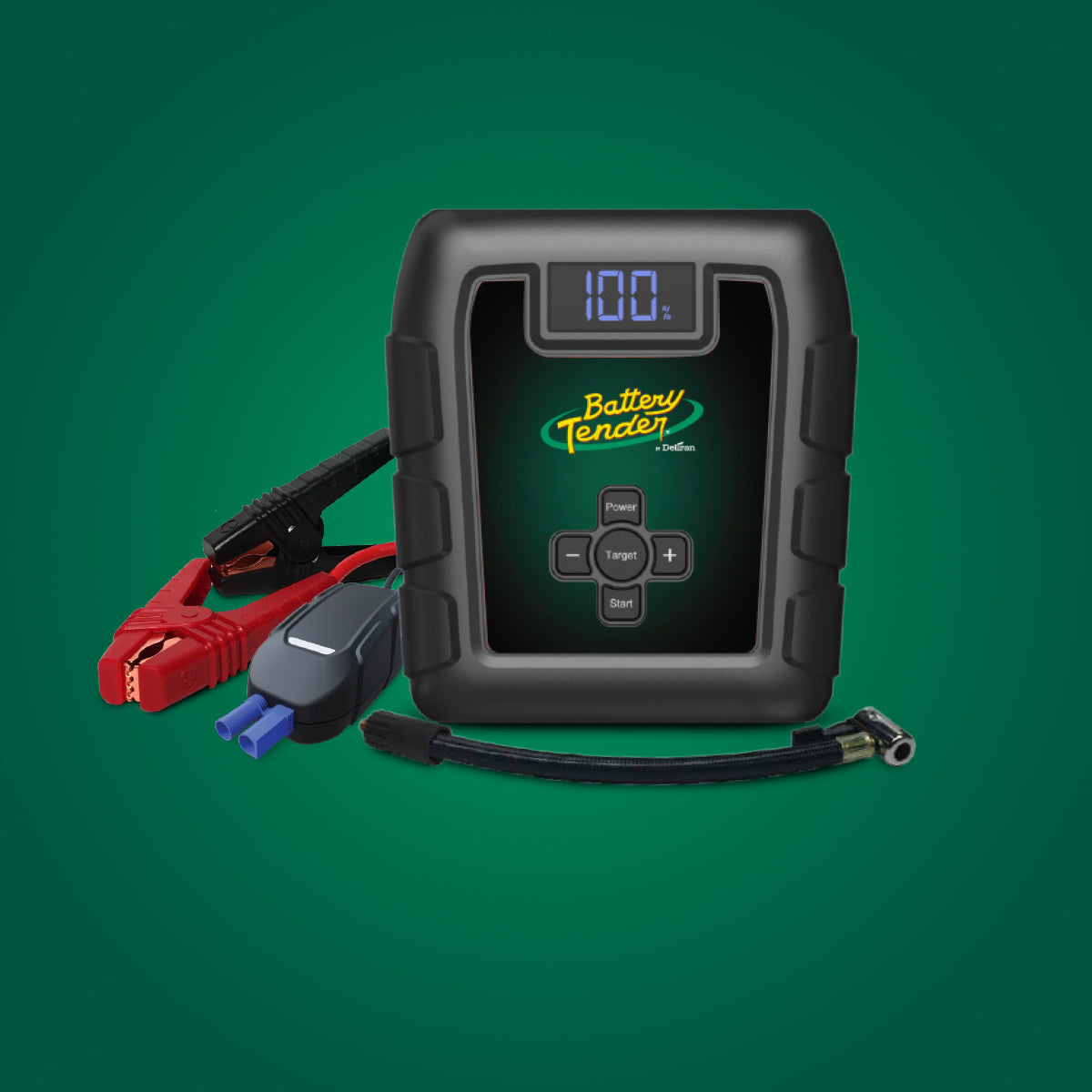
The Battery Tender 1500A Jump Starter delivers 1,500 peak amps from a 12,000 mAh lithium-ion battery pack — enough to start engines up to 7.0L gas or 5.5L diesel. It stores in a glove box or toolbox at the remote storage site, ready for the first start of the season even if the main battery has dropped below cranking threshold. Once the engine runs and the alternator begins charging, the solar panel resumes indefinite maintenance.
Battery Tender 1500A Jump Starter
For vehicles stored in truly remote locations where both solar maintenance and emergency starting capability are needed, pairing the Battery Tender 17W solar charger with a Battery Tender Charge N Start 1100 covers both bases. The Charge N Start 1100 includes a 1A smart charger for overnight plug-in recovery when outlet access becomes available, plus 1,000A jump-start capability for immediate engine cranking. Its internal lithium-ion battery holds charge for months in standby.
Battery Tender Charge N Start 1100 — 1A Battery Charger + 1000A Jump Starter
Frequently Asked Questions
Can a portable solar battery charger overcharge a battery?
Not when the charger includes a built-in charge controller. Battery Tender solar chargers regulate voltage output and taper current as the battery reaches full charge, then drop to a float maintenance level. This prevents overcharging, electrolyte boil-off, and thermal damage. Bare, unregulated solar panels without controllers can overcharge batteries and should be avoided for unattended use.
How long does a solar battery charger take to charge a dead battery?
Charging time depends on panel wattage, battery capacity, and available sunlight. Using the formula (battery Ah × depth of discharge) ÷ charger amps: a 17W panel producing ~1.0A would take approximately 50 peak-sun hours to fully recharge a 50Ah battery from empty — roughly 10–12 days. Solar chargers are designed primarily for maintenance, not rapid recovery of dead batteries.
Will a portable solar battery charger work in cloudy weather?
Yes, but at reduced output. Cloud cover typically reduces solar panel production to 10–25% of rated output, according to NREL data. A 17W panel might produce only 0.1–0.25A under heavy clouds. For battery maintenance — where the goal is offsetting 1–3% monthly self-discharge — even reduced cloudy-day output contributes meaningfully over time. Regions with frequent overcast conditions may benefit from selecting a higher-wattage panel like the 35W model.
What battery types are compatible with Battery Tender solar chargers?
Battery Tender solar chargers are compatible with all common 12V battery chemistries: conventional flooded lead-acid, AGM (Absorbed Glass Mat), GEL, and lithium (LiFePO4). The built-in charge controller adjusts voltage regulation to safe levels for each type. Always verify the specific product listing for chemistry compatibility details before connecting to a lithium battery.
Conclusion
A portable solar battery charger solves one of the most common battery problems — slow discharge during storage — without requiring any connection to the electrical grid. By combining photovoltaic panels with intelligent charge regulation, Battery Tender solar products deliver safe, automated maintenance for boats, classic cars, farm equipment, RVs, motorcycles, and any 12V battery system stored in a location where running an extension cord is impractical or impossible. The 17W mountable panel covers most single-battery applications, while 5W and 35W options scale down for small powersports batteries or up for high-capacity RV battery banks.
Explore the full lineup of solar charging solutions — from compact 5W maintainers to high-output panels with MPPT controllers — at the Battery Tender Solar Battery Chargers collection page.
Last updated: June 2026