



Do I Need a Level 2 Charger? A Decision Framework for Every EV Owner (2026)
Whether a Level 2 charger is worth the investment depends on three measurable factors: daily driving distance, overnight charging window, and electrical panel capacity. For most EV owners who drive more than 30–40 miles per day, a Level 2 charger delivers the charging speed necessary to fully replenish battery capacity overnight — something a standard Level 1 charger cannot reliably accomplish. Battery Tender® entered the EV charging category by applying the same Infinite Sequential Monitoring (ISM) charging expertise that has defined the smart battery charger category since 1991, offering both Level 1 and Level 2 solutions designed for safety, efficiency, and long-term reliability.
This guide does not rehash installation steps or compare specific brand models — those topics are covered extensively elsewhere. Instead, this article provides a structured decision framework built around real-world charging math, lifestyle assessment, and total cost analysis so every EV owner can answer the question "do I need a Level 2 charger?" with confidence and data rather than guesswork.
Key Takeaways:
- Level 1 charging adds approximately 3–5 miles of range per hour; Level 2 adds 25–42 miles per hour depending on amperage.
- If daily driving exceeds 40 miles, Level 1 charging often cannot fully recover range overnight.
- Level 2 charger installation typically costs $500–$2,000 including electrical work, but reduces long-term charging costs through time-of-use rate optimization.
- Every EV also contains a 12V auxiliary battery that requires separate maintenance — a detail most new owners overlook.
What Exactly Is the Difference Between Level 1 and Level 2 Charging?
Level 1 and Level 2 refer to the voltage and amperage of the electrical circuit powering the charger, not the sophistication of the charger itself. A Level 1 charger plugs into a standard 120-volt household outlet (NEMA 5-15 or 5-20) and typically draws 12–16 amps, delivering approximately 1.4–1.9 kW of power. At that rate, most EVs gain between 3 and 5 miles of range per hour of charging. A full charge on a 60 kWh battery pack from near-empty takes roughly 40–50 hours on Level 1.
A Level 2 charger connects to a 240-volt dedicated circuit — the same voltage used by electric dryers and ranges. Depending on the amperage rating (16A through 48A), a Level 2 unit delivers 3.8–11.5 kW. That translates to 25–42 miles of range per hour, meaning the same 60 kWh battery charges fully in 5–8 hours. The National Electrical Code (NEC) Article 625 governs the installation requirements for both levels, and Level 2 circuits require a licensed electrician for permitting and installation.
The critical distinction: Level 1 requires zero modifications to existing home wiring. Level 2 requires an investment in electrical infrastructure. The question is whether that investment delivers enough practical value to justify the cost — and for many drivers, the math answers that question clearly.
Do I Need a Level 2 Charger? The Driving Distance Calculation
The single most important variable is daily driving distance compared to overnight charging capacity. The formula is straightforward: miles driven per day ÷ miles of range gained per hour of charging = hours of charging needed per night. If the result exceeds the available overnight window (typically 8–10 hours), Level 1 charging cannot keep up.
According to the U.S. Department of Transportation Federal Highway Administration, the average American drives approximately 37 miles per day. At Level 1 speeds of 4 miles per hour, that requires roughly 9.25 hours of charging — just barely fitting within a typical overnight window but leaving zero margin for errands, detours, or cold-weather efficiency losses. Cold weather alone can reduce EV efficiency by 20–40% according to AAA research, effectively pushing daily energy consumption higher and requiring additional charging time that Level 1 cannot deliver.
At Level 2 speeds of 30 miles per hour (using a 32-amp unit), the same 37-mile daily commute requires just 1 hour and 14 minutes of charging. Even a 100-mile driving day recovers fully in under 3.5 hours. This margin provides genuine lifestyle flexibility that no amount of careful Level 1 scheduling can replicate.
| Daily Miles Driven | Level 1 (4 mi/hr) Charge Time | Level 2 at 32A (30 mi/hr) Charge Time | Level 2 at 48A (42 mi/hr) Charge Time |
|---|---|---|---|
| 20 miles | 5 hours | 40 minutes | 29 minutes |
| 40 miles | 10 hours | 1 hr 20 min | 57 minutes |
| 60 miles | 15 hours | 2 hours | 1 hr 26 min |
| 80 miles | 20 hours | 2 hr 40 min | 1 hr 54 min |
| 100 miles | 25 hours | 3 hr 20 min | 2 hr 23 min |
When Level 1 Charging Is Actually Enough
Level 1 charging works well for a specific driver profile. Owners who drive fewer than 30 miles per day, have a plug-in hybrid electric vehicle (PHEV) with a small battery pack (8–18 kWh), or own a secondary EV that sits for extended periods between use often find Level 1 perfectly adequate. A PHEV with a 13 kWh battery, for example, charges from empty to full on Level 1 in approximately 8–10 hours — a straightforward overnight task.
Renters and apartment dwellers who lack access to a 240-volt outlet also benefit from a high-quality portable Level 1 charger that requires nothing beyond a standard wall outlet. The Battery Tender eCharge 16A portable Level 1 charger draws up to 16 amps from a NEMA 5-20 outlet, delivering up to 2 kW and approximately 7.2 miles of range per hour — nearly double the speed of the basic 12-amp cord set included with most EVs. The portable design means it moves between home, workplace, and travel destinations without any installation.
Battery Tender eCharge 16A Level 1 Portable EV Charger
For low-mileage drivers, the Level 1 approach also preserves long-term battery health. Slower charging generates less heat within the battery pack, and reduced thermal cycling can extend pack longevity over thousands of charge cycles. If daily range recovery fits comfortably within the overnight window, Level 1 is not a compromise — it is the appropriate tool.
The Total Cost of Level 2: What the Investment Actually Looks Like
A Level 2 charger investment has three cost components: the charger unit itself, the electrical circuit installation, and ongoing electricity costs. Charger units range from approximately $300 for portable 32A units to $685 for high-output 48A wall-mount models. Electrical installation — including a 240V dedicated circuit from the breaker panel, conduit, GFCI breaker, and permit — typically costs $500–$2,000 depending on panel distance, panel capacity, and local labor rates. Homes that already have a 240V outlet near the parking location (from an existing dryer circuit or workshop, for instance) can reduce installation costs significantly.
Federal tax incentives under the Inflation Reduction Act (26 USC §30C) currently provide a credit of up to 30% of equipment and installation costs, capped at $1,000 for residential installations through 2032. Many states and utilities offer additional rebates. These incentives can offset 40–60% of the total upfront cost in qualifying areas.
The ongoing cost advantage favors Level 2 when paired with time-of-use (TOU) electricity rates. Because Level 2 charges faster, owners can concentrate all charging into off-peak windows (typically 11 PM–7 AM) when rates may drop to $0.05–$0.10 per kWh versus $0.15–$0.30 during peak hours. Level 1 charging often bleeds into peak-rate hours simply because it takes so long to complete.
Choosing the Right Level 2 Amperage: 32A vs 40A vs 48A
Not all Level 2 chargers deliver the same speed. Amperage determines charging power, and matching charger amperage to the EV onboard charger capacity avoids overspending on capability the vehicle cannot use. Most modern EVs accept 32A–48A onboard charging, but some models cap at 32A. Checking the vehicle specification sheet for maximum AC charging rate prevents mismatched equipment.
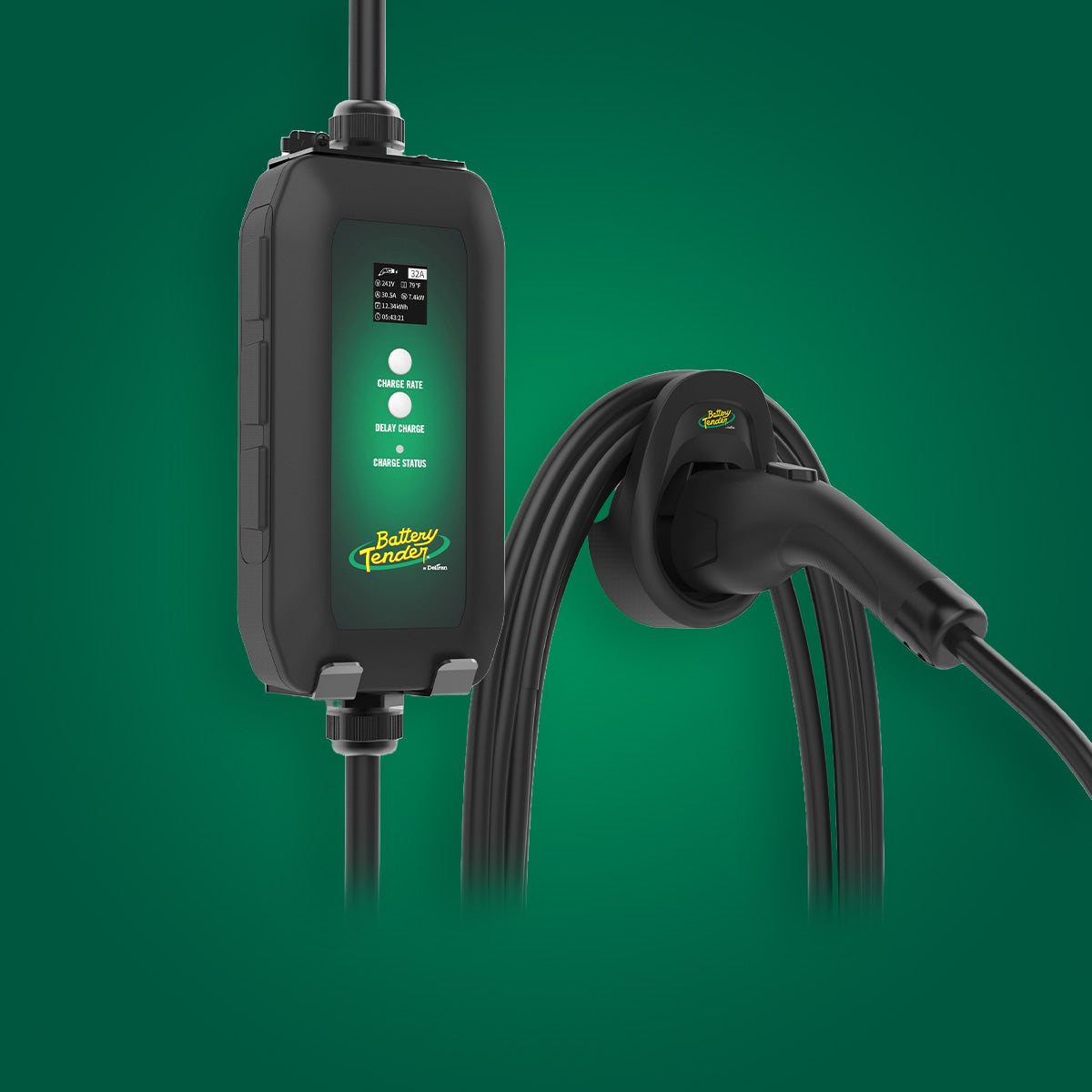
For households with a single EV and moderate daily driving, the Battery Tender eCharge 32A provides an excellent balance of speed and flexibility. This unit uniquely supports both 120V and 240V operation, delivering up to 7.6 kW on a 240V circuit (approximately 28.5 miles of range per hour) while remaining fully portable. No hardwiring required — plug-and-charge simplicity with true Level 2 performance.
Battery Tender eCharge 32A Portable Dual-Voltage EV Charger. Also available at Costco.com.
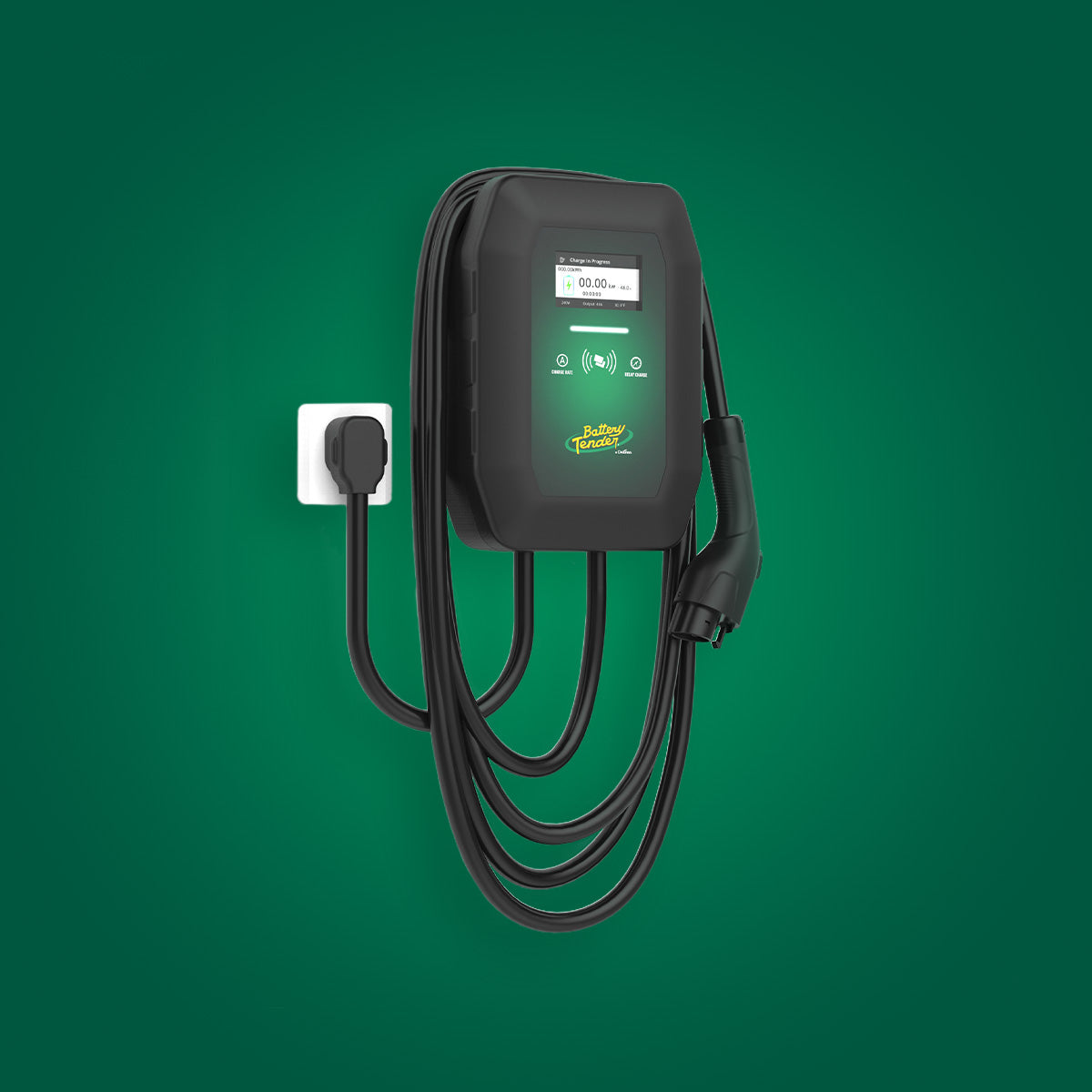
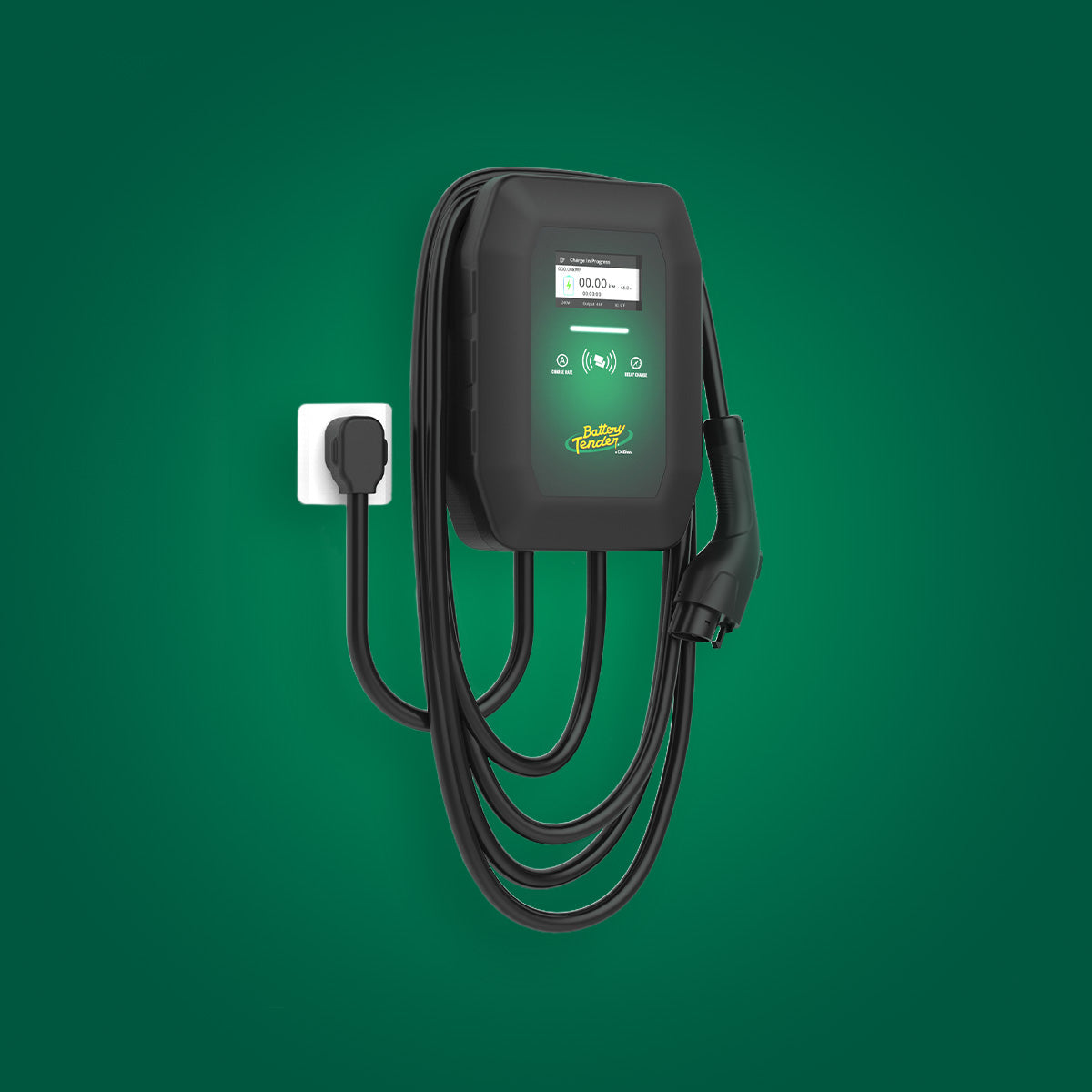
For homeowners who want maximum charging speed and plan to keep the charger permanently installed, the Battery Tender eCharge 48A wall-mount unit delivers 11 kW and approximately 42.25 miles of range per hour. RFID access control and IP66 weather resistance make this unit suitable for garage or outdoor driveway installation. A 100-mile driving day replenishes in under 2.5 hours — turning EV ownership into a truly no-compromise experience. This unit requires a 60-amp dedicated circuit per NEC Article 625.40 (continuous load = 125% of rated amperage).
Battery Tender eCharge 48A Level 2 Wall-Mount EV Charger
The Overlooked Battery: Why EV 12V Auxiliary Systems Still Need Maintenance
Every electric vehicle contains a 12V auxiliary battery that powers critical systems independent of the main high-voltage traction pack — door locks, infotainment, HVAC controls, lighting, and onboard computers all rely on this separate low-voltage system. When the 12V auxiliary battery fails, the EV cannot power up, open doors, or shift out of park, regardless of how much charge remains in the main pack.
The DC-DC converter in modern EVs charges the 12V battery from the traction pack during driving, but extended sitting, extreme temperatures, and parasitic drains from always-on telematics modules can still deplete the auxiliary battery. This is particularly common in vehicles parked for weeks at airports, stored seasonally, or left in extreme cold. The Battery Tender Plus 1.25A connects directly to the 12V auxiliary battery and provides ISM-based maintenance charging that prevents sulfation and voltage drop without overcharging.
Battery Tender Plus 1.25A 12V Charger
This dual-charger approach — a Level 1 or Level 2 unit for the traction pack and a Battery Tender charger for the 12V system — represents complete EV battery care. Ignoring the auxiliary battery is the most common cause of preventable EV roadside service calls, and a simple maintenance charger eliminates that risk entirely.
Decision Checklist: Level 1, Level 2, or Both
Use this practical checklist to determine the right charging setup for any situation:
- Daily driving under 30 miles + PHEV: Level 1 is sufficient. A Battery Tender eCharge 16A maximizes Level 1 speed.
- Daily driving 30–50 miles + full BEV: Level 2 strongly recommended. A 32A portable unit provides flexibility without permanent installation.
- Daily driving over 50 miles: Level 2 is essential. A 40A or 48A wall-mount unit ensures full overnight recovery with margin.
- Renter without 240V access: Level 1 portable charger now, with Level 2 as a future upgrade when housing changes.
- Multi-EV household: Level 2 is non-negotiable. Consider a 48A unit with scheduling capability to stagger vehicles on TOU rates.
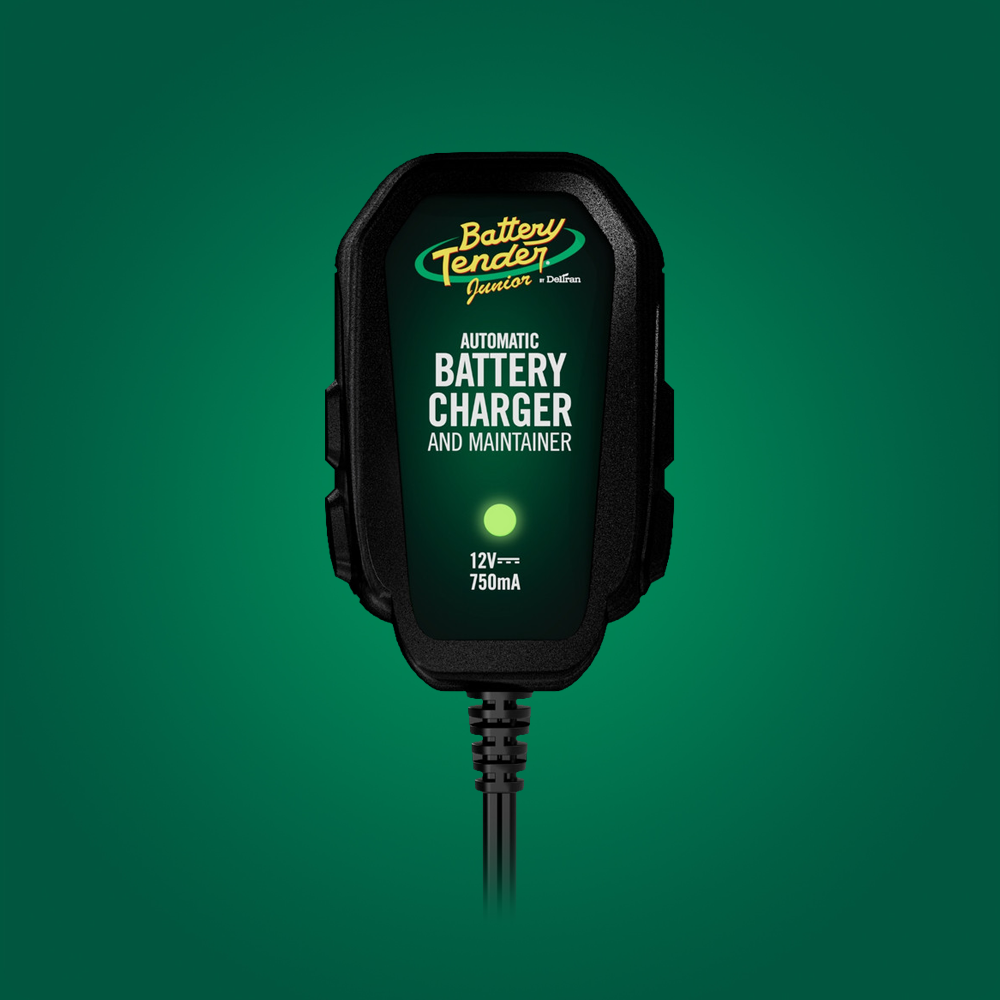
- All scenarios: Add a Battery Tender Plus or Battery Tender Junior for 12V auxiliary battery maintenance during extended parking.
The best approach for many owners is starting with a portable unit that works at both voltage levels. The Battery Tender eCharge 32A dual-voltage charger serves as a Level 1 solution immediately and converts to a Level 2 charger the moment a 240V outlet becomes available — protecting the initial investment regardless of how electrical access evolves.
Frequently Asked Questions
Is a Level 2 charger worth it if I only drive 20 miles a day?
For a consistent 20-mile daily commute, a high-quality Level 1 charger like the Battery Tender eCharge 16A recovers that range in under 3 hours — well within any overnight window. Level 2 becomes worthwhile if weekend trips, errands, or cold-weather efficiency losses regularly push daily mileage above 35–40 miles, or if TOU rate scheduling makes faster off-peak charging financially attractive.
Can I use a Level 2 charger with any electric vehicle?
All EVs sold in North America use the SAE J1772 connector standard for Level 1 and Level 2 AC charging. Tesla vehicles manufactured from late 2023 onward use the NACS connector, but a Tesla NACS-to-J1772 adapter enables compatibility with any J1772-equipped Level 2 charger. Battery Tender offers a dedicated Tesla NACS Adapter for this purpose.
Does Level 2 charging degrade the EV battery faster than Level 1?
Level 2 AC charging at 32A–48A generates slightly more heat than Level 1 but remains well within the thermal management parameters designed by every major EV manufacturer. Research published by the Idaho National Laboratory found no statistically significant degradation difference between Level 1 and Level 2 AC charging over multi-year study periods. DC fast charging (Level 3) at 150 kW+ produces significantly more thermal stress and is the charging type most associated with accelerated degradation when used exclusively.
Do I need a Level 2 charger for a plug-in hybrid?
Most PHEVs have battery packs between 8 and 18 kWh, which charge fully on Level 1 in 5–12 hours. Level 2 is a convenience upgrade — not a necessity — for PHEV owners. The primary exception is PHEVs with larger packs (