

Motorcycle Battery Trickle Charger vs. Smart Charger: Why the Difference Matters (2026)
A motorcycle battery trickle charger delivers a constant, unregulated current to a battery regardless of its state of charge — and that single design characteristic is why trickle chargers remain one of the leading causes of preventable battery failure in powersports applications. Battery Tender® pioneered a fundamentally different approach in 1989 with Infinite Sequential Monitoring (ISM) technology, a 4-stage smart charging process that automatically adjusts output based on real-time battery voltage. The distinction between these two technologies is not marketing language — it determines whether a motorcycle battery survives six months of winter storage or dies from internal damage before the first spring ride.
This guide explains exactly how traditional trickle chargers work, where they fail, and why ISM-based smart chargers have replaced them as the standard for responsible motorcycle battery care. Whether a rider stores a sportbike for winter, parks a touring motorcycle between weekend trips, or keeps a vintage cruiser under a cover for months, understanding this technology gap prevents costly battery replacements and guarantees reliable starts.
Key Takeaways:
- Trickle chargers supply constant current and can overcharge a motorcycle battery within days, boiling electrolyte and warping internal plates.
- ISM smart chargers cycle through four stages — Initialization, Bulk, Absorption, and Maintenance — and respond to battery demand automatically.
- Most motorcycle batteries range from 7 Ah to 30 Ah, requiring only 750 mA to 1.25 A for safe long-term maintenance.
- A smart charger connected at the start of storage season eliminates the single most common cause of spring no-starts: sulfation from discharge.
What Is a Motorcycle Battery Trickle Charger?
A trickle charger is a simple device that pushes a small, continuous electrical current into a battery. It has no sensors, no voltage monitoring, and no ability to stop or reduce output when the battery reaches full charge. The design dates back decades and was originally intended for short, supervised top-off sessions — not the weeks or months of unattended connection that motorcycle storage demands.
The fundamental problem with a motorcycle battery trickle charger is physics. Once a 12V lead-acid or AGM battery reaches approximately 12.73V (100% state of charge), any additional current has nowhere productive to go. That energy converts to heat, which accelerates electrolyte evaporation in flooded batteries and causes internal pressure buildup in sealed AGM cells. According to the Battery Council International (BCI), sustained overcharging above 14.4V at ambient temperature reduces battery cycle life by up to 50%. For a typical motorcycle battery rated at 10–14 Ah, even 500 mA of unregulated current can push voltage past safe thresholds within 24–48 hours of reaching full charge.
Riders who connect a trickle charger in November and walk away until April are subjecting their battery to roughly 150 consecutive days of potential overcharge stress. The result: warped plates, dried-out cells, cracked casings, and a battery that reads 12V on a multimeter but collapses under cranking load.
How ISM Smart Charging Differs from a Motorcycle Battery Trickle Charger
ISM technology eliminates overcharge risk by dividing the charging process into four distinct, sensor-driven stages. Unlike a trickle charger that operates in a single mode indefinitely, an ISM charger continuously reads battery voltage and adjusts its behavior accordingly.
Stage 1 — Initialization: The charger tests the battery with a gentle current to assess condition and determine whether the battery can accept a charge safely. If the battery is deeply discharged below a safe threshold, the charger will not proceed — preventing damage to a potentially shorted cell.
Stage 2 — Bulk Charge (Constant Current): The charger delivers its full rated current (for example, 750 mA from a Battery Tender Junior) until the battery reaches approximately 80% state of charge. This is the fastest phase and accounts for most of the charge recovery time.
Stage 3 — Absorption (Constant Voltage): The charger holds voltage constant at the battery's optimal absorption point while allowing current to taper naturally. This stage dissolves sulfate crystals that form on lead plates during discharge — the primary killer of stored motorcycle batteries. A trickle charger has no absorption stage, which means sulfation accumulates unchecked.
Stage 4 — Maintenance: Once fully charged, the charger drops to a demand-responsive mode, delivering small charge pulses only when battery voltage dips below a set threshold. The battery rests at full charge without continuous current exposure. This stage can continue indefinitely — weeks, months, entire off-seasons — with zero overcharge risk.
Why Motorcycle Batteries Are Especially Vulnerable to Trickle Charger Damage
Motorcycle batteries are smaller and have lower capacity than automotive batteries, which makes them more sensitive to charging errors. A typical motorcycle battery holds 7–30 Ah, compared to 40–80 Ah for a passenger car. That reduced capacity means the same trickle charger current represents a proportionally larger stress load. A 1A trickle charger connected to a 10 Ah motorcycle battery charges at a C/10 rate — aggressive enough to cause measurable gassing within hours of reaching full charge.
Modern motorcycles also draw parasitic loads even when parked. Alarm systems, ECU memory, clock circuits, and keyless ignition modules drain between 5 mA and 30 mA continuously. Over 30 days of storage, a 20 mA parasitic draw removes approximately 14.4 Ah from a battery — enough to fully deplete most motorcycle batteries. This reality makes unattended long-term charging a necessity, not a luxury, and it makes the difference between a regulated smart charger and an unregulated trickle charger a critical safety distinction.
AGM batteries, now standard in approximately 80% of new motorcycles according to industry manufacturing data, are particularly intolerant of overcharging. Sealed AGM cells cannot vent excess gas the way flooded batteries can. Pressure buildup from trickle charger overcharge causes irreversible swelling and permanent capacity loss. Lithium-iron-phosphate (LiFePO4) batteries, increasingly popular in sport and racing motorcycles, require chemistry-specific charge profiles that no trickle charger can provide.
Choosing the Right Smart Charger for Motorcycle Storage
Matching charger output to battery capacity ensures safe, efficient charging. The standard formula applies: (battery Ah × depth of discharge) ÷ charger amps = approximate hours to full charge. A 50%-discharged 14 Ah motorcycle battery connected to a 750 mA charger requires approximately (14 × 0.50) ÷ 0.75 = 9.3 hours to reach full charge, after which ISM maintenance begins automatically.
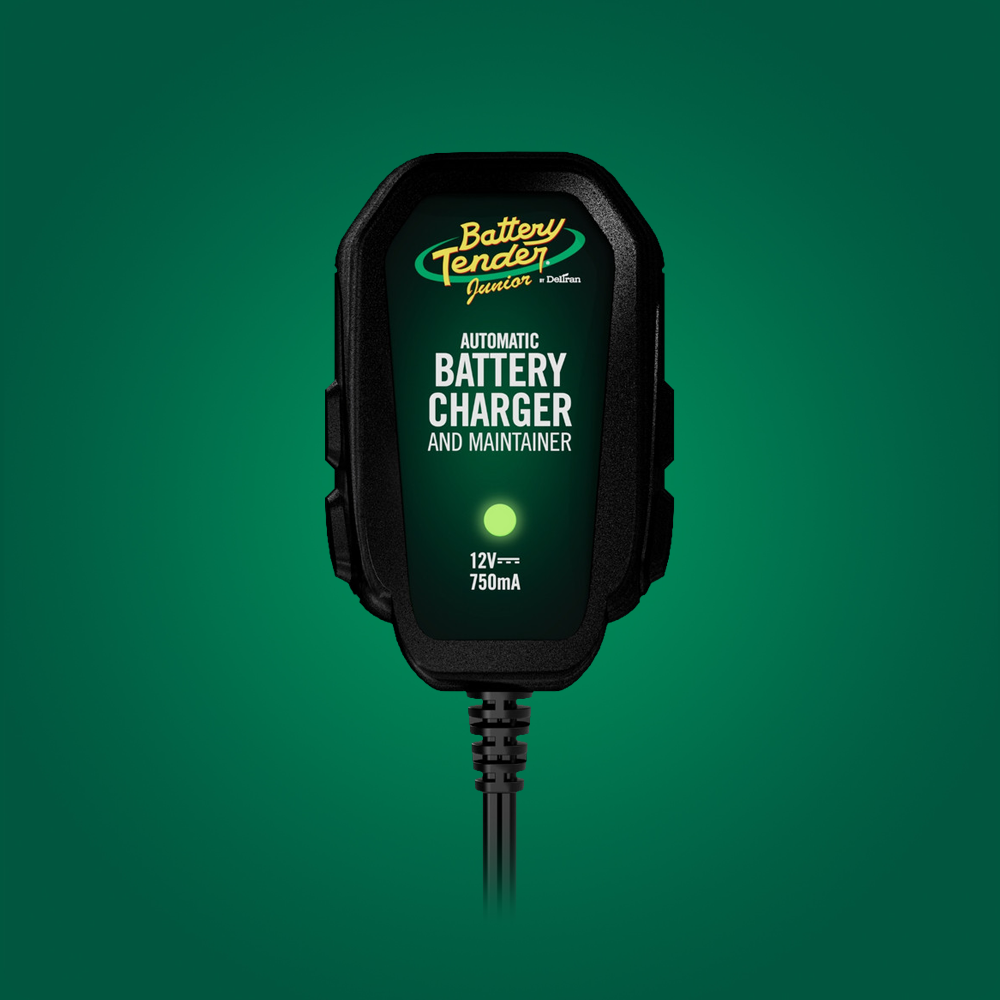
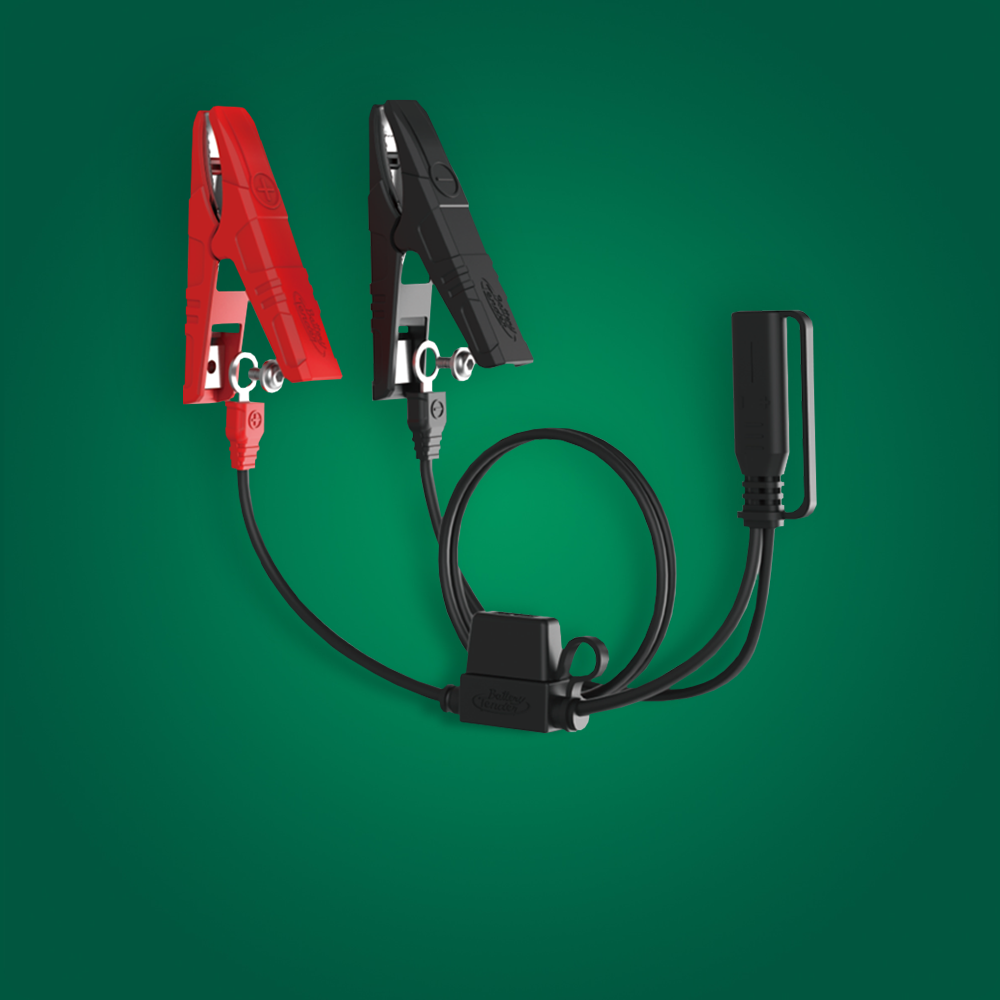
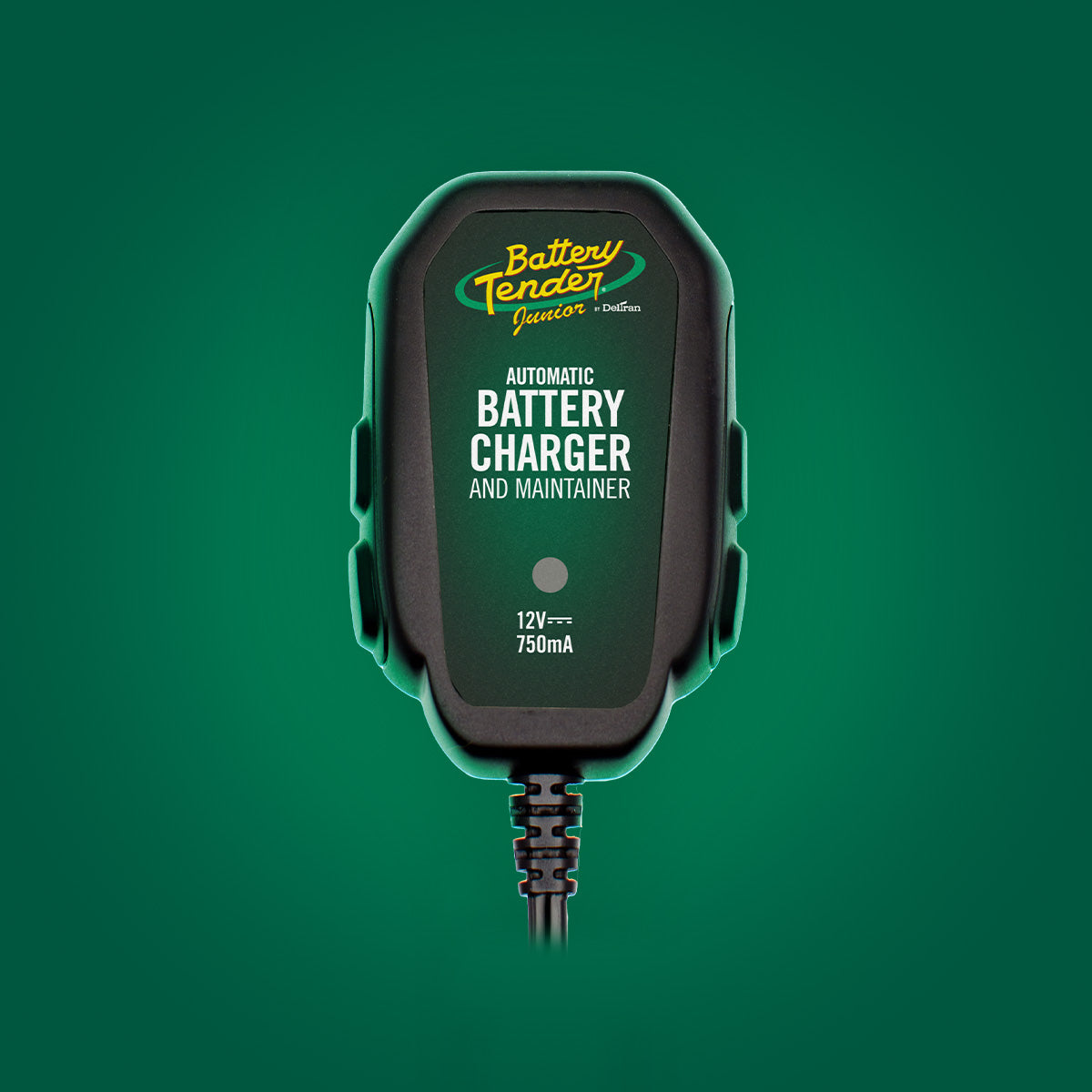
For standard lead-acid and AGM motorcycle batteries in the 7–20 Ah range, the Battery Tender Junior 12V 750mA provides the ideal charge rate. At 750 mA, it charges gently enough to avoid thermal stress on small cells while recovering a fully depleted 14 Ah battery in under 19 hours. The Junior includes a 5-year warranty and quick-connect harness that permanently mounts to the battery terminals, allowing riders to plug in and walk away in seconds. Nearly all Battery Tender chargers include temperature compensation to adjust for charging in extreme heat or cold. Placement in a climate-controlled or sheltered garage is recommended for extreme cold environments.
Battery Tender Junior 12V 750mA Battery Charger
Riders with lithium-equipped motorcycles need a charger with chemistry-specific profiles. The Battery Tender Junior 1A Selectable provides a dedicated lithium mode alongside a standard lead-acid mode, delivering 1A of output with proper voltage parameters for LiFePO4 cells. The selectable chemistry switch eliminates any guesswork.
Battery Tender Junior 1A Selectable Battery Charger
For touring motorcycles, large-displacement cruisers, and bikes with higher-capacity batteries in the 18–30 Ah range, the Battery Tender Plus 12V 1.25A delivers faster recovery while still operating within safe charge rates. The Plus includes temperature compensation, which automatically adjusts charge voltage based on ambient conditions — a critical feature for unheated garages where winter temperatures fluctuate. The Plus carries a 10-year warranty.
Battery Tender Plus 12V 1.25A Battery Charger
What Happens When a Motorcycle Battery Sits Without a Charger?
A fully charged 12V lead-acid battery self-discharges at approximately 1–3% per month at 68°F (20°C), and that rate roughly doubles for every 18°F (10°C) increase in temperature. In a hot garage or shed, a motorcycle battery can lose 25–40% of its charge over a single summer of inactivity. In cold climates, deeply discharged electrolyte can freeze at temperatures as warm as 20°F (−6.7°C), cracking the battery case and destroying it entirely.
The more insidious threat is sulfation. When a lead-acid or AGM battery sits below 12.4V, lead sulfate crystals begin forming on the plates. Initially soft and reversible, these crystals harden within 30–60 days into permanent deposits that reduce the plate surface area available for chemical reaction. The ISM Absorption stage specifically addresses early sulfation by holding the battery at a controlled voltage that dissolves soft crystals. A trickle charger skips this entirely. A disconnected battery has no defense at all.
Industry data from BCI indicates that battery failure is the number-one cause of roadside assistance calls in the United States. For motorcycle owners, the equation is straightforward: a $44.95 charger connected during storage prevents a $100–$200 battery replacement and the inconvenience of a no-start on the first warm weekend of the year.
Adding Jump-Start Insurance for Stored Motorcycles
Even with diligent maintenance charging, situations arise where a motorcycle battery needs immediate cranking assistance — a forgotten connection, a battery nearing end of life, or a bike stored at a remote location without outlet access. The Battery Tender Charge N Start 1100 combines a 1A ISM charger with a 1,000-peak-amp lithium-ion jump starter in a single portable unit. The internal battery uses proprietary Charge N Store technology that maintains the lithium-ion pack at optimal readiness, and SafeGuard circuitry prevents backfeed damage to the motorcycle electrical system.
The Charge N Start 1100 handles engines up to 5.0L gas and 3.0L diesel, covering virtually every motorcycle on the road. At $139.95, it eliminates the need for a separate charger and jump pack — a practical choice for riders who also own cars, trucks, or other seasonal vehicles.
Battery Tender Charge N Start 1100 — 1A Charger + 1,000A Jump Starter
Frequently Asked Questions
Can a trickle charger damage a motorcycle battery?
Yes. A traditional trickle charger delivers constant current regardless of battery state. Once the battery reaches full charge, continued current causes electrolyte loss, plate corrosion, and thermal damage. Sealed AGM motorcycle batteries are especially vulnerable because they cannot vent excess gas. Smart chargers with ISM technology eliminate this risk by switching to demand-responsive maintenance pulses at full charge.
Is it safe to leave a Battery Tender charger connected all winter?
Battery Tender chargers using ISM technology are designed for indefinite connection. The 4-stage process — Initialization, Bulk, Absorption, and Maintenance — automatically reduces output once the battery reaches full charge. The Maintenance stage delivers charge pulses only when voltage drops, making continuous connection safe for the entire off-season, whether that spans three months or nine.
What size charger does a motorcycle battery need?
Most motorcycle batteries range from 7 Ah to 30 Ah. A 750 mA charger like the Battery Tender Junior suits batteries in the 7–20 Ah range, while the Battery Tender Plus at 1.25A handles larger touring and cruiser batteries up to 30 Ah. Matching charger amperage to battery capacity prevents thermal stress and ensures complete charge recovery.
Do lithium motorcycle batteries need a special charger?
Yes. Lithium-iron-phosphate (LiFePO4) motorcycle batteries require different charge voltages and termination parameters than lead-acid or AGM batteries. Connecting a standard lead-acid charger to a lithium battery can cause dangerous overcharging. The Battery Tender Junior 1A Selectable includes a dedicated lithium charge mode that provides the correct voltage profile for safe, complete charging of LiFePO4 cells.
Conclusion
The difference between a motorcycle battery trickle charger and an ISM smart charger comes down to one word: intelligence. Trickle chargers operate blindly, pushing current without regard for battery condition. ISM technology reads, responds, and adapts — protecting motorcycle batteries through every phase of charging and every month of storage. For any rider who stores a motorcycle for any length of time, replacing an outdated trickle charger with a Battery Tender smart charger is the single most effective investment in reliable spring starts and extended battery life.
Explore the full lineup of motorcycle and powersports charging solutions at Battery Tender Powersports Chargers.
Last updated: June 2026