


Deep Cycle Battery Charger Guide: Choosing the Right One (2026)
A deep cycle battery charger must do more than simply push current into a battery — it must recognize each stage of the charge cycle, adapt output in real time, and prevent the sulfation that kills deep cycle batteries long before their rated lifespan expires. Unlike starting batteries that deliver short bursts of high current, deep cycle batteries discharge slowly to 50% or deeper hundreds of times over their service life. That repeated cycling demands a charger intelligent enough to restore full capacity without damaging the plates. Battery Tender® pioneered this approach in 1989 with Infinite Sequential Monitoring (ISM), a proprietary 4-stage charging process that makes safe, indefinite connection possible.
This guide explains exactly how deep cycle batteries differ from starting batteries, why standard trickle chargers destroy them, how to match charger amperage to battery capacity, and which ISM-equipped chargers deliver the best results for boats, RVs, solar banks, trolling motors, and off-grid systems in 2026. The goal is straightforward: help every deep cycle battery reach — and exceed — its full rated cycle life.
Key Takeaways:
- Deep cycle batteries require chargers that complete all four charge stages — Initialization, Bulk, Absorption, and Float Maintenance — to prevent sulfation and capacity loss.
- Constant-current trickle chargers can overcharge and permanently damage deep cycle batteries within months.
- Matching charger amperage to battery amp-hour (Ah) capacity determines both charge time and battery longevity.
- ISM technology from Battery Tender enables safe indefinite connection, extending deep cycle battery life from a typical 2–3 years to 5 years or more.
- Chemistry-selectable chargers handle standard flooded, AGM, GEL, and lithium deep cycle batteries with a single unit.
What Makes Deep Cycle Batteries Different from Starting Batteries?
Deep cycle batteries use thicker lead plates and denser active material than starting batteries. This construction allows them to deliver sustained current over hours rather than the brief high-amperage burst a starting battery provides to crank an engine. According to the Battery Council International (BCI) classification system, deep cycle batteries are rated primarily by amp-hours (Ah) and cycle life at a specified depth of discharge (DOD), while starting batteries emphasize cold cranking amps (CCA).
A typical deep cycle battery is designed to be discharged to 50% state of charge (SOC) or deeper across 300–1,500 cycles, depending on chemistry. Flooded lead-acid deep cycle batteries generally deliver 300–500 cycles at 50% DOD. AGM deep cycle batteries reach 500–800 cycles. Lithium iron phosphate (LiFePO4) deep cycle batteries can exceed 2,000 cycles at 80% DOD. Each chemistry requires different charge voltage profiles — a critical consideration when selecting a deep cycle battery charger.
The charging challenge with deep cycle batteries is the Absorption stage. After the Bulk stage brings the battery to approximately 80% SOC, a deep cycle battery needs an extended period at constant voltage with tapering current to dissolve sulfate crystals from the plates and push charge into the remaining 20% of capacity. Chargers that skip or shorten this stage leave deep cycle batteries chronically undercharged — a condition that accelerates sulfation and can reduce a 5-year battery to a 2-year battery.
Why Trickle Chargers Damage Deep Cycle Batteries
Trickle chargers deliver constant current regardless of battery state. A trickle charger has no mechanism to detect when a deep cycle battery reaches full charge, so it continues forcing current into the battery after 100% SOC is achieved. This overcharging causes electrolysis — the breakdown of water in the electrolyte into hydrogen and oxygen gas. In flooded batteries, overcharging boils off electrolyte and exposes the plates to air. In sealed AGM and GEL batteries, excess gas pressure can vent through the safety valves, permanently reducing capacity since the lost electrolyte cannot be replaced.
The U.S. Department of Energy estimates that overcharging reduces lead-acid battery life by up to 50% compared to properly maintained batteries. For a deep cycle battery rated at 500 cycles, that means losing 250 cycles — potentially two or more years of service. The financial impact is significant: replacing a quality AGM deep cycle battery costs $200–$400, and many RV and marine systems use two or more batteries in a bank.
Float chargers represent an improvement over trickle chargers because they hold a constant voltage rather than constant current. However, float chargers lack a dedicated Absorption stage. They reach the target voltage quickly during initial charging but cannot provide the sustained constant-voltage/tapering-current profile that deep cycle batteries need to fully dissolve sulfate buildup. The result is chronic undercharging — the opposite extreme, but equally damaging over time.
How Does a Deep Cycle Battery Charger with ISM Technology Work?
ISM technology from Battery Tender provides the complete 4-stage charging process that deep cycle batteries require. Each stage serves a specific electrochemical purpose, and the charger transitions between stages automatically based on real-time voltage and current measurements.
Stage 1: Initialization — The charger applies a gentle test current to evaluate battery condition. This stage detects whether the battery can accept charge safely and identifies severely sulfated or damaged batteries before applying full current. For deep cycle batteries that have been sitting in storage at low SOC, Initialization prevents the thermal shock that occurs when a high-current charger hits a deeply discharged battery.
Stage 2: Bulk Charge — Full rated current flows into the battery at a constant rate until the battery reaches approximately 80% SOC. This is where charger amperage matters most. A higher-amperage charger completes Bulk Charge faster, but the amperage must remain within the battery manufacturer's recommended charge rate — typically 10–25% of the battery's Ah capacity.
Stage 3: Absorption — The charger holds voltage constant while current tapers naturally as the battery approaches full charge. This is the critical stage for deep cycle batteries. During Absorption, lead sulfate crystals that formed during discharge are dissolved back into the electrolyte. Chargers that truncate this stage leave sulfate on the plates, progressively reducing usable capacity with each cycle.
Stage 4: Float Maintenance — Once the battery reaches 100% SOC, ISM drops to a demand-responsive mode. The charger delivers brief charge pulses only when voltage drops below a set threshold, then returns to monitoring. This makes ISM-equipped chargers safe to leave connected indefinitely — days, weeks, or entire storage seasons — without risk of overcharging. For deep cycle batteries in seasonal boats, stored RVs, or backup solar banks, this stage is what separates smart maintenance from slow destruction.
How to Match Charger Amperage to Deep Cycle Battery Capacity
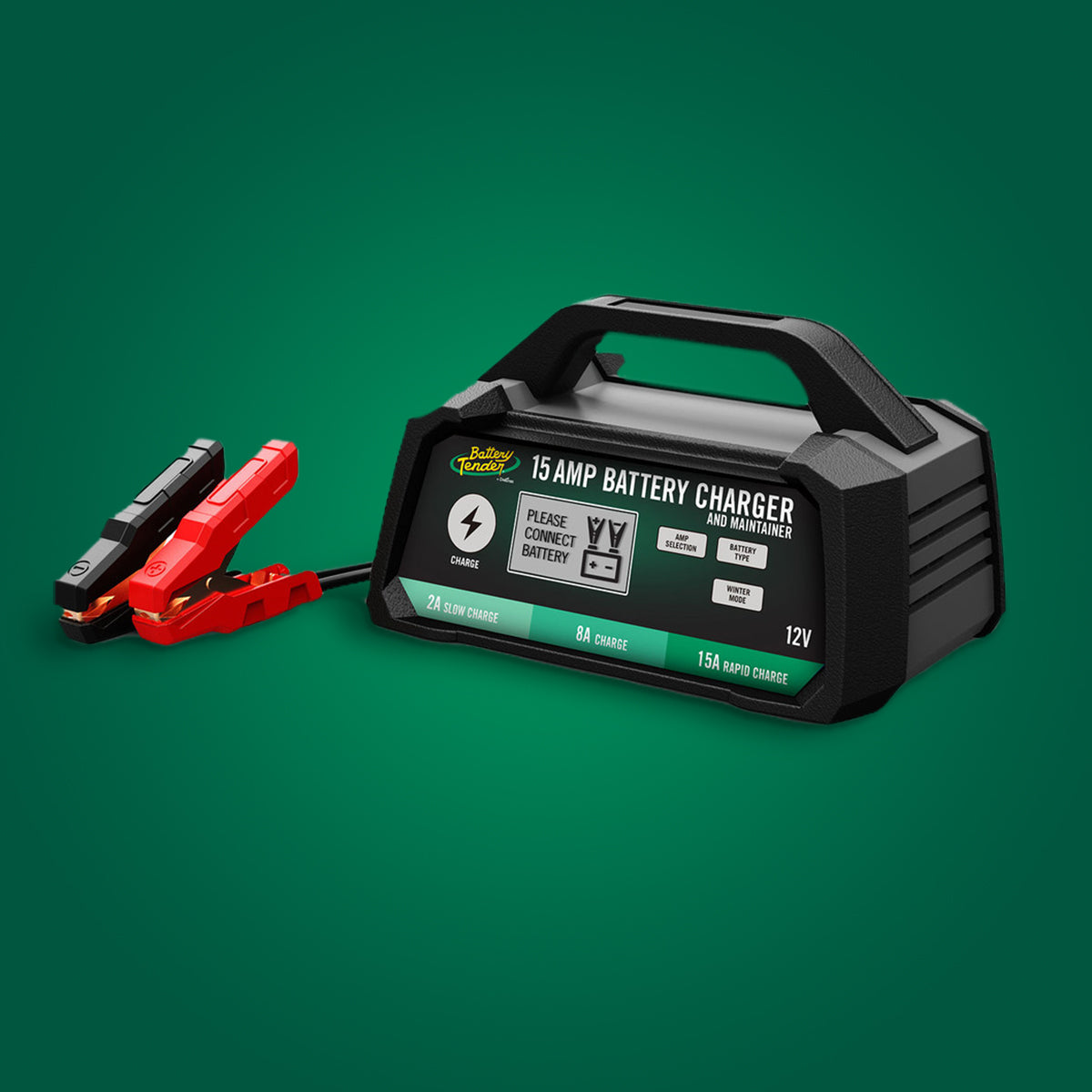
Selecting the correct amperage for a deep cycle battery charger requires a simple formula: (Battery Ah × depth of discharge) ÷ charger amps = approximate charge time in hours. Most battery manufacturers recommend a charge rate between 10% and 25% of the battery's Ah rating. Charging too fast generates excess heat and can warp plates. Charging too slowly extends the time the battery spends in a partially discharged state, which promotes sulfation.
For example, a 100Ah AGM deep cycle battery discharged to 50% SOC contains 50Ah of deficit. At an 8A charge rate: 50Ah ÷ 8A = approximately 6.25 hours for the Bulk stage, plus 2–4 hours for Absorption. At 750mA (0.75A): 50Ah ÷ 0.75A = approximately 66.7 hours — nearly three days. The 8A charger is appropriate for restoration charging and regular cycling. The 750mA charger is ideal for maintenance on smaller deep cycle batteries in the 2–30Ah range, such as those found in powersports applications and small trolling motor setups.
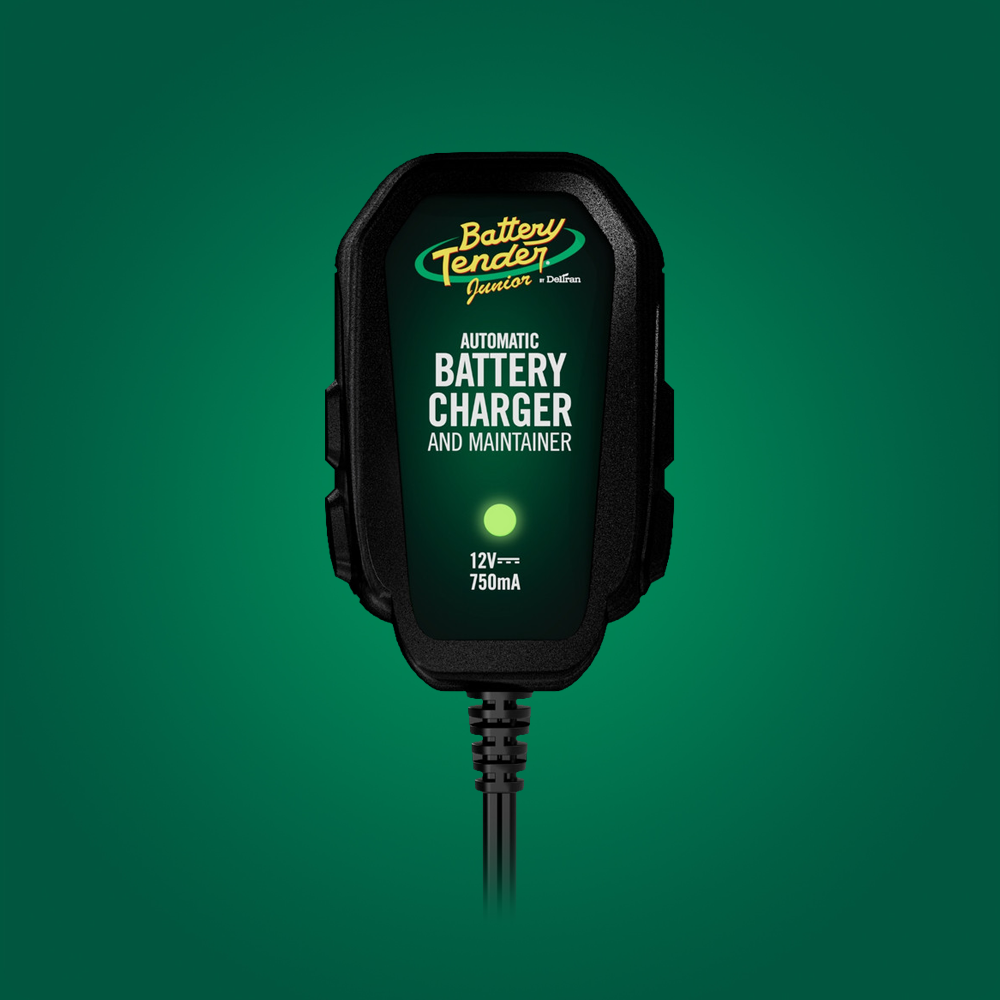
Battery Tender offers ISM chargers across the full amperage spectrum for deep cycle applications. For smaller deep cycle batteries used in motorcycles, PWC, and compact trolling motors, the Battery Tender Junior provides 750mA of ISM-controlled charging optimized for batteries in the 2–30Ah range. It includes a 5-year warranty and delivers reliable maintenance charging during storage seasons.
Battery Tender Junior 12V 750mA Battery Charger
For deep cycle batteries that serve dual chemistry applications — or for owners transitioning from lead-acid to lithium deep cycle batteries — the Battery Tender Junior 1A Selectable handles both lead-acid and lithium chemistries with a simple switch. The 1A output suits deep cycle batteries up to approximately 10Ah for full recovery, and larger batteries for float maintenance.
Battery Tender Junior 1A Selectable 12V Battery Charger
Choosing a Deep Cycle Battery Charger for Large Battery Banks
RVs, boats with house battery systems, and solar energy storage banks typically use deep cycle batteries in the 75–200Ah range — sometimes configured in parallel banks exceeding 400Ah total capacity. These systems need charger amperage high enough to complete the Bulk stage in a reasonable timeframe while still providing the precise Absorption and Float Maintenance stages that protect battery longevity.
The Battery Tender 8A/2A Battery Tender Power Tender (SKU 022-1005-DL-WH) delivers selectable 8A or 2A charging with IP65 weather resistance, making it suitable for permanent outdoor installation in RV bays, boat engine compartments, and solar equipment sheds. At 8A, a 100Ah deep cycle battery discharged to 50% reaches full charge in roughly 6–8 hours including Absorption. The unit also includes a 6A power supply mode for running accessories during diagnostic work — a feature unavailable from conventional chargers. Lithium deep cycle battery support is built in.
Battery Tender 8A/2A Battery Tender Power Tender 12V Battery Charger (SKU 022-1005-DL-WH)
For deep cycle batteries installed in environments where ambient temperature varies significantly — unheated garages, boat bilges, RV storage during winter — chargers from the Battery Tender Plus tier and above automatically adjust charge voltage based on temperature sensor readings. This prevents undercharging in cold conditions and overcharging in heat, both of which degrade deep cycle battery plates over time. The Battery Tender Plus 1.25A 12V covers batteries in the 14–80Ah range with temperature compensation and carries an industry-best 10-year warranty.
How Sulfation Kills Deep Cycle Batteries — and How ISM Prevents It
Sulfation is the single largest cause of premature deep cycle battery failure. During discharge, lead sulfate crystals form naturally on the battery plates as part of the electrochemical reaction. In a healthy charge cycle, the Absorption stage dissolves these crystals back into sulfuric acid in the electrolyte. But when a battery sits at partial charge — or when a charger skips the Absorption stage — those soft sulfate crystals harden into a crystalline structure that resists dissolution. Hardened sulfation permanently blocks active plate surface area, reducing the battery's ability to accept and deliver charge.
The IEEE Standard 450-2010 for maintenance of lead-acid batteries identifies chronic undercharging and extended storage at partial SOC as primary causes of sulfation-related capacity loss. Deep cycle batteries are especially vulnerable because their duty cycle involves repeated deep discharges followed by recharging — each cycle must complete fully, or sulfation accumulates.
ISM addresses sulfation through two mechanisms. First, the Absorption stage runs for as long as the battery needs it — ISM monitors current taper and does not advance to Float Maintenance until the battery signals full charge. Second, during Float Maintenance, periodic charge pulses prevent the slow self-discharge (typically 2–5% per month for lead-acid) that would otherwise allow sulfation to restart during storage. This combination extends deep cycle battery life from the typical 2–3 year replacement cycle to 5 years or more of reliable service.
Emergency Readiness: Jump Starting a Vehicle with a Dead Deep Cycle System
Deep cycle batteries used as house batteries in RVs, boats, and off-grid systems sometimes share a vehicle electrical system with a starting battery. When the starting battery fails — often because house loads accidentally drained it — a portable jump starter provides immediate recovery without needing a second vehicle or shore power connection.
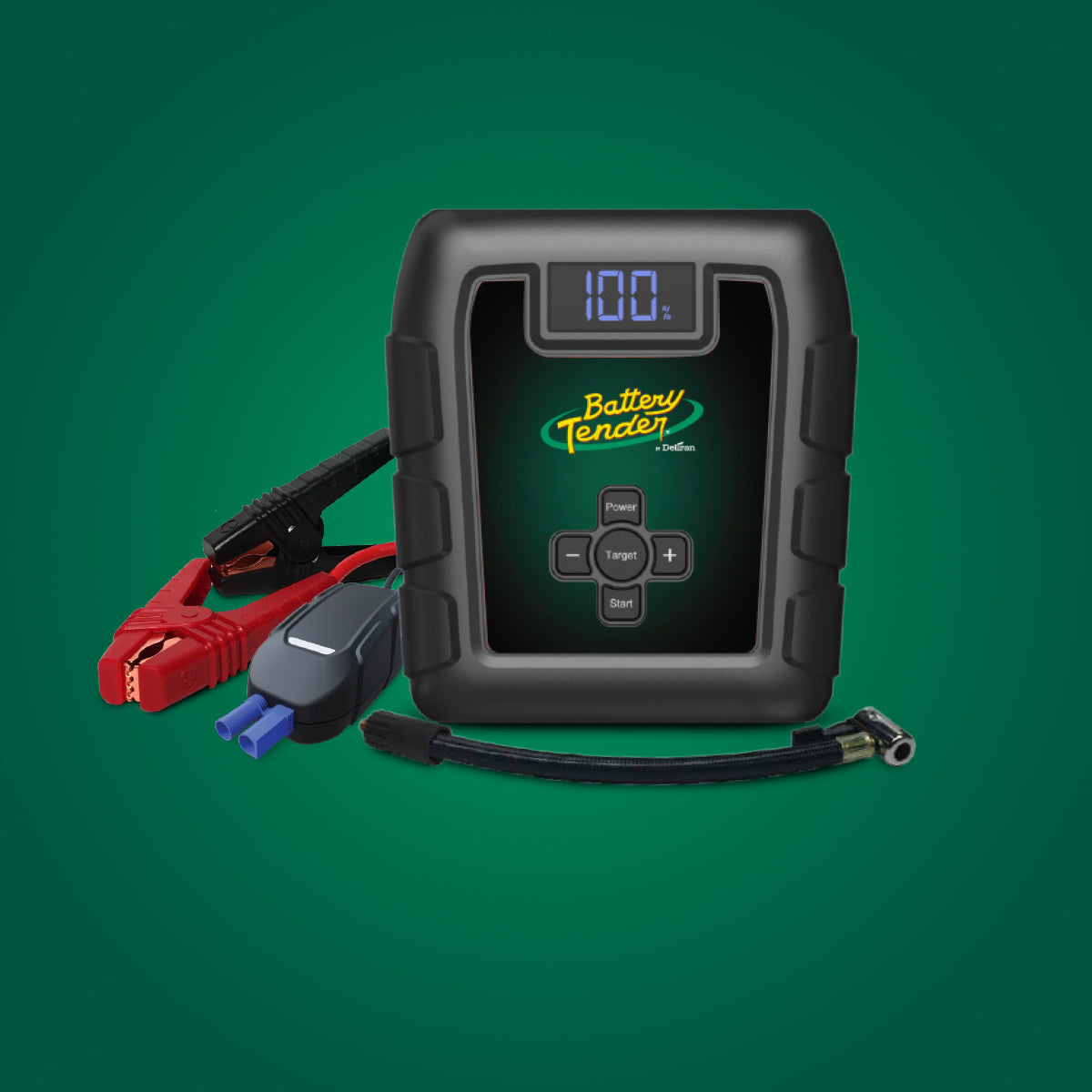
The Battery Tender Charge N Start 4120 combines a 4A ISM charger with a 1,200A lithium-ion jump starter in a single unit. The 4A charger can maintain deep cycle batteries up to approximately 40Ah during storage, while the jump start function handles engines up to 6.0L gas or 4.0L diesel. The proprietary Charge N Store technology maintains the internal lithium-ion jump start pack at optimal charge, and SafeGuard circuitry prevents backfeed that could damage vehicle electronics.
Battery Tender Charge N Start 4120 — 4A Charger + 1,200A Jump Starter
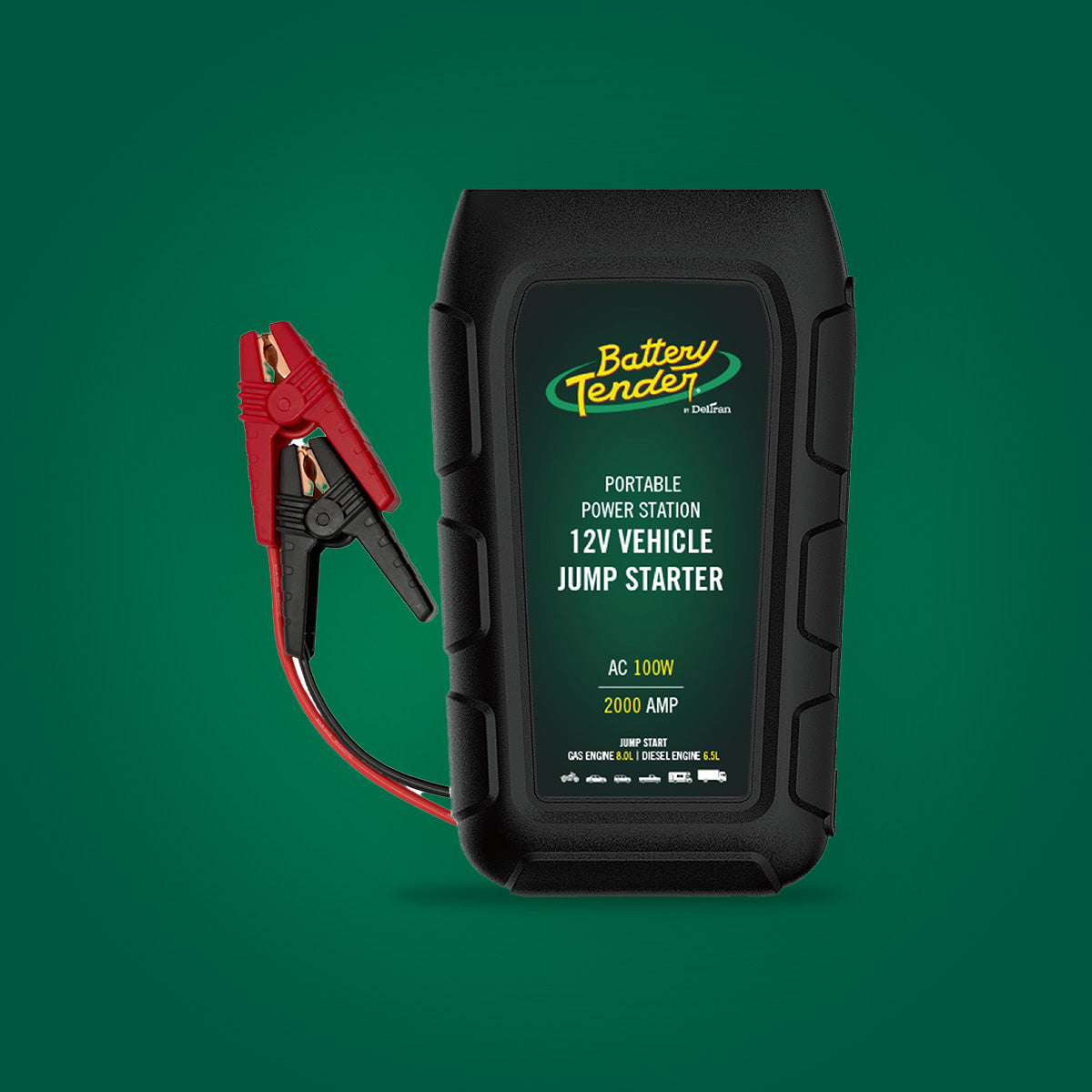
For lighter-duty needs, the Battery Tender 1500A Jump Starter provides 1,500 peak amps from a 12,000 mAh lithium-ion pack capable of approximately 40 starts per charge. It handles engines up to 7.0L gas or 5.5L diesel, making it suitable for trucks and large SUVs that may also run deep cycle auxiliary battery systems.
Battery Tender 1500A Portable Jump Starter
Frequently Asked Questions
Can a deep cycle battery charger be left connected indefinitely?
An ISM-equipped deep cycle battery charger from Battery Tender can remain connected indefinitely without risk of overcharging. During the Float Maintenance stage, the charger delivers brief charge pulses only when battery voltage drops below a set threshold, then returns to monitoring. This demand-responsive approach eliminates the electrolyte boiling and plate damage caused by constant-current trickle chargers. It is the safest method for seasonal storage of boats, RVs, and off-grid systems.
What amperage deep cycle battery charger do I need?
Select a charger rated at 10–25% of the battery's Ah capacity for primary charging. A 100Ah deep cycle battery pairs well with an 8A–10A charger. For maintenance-only applications on smaller batteries in the 2–30Ah range, a 750mA to 1.25A charger is sufficient. Use the formula: (Ah × depth of discharge) ÷ charger amps = approximate charge hours. Oversizing the charger generates excess heat; undersizing extends charge time and sulfation exposure.
Can I use the same charger for AGM, GEL, and lithium deep cycle batteries?
Chemistry-selectable Battery Tender chargers like the Battery Tender Junior 1A Selectable and the Battery Tender 8A/2A Battery Tender Power Tender (SKU 022-1005-DL-WH) support standard flooded lead-acid, AGM, GEL, and lithium deep cycle batteries. A physical switch or selector sets the correct voltage profile for each chemistry. Using the wrong profile can overcharge or undercharge the battery, so always verify the setting before connecting.
How long does it take to charge a deep cycle battery from 50% to full?
Charge time depends on battery capacity and charger amperage. A 100Ah deep cycle battery at 50% SOC has a 50Ah deficit. At 8A, the Bulk stage takes approximately 6.25 hours, plus 2–4 additional hours for the Absorption stage — roughly 8–10 hours total. At 1.25A, the same battery requires approximately 40 hours for Bulk alone. Larger battery banks in parallel take proportionally longer unless a higher-amperage charger is used.
Conclusion
Choosing the right deep cycle battery charger determines whether a battery reaches its full rated cycle life or fails years early from sulfation and overcharging. ISM technology from Battery Tender provides the complete 4-stage charging process — Initialization, Bulk Charge, Absorption, and Float Maintenance — that deep cycle batteries demand for every chemistry, from flooded lead-acid to AGM, GEL, and lithium. By matching charger amperage to battery capacity and selecting a unit with temperature compensation for variable-temperature installations, deep cycle battery owners protect their investment and maintain reliable power across seasons of use.
Explore the full lineup of ISM-equipped chargers and maintainers at Battery Tender Battery Chargers.