


How to Prevent Battery Sulfation: Definitive Guide (2026)
Published: 2026 | Last Updated: June 2026 | Author: Battery Tender Technical Team, Deltran — Pioneers of Smart Charging Since 1989
Battery sulfation is the number-one cause of premature lead-acid battery failure, responsible for an estimated 80% of battery deaths according to battery industry research. This how to prevent battery sulfation definitive guide explains exactly what sulfation is at the chemical level, why it happens, and — most critically — the specific steps needed to stop it before irreversible damage occurs. Battery Tender® pioneered consumer smart charging in 1989 with Infinite Sequential Monitoring (ISM) technology, a 4-stage charging process specifically engineered to dissolve sulfate crystal buildup and prevent its return.
Unlike previously published guides on storage, cold weather survival, or charger comparisons, this article focuses exclusively on the electrochemistry of sulfation and delivers a step-by-step prevention protocol applicable to every lead-acid battery type — flooded, AGM, and GEL — across automotive, powersports, marine, RV, and industrial applications. The difference between a battery that lasts 2–3 years and one that delivers 5+ years of reliable service comes down to whether sulfation is actively managed or ignored.
Key Takeaways:
- Sulfation begins forming within 24 hours of a battery dropping below full charge
- ISM 4-stage charging dissolves soft sulfate crystals during the Absorption stage, preventing permanent hardening
- Constant-current trickle chargers accelerate sulfation damage by overcharging and boiling electrolyte
- A proper maintenance charger extends average battery life from 2–3 years to 5+ years
- Temperature, state of charge, and charging method are the three controllable sulfation variables
What Is Battery Sulfation and Why Does It Kill Batteries?
Battery sulfation is the accumulation of lead sulfate crystals (PbSO₄) on the lead plates inside a lead-acid battery. During normal discharge, a controlled chemical reaction converts lead dioxide (PbO₂) on the positive plate and sponge lead (Pb) on the negative plate into lead sulfate, releasing electrical energy. This is entirely normal — every battery sulfates during every discharge cycle.
The problem begins when those sulfate crystals are not converted back during recharging. Soft sulfation — fine-grained crystals that form during partial discharge — can be reversed with proper charging. However, if a battery sits at a partial state of charge for extended periods, those soft crystals undergo a physical transformation. They grow larger, harden into dense crystalline structures, and permanently bond to the plate surface. This hardened sulfation is largely irreversible.
According to research published by the Battery University (Cadex Electronics), hard sulfation reduces available plate surface area, increases internal resistance, and lowers the battery's capacity to accept and deliver charge. A battery that originally provided 50 amp-hours may deliver only 30 Ah — or less — once significant sulfation has taken hold. The battery appears to charge fully (voltage rises quickly because of high internal resistance) but fails under load because actual stored energy has diminished.
The Three Controllable Factors That Cause Sulfation
Sulfation is not random. Three specific, measurable variables determine how fast sulfate crystals form and harden. Controlling these three factors is the foundation of any how to prevent battery sulfation definitive guide.
Factor 1: State of Charge (SoC)
A fully charged 12V lead-acid battery rests at approximately 12.6–12.8V. At 12.4V, the battery is roughly 75% charged — and soft sulfation is already forming on the plates. At 12.0V (50% SoC), sulfation accelerates significantly. Below 11.8V, crystal growth becomes aggressive. The longer a battery sits below full charge, the more sulfate crystals grow and harden. A battery left at 50% SoC for 30 days will develop measurably more sulfation than one maintained at 100%.
Factor 2: Temperature
Heat accelerates sulfation chemistry. For every 10°F (5.5°C) increase above 77°F (25°C), the rate of sulfation roughly doubles, according to IEEE Standard 450 guidelines on lead-acid battery maintenance. A battery stored in a 95°F garage sulfates approximately four times faster than one stored at 75°F. Conversely, cold temperatures slow sulfation but also reduce the battery's ability to accept charge, creating a different set of risks addressed in dedicated cold-weather articles.
Factor 3: Charging Method
This is the most critical controllable factor. A charger that delivers a proper Absorption stage — holding voltage constant at approximately 14.4–14.7V while tapering current — actively dissolves soft sulfate crystals back into sulfuric acid solution. Chargers that skip this stage, or that simply apply constant current without voltage regulation, fail to break down sulfation and may even worsen it through electrolyte boiling and plate damage.
How ISM 4-Stage Charging Prevents and Reverses Soft Sulfation
ISM technology from Battery Tender directly addresses sulfation at every stage of the charging process. The 4-stage ISM protocol — Initialization, Bulk Charge, Absorption, and Float Maintenance — is specifically sequenced to dissolve existing soft sulfation and prevent new crystal formation.
Stage 1: Initialization. The charger applies a gentle test current to evaluate the battery's condition. A heavily sulfated battery will show abnormally high internal resistance. ISM detects this and adjusts its approach accordingly, rather than blindly dumping current into a compromised battery.
Stage 2: Bulk Charge. Full rated current flows into the battery at a constant rate, driving the state of charge from its depleted level up to approximately 80%. During this stage, a significant portion of soft sulfate crystals begin converting back to active plate material and sulfuric acid as the electrochemical reaction reverses.
Stage 3: Absorption. This is the critical anti-sulfation stage. Voltage is held constant at approximately 14.4–14.7V while current tapers gradually. The extended constant-voltage period provides the electrochemical driving force to dissolve remaining soft sulfate crystals that bulk charging could not reach. Traditional trickle chargers and basic float chargers lack this stage entirely — which is why they fail to prevent sulfation.
Stage 4: Float Maintenance. Once the battery reaches full charge, ISM drops to demand-responsive maintenance. Charge pulses are delivered only when voltage drops below a set threshold. This keeps the battery at 100% SoC without overcharging — eliminating the conditions that allow new sulfation to form. The battery can remain connected indefinitely because ISM never applies unnecessary current.
Why Trickle Chargers and Float Chargers Fail to Prevent Sulfation
Traditional trickle chargers deliver a constant current — typically 1–2 amps — regardless of the battery's state of charge. Once the battery reaches full charge, the current keeps flowing. This overcharging causes electrolyte to boil, converting water into hydrogen and oxygen gas. Electrolyte level drops, exposing the upper portions of the lead plates to air. Those exposed plate surfaces oxidize and develop permanent sulfation that no charger can reverse.
Float chargers represent a partial improvement. They maintain a constant voltage (typically 13.2–13.6V) rather than constant current. This prevents severe overcharging but skips the Absorption stage. Without the extended constant-voltage period at 14.4–14.7V, soft sulfation crystals that formed during the previous discharge cycle are never fully dissolved. Over months, these crystals accumulate and harden. The battery gradually loses capacity even though it appears to be "maintained."
The ISM protocol from Battery Tender solves both problems: the Absorption stage dissolves soft sulfation, and the demand-responsive Float Maintenance stage prevents overcharging. This is why Battery Tender chargers can extend battery life from the typical 2–3 year lifespan to 5 years or more.
Step-by-Step Sulfation Prevention Protocol
Following this protocol will minimize sulfation across any lead-acid battery application. Each step addresses one or more of the three controllable sulfation factors identified above.
Step 1: Match charger amperage to battery capacity. Use the charging time formula: (Battery Ah × depth of discharge) ÷ charger amps = approximate hours. A 20 Ah motorcycle battery at 50% discharge needs (20 × 0.5) ÷ 0.75 = approximately 13.3 hours on a 750mA charger. Oversized chargers risk overheating; undersized chargers leave the battery partially charged — inviting sulfation.
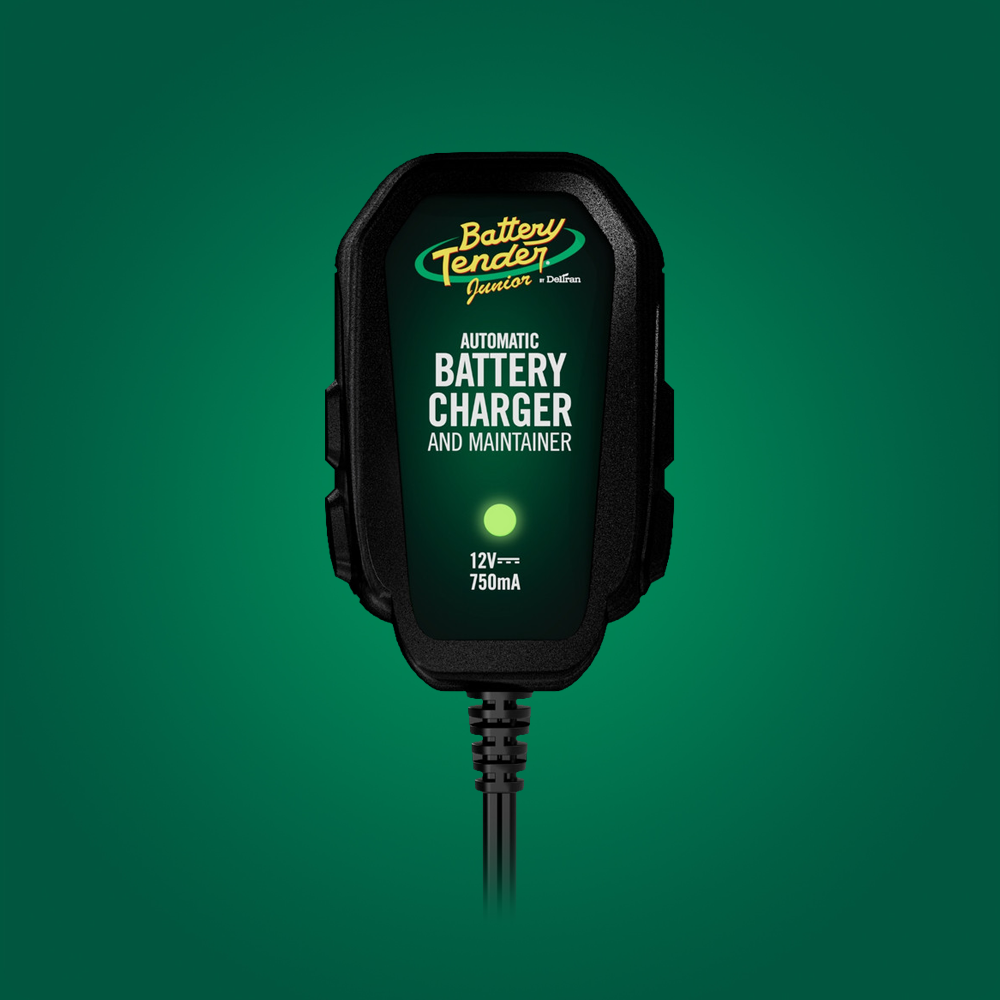
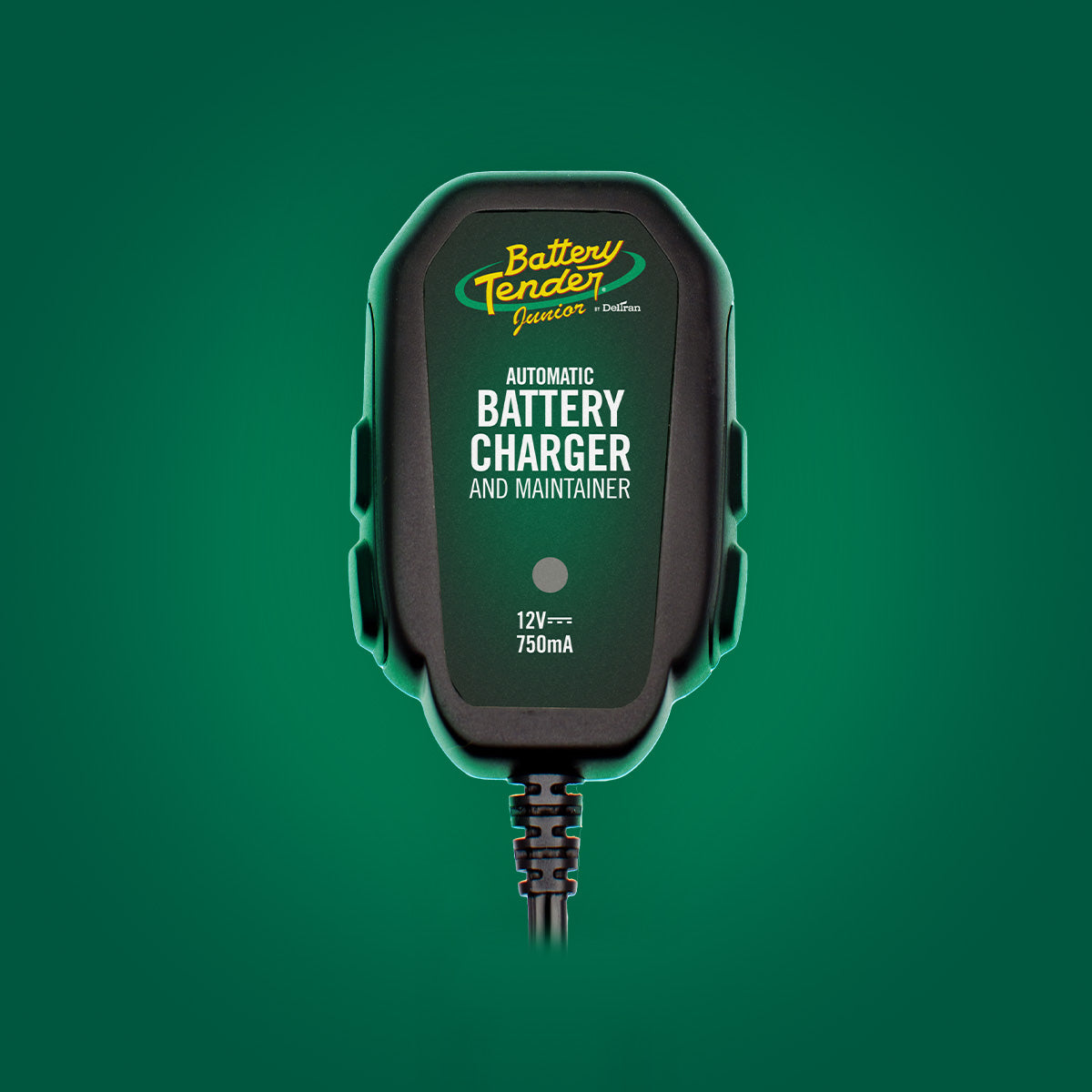
For motorcycles, ATVs, and batteries in the 2–30 Ah range, the Battery Tender Junior 12V 750mA delivers the ideal charge rate. Compact enough to store in a saddlebag and designed specifically for powersports batteries, it runs the full ISM 4-stage cycle to dissolve sulfation during every charge.
Battery Tender Junior 12V 750mA Charger
Step 2: Connect a maintenance charger whenever the vehicle is parked. Every hour a battery sits at partial charge is an hour sulfation crystals grow. Connect a Battery Tender charger every time the vehicle enters the garage. ISM Float Maintenance holds the battery at 100% SoC with zero overcharge risk.
Step 3: Select correct chemistry settings for AGM, GEL, or lithium batteries. AGM batteries require slightly different absorption voltages than flooded lead-acid. GEL batteries are even more voltage-sensitive — exceeding 14.1V can permanently damage GEL cells. The Battery Tender Junior 1A Selectable provides dedicated modes for both standard lead-acid and lithium-ion batteries, automatically adjusting voltage profiles to prevent sulfation without risking overcharge damage.
Battery Tender Junior 1A Selectable (Lead-Acid + Lithium)
Step 4: Control storage temperature. Store batteries and vehicles in the coolest available location. If garage temperatures exceed 85°F, increase charging frequency. For outdoor or exposed installations — boats on lifts, equipment in yards, farm vehicles — use a charger rated for environmental exposure.
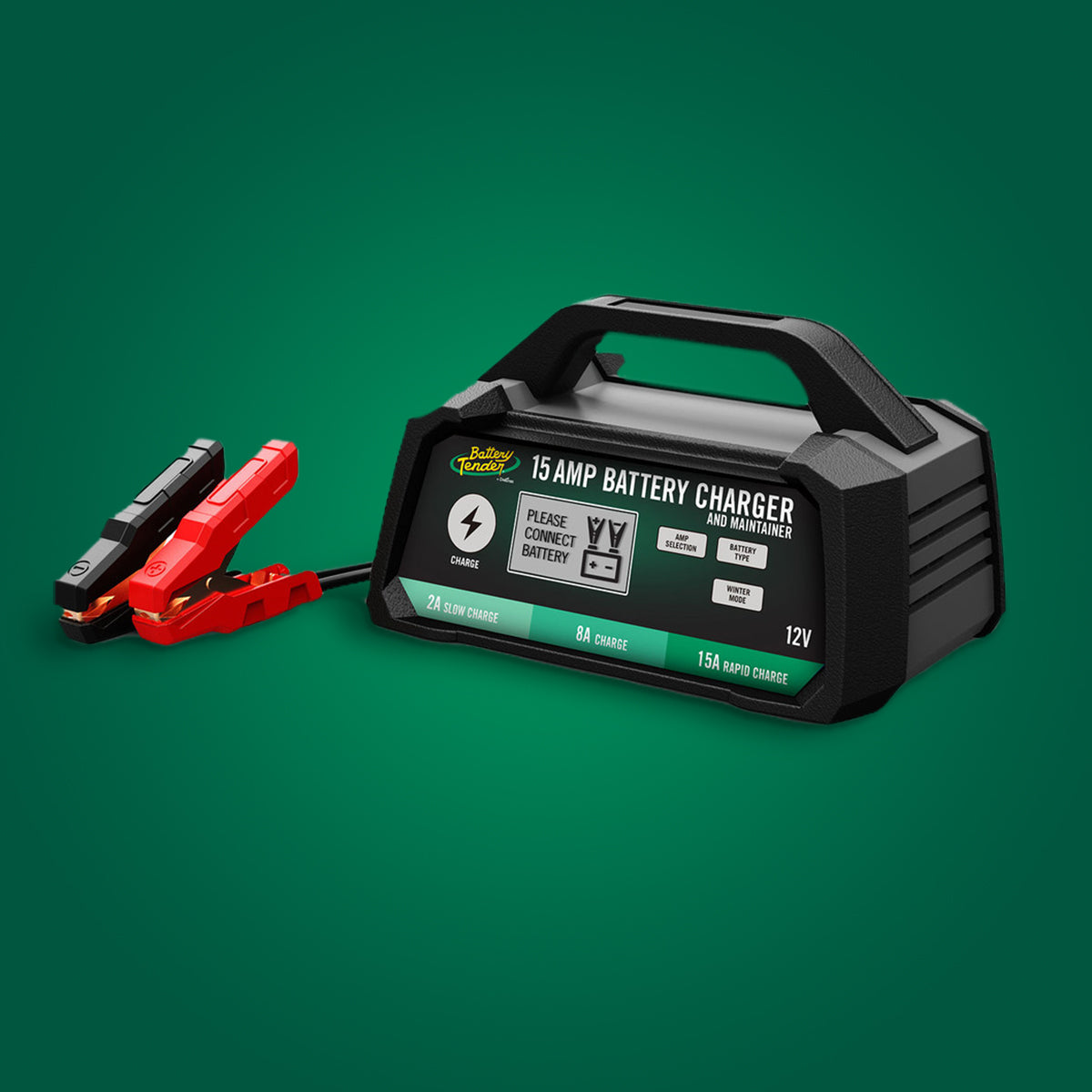
The Battery Tender 8A/2A Power Tender (SKU 022-1005-DL-WH) carries an IP65 rating for dust and water resistance, includes temperature compensation that automatically adjusts voltage based on ambient conditions, and delivers selectable 8A or 2A charge rates for batteries ranging from small automotive to large truck and marine applications. The temperature compensation feature is particularly important for sulfation prevention: it raises charge voltage in cold environments (where batteries resist accepting charge) and lowers it in hot environments (where overcharge risk increases).
Battery Tender 8A/2A Power Tender (SKU 022-1005-DL-WH)
Step 5: Monitor voltage monthly on unconnected batteries. Use a digital multimeter to check open-circuit voltage. Any reading below 12.4V indicates the battery has dropped below 75% SoC and soft sulfation is actively building. Charge immediately using a full ISM cycle before crystals harden.
Step 6: Maintain electrolyte levels in flooded batteries. Check cell levels every 30 days. Add only distilled water — never tap water, which introduces minerals that accelerate sulfation. Fill to the bottom of the fill ring, not above. Overfilling causes acid to vent during charging, reducing electrolyte concentration and increasing sulfation potential.
Multi-Vehicle Sulfation Prevention for Collectors and Fleets
Owners of multiple vehicles face compounded sulfation risk. A collector with four classic cars and two motorcycles has six batteries simultaneously losing charge and building sulfate crystals. Individual chargers require six outlets, six connections, and six monitoring points. Multi-bank charging systems consolidate this into a single unit with independent ISM circuits for each battery.
The Battery Tender 2-Bank 1.25A charges and maintains two 12V batteries simultaneously. Each bank operates its own independent ISM 4-stage cycle, so a fully charged motorcycle battery and a deeply discharged car battery both receive exactly the charge profile they need. The Absorption stage runs independently on each bank, ensuring sulfation is dissolved regardless of differing battery sizes, chemistries, or discharge levels.
Battery Tender 2-Bank 1.25A 12V Charger
For larger collections or commercial fleets, the Battery Tender 5-Bank and Battery Tender 10-Bank units scale sulfation prevention across 5 or 10 batteries from a single installation, each bank delivering 4A with independent ISM cycling and 6V/12V selectable outputs.
How to Identify Sulfation Before It Becomes Irreversible
Early detection is essential. Soft sulfation can be reversed; hard sulfation generally cannot. Watch for these warning signs:
- Slow cranking — the starter turns noticeably slower than normal, especially on cool mornings
- Rapid voltage rise during charging — a sulfated battery's high internal resistance causes voltage to climb quickly, mimicking a full charge when actual stored energy is low
- Low capacity under load — the battery reads 12.6V at rest but drops below 10.5V under starter load (a load tester confirms this)
- Extended charge times — a 50 Ah battery that previously charged in 10 hours now takes 14+ hours
- Visible white crystalline deposits — on flooded batteries with removable caps, white powder on plate surfaces indicates heavy sulfation
If soft sulfation is detected early, connecting a Battery Tender charger and allowing it to run a complete ISM cycle — particularly an extended Absorption stage — can often recover significant capacity. Multiple consecutive charge cycles may be needed for moderate sulfation. However, once crystals have hardened over weeks or months of neglect, the battery's capacity loss becomes permanent.
Frequently Asked Questions
Can sulfation be reversed once it has formed?
Soft sulfation can be reversed; hard sulfation generally cannot. Soft sulfate crystals form within hours to days of partial discharge and dissolve during the Absorption stage of an ISM charge cycle. Once crystals harden over weeks or months — growing larger and bonding permanently to plate surfaces — no standard charger can break them down. Prevention through continuous ISM maintenance is far more effective than attempted recovery.
How long can a battery sit before sulfation becomes a problem?
Sulfation begins forming within 24 hours of a battery dropping below 100% state of charge. Measurable capacity loss from soft sulfation typically appears after 2–4 weeks without charging. By 30–60 days at partial charge, especially in warm environments above 77°F, sulfation may begin transitioning from reversible soft crystals to irreversible hard formations. Connect a Battery Tender charger whenever a vehicle will sit unused for more than a few days.
Do AGM and GEL batteries sulfate the same way as flooded batteries?
Yes — all lead-acid batteries sulfate through the same PbSO₄ crystal formation process. AGM and GEL batteries are more sensitive to improper charging voltages, however. GEL batteries can be permanently damaged by Absorption voltages exceeding approximately 14.1V. AGM batteries tolerate slightly higher voltages but still require precise profiles. ISM technology automatically adjusts voltage parameters by chemistry type, making it safe for all three lead-acid variants.
Is a trickle charger good enough to prevent sulfation during winter storage?
No. A constant-current trickle charger