


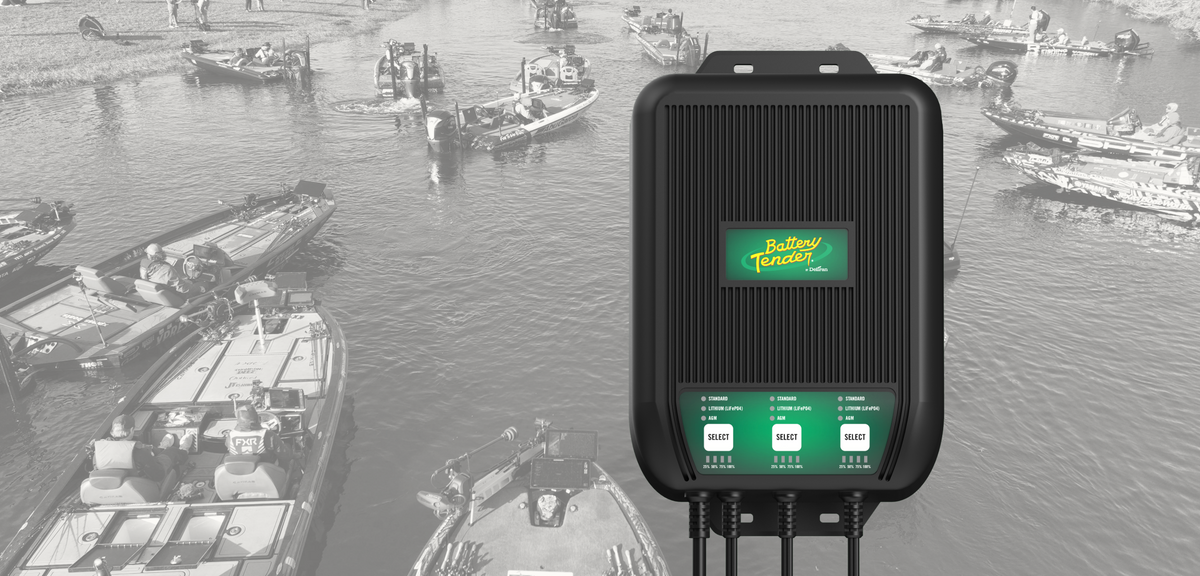
Boat 3 Bank Battery Tender® Charger: Setup and Sizing Guide (2026)
A boat 3 bank Battery Tender charger is one on-board unit with three isolated outputs, so the starting, house, and auxiliary batteries each get their own charge profile. Battery Tender WaveCharge models run Infinite Sequential Monitoring (ISM) on each bank separately, so a full battery is never overcharged while a depleted one catches up.
Most guides explain how to charge one boat battery. This guide covers what happens when a boat carries three: which battery goes on which bank, how many amps each bank needs, and what the marine environment demands of the hardware. The sections below also include a sizing table and a step-by-step install sequence.
Key Takeaways
- Each bank on a three-bank marine charger runs its own ISM cycle, so mixed battery sizes and charge levels do not interfere.
- Assign banks by job: bank 1 for engine starting, bank 2 for the house load, bank 3 for the trolling motor, thruster, or second engine.
- Per-bank amps set recovery time: 1.25A suits maintenance only, 3A suits most recreational boats, and 10A suits large deep-cycle banks.
- Engine rooms and bilges call for IP68 and ignition-protected hardware, such as Battery Tender WaveCharge Pro.
- Mount the charger on a rigid bulkhead, fuse every positive lead, and verify resting voltage 24 hours after the first full cycle.
What Does a Boat 3 Bank Battery Tender Charger Actually Do?
It charges three separate batteries at once through three electrically independent outputs, each with its own monitoring circuit. One AC input feeds all three banks, but no bank shares current or voltage with another.
That independence matters because boat batteries rarely sit at the same state of charge. Cranking the engine drains the starting battery by only a few percent. Running a fridge, electronics, and lights overnight can pull the house battery down 50%. A single-output charger wired through a selector switch or combiner treats both as one battery and either undercharges the house bank or overcharges the starter.
Each bank moves through the four Battery Tender ISM stages:
- Initialization: tests the battery and applies gentle current to judge its condition.
- Bulk Charge: delivers full rated current until the battery reaches roughly 80% state of charge.
- Absorption: holds voltage constant while current tapers, which helps dissolve sulfate crystals.
- Float Maintenance: sends charge pulses only when voltage drops, so the charger can stay connected indefinitely.
Many Battery Tender chargers also add temperature compensation, which adjusts charge voltage for hull and engine-room heat. Confirm the feature on the product page for your model. A float-only charger skips Absorption, and a conventional trickle charger pushes constant current regardless of battery state. ISM does neither.
Which Three Batteries Belong on Each Bank?
Assign banks by function, not by battery size: starting, house, then whatever your third load is. The assignment decides which bank needs the most amps.
Common Three-Bank Layouts
- Single-engine cruiser: bank 1 is the 70Ah engine starting battery, bank 2 is a 100Ah AGM house battery, and bank 3 is a bow thruster or windlass battery.
- Twin-engine boat: bank 1 is the port starter, bank 2 is the starboard starter, and bank 3 is the house battery.
- Bass or fishing boat: bank 1 is the cranking battery, bank 2 is the 12V auxiliary battery, and bank 3 is a dedicated electronics battery.
Lithium batteries are increasingly common on boats, and depending on the model, a bank can hold lead-acid, AGM, GEL, or lithium. Confirm chemistry compatibility on the product page for the exact model before connecting a lithium battery, because charge profiles differ by chemistry.
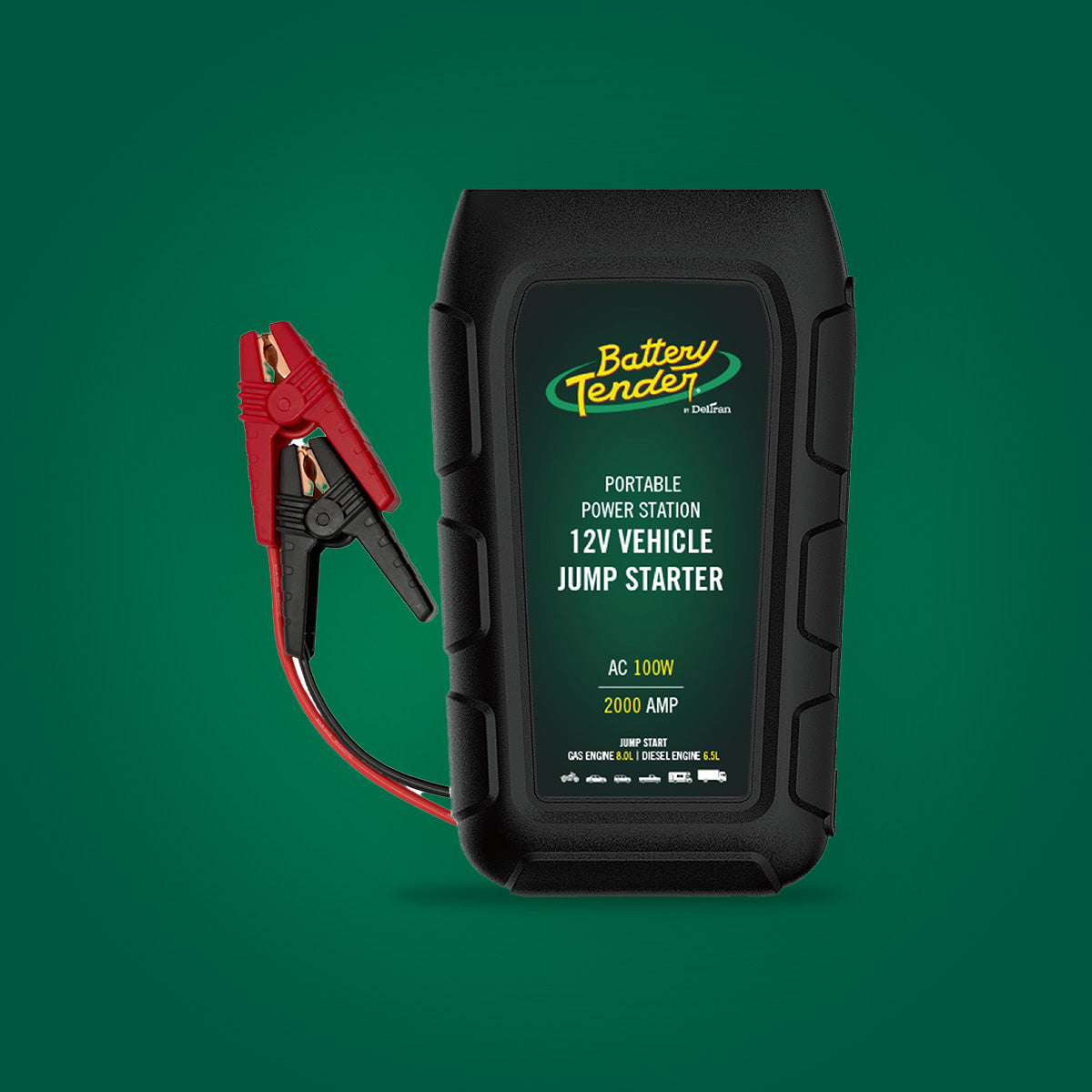
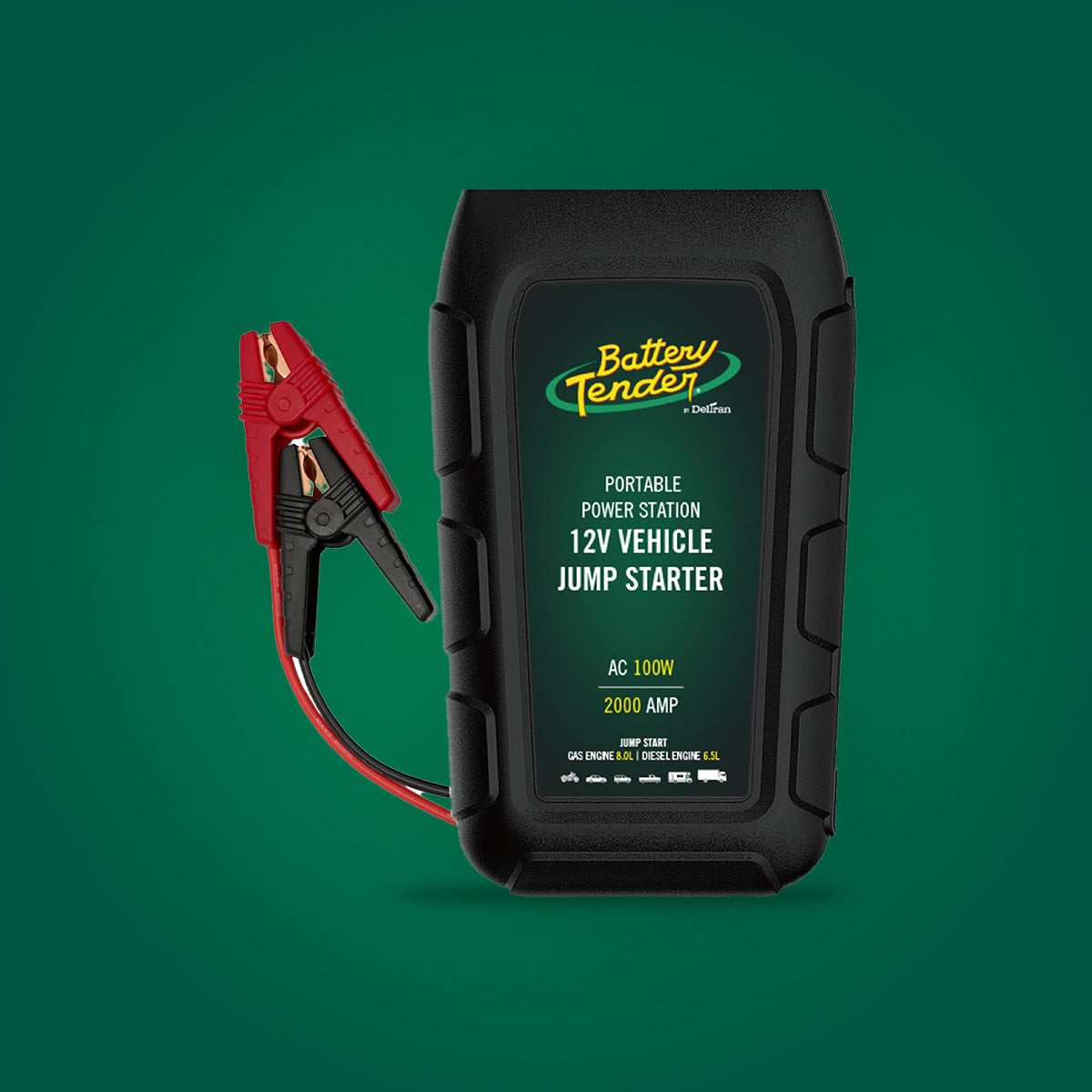
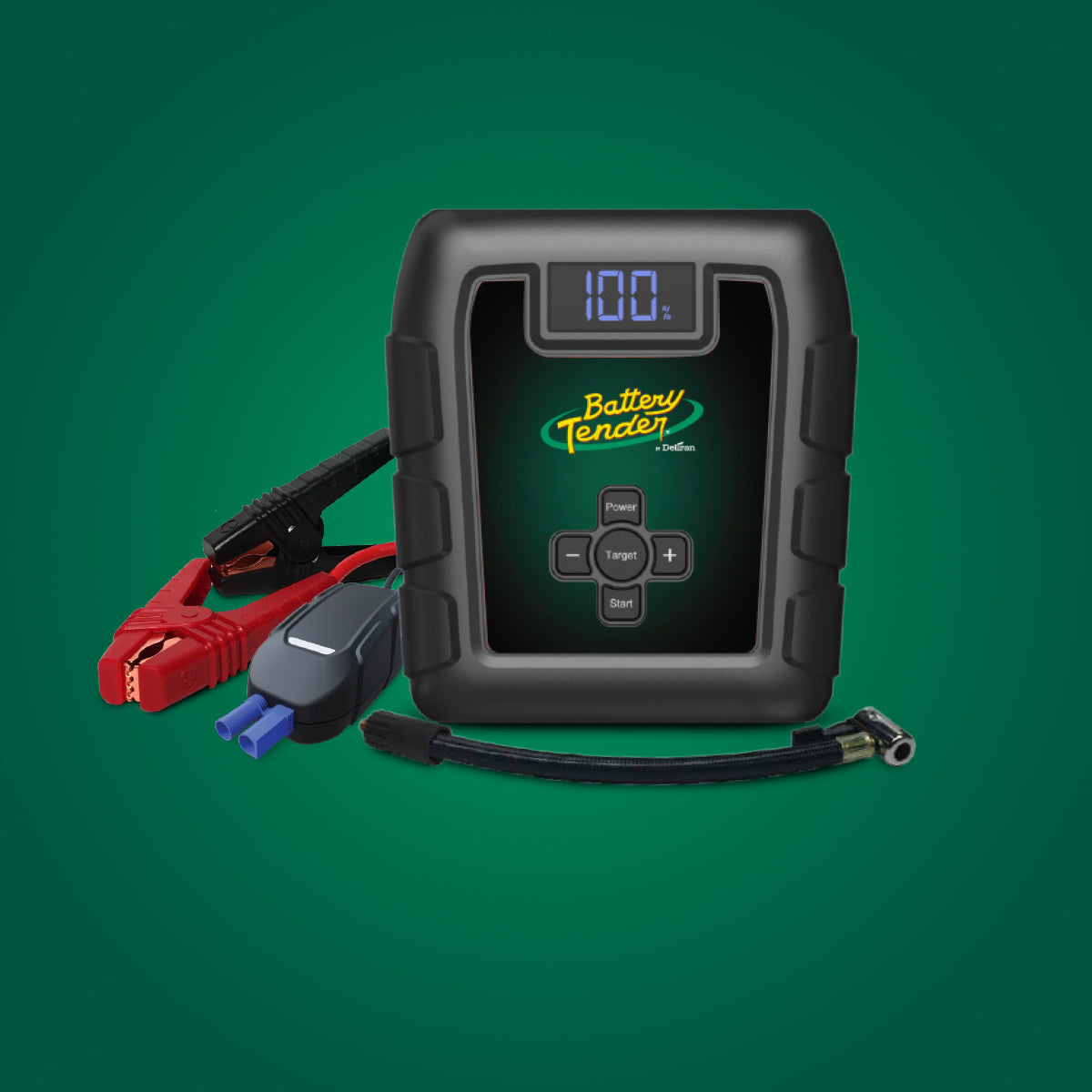
Keep a backup plan for the day a bank fails or a battery goes flat far from the dock. A portable lithium jump starter covers that gap. The Battery Tender Jump N Start 2000 Amp Lithium Jump Starter has a 16,000 mAh pack rated for engines up to 8.0L gas or 6.5L diesel, which covers most large outboards and inboards. It also starts an engine whose battery bank has been drained below what a charger can recover quickly.
Battery Tender Jump N Start 2000 Amp Lithium Jump Starter
How Do You Size a Boat 3 Bank Battery Tender Charger?
Size it by the largest battery on any bank and by how fast you need recovery. The formula is (battery Ah × depth of discharge) ÷ charger amps = approximate hours. Add 10-20% for the Absorption stage.
| Bank Role | Battery | Ah to Replace | At 1.25A | At 3A | At 10A |
|---|---|---|---|---|---|
| Engine starting | 70Ah, 20% discharged | 14Ah | 11.2 hrs | 4.7 hrs | 1.4 hrs |
| House bank | 100Ah AGM, 50% discharged | 50Ah | 40 hrs | 16.7 hrs | 5 hrs |
| Auxiliary or thruster | 125Ah deep cycle, 50% discharged | 62.5Ah | 50 hrs | 20.8 hrs | 6.3 hrs |
The table shows why amps per bank matter more than total amps. A 1.25A bank holds a charged battery but takes nearly two days to recover a half-drained house bank. A 3A bank recovers the same battery in under a day, and a 10A bank does it in about five hours. For a deeper timing breakdown, see How Long to Charge a Boat Battery with Battery Tender WaveCharge Marine Chargers (2026).
Matching Models to Banks
For heavy deep-cycle banks, 10A per bank is the strongest option. The Battery Tender WaveCharge Pro 3-Bank 30A delivers 10A to each bank at 12V, with IP68 construction. That suits a 200Ah house bank, a large trolling-motor battery, or a charter boat that is discharged daily and must be ready by morning.
Battery Tender WaveCharge Pro 3-Bank 12V 30 Amp Battery Charger and Maintainer
For a fourth battery, the Battery Tender WaveCharge 4-Bank 12A supplies 3A per bank. That is the right rate for a recreational boat with a starter, a house battery, a thruster battery, and a spare or generator battery that all see moderate use.
Battery Tender WaveCharge 4-Bank 12V 12 Amp Battery Charger and Maintainer
If the boat spends most of its life on a lift or in dry storage and the batteries are rarely discharged, 1.25A per bank is enough to hold them. The Battery Tender 4-Bank 12V 1.25 Amp Battery Charger and Maintainer covers four 12V batteries from one outlet. It is a maintainer, not a recovery charger, so it fits a boat that is used lightly and stored dry rather than a heavily cycled house bank. Check the product page for its environmental rating before mounting it anywhere damp.
Battery Tender 4-Bank 12V 1.25 Amp Battery Charger and Maintainer
For a boat with exactly three batteries and moderate use, the Battery Tender WaveCharge 3-Bank 9A delivers 3A per bank with IP67 sealing. It is the standard three-bank option when a Pro unit is more than the boat needs.
Battery Tender WaveCharge 3-Bank 12V 9 Amp Battery Charger and Maintainer
Why Does the Marine Environment Change the Charger Choice?
A boat exposes electronics to salt, vibration, and fuel vapor at the same time, and a household-style charger is built for none of them. Choose the hardware for where it will be mounted, not only for its amp rating.
Fuel Vapor and Ignition Protection
Gasoline vapor collects in bilges and engine compartments. Any spark-capable device mounted there should be ignition protected, and U.S. Coast Guard rules (33 CFR 183.410) require ignition-protected electrical components in gasoline engine spaces. Battery Tender WaveCharge Pro carries UL marine ignition protection, which makes it the correct choice for enclosed engine-room installation.
Salt, Spray, and Submersion
Salt creeps into connectors and corrodes terminals. Battery Tender WaveCharge Pro is rated IP68 and resists saltwater, while the standard Battery Tender WaveCharge line is rated IP67. Both are sealed for on-board permanent installation, but IP68 gives the most margin in a wet bilge or an open console.
Vibration
Engines and hull slap loosen fasteners over a season. Mount the charger on a rigid bulkhead or stringer, never on thin liner panels, and use strain relief on every cable so vibration cannot work a connection loose.
How Do You Install a Boat 3 Bank Battery Tender Charger Step by Step?
Install it in this order: location, bank mapping, wiring, fusing, then verification. Disconnect shore power and the battery negatives before touching any wire.
- Choose the location. Pick a dry, ventilated spot above the bilge waterline. Mount in an engine compartment only if the unit is ignition protected.
- Write the bank map. Label which battery connects to bank 1, 2, and 3 before wiring begins.
- Mount the charger. Use stainless fasteners into a rigid surface.
- Run output cables. Keep runs short, use tinned marine-grade copper, and crimp ring terminals with adhesive heat shrink.
- Fuse each positive lead. Place the fuse as close to the battery as practical. ABYC E-11 guidance is within 7 inches.
- Connect the AC input. Use a GFCI-protected shore circuit and a drip loop on the cord.
- Power up and watch the indicators. Confirm all three banks show an active charge state.
- Verify after 24 hours. A fully charged, rested 12V AGM or flooded battery reads about 12.6-12.8V. A reading under 12.4V means the bank is not full.
If the charger sits farther from the shore power inlet than the cord reaches, avoid household extension cords in a wet space. The Battery Tender WaveCharge 5ft Marine Extension Cable is a 14-gauge weatherproof cable made for these chargers, and it adds reach without compromising the seal.
Battery Tender WaveCharge 5ft Marine Extension Cable
Once installed, the charger can stay connected through the off-season. The Float Maintenance stage keeps all three banks topped up without overcharging, which is covered in Boat Battery Winter Storage with Battery Tender WaveCharge Marine Chargers (2026).
Frequently Asked Questions
Can each bank on a 3-bank marine charger hold a different battery size?
Yes. Each bank runs its own ISM cycle, so a 70Ah starting battery, a 100Ah house battery, and a 125Ah auxiliary battery can share one charger. Banks do not influence each other.
Is it safe to leave a boat 3 bank Battery Tender charger connected all season?
Yes. After Bulk Charge and Absorption, the Float Maintenance stage delivers charge pulses only when battery voltage drops, so the battery is never held at a constant overcharge. That makes ISM safe for long-term connection, unlike conventional trickle chargers. Keep the shore connection dry and inspect cords and terminals monthly.
What if my boat has four batteries instead of three?
Use a four-bank model. The Battery Tender WaveCharge 4-Bank 12A gives 3A per bank for boats that cycle all four batteries. For lightly used boats in dry storage, the Battery Tender 4-Bank 1.25 Amp maintainer holds four batteries at a lower rate.
Do I need an ignition-protected charger in the engine room?
Yes, if the boat has a gasoline engine and the charger is mounted in the engine space or bilge. Fuel vapor can ignite from a spark. Battery Tender WaveCharge Pro carries UL marine ignition protection and an IP68 rating, so it suits those locations. Check the boat's manual and local requirements.
Conclusion
A boat 3 bank Battery Tender charger works best when banks are assigned by job, amps are matched to the largest battery, and the hardware suits where it is mounted. Use the sizing table to choose between 1.25A, 3A, and 10A per bank, and choose IP68, ignition-protected hardware for engine rooms and wet bilges.
Next step: list your three batteries by role and amp-hours, then compare models in the Battery Tender marine charger collection.