


Best Battery Charger for Car: Complete Buyer's Guide (2026)
Choosing the right battery charger for car use is one of the most impactful decisions a vehicle owner can make — yet most drivers never think about it until a dead battery leaves them stranded. Battery Tender® pioneered smart battery charging in 1989, and the technology has evolved dramatically since then. A properly matched charger does far more than restore a dead battery; it actively prevents the chemical degradation that kills batteries prematurely, extending useful life from the typical 2–3 years to 5 years or more.
This guide breaks down exactly how to select a battery charger for car applications based on battery size, chemistry, parking environment, and usage patterns. Rather than covering storage scenarios or comparing charger architectures in the abstract — topics addressed in companion articles — this guide focuses on the practical decision framework: which specs matter for everyday car owners, how to match amperage to battery capacity, and which features justify a higher price point. The goal is to equip readers with the knowledge to make a confident, informed purchase.
Key Takeaways
- Smart chargers prevent overcharging — Infinite Sequential Monitoring (ISM) technology cycles through 4 stages and stops charging when the battery is full, unlike trickle chargers that deliver constant current.
- Match amperage to battery capacity — Use the formula (Battery Ah × depth of discharge) ÷ charger amps = approximate charge hours to select the right output.
- Temperature compensation matters — Chargers that adjust voltage output based on ambient temperature protect batteries in garages that fluctuate between freezing winters and hot summers.
- Sulfation is the #1 battery killer — A connected smart charger dissolves sulfate crystals during the Absorption stage, preventing the buildup that ruins 80% of batteries before their time.
Why Every Car Owner Needs a Dedicated Battery Charger
Modern vehicles place extraordinary demands on their batteries. Keyless entry modules, alarm systems, telematics units, dashcams, and onboard computers draw parasitic current 24 hours a day, even when the engine is off. According to the Battery Council International (BCI), parasitic loads in vehicles manufactured after 2018 typically range from 25 to 50 milliamps — enough to drain a standard 48 Ah car battery from full to critically low in as few as 40 days of sitting idle.
A dedicated battery charger for car use counteracts these parasitic draws automatically. More importantly, it prevents sulfation — the accumulation of lead sulfate crystals on battery plates that occurs whenever a lead-acid battery sits below full charge. The BCI estimates that sulfation is the primary cause of premature failure in approximately 80% of lead-acid batteries. A smart charger that maintains full charge continuously eliminates this failure mode entirely.
The financial case is straightforward. A quality replacement car battery costs $150–$300 in 2026. A smart charger that extends battery life from the average 2–3 years to 5+ years pays for itself after preventing a single premature replacement — and continues saving money for the life of the charger.
How to Choose the Right Battery Charger for Car Applications
Selecting the correct charger requires matching three variables: battery capacity (measured in amp-hours), battery chemistry (standard flooded, AGM, GEL, or lithium), and installation environment (indoor garage, outdoor carport, or engine bay). Getting any one of these wrong results in either underperformance or potential battery damage.
Step 1: Determine Battery Capacity
Check the label on the existing car battery for the Ah (amp-hour) rating. Most passenger cars use batteries between 40 Ah and 80 Ah. Trucks, SUVs, and vehicles with aftermarket accessories often use 80–110 Ah batteries. Use this number with the charging time formula: (Battery Ah × depth of discharge) ÷ charger amps = approximate charge hours. For example, a 60 Ah battery discharged 50% charged by a 1.25A charger takes approximately (60 × 0.50) ÷ 1.25 = 24 hours. An 8A charger reduces that same scenario to (60 × 0.50) ÷ 8 = 3.75 hours.
Step 2: Identify Battery Chemistry
Different chemistries require different charge profiles. Standard flooded lead-acid batteries are the most common, but AGM (Absorbent Glass Mat) batteries now ship in most European vehicles and start-stop equipped cars. Lithium batteries are increasingly mainstream in performance and lightweight applications. A charger with selectable chemistry modes ensures proper voltage limits for each type — charging a lithium battery with a lead-acid profile risks damage, and vice versa.
Step 3: Assess the Installation Environment
Chargers installed in climate-controlled garages face minimal environmental stress. Chargers mounted in outdoor carports, unheated workshops, or engine bays need IP65 or higher ingress protection ratings to resist moisture and dust. Temperature swings in these environments also demand temperature compensation circuitry, which adjusts charge voltage based on ambient conditions — critical because overcharging accelerates in heat while undercharging occurs in cold.
Understanding ISM Technology: What Makes a Battery Charger for Car Use Truly Smart
Infinite Sequential Monitoring (ISM) is the proprietary 4-stage charging process from Battery Tender that separates intelligent chargers from basic trickle chargers. ISM makes it safe to leave a charger connected indefinitely — something no constant-current trickle charger can claim without risk of overcharging and boiling electrolyte.
The four ISM stages work as follows:
- Initialization — The charger tests the battery with a gentle current to assess condition and determine whether it can accept a charge safely. Deeply sulfated or shorted cells are identified before full power is applied.
- Bulk Charge (Constant Current) — Full rated amperage flows into the battery until it reaches approximately 80% state of charge. This stage does the heavy lifting and is where amperage rating determines charging speed.
- Absorption (Constant Voltage) — Voltage is held constant while current tapers gradually. This stage dissolves sulfate crystals from the battery plates and brings the charge from 80% to 100% without stressing cell chemistry.
- Float Maintenance — The charger drops to demand-responsive mode, delivering brief charge pulses only when voltage dips below the maintenance threshold. Power consumption is negligible, and the battery is held at optimal charge indefinitely.
Traditional trickle chargers lack the Absorption and Float stages entirely. They deliver a constant current regardless of battery state, which means a fully charged battery continues receiving current — generating heat, decomposing electrolyte, and accelerating plate corrosion. This is why the answer to "Can I leave my charger connected overnight?" depends entirely on whether the charger uses ISM or constant-current technology.
Recommended Battery Charger for Car: Matching Products to Real Scenarios
No single charger fits every situation. The following recommendations match specific Battery Tender products to the most common car-owner scenarios based on battery size, environment, and usage pattern.
Best Overall: Battery Tender 8A/2A Battery Tender Power Tender (SKU 022-1005-DL-WH)
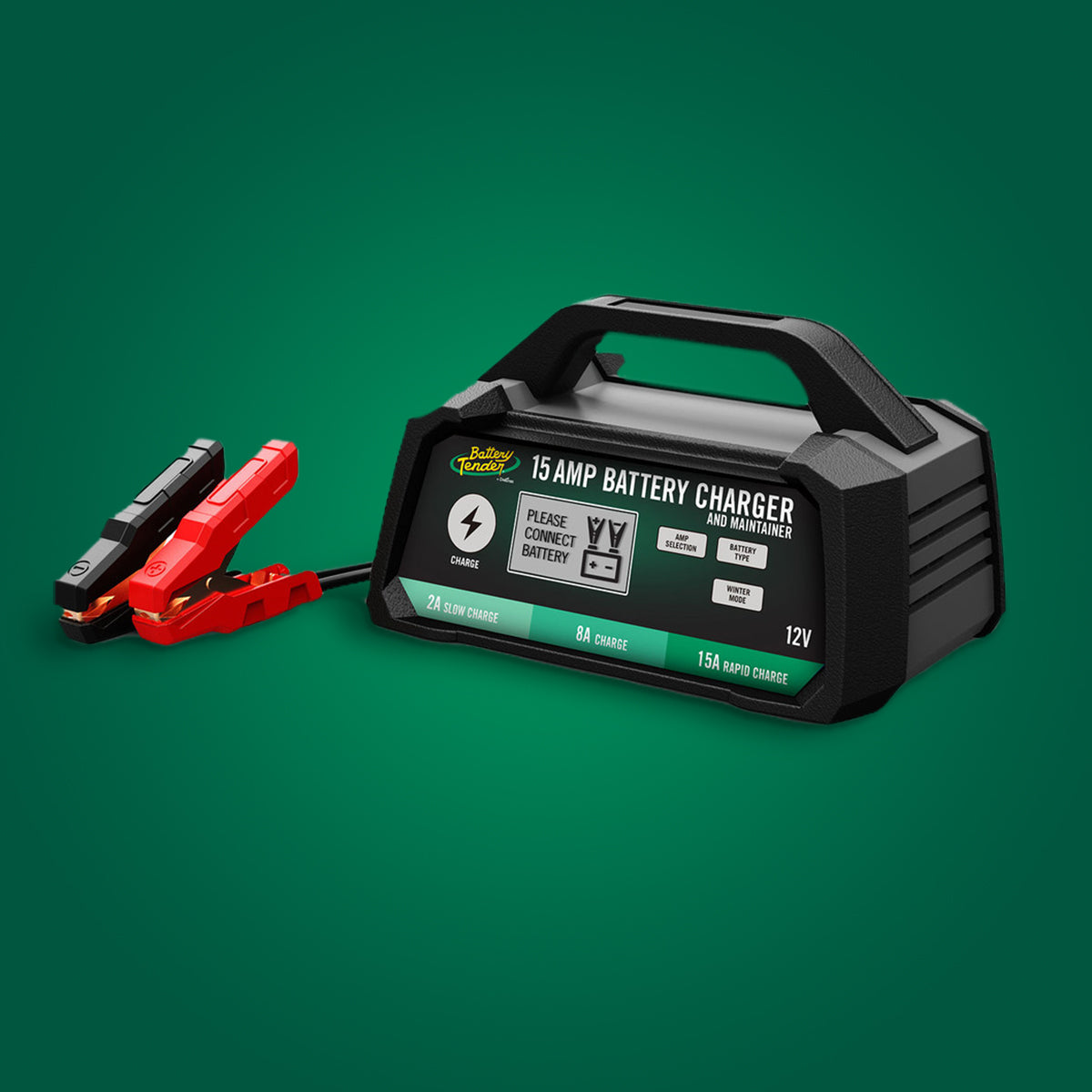
For car owners who want one charger to handle everything, the Battery Tender 8A/2A Battery Tender Power Tender is the most versatile option in the lineup. It delivers 8A for fast recovery of deeply discharged batteries and 2A for gentle maintenance — selectable at the push of a button. IP65-rated for outdoor installation, it handles standard flooded, AGM, GEL, and lithium batteries at 12V. A 60 Ah car battery at 50% discharge reaches full charge in approximately 3.75 hours on the 8A setting. The unit also functions as a 6A power supply for diagnostic tools and ECU programming — a feature no other charger in this class provides. Temperature compensation adjusts output voltage automatically across seasons.
Battery Tender 8A/2A Battery Tender Power Tender — 12V IP65 Selectable Smart Charger
Best for Daily Drivers in Covered Garages: Battery Tender Plus 12V 1.25A
The Battery Tender Plus has been the flagship smart charger for over three decades, and it remains the best value for car owners with a single vehicle in an indoor garage. At 1.25A, it handles batteries from 14 Ah to 80 Ah — covering virtually every passenger car on the road. It includes temperature compensation, full ISM 4-stage charging, and an industry-leading 10-year warranty. A 48 Ah battery discharged 30% recovers in approximately (48 × 0.30) ÷ 1.25 = 11.5 hours — comfortably overnight. At $64.95, the cost-per-year of ownership over the warranty period is under $6.50.
Battery Tender Plus 12V 1.25A Smart Charger with 10-Year Warranty
Best for Outdoor or Unheated Environments: Battery Tender Plus IP65 1.25A
Identical charging performance to the standard Battery Tender Plus, but housed in an IP65-rated enclosure that resists dust and water jets. This is the correct choice for carports, unheated detached garages, or any environment exposed to humidity, condensation, or temperature extremes. Temperature compensation ensures accurate charge voltage whether ambient temperature is 14°F or 104°F. Priced at $84.95, the $20 premium over the standard Plus buys meaningful protection for the charger itself.
Battery Tender Plus IP65 1.25A Weatherproof 12V Smart Charger
Best for Households with Two Vehicles: Battery Tender 2-Bank 1.25A 12V
Households that own two cars — or a car and a motorcycle — benefit from the Battery Tender 2-Bank charger. Each bank operates independently with its own ISM circuit, so a fully charged sedan battery and a partially discharged motorcycle battery receive exactly the care each needs simultaneously. This eliminates the need to purchase, store, and manage two separate chargers. At $139.95, it costs less than buying two individual Battery Tender Plus units.
Battery Tender 2-Bank 1.25A 12V Dual-Output Smart Charger
Emergency Backup: Why a Jump Starter Complements a Car Battery Charger
A smart charger prevents dead batteries at home. A portable jump starter handles dead batteries everywhere else — parking lots, airports, remote trailheads. Carrying both provides complete coverage.
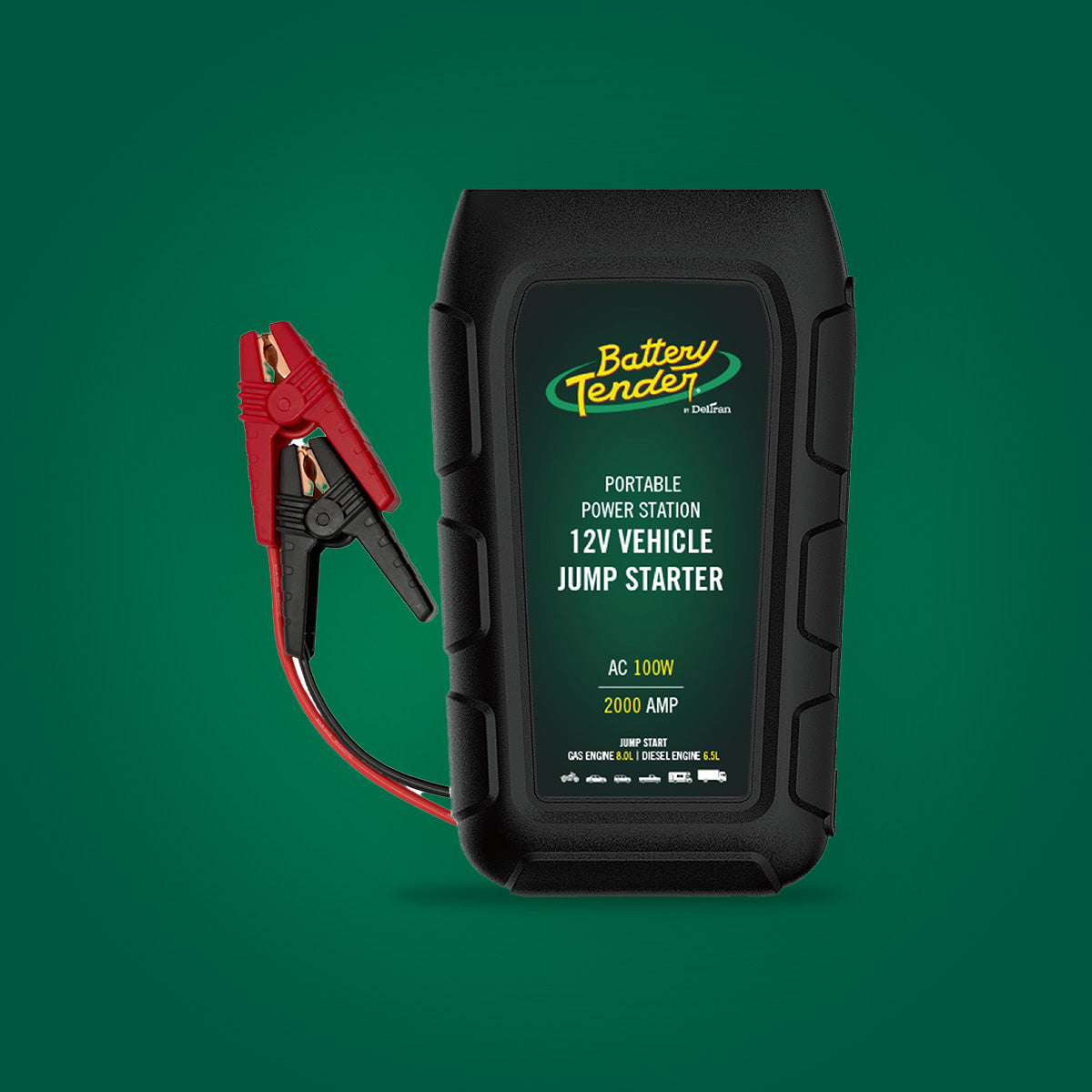
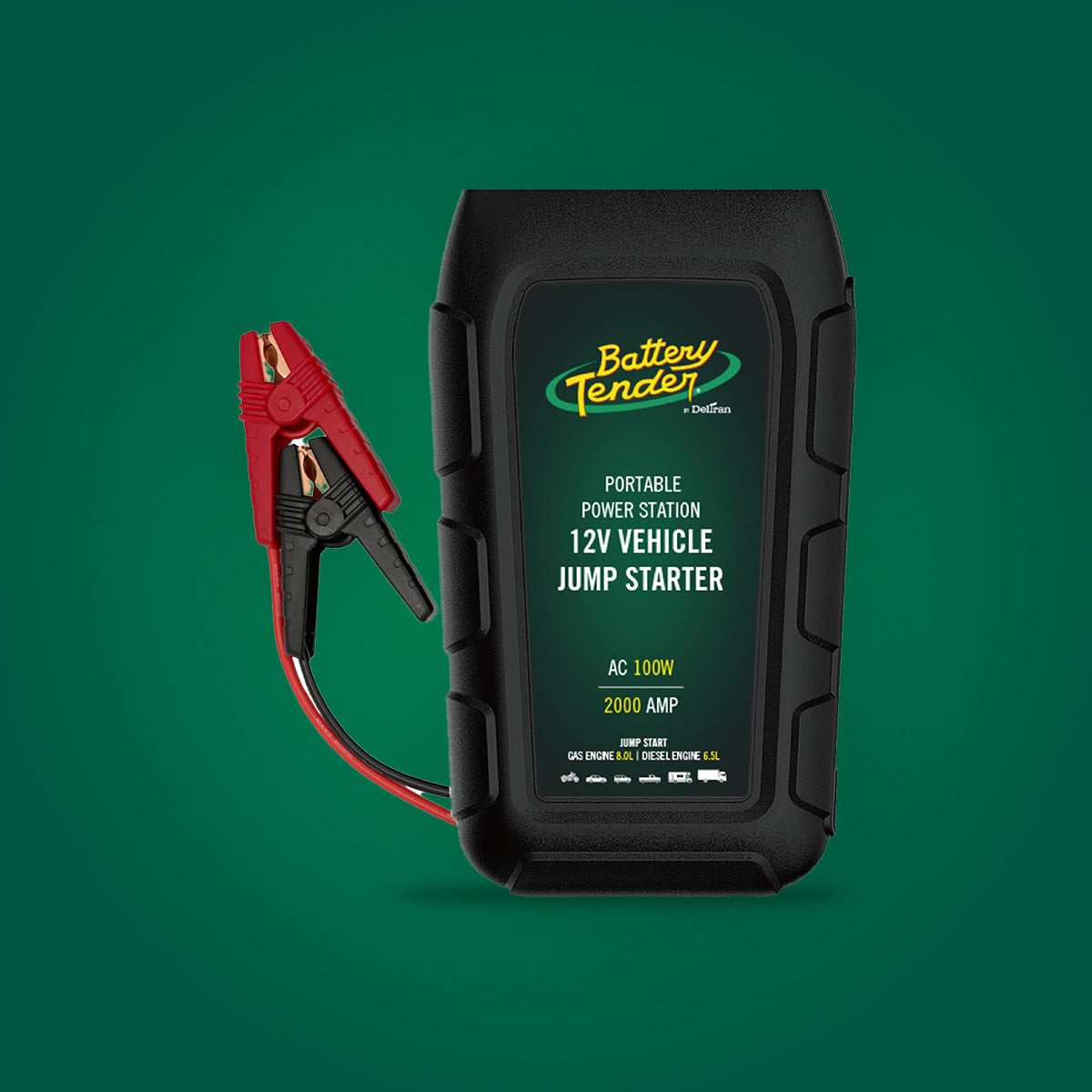
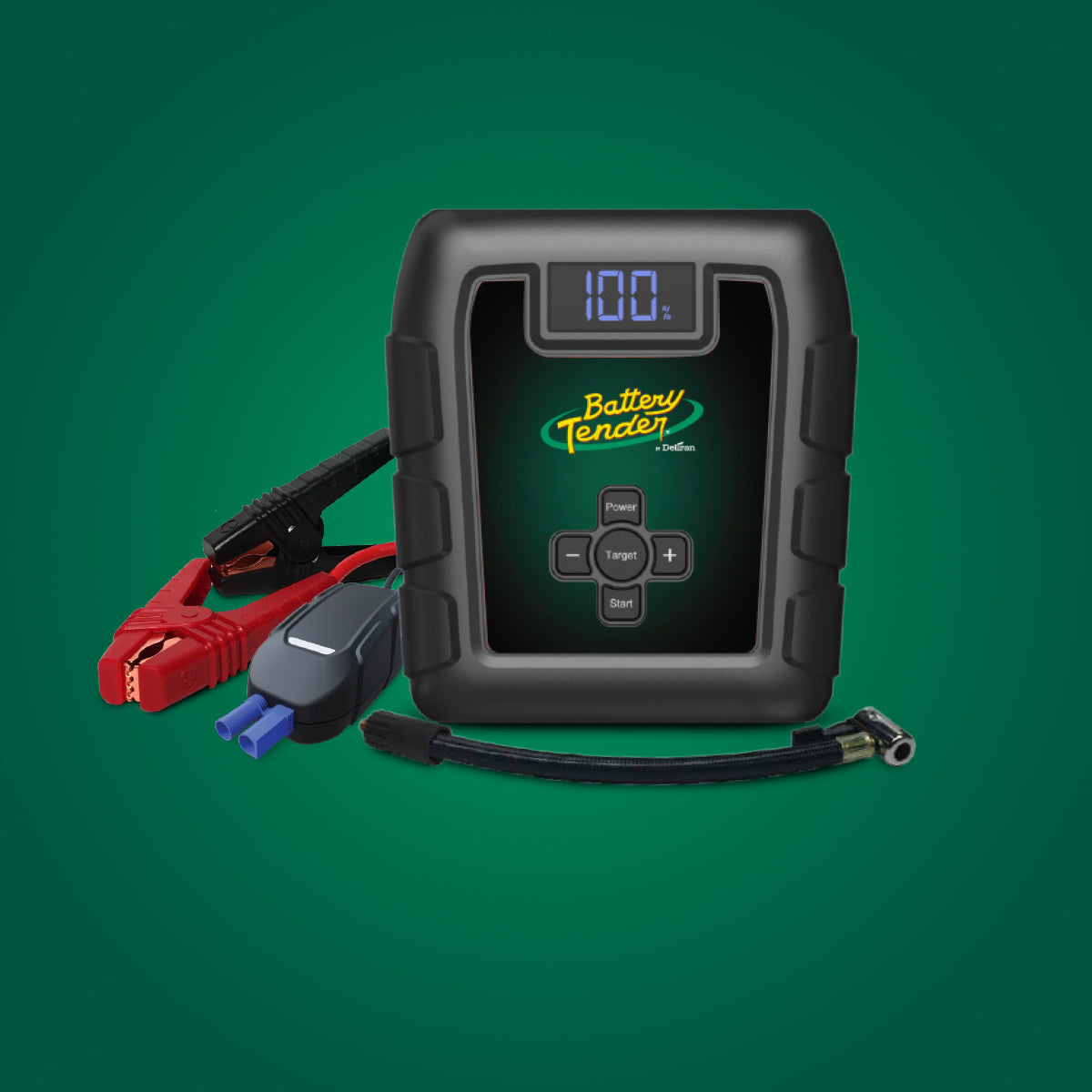
The Battery Tender 1500A Jump Starter delivers 1,500 peak amps from a 12,000 mAh lithium-ion battery pack, enough to start engines up to 7.0L gas or 5.5L diesel — covering virtually every passenger car, SUV, and light truck. It holds a charge for months on standby, weighs under 2 lbs, and fits in a glove compartment. For drivers who also want integrated charging capability, the Battery Tender Charge N Start 4120 combines a full 4A ISM smart charger with a 1,200A jump starter in a single unit that lives in the garage and charges the car battery continuously while remaining ready to jump-start a second vehicle at any time.
Battery Tender 1500A Portable Jump Starter
Battery Tender Charge N Start 4120 — 4A Charger + 1,200A Jump Starter
Installation Best Practices for a Car Battery Charger
Proper installation maximizes both safety and convenience. The following guidelines apply to all Battery Tender charger models used with car batteries.
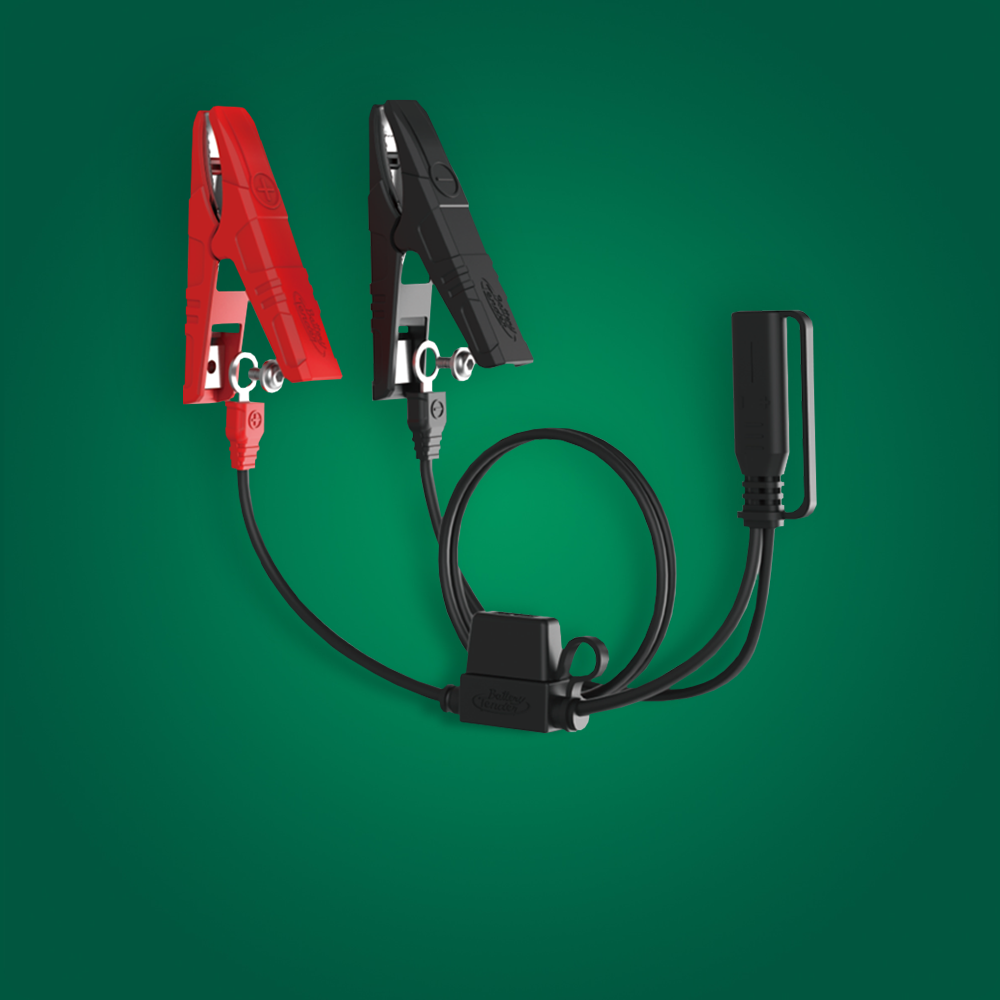
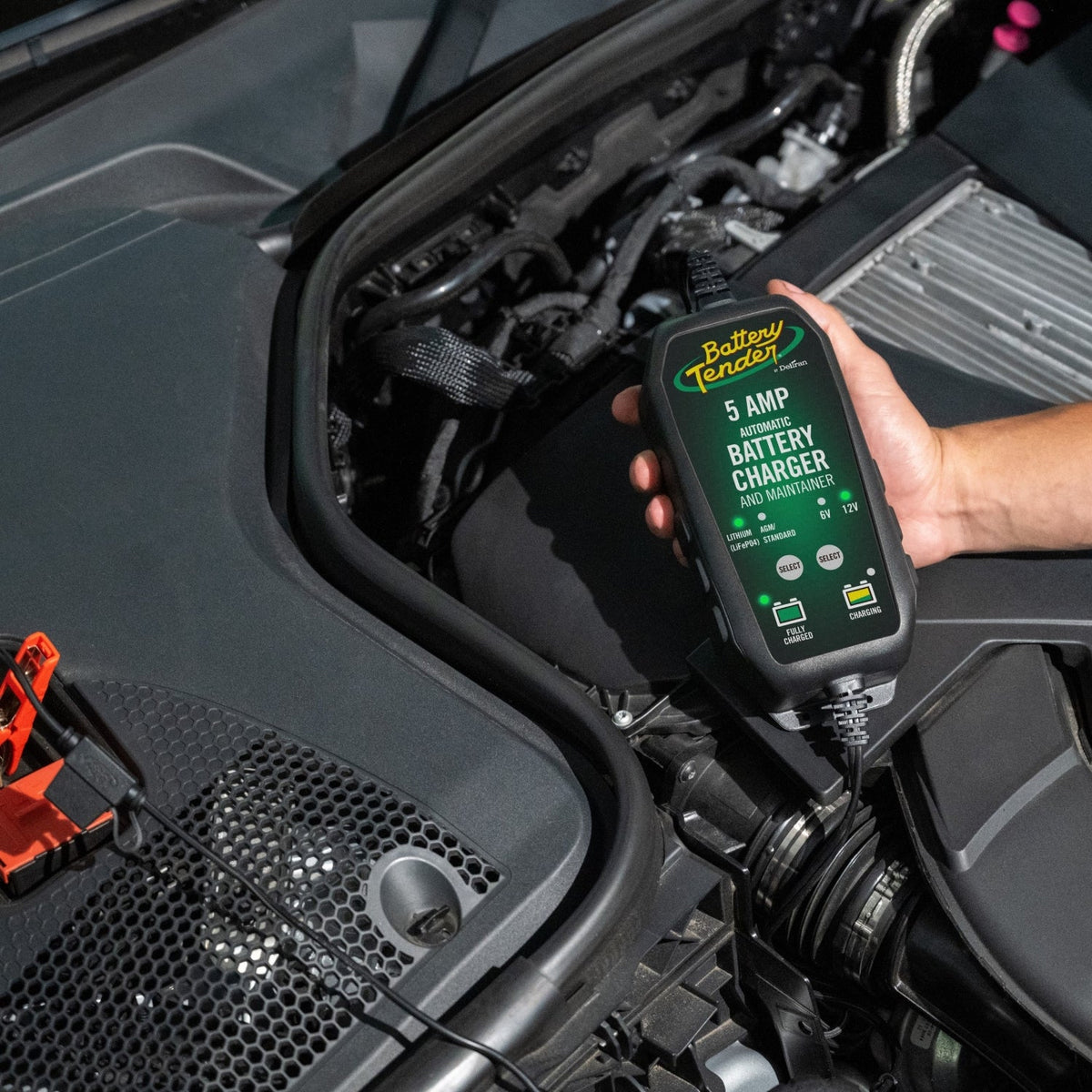
Use ring terminal harnesses for permanent connection. Every Battery Tender charger ships with alligator clips and a ring terminal harness. Bolt the ring terminals directly to the battery posts, route the connector through the engine bay to an accessible location, and plug in the charger whenever the car is parked. This eliminates the need to open the hood every time — a small convenience that dramatically increases the likelihood of consistent use.
Route cables away from heat sources and moving parts. Keep wiring clear of exhaust manifolds, serpentine belts, and cooling fans. Use zip ties or adhesive cable clips to secure the harness along existing wire runs. Never allow slack to hang near pulleys.
Ensure adequate ventilation. Flooded lead-acid batteries emit hydrogen gas during charging. Garages and enclosed spaces should have passive ventilation. AGM and GEL batteries are sealed and do not produce gas under normal ISM charging conditions, but ventilation remains a good safety practice per National Fire Protection Association (NFPA) guidelines.
Frequently Asked Questions
What size battery charger do I need for my car?
Most passenger car batteries range from 40 Ah to 80 Ah. A 1.25A charger like the Battery Tender Plus handles this range effectively for overnight maintenance and recovery. For faster charging or batteries above 80 Ah — common in trucks and SUVs — the Battery Tender 8A/2A Battery Tender Power Tender (SKU 022-1005-DL-WH) provides significantly quicker recovery while still offering a gentle 2A maintenance mode.
Can I leave a battery charger connected to my car all the time?
With an ISM-equipped smart charger, yes. ISM technology transitions to demand-responsive Float Maintenance once the battery reaches full charge, delivering brief pulses only when voltage dips below the maintenance threshold. This makes indefinite connection safe. Traditional trickle chargers without ISM deliver constant current regardless of battery state and should never be left connected unattended due to overcharge risk.
Will a battery charger work on AGM and lithium car batteries?
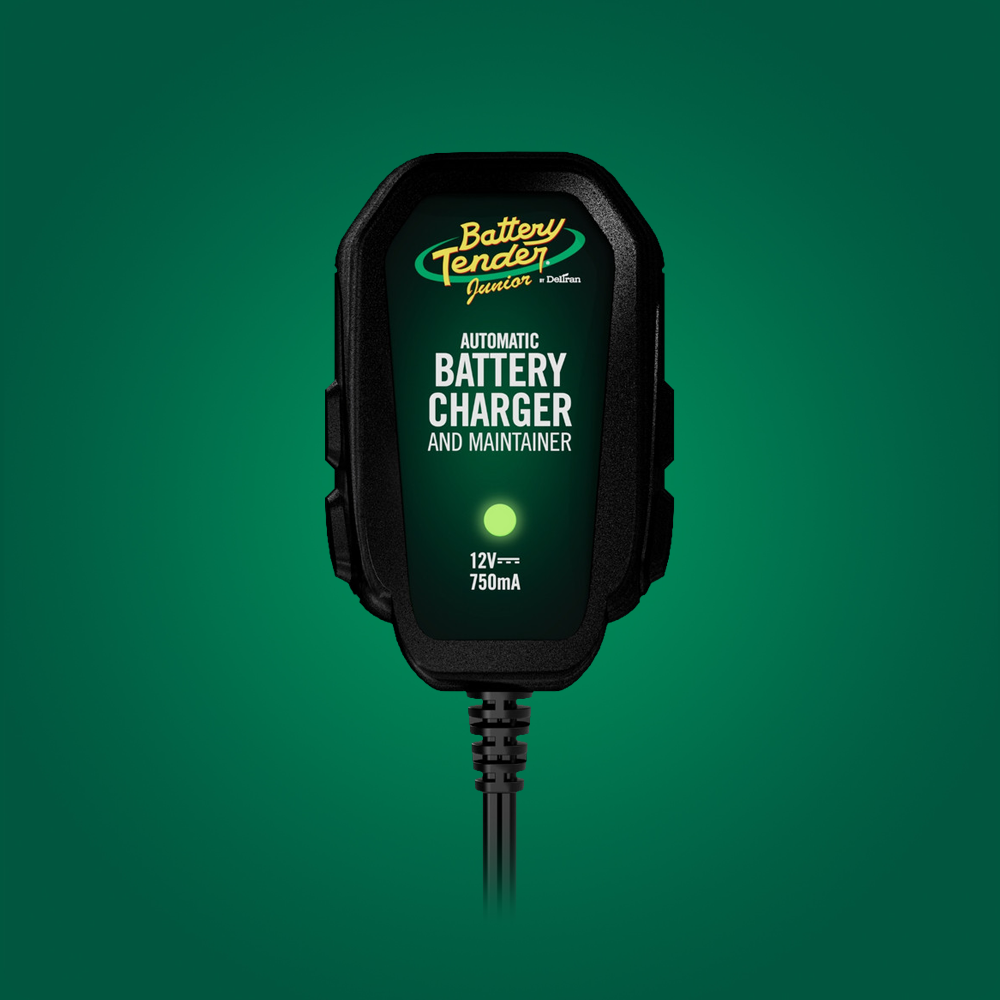
Only if the charger has selectable chemistry modes. AGM batteries require lower absorption voltage than standard flooded batteries, and lithium batteries require a completely different charge profile. Battery Tender chargers with selectable modes — including the 8A/2A Battery Tender Power Tender and the Battery Tender Junior 1A Selectable — automatically adjust voltage limits and termination criteria for each chemistry type to prevent damage.
How long does it take to charge a dead car battery?
Use the formula: (Battery Ah × depth of discharge) ÷ charger amps = approximate hours. A completely dead 60 Ah battery on a 1.25A charger takes roughly (60 × 1.0) ÷ 1.25 = 48 hours. The same battery on an 8A charger takes approximately (60 × 1.0) ÷ 8 = 7.5 hours. Severely sulfated batteries may take longer as the Absorption stage works to dissolve crystal deposits from the plates.
Conclusion
Selecting the right battery charger for car use comes down to three decisions: amperage matched to battery size, chemistry compatibility matched to battery type, and environmental protection matched to installation location. ISM technology from Battery Tender ensures that any charger in the lineup can be connected indefinitely without overcharge risk — protecting batteries from sulfation and extending service life well beyond the 2–3 year average that plagues unmaintained batteries. Whether the choice is a Battery Tender Plus for a single daily driver or the 8A/2A Battery Tender Power Tender for a household with larger batteries and outdoor exposure, the investment pays for itself after preventing one premature battery replacement.
Explore the full lineup of smart chargers, maintainers, and jump starters to find the right match for every vehicle in the household: