



RV Solar Power Systems: The Complete Guide to Off-Grid Energy Independence
RV solar power systems have fundamentally changed what it means to travel by recreational vehicle. Where boondocking once meant rationing electricity, running a noisy generator twice a day, or cutting trips short when batteries ran low, a properly designed solar installation now makes weeks of genuine off-grid living practical and comfortable. The formula is straightforward: match your solar array output to your daily consumption, pair it with a battery bank large enough to bridge cloudy days, and connect both through a quality charge controller that protects your investment. Get those three elements right, and you eliminate generator fuel costs, campground hookup fees, and the noise and exhaust that remind you and your neighbors that you are not quite as far from civilization as you intended to be.
This guide walks through every layer of RV solar system design — load analysis, panel selection, battery chemistry, charge controller technology, and shore power integration — using Battery Tender® components as the practical foundation for each stage of your build.
Understanding Your Daily Power Consumption
Every successful RV solar installation begins with an honest load analysis. Before selecting a single panel or battery, you need to know how many amp-hours your RV consumes on a typical day. That number drives every other decision in the system.
Start by listing every 12-volt and 120-volt load in the RV, estimating the amperage draw of each device, and multiplying by the hours per day you run it. A few common reference points help frame the math:
- LED lighting (8 fixtures): approximately 0.5A each × 4 hours = 16Ah per day
- 12V residential refrigerator: approximately 4–6A average draw × 24 hours = 96–144Ah per day
- Water pump: approximately 5A × 0.25 hours = 1.25Ah per day
- Laptop and phone charging: approximately 3–5A × 4 hours = 12–20Ah per day
- Roof vent fan: approximately 1–3A × 6 hours = 6–18Ah per day
A moderately equipped travel trailer or Class B motorhome with the loads above lands between 60 and 100Ah of daily consumption — a very achievable target for a 200 to 400-watt solar array. Add a residential air conditioner, an electric cooktop, a large inverter, or a residential-size refrigerator running continuously in hot weather, and daily consumption climbs to 200–400Ah or beyond. That kind of demand requires serious panel square footage, a large lithium battery bank, and realistic expectations about overcast-day performance.
How to Size an RV Solar Array
Once you know your daily amp-hour consumption, sizing the solar array requires accounting for average peak sun hours at your typical camping destinations. Most of the continental United States receives between 4 and 6 peak sun hours per day in summer, dropping to 2–4 hours in winter or during extended overcast periods.
A practical sizing formula: divide your daily consumption in watt-hours by your average peak sun hours, then add a 25% buffer for real-world inefficiencies including panel temperature derating, wiring losses, and charge controller conversion overhead.
For a 100Ah daily load at 12 volts (1,200Wh), targeting 5 peak sun hours:
1,200Wh ÷ 5 hours × 1.25 buffer = 300 watts of panel capacity
That 300-watt target is achievable with two 150-watt panels or three 100-watt panels mounted flush to the roof. For RVers who camp primarily at developed campgrounds and want solar as a supplement to shore power rather than a replacement for it, a smaller entry-level system makes both financial and practical sense before committing to a full roof installation.
The Battery Tender 35 Watt Mountable Solar Panel with Controller is the logical starting point for this supplemental role. Its integrated charge controller eliminates a separate component for small installations, the mountable design suits permanent roof attachment, and it keeps batteries topped off during storage or light-use periods when generator and shore power are unavailable. It is not a standalone off-grid system, but it is an excellent foundation and a meaningful contributor to a larger multi-panel array on a small camper or van build.
Choosing the Right Charge Controller for Your RV Solar Power System
The charge controller is the brain of an RV solar power system. It sits between the panels and the battery bank, regulating voltage and current to protect batteries from overcharge, managing multi-stage charging profiles, and — in the case of MPPT controllers — actively maximizing the power harvested from your panels regardless of changing sun angles and temperatures.
Two controller technologies dominate the RV market:
PWM (Pulse Width Modulation) controllers are simpler and less expensive. They work by connecting the solar panel directly to the battery once voltage rises above a set threshold, then rapidly switching the connection on and off to regulate charging. PWM controllers are adequate for small systems where panel voltage closely matches battery voltage, but they waste available panel capacity in most real-world installations.
MPPT (Maximum Power Point Tracking) controllers continuously calculate the voltage and current combination at which the panel produces maximum power, then convert that power to the voltage and current the battery actually needs. In practical terms, MPPT controllers recover 15–30% more energy from the same panels compared to PWM — a meaningful difference when you are trying to make a 300-watt array do the work of 400 watts on marginal sun days.
The Battery Tender 30 Amp MPPT Solar Charge Controller handles systems up to 400 watts at 12 volts or 800 watts at 24 volts — covering the full range from serious weekend boondockers to full-time RV solar installations. Its multi-stage charging algorithm delivers the bulk, absorption, and float stages that both AGM and lithium batteries require for full capacity and maximum cycle life. For any installation beyond a single small panel, the efficiency gains of MPPT technology pay for the price difference within the first season of heavy solar use.
Larger Class A motorhomes and fifth wheels with high daily consumption demands may outgrow the 30-amp controller entirely. For those builds, the Battery Tender 50 Amp MPPT Solar Charge Controller supports arrays up to 700 watts at 12 volts or 1,400 watts at 24 volts, providing the headroom that full-time RVers and high-consumption installations genuinely need without compromising on MPPT efficiency gains.
Battery Chemistry for Solar-Powered RV Solar Power Systems
Your battery bank is the fuel tank of your solar system. Panel output fluctuates with clouds, shadows, and sun angle. Your loads run continuously. The battery bank bridges that gap, storing energy when production exceeds consumption and supplying it when consumption exceeds production. Choosing the right battery chemistry determines how much of your rated capacity you can actually use, how long the bank will last, and how the system behaves at temperature extremes.
AGM (Absorbed Glass Mat) batteries remain the practical choice for many RV solar installations. Their sealed construction eliminates acid spill risk in any mounting orientation. They tolerate the temperature swings of outdoor storage better than flooded lead-acid batteries. They accept charge current well from solar sources and are fully compatible with standard three-stage chargers. The practical limitation of AGM is depth of discharge: regularly drawing below 50% state of charge accelerates sulfation and shortens battery life, which means a nominally 200Ah AGM bank delivers only 100Ah of reliably usable energy per cycle.
Lithium iron phosphate (LiFePO4) batteries have become the preferred choice for boondockers and full-timers willing to invest in longer-term performance. LiFePO4 chemistry tolerates 80% depth of discharge without accelerating degradation, effectively doubling the usable capacity of an equivalent amp-hour rating compared to AGM. A 100Ah LiFePO4 battery delivers 80Ah of usable energy versus 50Ah from a 100Ah AGM — and does so across 2,000 or more charge cycles versus 400–600 for AGM under regular solar cycling.
Battery Tender's line of smart chargers and maintainers supports both chemistries. When your RV is connected to shore power at a developed campground, a dedicated charger keeps the house bank fully conditioned regardless of the solar array's contribution that day.
Shore Power and Solar: Complementary, Not Competing
A common misconception among new RV solar enthusiasts is that solar replaces shore power entirely. For most RVers, the better framing is that solar and shore power serve different phases of the same trip. At a campground with full hookups, shore power handles heavy loads and keeps batteries fully charged overnight. In the backcountry without any external power source, solar and the battery bank carry everything.
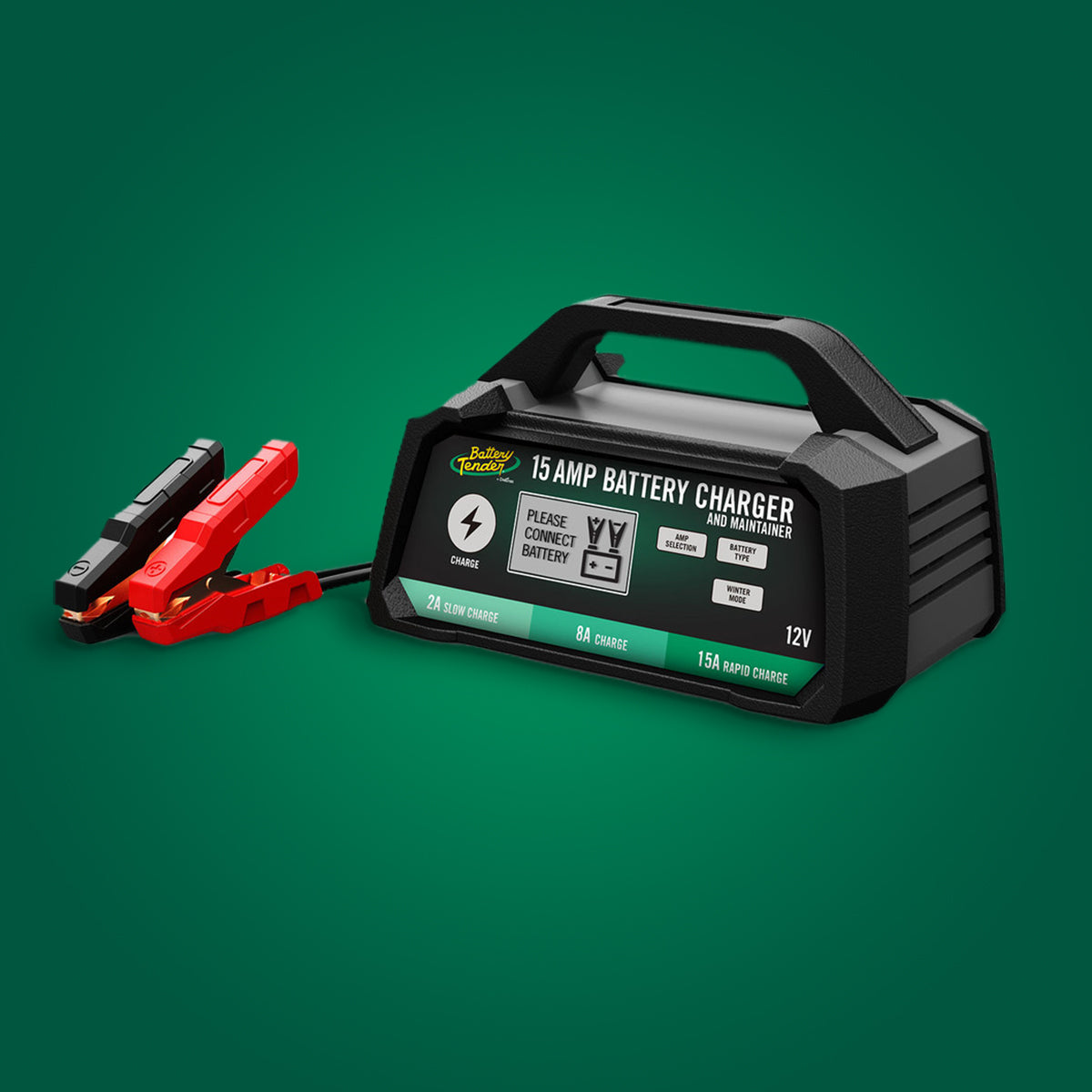
The Battery Tender 8A/2A Battery Charger and Maintainer (022-1005-DL-WH) fills the shore power role with precision. Its four-stage charging algorithm — initialization, bulk charge, absorption, and float maintenance — brings a depleted house bank to full charge efficiently and then holds it there without overcharging. For RVs with both a house battery bank and a separate chassis starting battery, this charger's two-bank capability means both batteries receive proper attention from a single shore power connection.
The practical integration looks like this: arrive at a developed campground after several days of boondocking, plug into shore power, and let the Battery Tender charger restore the house bank overnight while the solar array contributes supplemental charging during daylight. Depart for your next remote destination with a full battery bank regardless of how much solar production the previous day provided.
Wiring, Safety, and System Protection
Proper wiring is as important as component selection in an RV solar power system. Undersized wire creates resistive losses that steal the efficiency you paid a premium MPPT controller to recover. More critically, undersized wire is a fire hazard in a living space.
Key wiring guidelines for RV solar installations:
- Size wire for the maximum short-circuit current of your panel array, not just the operating current
- Install a fuse or breaker within 18 inches of the battery positive terminal on every circuit
- Use tinned marine-grade wire in any location subject to moisture or temperature cycling
- Keep panel-to-controller wire runs as short as practical to minimize voltage drop
- Install a disconnect switch between the panel array and the charge controller for safe maintenance
Grounding deserves particular attention in RV installations. The RV chassis serves as the negative return path for 12-volt systems, and improper grounding creates both shock hazards and corrosion damage at connection points.
Expanding Your RV Solar Power System Over Time
One of the practical advantages of building an RV solar power system around quality components is the ability to expand incrementally as your camping habits evolve. An RV owner who starts with the Battery Tender 35 Watt Mountable Solar Panel for basic battery supplementing can later add larger panels, upgrade to the Battery Tender 30 Amp MPPT Solar Charge Controller to handle the expanded array efficiently, and increase battery bank capacity as budget allows — all without scrapping earlier investments. Full-time RVers or those with particularly power-hungry rigs can take that expansion further still by stepping up to the Battery Tender 50 Amp MPPT Solar Charge Controller when panel wattage outgrows the 30-amp model.
The upgrade path that consistently delivers the most boondocking capability per dollar is: MPPT charge controller first, battery bank expansion second, additional panel wattage third. Storage capacity determines how long you can camp through consecutive cloudy days. Charge controller efficiency determines how completely the available sun restores that storage. Panel wattage determines the ceiling of daily production in ideal conditions.
Frequently Asked Questions About RV Solar Power Systems
How many solar panels does an RV need to run without shore power?
The answer depends entirely on your daily power consumption. A conservative RV lifestyle consuming 60–80Ah per day can sustain genuine off-grid operation with 200–300 watts of panels and a 200Ah battery bank. An RV with a residential air conditioner or high-draw cooking appliances may need 800 watts or more of panel capacity and a 400Ah lithium battery bank to achieve reliable off-grid operation in typical sun conditions.
What is the difference between an MPPT and PWM charge controller?
PWM controllers regulate charging by rapidly switching the panel connection on and off, wasting panel capacity whenever panel voltage significantly exceeds battery voltage. MPPT controllers continuously track the maximum power point of the panel — the voltage and current combination producing peak wattage — and convert that power to what the battery needs. MPPT controllers recover 15–30% more energy from the same panels in most real-world conditions, making them the correct choice for any system larger than a single small supplemental panel.
Can I use lithium batteries with my existing RV solar setup?
In most cases, yes — but verify that your charge controller supports lithium iron phosphate charging profiles. LiFePO4 batteries require a slightly different absorption voltage and do not benefit from the float maintenance stage that lead-acid chemistries need. Both the Battery Tender 30 Amp and 50 Amp MPPT Solar Charge Controllers support selectable battery type profiles including lithium, making them compatible with both legacy AGM banks and modern LiFePO4 upgrades.
Does solar charging damage RV batteries?
Properly controlled solar charging does not damage batteries — in many cases, the gentle, consistent charging profile of a quality MPPT controller is gentler on battery chemistry than the rapid bulk charging of a shore power converter. The risk comes from unregulated or poorly regulated solar charging, which can overcharge batteries and cause permanent capacity loss. Always use a quality charge controller sized appropriately for your panel array.
How should I maintain RV batteries when the RV is in storage?
A small solar panel combined with a quality battery maintainer is the most effective storage solution. The solar panel provides supplemental charging during daylight, while a smart maintainer like the Battery Tender 8A/2A Battery Charger and Maintainer keeps the battery in a correctly maintained float state during extended periods without use. This combination prevents the self-discharge and sulfation that shortens battery life when RVs sit unused for weeks or months.
Conclusion: Building RV Solar Power Systems That Perform
RV solar power systems reward careful planning and quality components. The boondocker who spends time upfront calculating actual daily consumption, selecting charge controller technology appropriate for their panel array, and matching battery bank capacity to realistic cloudy-day autonomy goals will consistently outperform the camper who assembled a system based on round numbers and marketing claims. Start with an honest load analysis, invest in MPPT charge control, choose battery chemistry appropriate for your depth-of-discharge habits, and integrate shore power charging to bridge the gaps that solar cannot cover alone.
Battery Tender products — from the entry-level 35 Watt Mountable Solar Panel with Controller to the mid-range 30 Amp MPPT Solar Charge Controller, the high-capacity 50 Amp MPPT Solar Charge Controller, and the dependable 8A/2A Battery Charger and Maintainer — provide the reliable, technically capable foundation that serious RV solar installations demand at every scale. Build your system correctly from the start, and the return on that investment will be measured in years of quiet, fuel-free nights under open skies.
Related guides: RV Battery Maintenance: Keep House Batteries Healthy Between Every Trip (2026) · How to Winterize RV Battery Banks for Spring-Ready Power (2026) · More automotive battery care guides