



Marine batteries face unique winter challenges that automotive batteries never encounter. Humidity, temperature fluctuations, saltwater corrosion, and extended storage periods conspire to destroy unprepared batteries. A $300 marine AGM battery—or $800 lithium battery—can become worthless scrap if improperly stored for just one winter season.
Battery Tender® has spent 60 years engineering marine-specific charging solutions. We pioneered consumer smart chargers in 1989, and our products now power everything from tournament bass boats to ocean-going yachts, supporting both traditional lead-acid and modern lithium technologies. This comprehensive guide shares proven winterization techniques that preserve battery life and ensure spring readiness.
Understanding Marine Battery Types
Marine batteries have evolved dramatically. While lead-acid remains common, lithium technology is rapidly gaining market share—especially in performance and tournament fishing applications.
Lead-Acid Starting Batteries
- Designed for high-amperage cranking bursts
- Not intended for deep discharge
- Typically flooded or AGM construction
- Require monthly charging during storage
- Cost: $150-300 typical
Lead-Acid Deep-Cycle Batteries
- Designed for sustained power delivery
- Handle repeated deep discharge cycles
- Common in house bank applications
- Traditional trolling motor choice
- Cost: $200-500 typical
AGM Marine Batteries (Lead-Acid)
- Sealed, maintenance-free construction
- Superior vibration resistance
- Faster recharging than flooded batteries
- Preferred for modern boats with electronics
- Cost: $300-500 typical
Lithium Marine Batteries (LiFePO4) - The Modern Choice
Why Lithium is Taking Over:
Lithium batteries now dominate tournament bass fishing and are rapidly expanding into recreational marine applications. The advantages are compelling:
Weight Savings:
- 60-70% lighter than equivalent lead-acid
- 100Ah lithium: ~25 lbs vs 65 lbs lead-acid
- Critical for bass boats where every pound affects speed
- Improves handling and fuel economy
Usable Capacity:
- 80% depth of discharge vs 50% for lead-acid
- 100Ah lithium = 80Ah usable vs 50Ah from lead-acid
- Doubles effective runtime
- Reduces battery bank size needed
Cycle Life:
- 2,000-5,000+ cycles typical
- Lead-acid: 300-1,000 cycles
- 10-15 year lifespan common
- Long-term cost advantage despite higher initial price
Performance:
- Maintains voltage under load (no voltage sag)
- Rapid recharge capability (1-2 hours vs 8-12 hours)
- Consistent power throughout discharge curve
- No sulfation issues
Common Marine Lithium Applications:
- Trolling motors (most popular - dramatic weight reduction)
- Starting batteries (cold cranking performance)
- House banks (capacity and weight advantages)
- Tournament boats (every advantage matters)
Special Lithium Considerations:
- CANNOT charge below 32°F (critical!)
- Require lithium-compatible chargers
- Higher initial cost ($600-1,500 typical)
- Built-in Battery Management System (BMS)
- Different winterization requirements
Battery Tender Lithium History:
We previously manufactured a line of lithium batteries and are launching a complete new lithium battery line in summer 2026, specifically engineered for marine and powersports applications with enhanced cold-weather protection and optimized BMS systems.
Pre-Winter Battery Assessment
Visual Inspection (All Types):
- Check for cracks, bulges, or case damage
- Inspect terminals for corrosion
- Verify hold-down hardware integrity
- Examine cables for fraying or damage
- Lithium: Check BMS indicator lights if equipped
Voltage Testing:
Lead-Acid Batteries:
- 12.6-12.8V: Fully charged, excellent
- 12.4-12.6V: Acceptable, charge before storage
- 12.2-12.4V: Partially discharged, charge immediately
- Below 12.2V: Deeply discharged, potential damage
Lithium Batteries:
- 13.3-13.6V: Fully charged
- 13.0-13.3V: 50-90% charged
- Below 13.0V: Charge before storage
- Note: Lithium voltage doesn't correlate directly to lead-acid
Complete Winterization Procedure
Step 1: Battery Removal Decision
Remove Battery If:
- Storing boat outdoors or unheated garage
- Temperature drops below 32°F regularly
- Cannot access battery for monthly checks
- No power outlet available near boat
- Lithium: ALWAYS remove if temperature drops below 32°F
Can Leave In Boat If:
- Heated indoor storage (above 40°F minimum)
- Easy battery access
- Power outlet available for Battery Tender®
- Planning permanent charger installation
- Lithium: ONLY if temperature stays above 40°F consistently
Step 2: Safe Battery Removal
Lead-Acid Removal:
1. Disconnect negative cable first (prevents sparks)
2. Disconnect positive cable second
3. Remove hold-down hardware
4. Lift carefully (50-70 lbs typical)
5. Transport to storage location
Lithium Removal:
1. Check BMS disconnect switch if present
2. Disconnect negative cable first
3. Disconnect positive cable second
4. Remove hold-down hardware
5. Lift carefully (12-25 lbs typical - much lighter!)
6. Handle carefully - contains sensitive electronics
Step 3: Cleaning
Terminal Cleaning (Lead-Acid):
- Mix baking soda and water (1:1 ratio)
- Scrub terminals with wire brush
- Rinse with distilled water
- Dry thoroughly
- Apply terminal protector or dielectric grease
Terminal Cleaning (Lithium):
- Use contact cleaner spray (NO baking soda - damages BMS)
- Clean with soft cloth
- Dry completely
- Apply dielectric grease
- Avoid corrosive cleaners near BMS connections
Case Cleaning (All Types):
- Wipe case with damp cloth
- Remove salt deposits or marine growth
- Check for leaks (flooded lead-acid only)
- Lithium: Inspect BMS housing for water intrusion
Step 4: Electrolyte Service (Flooded Lead-Acid Only)
- Remove vent caps
- Check electrolyte level in each cell
- Level should cover plates by 1/4-1/2 inch
- Add only distilled water to low cells
- Charge battery after adding water
AGM and lithium batteries require no electrolyte service - completely sealed.
Step 5: Full Charge Before Storage
Critical: Never store batteries in discharged state!
Charging by Battery Type
Lead-Acid Battery Charging

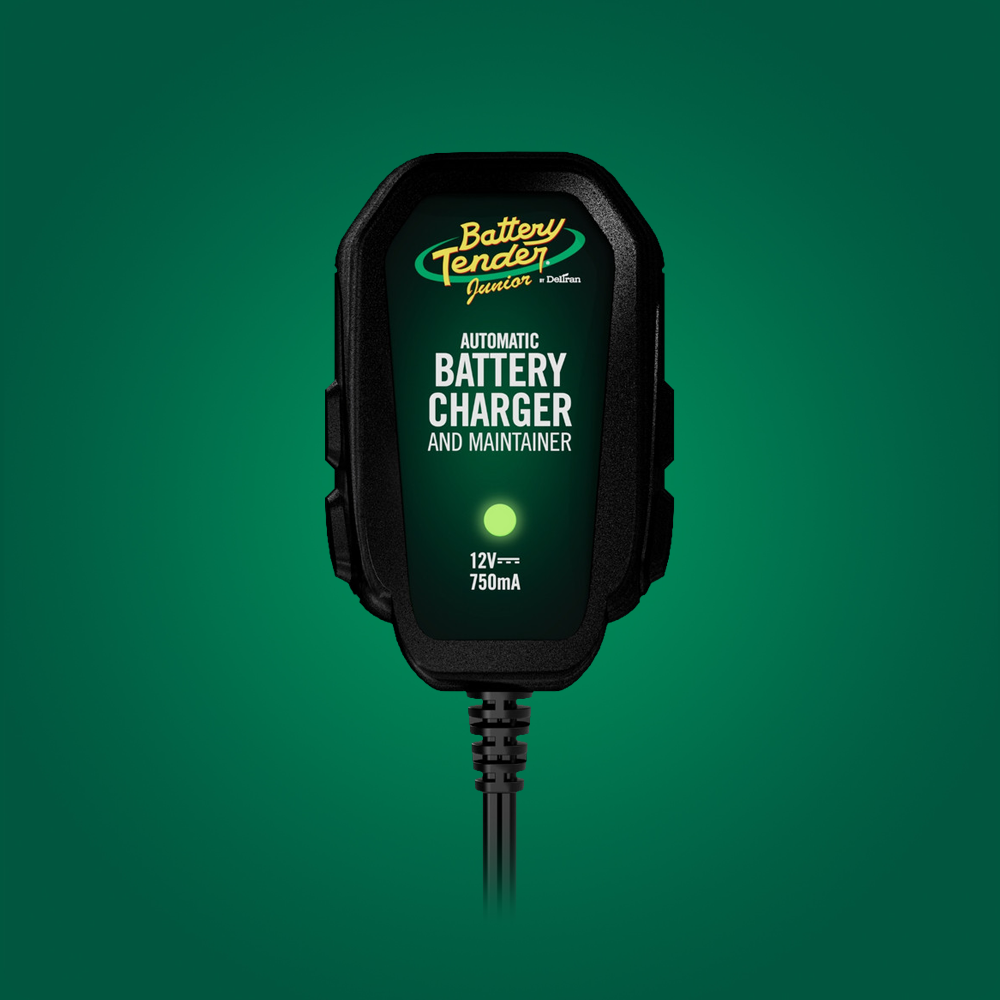
- Perfect for single starting battery
- Automatic float mode
- Safe for 6-month continuous connection
- Works with flooded, AGM, gel

- Charge up to 4+ batteries simultaneously
- Independent charging per battery
- Waterproof marine design
- Ideal for complex battery banks

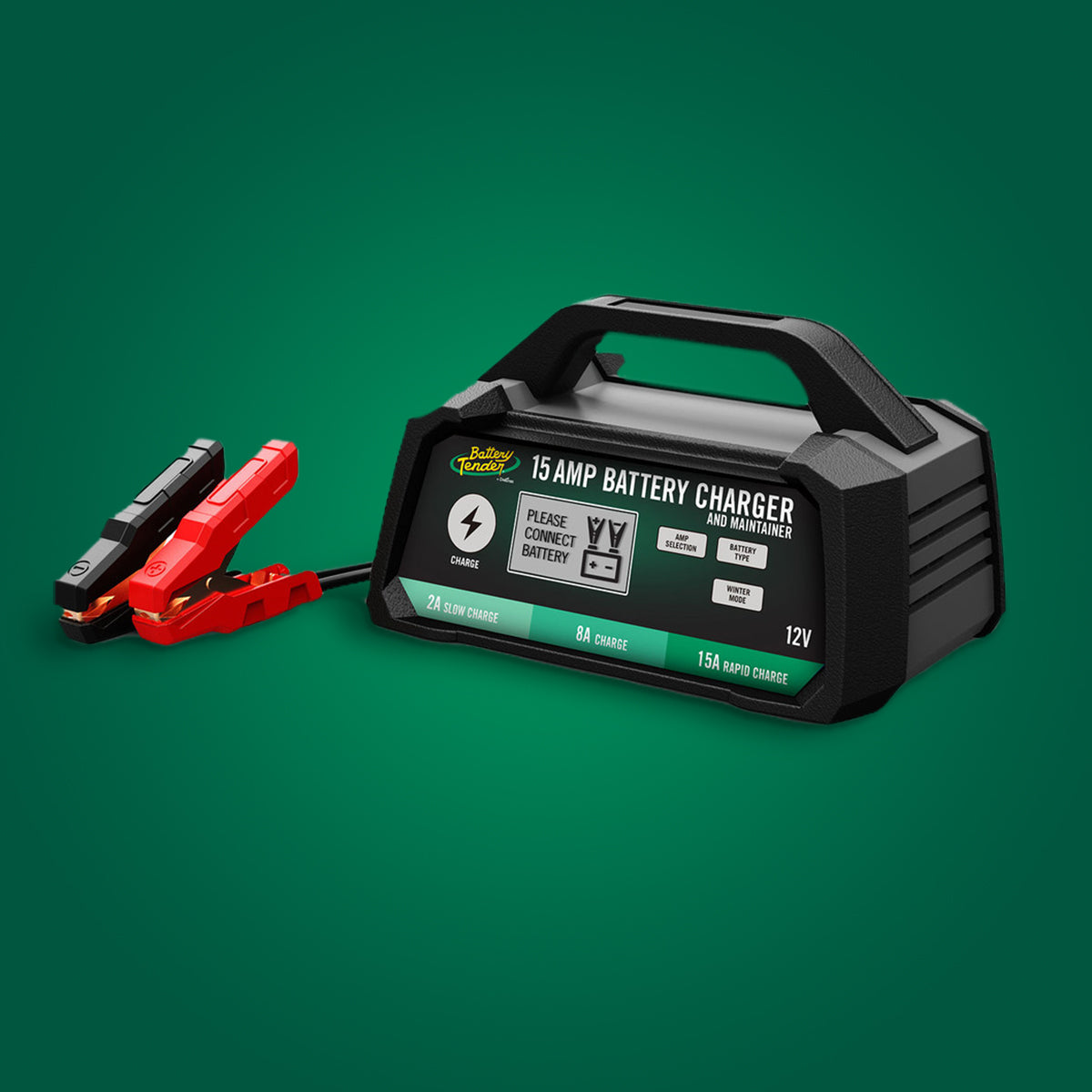
- Fast charging for large batteries
- Multiple amperage settings
- Chemistry selection for AGM, flooded, gel, AND lithium
Lithium Battery Charging
CRITICAL Lithium Requirements:
Temperature Restriction:
- CANNOT charge below 32°F (0°C)
- BMS will reject charge in cold temperatures
- Attempting cold charging causes permanent damage
- Must warm battery to 40°F+ before charging
- This is THE critical lithium limitation
Charger Requirements:
- MUST use lithium-compatible charger
- Battery Tender 10 AMP Selectable has dedicated lithium mode
- Using lead-acid charger damages lithium batteries
- Check charger specifications before connecting
Lithium Charging Profile:
- Bulk charge: 14.2-14.6V (varies by manufacturer)
- No float charging needed
- BMS manages cell balancing automatically
- Temperature monitoring prevents cold charging
- Much faster than lead-acid (1-2 hours vs 8-12 hours)
Storage Location Selection
Ideal Storage Conditions:
Lead-Acid Batteries:
- Temperature: 32-80°F acceptable
- Humidity: 40-60%
- Ventilation: Good airflow
- Surface: Non-conductive platform
Lithium Batteries:
- Temperature: 40-80°F (CRITICAL)
- Humidity: 40-60%
- Ventilation: Normal (no hydrogen emissions)
- Surface: Any stable platform
- MUST be temperature-controlled environment
- Cannot store in unheated garage/shed
Winter Maintenance Schedule
Lead-Acid Maintenance
Monthly Checks:
1. Test voltage with multimeter
2. Recharge if below 12.4V
3. Inspect for damage/leakage
4. Verify Battery Tender green light
Or: Continuous Battery Tender Connection
- Float mode maintains charge automatically
- No monthly checks needed
- Eliminates sulfation risk
- Ensures spring readiness
Lithium Maintenance
Monthly Checks:
1. Check voltage (should stay 13.2V+)
2. Verify BMS indicators
3. Confirm storage temperature above 40°F
4. Inspect physical condition
Lithium Storage Best Practices:
- Store at 60-80% charge (not 100%)
- Check voltage every 30 days
- Very low self-discharge (2-3% per month)
- No maintenance charging needed if stored properly
- Temperature monitoring is CRITICAL
Key Difference:
- Lead-acid needs monthly charging OR continuous Battery Tender connection
- Lithium needs temperature control and occasional voltage check
Multi-Battery Bank Management
Most boats have multiple batteries:
Typical Configuration:
- Starting battery (lead-acid or lithium)
- House bank (1-4 batteries)
- Trolling motor battery (increasingly lithium)
Critical Rules:
- Never mix lithium and lead-acid in same bank
- Charge each battery individually
- Monitor each battery voltage separately
- Different chemistries require different chargers

- Charge up to 5 batteries simultaneously
- Individual chemistry selection per battery
- Can charge mixed lead-acid and lithium banks (with proper settings)
- Single outlet powers entire system
- Saltwater-Specific Concerns
All Battery Types:
- Salt accelerates corrosion dramatically
- Clean terminals extra thoroughly
- Apply marine-grade protector
- Consider indoor storage
Lithium Specific:
- Salt can damage BMS electronics
- Clean with contact cleaner only
- Protect BMS connections carefully
- Less terminal corrosion than lead-acid
Spring Recommissioning
Pre-Installation Testing
Lead-Acid:
1. Check voltage (12.6-12.8V if maintained)
2. Perform load test
3. Clean any storage dust
4. Inspect terminals
Lithium:
1. Check voltage (13.2-13.6V)
2. Verify BMS status
3. Confirm no damage
4. Check terminals
5. Allow battery to warm to 50°F+ if stored cold
Installation
All Types:
1. Verify correct placement
2. Connect positive first
3. Connect negative second
4. Secure hold-down
5. Apply terminal protector
6. Lithium: Reconnect BMS if external disconnect
7. Test all systems before launch
Break-In Period
Lead-Acid:
- Run engine 30-60 minutes first use
- Monitor charging system (13.8-14.4V)
- Check battery voltage after first day
Lithium:
- Run engine 20-30 minutes first use
- Monitor charging system (14.2-14.6V with lithium profile)
- Verify BMS functioning
- Ensure alternator has lithium-compatible profile
Lead-Acid vs Lithium: Complete Comparison
Lead-Acid |
Lithium (LiFePO4) |
Cost $150-500 |
Cost $600-1,500 |
|
Weight 60-70 lbs |
Weight 12-25 lbs |
|
Usable Capacity 50% (50Ah from 100Ah) |
Usable Capacity 80% (80Ah from 100Ah) |
|
Cycle Life 300-1,000 cycles |
Cycle Life 2,000-5,000+ cycles |
|
Lifespan 3-7 years |
Lifespan 10-15 years |
|
Charge Time 8-12 hours |
Charge Time 1-2 hours |
|
Storage Temp 32-90°F acceptable |
Storage Temp 40-80°F required |
|
Charging Temp Down to 0°F |
Charging Temp CANNOT charge below 32°F |
|
Maintenance Charging Required monthly |
Maintenance Charging
Optional (low self-discharge) |
|
Self-Discharge 3-5% per month |
Self-Discharge 1-2% per month |
|
Voltage Sag Significant under load |
Voltage Sag Minimal |
|
Sulfation Risk High if discharged |
Sulfation Risk None |
|
BMS Required No |
BMS Required Yes (built-in) |
When to Choose Lead-Acid:
- Budget constrained
- No temperature-controlled storage
- Recreational/occasional use
- Traditional applications
- Proven, familiar technology
When to Choose Lithium:
- Weight matters (bass boats, performance)
- Heavy cycling use (trolling motors)
- Budget allows higher initial cost
- Temperature-controlled storage available
- Want maximum performance and longevity
Tournament Bass Boat Case Study
Why Pro Anglers Choose Lithium:
Weight Savings:
- Typical 36V trolling system: 3x 100Ah batteries
- Lead-acid: 195 lbs
- Lithium: 72 lbs
- 123 lb weight savings = faster boat = longer runs
Performance:
- All-day trolling without voltage drop
- Faster recharge between tournament days
- More consistent trolling motor speed
- Extended range vs lead-acid
Cost Analysis (5 years):
- Lead-acid: $1,500 initial + $1,500 replacement = $3,000
- Lithium: $3,000 initial + $0 replacement = $3,000
- Break-even at 5 years, then lithium pulls ahead
- Plus performance advantages throughout
FAQ
Q: Can I leave my batteries in my boat over winter?
A: Lead-acid: Only if heated storage and Battery Tender® connected. Lithium: Only if the temperature stays above 40°F and a lithium-compatible charger is available.
Q: Why can't lithium batteries charge when cold?
A: Charging cold lithium causes lithium plating on the anodes, permanently damaging the battery. The BMS prevents this by blocking charge below 32°F. This protects the battery but requires temperature-controlled storage.
Q: Can I replace my lead-acid trolling motor batteries with lithium?
A: Yes! This is the most popular lithium upgrade. Verify: (1) Charger is lithium-compatible, (2) You have temperature-controlled storage, (3) Budget allows. Weight savings and performance gains are dramatic.
Q: Do I need different Battery Tender charger for lithium?
A: Yes. Use the 10 AMP Selectable with lithium mode. Our new lithium battery line launches summer 2026 with dedicated charging solutions.
Q: Can I mix lithium and lead-acid batteries on my boat?
A: Never in the same bank (parallel or series). You can have lithium trolling motor and lead-acid starting battery, but they need separate charging systems.
Q: Should I upgrade to lithium?
A: Consider lithium if: (1) Weight matters, (2) Heavy trolling motor use, (3) Budget allows, (4) Temperature-controlled storage available. Lithium is becoming the standard for serious anglers.
Conclusion
Proper winterization preserves expensive marine batteries and ensures spring readiness. Whether maintaining traditional lead-acid or upgrading to modern lithium technology, Deltran's (the parent company of Battery Tender) proven charging solutions—refined over 60 years and pioneered with our 1989 smart charger innovation—provide the technology needed for successful long-term storage.
The marine battery landscape is evolving rapidly. Lithium offers compelling advantages for performance-focused boaters, while AGM lead-acid remains the reliable, cost-effective choice for recreational use. The upcoming summer 2026 Battery Tender lithium line will bring our trusted charging expertise to this emerging technology.
Don't let winter destroy your investment in quality marine batteries. Choose the right charging solution for your battery chemistry and eliminate spring surprises.
Browse our marine battery chargers and accessories.