


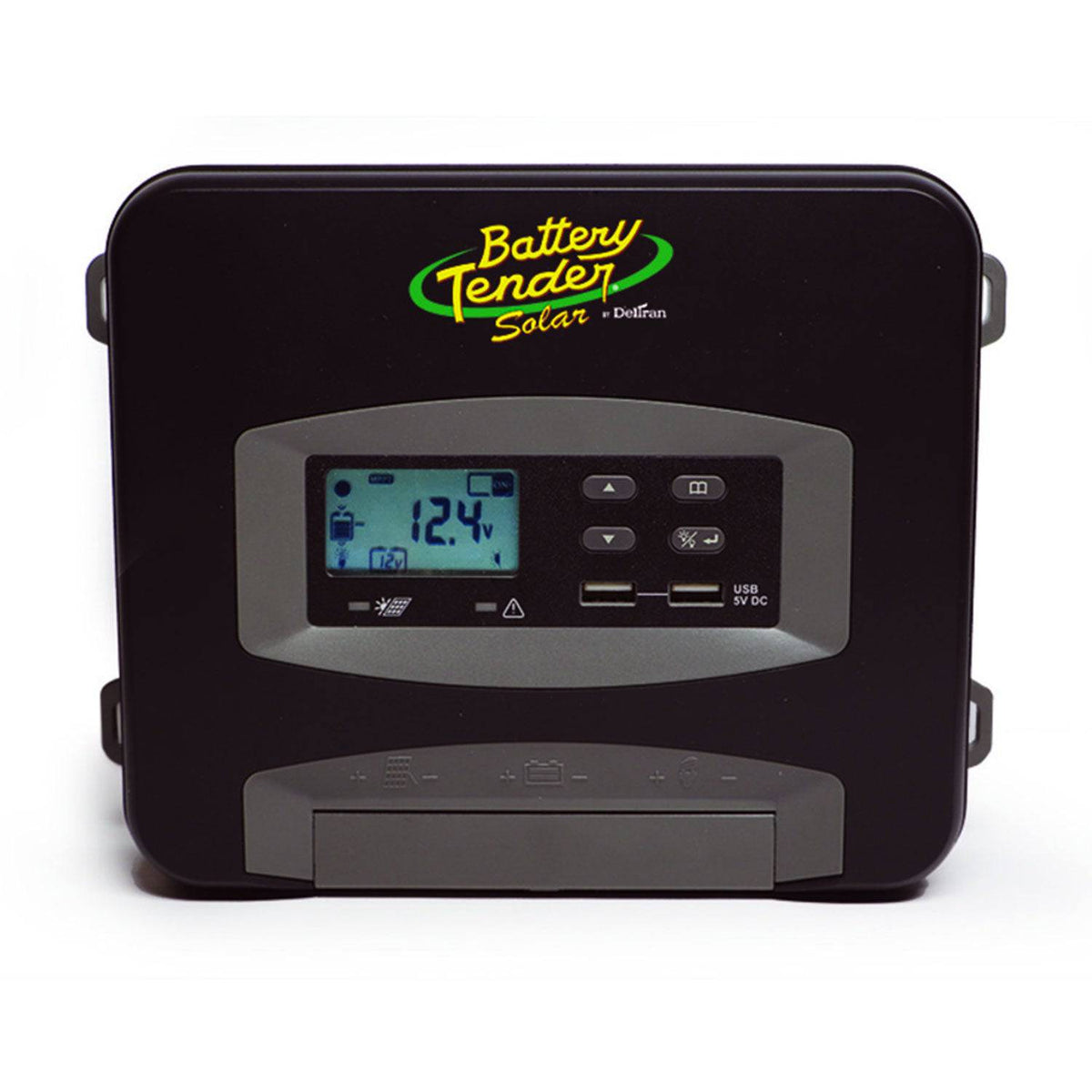
Solar Controller Guide: PWM vs MPPT, Sizing & Wiring (2026)
A solar controller sits between a solar panel and a battery and regulates voltage and current so the battery charges without overcharging. Without one, a 12V panel that peaks near 18V can push a battery well past safe limits. Battery Tender® solar maintainers solve this with built-in or add-on controllers matched to panel size.
Key Takeaways
- A solar controller is required for any panel whose output current exceeds about 1% of the battery's amp-hour capacity (for example, more than 1A on a 100Ah battery).
- Small panels (5W to 45W) work well with a simple automatic controller. Arrays above roughly 100W benefit from MPPT.
- Size the controller with this formula: panel watts ÷ battery volts × 1.25 = minimum controller amps.
- Install order matters: battery first, panel second. Reverse the order to disconnect.
- Match the controller to battery chemistry. Lithium, AGM, gel and flooded lead-acid use different voltage targets.
What Does a Solar Controller Do for Your Battery?
A solar controller matches panel output to what the battery can safely accept and stops current from flowing backward at night. It is the gatekeeper of every solar charging setup.
A "12V" panel is not really 12 volts. Most produce 17V to 22V open-circuit. A lead-acid battery charges at roughly 14.4V to 14.8V and rests at 12.6V to 12.8V when full. Without regulation, that surplus is either wasted or, worse, forced into the battery as heat and gassing.
A good solar controller handles four jobs:
- Voltage regulation: holds the battery at its target charge voltage (about 14.4V to 14.8V for lead-acid, 14.2V to 14.6V for most lithium iron phosphate).
- Current limiting: keeps amps within the battery and wiring ratings.
- Reverse-current blocking: stops the battery from discharging through the panel after dark.
- Staged charging: moves from bulk to absorption to float so the battery is topped off, then maintained.
Battery Tender solar maintainers, including the 17 Watt Mountable Solar 12V Battery Charger with Solar Controller, pair a weather-resistant panel with a built-in solar controller for 12V batteries. Check each product page for supported battery chemistries. That makes them a set-and-forget option for stored vehicles with no outlet nearby.
PWM vs. MPPT: Which Solar Controller Type Do You Need?
Small panels under 50W run well on a simple automatic or PWM solar controller, while arrays above about 100W usually justify MPPT. The right type depends on panel wattage, panel voltage, and how cold it gets.
| Controller Type | Best Panel Size | How It Works | Typical Use |
|---|---|---|---|
| Automatic / built-in | 5W to 45W | Regulates voltage and blocks reverse current | Motorcycles, ATVs, cars in storage |
| PWM | 50W to roughly 300W | Pulses panel output down to battery voltage | Boats, trailers, small RV systems |
| MPPT | 100W and up | Converts excess panel voltage into extra charging current | RVs, farm equipment, off-grid banks |
Why MPPT Pulls More Power
MPPT tracks the panel's maximum power point and converts surplus voltage into amps. In cold weather or when panel voltage sits well above battery voltage, that commonly adds 10% to 30% more harvest than PWM. The gain shrinks on small panels, so it rarely pays off below 100W.
For a deeper sizing walkthrough, read MPPT Solar Charge Controller: How to Choose and Size One (2026). For camper builds, RV Solar Power Systems: Battery Charging for Off-Grid Camping covers full-system layouts.
Chemistry Compatibility
Every solar controller must match the battery. Flooded, AGM and gel lead-acid use different absorption and float voltages. Lithium needs a tighter ceiling and no float at lead-acid levels. Many lithium packs also should not be charged below 32°F (0°C), so check the battery maker's specification before leaving a panel connected through winter.
How to Size a Solar Controller Correctly
Divide panel watts by battery voltage, then multiply by 1.25 to get the minimum controller amp rating. The 1.25 factor covers short bursts of intense sunlight that push panels above their rating.
Example: a 200W array on a 12V battery bank gives 200 ÷ 12 = 16.7A. Multiply by 1.25 for 20.8A, so a 30A controller is the correct choice. A 12V setup with a 100W panel needs only 10.4A minimum, so a 20A unit has headroom.
Then check whether the panel can actually keep up with the battery. Daily harvest is roughly panel watts × 4 peak sun hours × 0.75 system efficiency. Divide by 12V to get amp-hours per day. These figures are estimates and vary with season, angle and shade.
| Application | Typical Battery | Panel | Estimated Daily Harvest | Controller |
|---|---|---|---|---|
| Motorcycle / ATV | 8Ah to 18Ah | 5W | About 1.25Ah | Built-in or automatic |
| Car / classic / truck | 35Ah to 75Ah | 17W | About 4.25Ah | Built-in or automatic |
| Boat / trailer | 75Ah to 100Ah | 35W to 45W | About 8.75Ah to 11Ah | Automatic or PWM |
| RV / farm / off-grid | 200Ah+ bank | 200W to 400W | About 50Ah to 100Ah | MPPT |
For storage, the math is forgiving. A 12Ah motorcycle battery that self-discharges 3% per month loses about 0.36Ah. Even a 5W panel on a cloudy day replaces that easily. Self-discharge runs roughly 1% to 3% per month for AGM and can reach 5% or more for flooded batteries, higher in heat.
Parked outdoors with a car battery? Can a Solar Panel Keep a Car Battery Charged? (2026) explains panel placement and expected results.
How to Install a Solar Controller Step by Step
Connect the battery to the solar controller first, then the panel, and always reverse that order when disconnecting. This sequence lets the controller detect system voltage before panel power arrives.
- Mount the controller in a dry, shaded spot within a few feet of the battery to keep wire runs short.
- Cover the panel with an opaque cloth, or work in low light, so it produces no power while you wire.
- Add a fuse in the positive battery lead as close to the battery as practical. Marine practice (ABYC) calls for it within 7 inches.
- Connect the battery terminals to the controller's battery input: positive to positive, negative to negative. Confirm the controller recognizes 12V.
- Connect the panel leads to the controller's panel input, checking polarity.
- Uncover the panel and confirm the charging indicator lights up.
- Verify with a multimeter. Battery voltage should climb toward 13.5V to 14.8V in sunlight, depending on stage.
Use wire sized for the amps and run length, and keep connections tight and corrosion-free. Never wire a panel directly to a battery on a permanent install without a controller.
Which Battery Tender Solar Controller Fits Your Setup?
Choose by panel wattage and battery bank size: the Battery Tender 5-45W Automatic Solar Controller for small panels, the Battery Tender Solar Charge Controller for general 12V use, and the 30 AMP MPPT unit for large arrays.
Small Panels and Stored Vehicles
Anyone running a panel between 5W and 45W on a motorcycle, ATV, classic car or boat battery needs a controller sized for that range. The Battery Tender 5-45W Automatic Solar Controller covers every panel in that window, so you can upgrade later from a 5W to a 35W panel without replacing the controller.
Battery Tender 5-45W Automatic Solar Controller
General 12V Panel Setups
Readers pairing a third-party or existing panel with a 12V battery for a trailer, tractor or utility vehicle need a dedicated unit that prevents overcharging and reverse discharge. The Battery Tender Solar Charge Controller fits that role as a straightforward regulator between panel and battery.
Battery Tender Solar Charge Controller
Large Arrays and Off-Grid Banks
An RV, farm shop or off-grid cabin with 200W to 400W of panels on a 12V or 24V bank has outgrown simple controllers. At 12V, a 30A MPPT unit handles roughly 400W of panels, and at 24V roughly twice that. The extra harvest from MPPT matters most in winter, when panel voltage runs high and sun hours are short.
Battery Tender 30 AMP, 24V/12V MPPT Solar Charge Controller
Mounting on a Motorcycle
Motorcycle owners who want the panel in sunlight while the bike sits outdoors need a secure mount that keeps the panel angled and out of the way. A handlebar mount holds a small panel upright without drilling or adhesives, so it can be removed before riding.
Battery Tender Solar Panel Handlebar Mount
Frequently Asked Questions
Do I need a solar controller for a small solar panel?
Yes, in almost every case. Even a 5W panel can deliver an unregulated 18V to a 12V battery, which risks overcharging during long summer days. The exception is a panel whose output current stays below about 1% of battery capacity, such as a 1W panel on a 100Ah battery. Even then, a built-in or external solar controller is the safer choice.
What is the difference between a solar controller and a solar charge controller?
There is no functional difference. Both terms describe the device that regulates power from a solar panel to a battery. "Solar charge controller" is the more formal name and appears in product titles, while "solar controller" is the common shorthand. Both can be PWM, MPPT, or simple automatic designs depending on panel size.
Can a solar controller overcharge a battery?
A correctly matched solar controller will not, because it limits voltage to the battery's target. Overcharging happens when the controller is set for the wrong chemistry, is undersized, or has failed. Confirm the controller supports lithium, AGM, gel or flooded batteries, and check battery voltage monthly during the first season.
How many watts of solar do I need to maintain a stored battery?
For storage, 5W to 17W is usually enough. A 5W panel yields roughly 1.25Ah per day at 12V in average sun, far more than the roughly 0.3Ah to 3Ah per month a typical motorcycle or car battery loses to self-discharge. Larger or colder-climate setups, such as a 100Ah boat battery, benefit from 35W to 45W for winter margin.
Where should I mount a solar controller?
Mount it in a dry, ventilated, shaded location close to the battery, ideally within 3 to 6 feet of cable. Heat reduces controller efficiency and shortens electronics life. Avoid enclosed engine compartments, and never mount a non-waterproof unit where it can get rained on or splashed.
Conclusion
A solar controller turns a raw panel into a safe, automatic battery maintainer. Size it with panel watts ÷ battery volts × 1.25, match it to battery chemistry, wire the battery first and the panel second, and a stored vehicle stays charged without an outlet. Next step: pick the controller that matches your panel from the options above, then browse the full lineup of Battery Tender solar battery chargers.