
Motorcycle Battery Winter Storage: Month-by-Month Plan (2026)
For motorcycle battery winter storage, charge the battery to full, then keep it on a Battery Tender® maintainer until spring. A 7–30Ah battery left unattended for 6–9 months will usually fall below 12.0V, well past the 12.4V threshold where sulfation begins to permanently reduce capacity.
Most riders blame "a bad battery" when the bike won't start in April. Usually the battery was fine in October. It lost charge slowly all winter, and the loss was predictable. This guide puts numbers on that loss and gives a month-by-month plan for storing the battery. It also shows how to match a maintainer to battery size and garage conditions, which is where most storage plans go wrong.
Key Takeaways
- A stored lead-acid or AGM motorcycle battery loses roughly 3–5% of its charge per month on its own, before any electrical drain from the bike.
- Resting voltage below 12.4V means the battery is under 75% charged and begins sulfating. Below 12.0V, a discharged battery can also freeze at around 20°F.
- A 750mA to 800mA maintainer is enough for nearly every 7–30Ah powersports battery. Maintaining a charge takes far less current than recovering a dead one.
- Connect the maintainer when the bike goes into storage, not after the first cold snap.
- Nearly all Battery Tender chargers include temperature compensation to adjust for charging in extreme heat or cold.
Why Motorcycle Battery Winter Storage Fails Without a Maintainer
Motorcycle battery winter storage fails because a battery discharges whether or not the bike runs. Two separate drains work against it: internal self-discharge and parasitic draw from the bike's electronics.
Self-discharge is chemistry. Flooded lead-acid batteries lose about 3–5% of capacity per month at 77°F, and AGM batteries lose somewhat less. Heat speeds it up, so the loss is slower in a cold garage but never zero.
Parasitic draw is the bike's clock, ECU memory, alarm, and immobilizer. A fuel-injected bike with an alarm commonly pulls 5–30mA with the key off. At 8mA, that is about 192mAh per day, or nearly 6Ah per month. On a 12Ah battery, that is 48% of the capacity gone in 30 days from the draw alone.
What a Battery Tender maintainer does differently
Battery Tender chargers use Infinite Sequential Monitoring (ISM), a proprietary four-stage process:
- Initialization: tests the battery and applies gentle current to judge its condition.
- Bulk Charge: delivers full rated current until the battery reaches about 80% state of charge.
- Absorption: holds voltage constant while current tapers, which finishes the charge and helps dissolve sulfate crystals.
- Float Maintenance: monitors the battery and sends charge pulses only when its voltage drops.
This is why a Battery Tender charger with ISM is safe to leave connected for months. Conventional trickle chargers push constant current regardless of battery state, which risks overcharging a small powersports battery. Float-only chargers hold a constant voltage and skip the Absorption stage, so they charge more slowly.
The Numbers Behind Motorcycle Battery Winter Storage
Resting voltage is the simplest way to read a stored battery. Measure with a multimeter after the bike has sat at least 4 hours with the charger disconnected.
| Resting Voltage (12V Lead-Acid/AGM) | Approx. State of Charge | Storage Meaning |
|---|---|---|
| 12.7V or higher | 100% | Ready for storage |
| 12.4V | 75% | Sulfation begins; connect a maintainer now |
| 12.2V | 50% | Needs a full recharge before storage |
| 12.0V | 25% | Capacity loss likely; freeze risk rises |
| Below 11.9V | Discharged | May need replacement |
These readings apply to lead-acid and AGM chemistry. Lithium (LiFePO4) batteries rest at higher voltages and need a lithium-compatible charger, so check the battery label before connecting any charger.
Freeze risk in an unheated garage
A fully charged battery withstands temperatures far below -40°F. A discharged one can freeze at roughly 20°F. A frozen battery can crack its case and deform its plates. Keeping the battery charged is the cheapest freeze protection available.
Charge time math before storage
Use this formula: (battery Ah × depth of discharge) ÷ charger amps = approximate hours. A 14Ah battery at 50% discharge needs 7Ah, so on a 0.75A charger that is 7 ÷ 0.75 ≈ 9.3 hours. Add about 20% for charging losses, and plan on roughly 11 hours. A 30Ah battery at the same depth needs 15 ÷ 0.75 = 20 hours, plus losses.
Step-by-Step: A Month-by-Month Motorcycle Battery Winter Storage Plan
This plan assumes the battery stays on the bike and the bike sits 6–9 months. Adjust the dates for your climate.
Before storage (October or November)
- Ride the bike at least 20–30 minutes so the charging system tops off the battery.
- Clean the terminals with a baking-soda solution and a brush, then dry them.
- For flooded batteries with removable caps, check the electrolyte level and top off with distilled water only.
- Measure resting voltage after 4 hours. If it reads below 12.7V, charge the battery fully before storage.
- Connect the maintainer and confirm the indicator shows the maintenance state.
- Switch the ignition off and remove the key.
During storage (December through February)
- Check once a month that the charger is still plugged in and the indicator shows normal operation.
- Look for power-strip switches, tripped breakers, or unplugged cords. These are the usual causes of a dead battery with a charger "connected."
- Do not disconnect and reconnect the charger repeatedly. ISM handles the charging cycle automatically.
Before the first ride (March or April)
- Disconnect the charger and let the battery rest 4 hours.
- Measure voltage. A healthy battery reads 12.7V or higher.
- Inspect terminals for corrosion and tighten the connections.
Riders who store several bikes, or a boat alongside the motorcycle, can apply the same approach across vehicles. The article on boat battery winter storage with Battery Tender WaveCharge marine chargers covers the marine side of that routine.
Choosing a Maintainer for Motorcycle Battery Winter Storage
The right maintainer depends on battery size, where the bike is stored, and whether an outlet is nearby. Powersports batteries typically range from 7Ah to 30Ah, and a charger in the 750mA to 800mA range suits that whole span for maintenance.
| Situation | Typical Battery | Suggested Product |
|---|---|---|
| Heated or sheltered garage, outlet available | 7–18Ah | Battery Tender Junior 750mA |
| Unheated shed, carport, trailer, or damp space | 12–30Ah | Battery Tender Weather Resistant 800mA |
| Covered storage, no outlet | 12–30Ah | Battery Tender 17 Watt Mountable Solar charger |
| Several bikes in one place | Mixed | One charger and one ring terminal harness per bike |
Weather-exposed storage: the primary pick
Storage spaces such as sheds, trailers, and carports often have condensation, dust, and wide temperature swings. The Battery Tender Weather Resistant 800mA is built for those conditions. Nearly all Battery Tender chargers include temperature compensation to adjust for charging in extreme heat or cold.
Battery Tender Weather Resistant 12V 800mA Battery Charger and Maintainer
Sheltered garage: the compact option
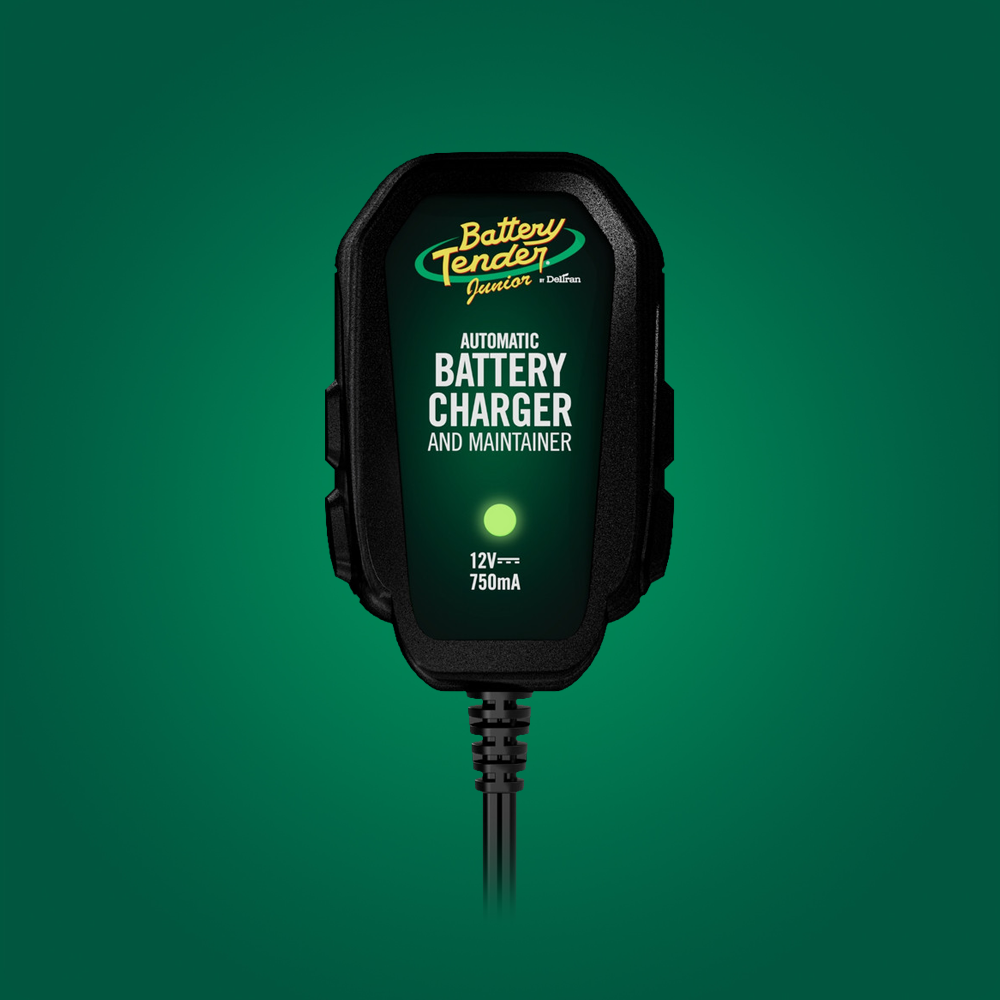
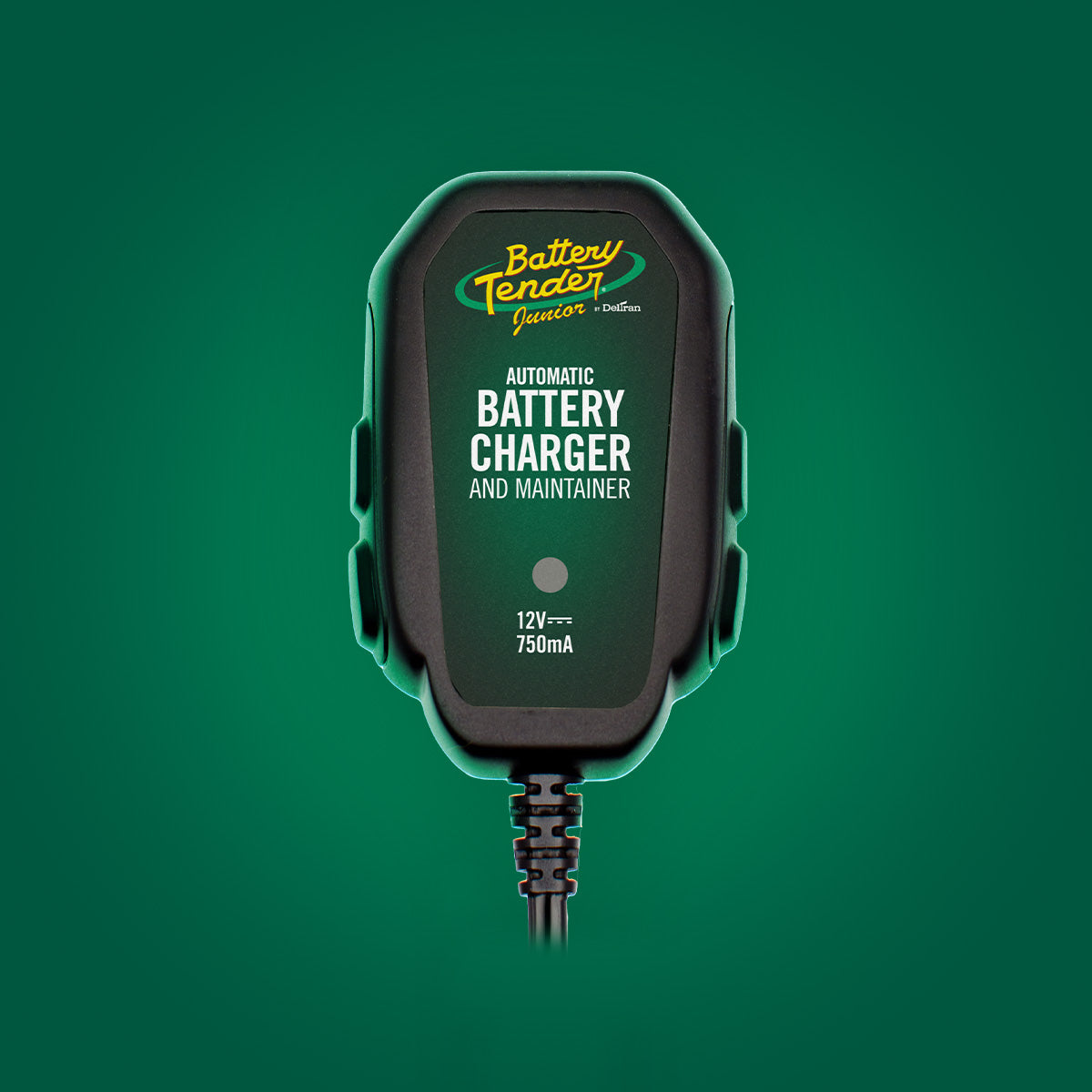
For a typical 7–18Ah battery in a dry garage, the Battery Tender Junior 750mA is a compact maintainer. It runs ISM and can stay connected all winter. Nearly all Battery Tender chargers include temperature compensation to adjust for charging in extreme heat or cold. If the garage regularly drops well below freezing, choose a model with temperature compensation.
Battery Tender Junior 750mA 12V Battery Charger and Maintainer
No outlet: solar maintenance
A bike stored under a carport, in a barn, or at a seasonal property may have no power at all. The Battery Tender 17 Watt Mountable Solar charger includes a built-in solar controller and mounts on a wall, roof, or bracket facing the sun. It suits 12V batteries where sunlight reaches the panel, though short winter days reduce its output, so it works best for light parasitic loads. Confirm the voltage stays above 12.4V during monthly checks.
17 Watt Mountable Solar 12V Battery Charger with Solar Controller
Backup Power, Quick Connections, and Spring Startup
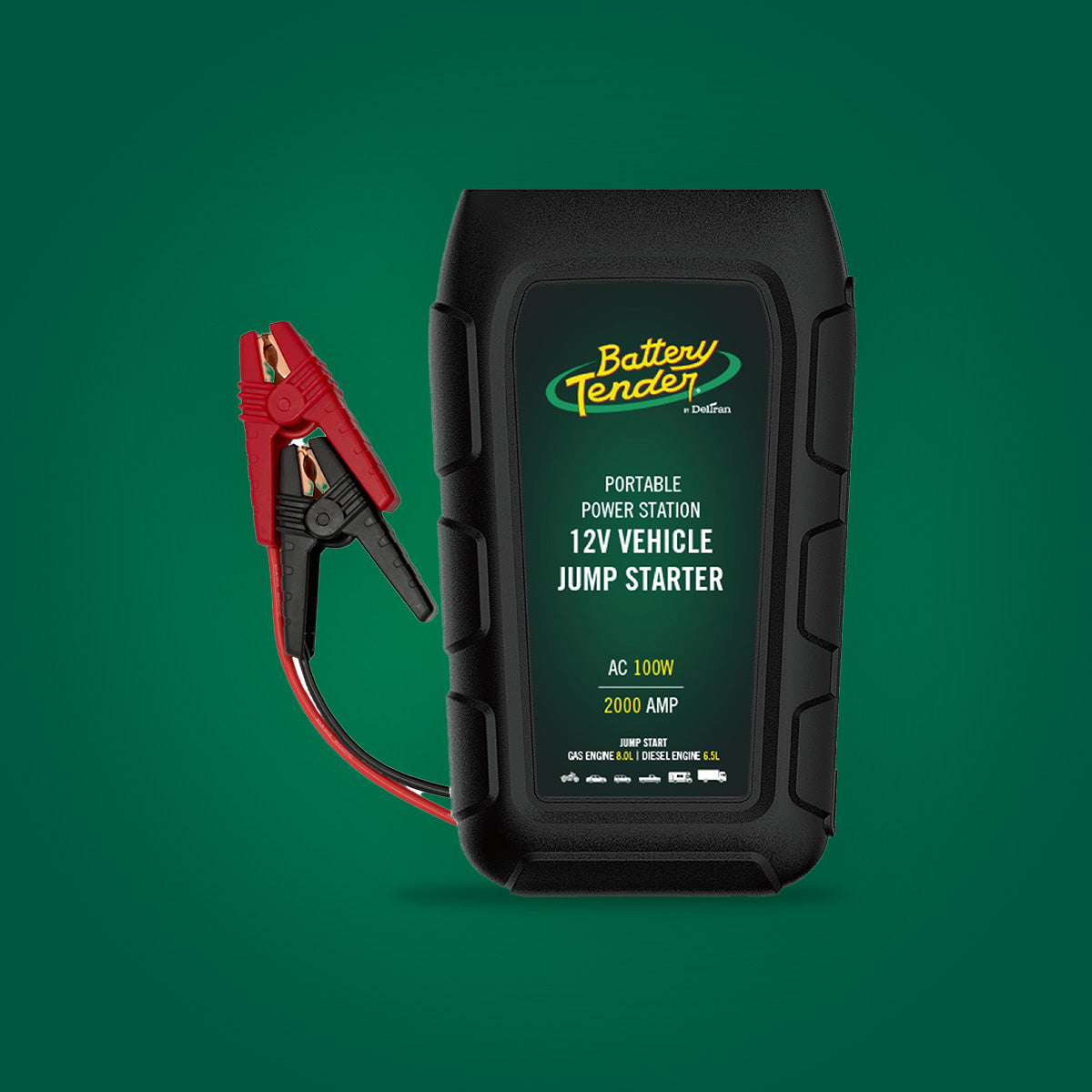
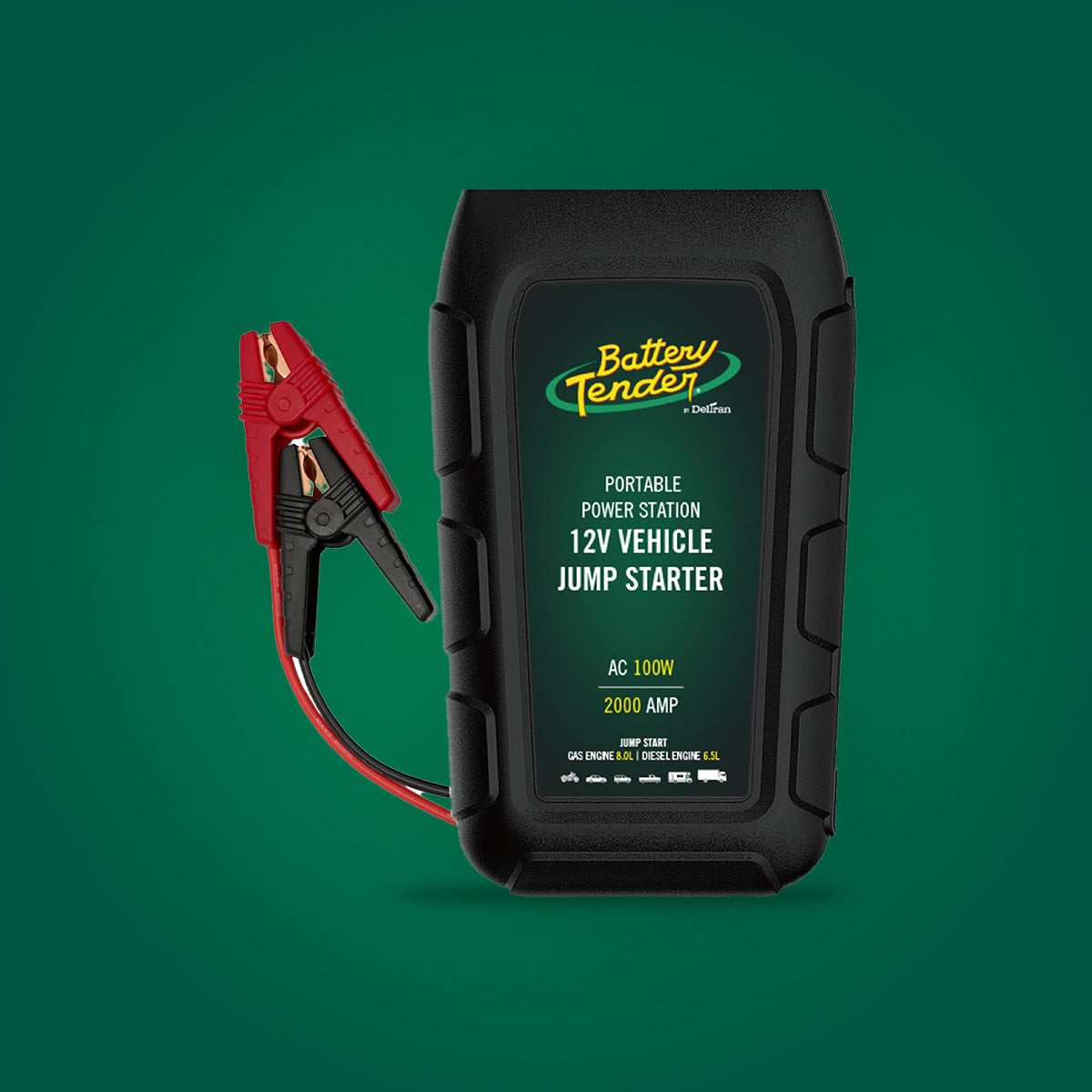
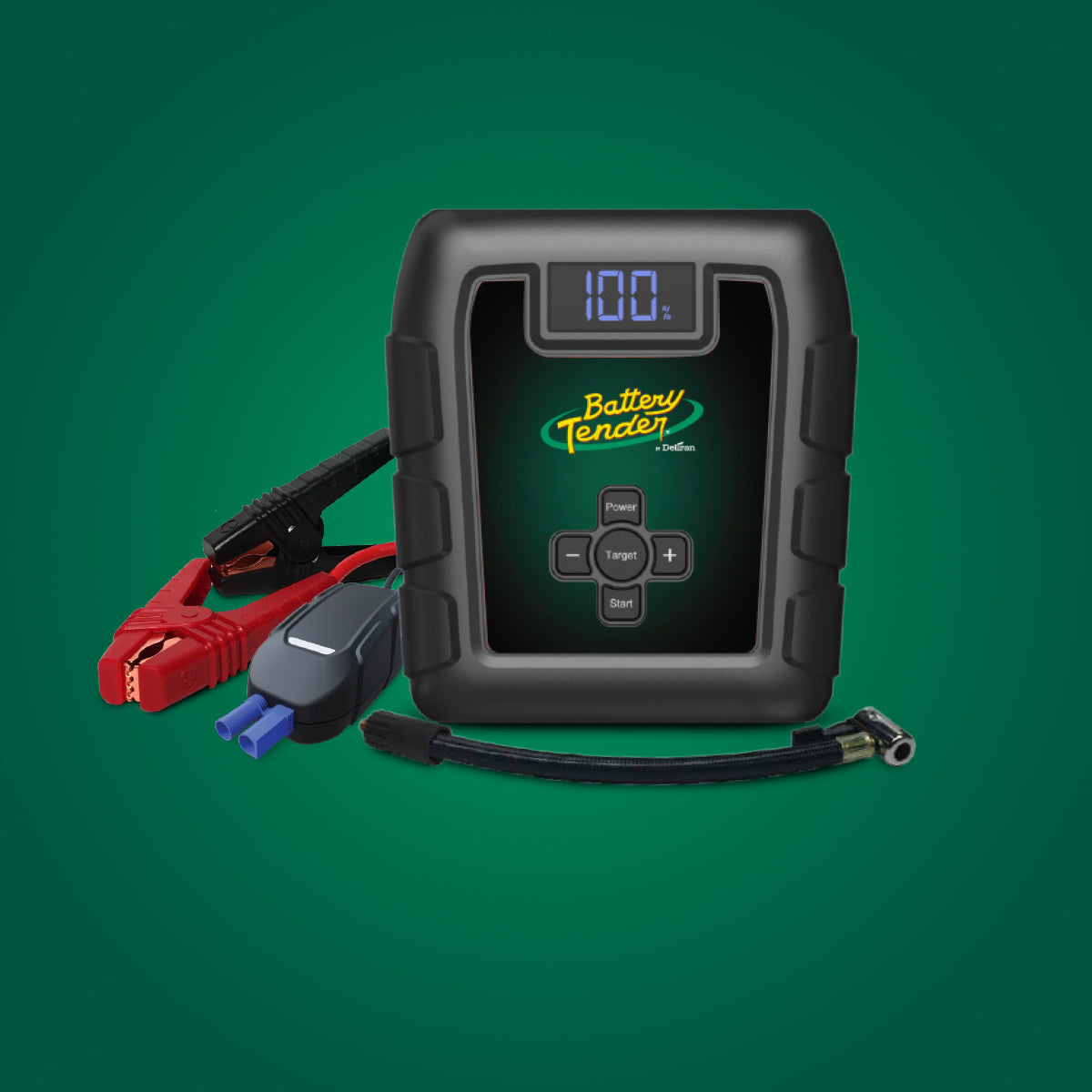
Even with a maintainer, a backup plan for starting problems costs little. A portable jump starter covers a battery that died before the charger was connected, or a bike that sat longer than planned. The Battery Tender Jump N Start Bundle (2000 Amps) pairs a lithium jump starter with a ring terminal cable. It exceeds what a motorcycle needs, but the same unit also starts the truck or car that hauls the bike, so one device covers the household. Recharge any lithium jump starter every few months so it is ready when needed.
Battery Tender Motorcycle & Powersports Battery Tender Jump N Start Bundle (2000 Amps)
Ring terminals make storage easier
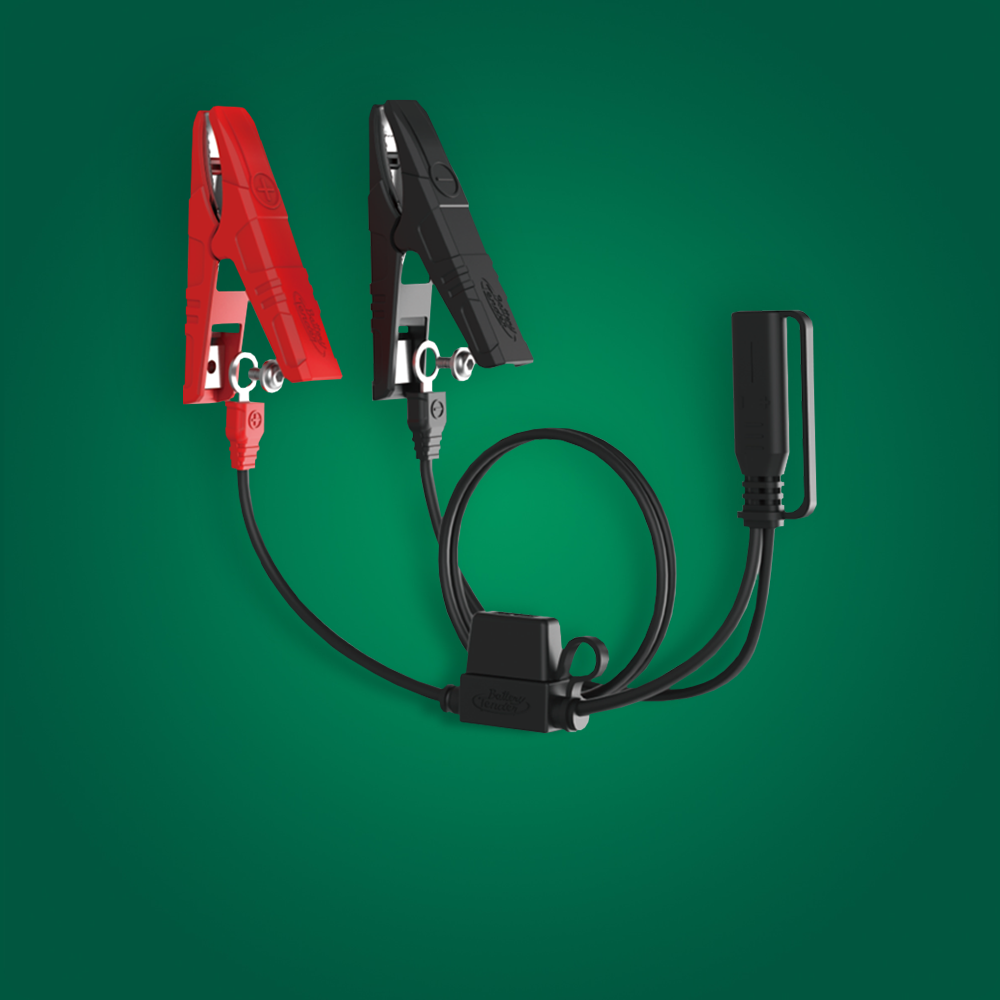
Pulling the seat or fairing every time the bike goes in and out of storage discourages good habits. Permanently attaching a ring terminal harness to each battery gives a plug-in point that stays accessible. The 25-pack suits riders with several bikes, ATVs, or a small collection, and it leaves spare harnesses for friends and family.
Battery Tender Ring Terminal Harness 25 Pack
Spring recommissioning checklist
- Disconnect the charger and rest the battery 4 hours.
- Read resting voltage. 12.7V or higher is ready. 12.4V to 12.6V needs a full charge cycle.
- Check that cables, terminals, and the battery case are clean, dry, and free of swelling.
- Start the bike and ride at least 20 minutes to let the stator replenish the charge.
- Retest voltage the next day. If it falls under 12.4V overnight, the battery has lost capacity or the bike has an excessive parasitic draw.
Riders of cruisers with large electrical loads can find more battery-specific advice in the Harley-Davidson battery maintenance guide.
Frequently Asked Questions
How long can a motorcycle battery sit in winter without a charger?
A healthy lead-acid or AGM battery typically holds a usable charge for 4–8 weeks of storage. Bikes with alarms or ECU memory drain faster. Past that point, voltage falls below 12.4V and sulfation starts. For storage longer than two months, connect a maintainer rather than relying on the battery alone.
Should I remove the battery or leave it on the bike for winter storage?
Either works if the battery stays charged. Leaving it installed and connected to a maintainer is simpler, and the maintainer offsets the bike's parasitic draw. If you remove it, store it somewhere dry and above freezing, and still connect a maintainer.
Is it safe to leave a Battery Tender charger connected all winter?
Yes. Battery Tender chargers use Infinite Sequential Monitoring, which sends charge only when the battery voltage drops during the Float Maintenance stage. This makes the charger safe to leave connected for the entire storage season. Conventional trickle chargers, which push constant current, carry a real overcharge risk.
What voltage should my motorcycle battery read in spring?
A healthy 12V lead-acid or AGM battery should read 12.7V or higher after resting 4 hours off the charger. A reading of 12.4V means roughly 75% charge, and 12.0V is about 25%. If a battery cannot hold 12.4V overnight after a full charge, test it or replace it.
Can a motorcycle battery freeze in an unheated garage?
Yes, but mostly when it is discharged. A fully charged battery resists freezing well below -40°F, while a discharged one can freeze near 20°F. Freezing can crack the case and damage the plates. Keeping the battery fully charged through winter is the best protection.
Conclusion
Good motorcycle battery winter storage comes down to one habit: charge fully, then maintain through the entire storage period. The numbers are consistent. Self-discharge plus parasitic draw can remove half of a small battery's charge in a single month, and a maintainer with ISM prevents that loss.
Next step: measure your battery's resting voltage today, pick the maintainer that matches your storage space, and connect it before the bike goes under the cover. Browse the full range of motorcycle battery chargers to match one to your bike.