

Does a Jump Starter Work on a Dead Battery? What Actually Happens (2026)
Yes, a portable jump starter does work on a dead battery — but only under specific conditions. Battery Tender® lithium jump starters deliver a concentrated surge of cranking amps that bypasses the depleted vehicle battery and powers the starter motor directly, enabling ignition even when the dashboard is completely dark. However, the word "dead" covers a wide spectrum of battery states, and understanding where a jump starter succeeds versus where it cannot help is the difference between a quick roadside recovery and a frustrating, potentially damaging misdiagnosis.
The critical factor most drivers overlook is why the battery died. A battery drained by leaving headlights on overnight responds very differently to a jump starter than a battery with an internal short circuit or a frozen electrolyte. This guide breaks down the science behind dead battery states, explains exactly when a portable jump starter will and will not work, and identifies the smartest approach for each scenario — including hybrid devices that can both jump start and restore a dead battery to full health after the engine runs.
What "Dead Battery" Actually Means: The Three Levels
A "dead battery" is not a single condition. Automotive batteries exist on a continuum from fully charged (12.6–12.8V for a 12V lead-acid battery) to genuinely destroyed. Understanding these levels determines whether a jump starter will work.
Level 1 — Surface Discharged (10.5V–12.0V): The battery has been drained by a parasitic load, dome light, or accessory left on. Interior lights may be dim or off. The starter motor clicks or turns slowly. The battery plates are intact, and the electrolyte is liquid. A jump starter works reliably at this level. According to BCI (Battery Council International) data, approximately 70% of roadside "dead battery" calls fall into this category. After jump starting, the alternator or an external charger can fully recover the battery.
Level 2 — Deeply Discharged (6.0V–10.5V): The battery has sat unused for weeks or months, often in storage. Voltage has dropped below the threshold where most smart chargers will even recognize it. Heavy sulfation has begun forming on the lead plates. A jump starter can still work here because it provides its own power to the starter motor, but the vehicle battery may not hold a charge afterward without extended reconditioning. The engine will start, but the alternator alone may not fully recover a deeply sulfated battery.
Level 3 — Internally Failed (any voltage reading, including 0V): The battery has a shorted cell, cracked casing, frozen electrolyte, or warped plates. A single shorted cell drops the resting voltage to approximately 10.5V even when "charged." A jump starter may or may not crank the engine depending on the failure mode, but the battery itself is beyond recovery and must be replaced. Jump starting in this scenario is a temporary measure to reach a repair facility — not a fix.
How a Portable Jump Starter Actually Powers a Dead Battery Start
A portable lithium jump starter does not "charge" the dead battery. It provides a parallel power path directly to the starter motor. When the clamps connect to the battery terminals, the jump starter pack and the vehicle battery form a parallel circuit. The jump starter supplies the high-amperage burst — typically 600A to 2,000A peak — needed to turn the starter motor, while the depleted vehicle battery contributes whatever residual charge it holds.
This parallel arrangement is why jump starters work even when the vehicle battery reads 0V on the dashboard display. The starter motor requires approximately 150–250A for a 4-cylinder gasoline engine and 300–500A for a V8 diesel (per SAE J537 cranking current standards). A fully charged lithium jump pack can deliver these currents independently, regardless of the vehicle battery state. The vehicle battery simply needs to present a valid circuit path — which it does as long as the internal connections and terminals are intact.
Modern lithium jump starters also include spark-proof clamp technology and reverse polarity protection, which means connecting to a dead battery — even one showing zero volts — does not create the dangerous sparking that was common with old-style booster cables. This safety layer is particularly important when working around deeply discharged batteries that may be off-gassing hydrogen.
Five Scenarios Where a Jump Starter Works on a Dead Battery
Knowing the specific failure scenario helps predict jump starter success rates with high accuracy.
- Headlights or dome light left on overnight: Success rate near 100%. The battery is surface-discharged, plates are healthy, and the jump starter easily overcomes the deficit. Most reliable scenario.
- Vehicle sat unused for 2–6 weeks: Success rate approximately 90%. Self-discharge and minor sulfation reduce capacity, but the jump starter provides enough cranking power. Drive for 30+ minutes afterward or connect an external charger.
- Cold weather reduced cranking power: Success rate 85–95% depending on temperature. At 0°F (−18°C), a lead-acid battery loses roughly 60% of its cranking capacity per SAE testing protocols. A lithium jump starter retains more of its rated output in cold conditions than the vehicle battery does, making it an effective supplement.
- Parasitic drain from aftermarket electronics: Success rate near 100% for the jump start itself. The underlying drain must still be diagnosed, or the battery will die again.
- Seasonal vehicle stored 3–6 months without a maintainer: Success rate 70–85%. Deep discharge means the battery may start the vehicle but require professional charging or replacement afterward.
When a Jump Starter Will Not Work on a Dead Battery
A jump starter is not a universal solution. These conditions prevent successful starting regardless of how powerful the jump pack is:
- Shorted internal cell: A shorted cell creates a low-resistance path that absorbs the jump starter current without sending it to the starter motor. The jump pack may overheat or trigger its short-circuit protection.
- Frozen electrolyte: At approximately −20°F (−29°C), a fully discharged lead-acid battery can freeze solid. Attempting to jump start a frozen battery risks a casing rupture and acid spill. Always inspect for bulging or ice crystals before connecting.
- Corroded or broken terminal connections: If the clamp-to-terminal contact resistance is too high, insufficient current reaches the starter motor. Clean terminals with a wire brush before attempting a jump.
- Starter motor or alternator failure: No amount of cranking amps fixes a seized starter or a dead alternator. If the jump starter delivers power but the engine does not turn, the problem is mechanical — not electrical.
- Undersized jump starter for the engine: A 600A jump pack attempting to crank a 6.7L diesel in winter will likely fail. Match cranking amps to engine displacement for reliable results.
Sizing the Right Jump Starter for a Dead Battery Recovery
Matching jump starter capacity to engine size is essential when working with a dead battery, because the vehicle battery contributes little or no assist. The jump pack must supply nearly all cranking current on its own.
For motorcycles, ATVs, and small engines under 2.0L, a compact 600A jump starter provides adequate cranking power while remaining pocket-sized. The Battery Tender 600A Jump Starter packs 6,400 mAh into a unit small enough to store under a motorcycle seat, with spark-proof clamps and reverse polarity protection.
Battery Tender 600A Jump Starter
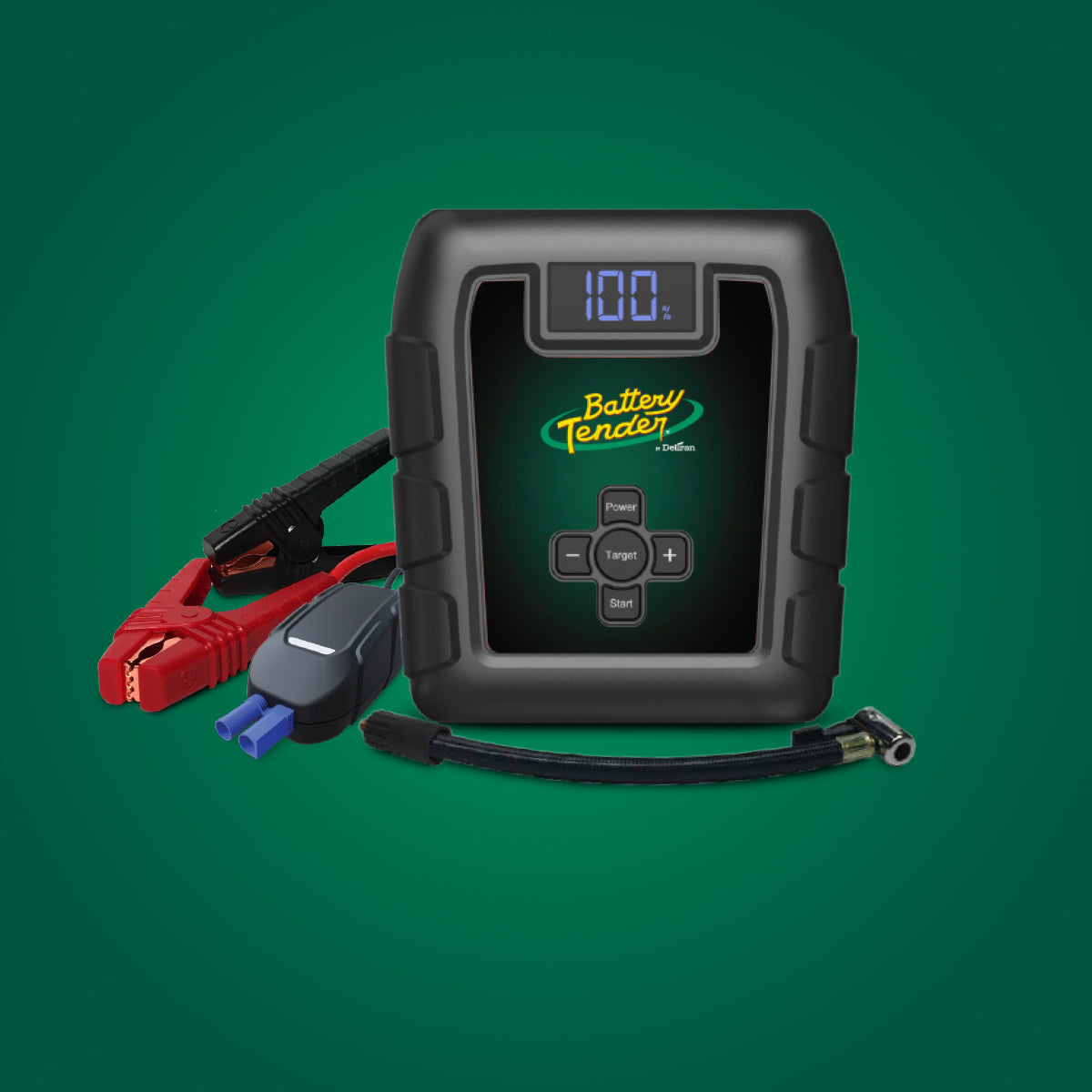
For passenger cars, crossovers, and SUVs with gasoline engines up to 5.0L, the 1,000A–1,200A range delivers confident starting even from a completely dead battery. The Battery Tender Charge N Start 1100 is the standout choice here — it combines a 1,000A jump starter with a built-in 1A smart charger that uses Infinite Sequential Monitoring (ISM) technology to restore the vehicle battery after the jump. This means a single device handles both the emergency start and the follow-up recovery charging that prevents repeated dead battery incidents.
Battery Tender Charge N Start 1100 — 1A Charger + 1000A Jump Starter
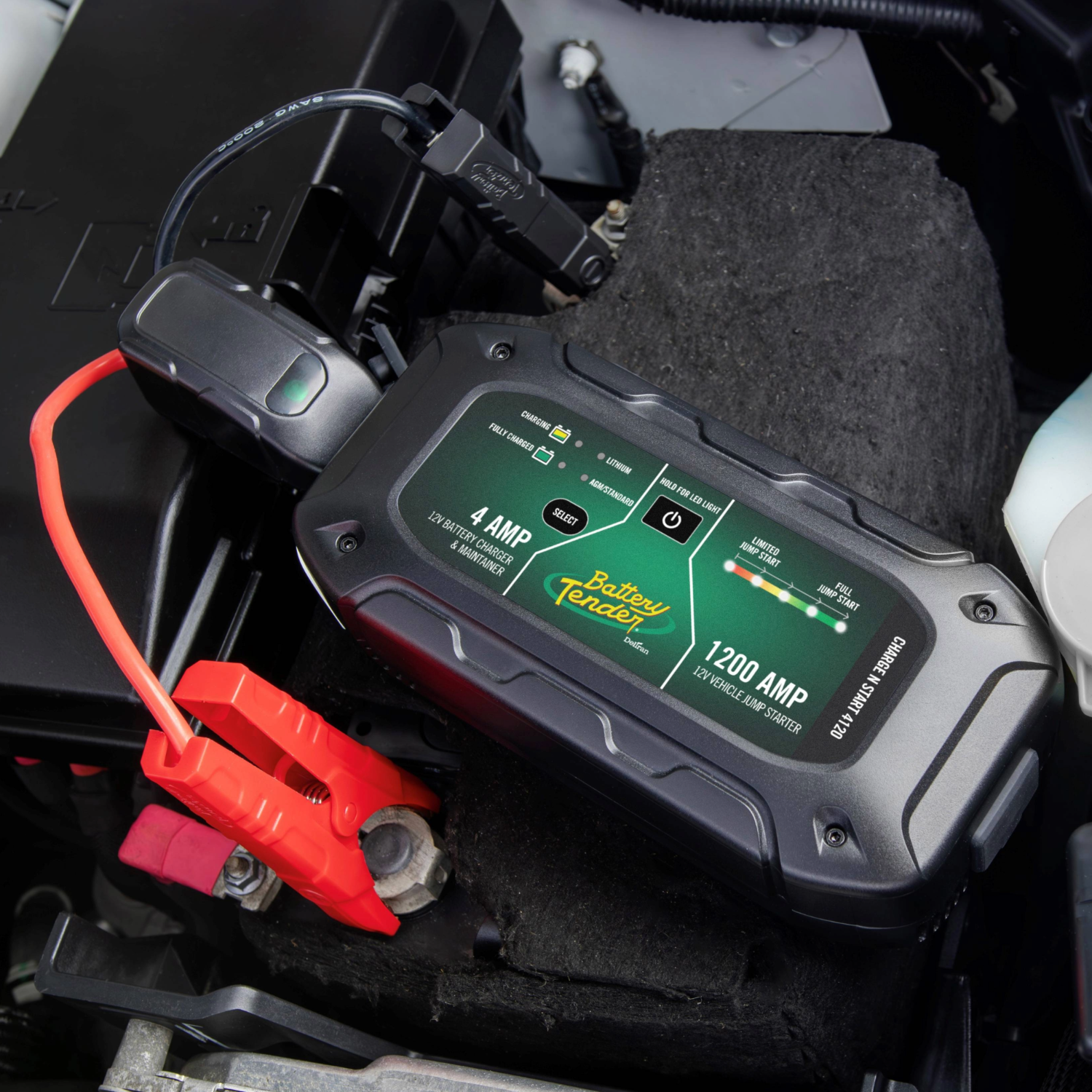
For trucks, large SUVs, and diesel engines up to 6.5L, the Battery Tender Charge N Start 4120 delivers 1,200A of jump starting power plus a 4A charger — four times the charging speed of the 1100 model. The faster charging rate matters significantly for deeply discharged batteries, reducing recovery time from roughly 50 hours (on a 1A charger with a 50Ah battery) to approximately 12.5 hours. Using the formula (50Ah × 100% depth of discharge) ÷ 4A = 12.5 hours, the 4A charger restores capacity before the next morning commute.
Battery Tender Charge N Start 4120 — 4A Charger + 1200A Jump Starter
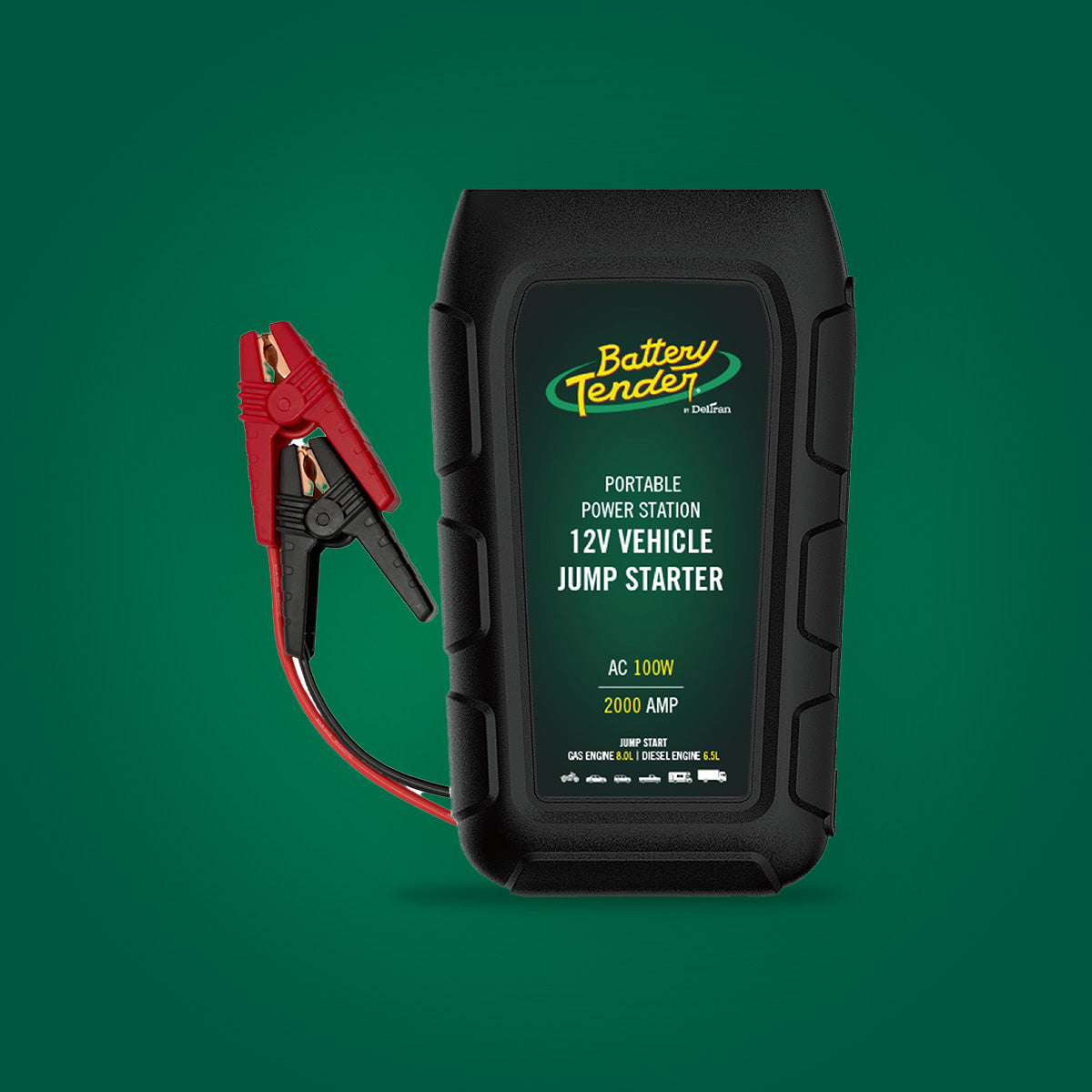
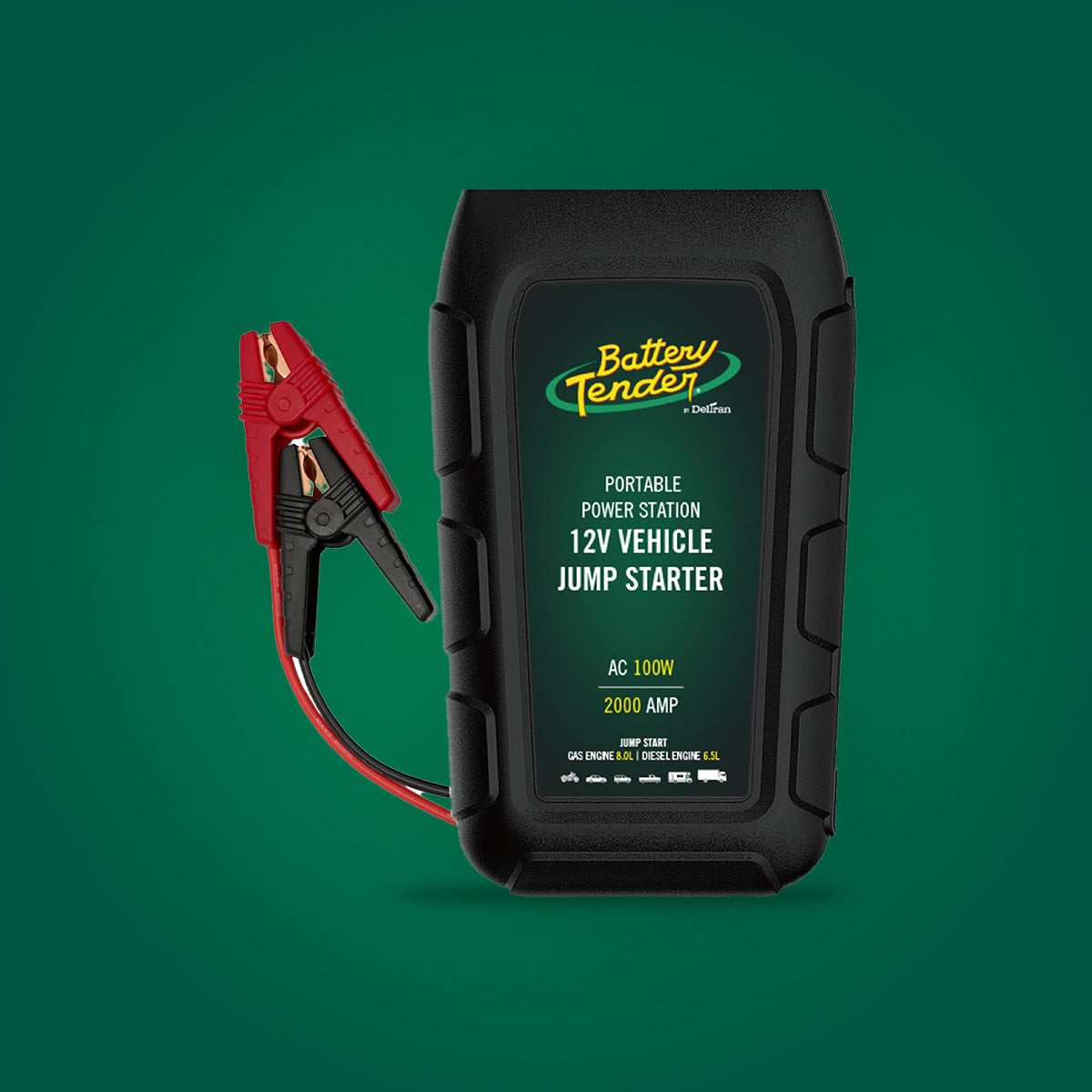
For heavy-duty diesel trucks and large displacement V8 engines up to 8.0L, the Battery Tender 2000A Jump Starter delivers maximum cranking power from a 16,000 mAh lithium-ion pack capable of approximately 50 jump starts on a single charge.
Battery Tender 2000A Jump Starter
What to Do After Jump Starting a Dead Battery
Successfully jump starting is only step one. A dead battery that has been jump started requires proper follow-up to avoid a repeat failure within hours or days.
Drive for a minimum of 30 minutes continuously after jump starting. The alternator produces roughly 13.8–14.4V while the engine runs, pushing current back into the depleted battery. Short trips of 5–10 minutes may not restore enough charge to restart the vehicle after shutdown. Highway driving at consistent RPM charges faster than stop-and-go city driving.
Connect an external smart charger within 24 hours. Alternators are not optimized battery chargers — they lack the absorption stage needed to dissolve sulfation that formed during the discharge period. ISM technology in Battery Tender chargers includes a dedicated absorption stage that holds voltage constant while tapering current, actively reversing sulfate crystal buildup on the lead plates. This stage is what separates smart charging from simple alternator charging and extends battery lifespan by months or years.
Test the battery within 48 hours. A professional load test or conductance test reveals whether the battery has suffered permanent capacity loss from deep discharge. If the battery tests below 75% of its rated CCA (cold cranking amps), replacement is recommended regardless of successful jump starting.
Why Hybrid Charger-Jump Starters Solve the Real Problem
A standalone jump starter addresses the symptom — a dead battery that will not crank the engine. A hybrid charger-jump starter addresses both the symptom and the cause. The Battery Tender Charge N Start line combines portable jump starting with ISM smart charging in a single device, providing the 4-stage charging process (Initialization, Bulk, Absorption, and Maintenance) that prevents dead batteries from recurring.
The practical workflow is straightforward: jump start the vehicle, then switch the Charge N Start unit to charging mode and connect it to the battery while parked. The ISM system automatically detects battery condition, applies the correct charging profile, and transitions to maintenance mode when the battery reaches full charge. Because the Charge N Start uses lithium-ion internal batteries with Charge N Store technology, the jump start function remains ready for months without recharging — unlike lead-acid jump packs that self-discharge within weeks.
Frequently Asked Questions
Does a jump starter work on a battery that reads 0 volts?
A jump starter can still crank the engine when the vehicle battery reads 0V on the dashboard, because it supplies cranking current independently through a parallel circuit. However, a 0V reading often indicates an internal short or shorted cell. If the engine starts, drive directly to a service facility for battery testing and likely replacement.
Can jump starting a completely dead battery damage the vehicle electronics?
Modern lithium jump starters with spark-proof clamps and reverse polarity protection eliminate the voltage spikes that older booster cables could produce. Battery Tender jump starters include short-circuit protection that automatically disconnects current flow if an unsafe condition is detected, safeguarding sensitive vehicle computers and infotainment systems.
How many times can a portable jump starter start a dead battery before it needs recharging?
Capacity varies by model. The Battery Tender 2000A Jump Starter delivers approximately 50 starts from its 16,000 mAh lithium-ion pack. The Battery Tender 600A model provides fewer starts from 6,400 mAh but recharges quickly via USB-C. Deeply dead batteries consume more energy per start than partially discharged ones.
Does a jump starter work on a dead battery in freezing temperatures?
Yes, lithium jump starters retain significantly more capacity in cold weather than the lead-acid vehicle battery they supplement. At 0°F (−18°C), a lead-acid battery loses roughly 60% of cranking capacity, while a lithium jump pack experiences less capacity reduction. Never attempt to jump start a battery with a frozen or bulging casing — this indicates frozen electrolyte and risk of rupture.
Conclusion
A portable jump starter does work on a dead battery in the majority of real-world scenarios — surface discharges, cold weather drain, parasitic loads, and seasonal storage neglect. The key variables are matching cranking amps to engine size, verifying the battery is not physically damaged or frozen, and following up with proper smart charging to prevent recurrence. For drivers who want a single device that answers both the immediate question — does a jump starter work on a dead battery — and the longer-term question of preventing the next dead battery, the Battery Tender Charge N Start line provides jump starting and ISM charging in one compact unit.
Explore the full lineup of portable jump starters and hybrid charger-jump starters at Battery Tender Jump Starters.