




48V Golf Cart Charger Guide: Choosing the Right PowerPlus for Deep-Cycle Demands (2026)
A 48V golf cart charger must do more than restore voltage — it must recover batteries that lose 50–80% of their capacity every single day. Battery Tender® pioneered smart charging technology in 1989, and the Battery Tender PowerPlus 48V delivers Infinite Sequential Monitoring (ISM) across four precision stages specifically engineered for the punishing deep-discharge cycles golf cart batteries endure. Unlike conventional chargers that apply a fixed charge profile, ISM continuously adapts current and voltage to each battery pack's real-time condition, preventing sulfation and extending usable lifespan by up to 2–3 seasons.
Golf cart batteries represent one of the most demanding use cases in consumer battery charging. A typical 48V pack consisting of six 8-volt or four 12-volt deep-cycle batteries can hold 150–225 amp-hours, and daily rounds of golf or neighborhood driving can deplete 60–80% of that capacity. Choosing the wrong charger — or relying on aging equipment — accelerates sulfate crystal buildup, reduces range, and forces premature battery replacement at $1,000–$2,500 per pack. This guide explains how to select, size, and install a 48V golf cart charger that protects that investment through 2026 and beyond.
Key Takeaways:
- Most modern golf carts from Club Car, E-Z-GO, and Yamaha use 48-volt electrical systems requiring a matched 48V charger.
- ISM 4-stage charging (Initialization → Bulk → Absorption → Maintenance) prevents sulfation and overcharging.
- IP68-rated chargers like the Battery Tender PowerPlus 48V withstand permanent outdoor installation in rain, dust, and humidity.
- Charger amperage determines recovery time — a 15A charger restores a 225 Ah pack from 70% depth of discharge in roughly 10.5 hours.
- Matching the wrong voltage charger to a golf cart battery pack causes irreversible damage.
Why 48V Golf Cart Batteries Need a Smarter Charger
Golf cart batteries face a unique combination of stresses that standard automotive chargers cannot address. Deep-cycle batteries are designed to discharge to 20–50% state of charge (SOC) regularly, while automotive starting batteries rarely drop below 95% SOC. This repeated deep cycling accelerates lead sulfate crystal formation on battery plates. According to research published by the Battery Council International (BCI), sulfation accounts for approximately 80% of lead-acid battery failures.
A 48V golf cart charger equipped with ISM technology combats sulfation through its Absorption stage, which holds voltage constant while tapering current. This extended constant-voltage phase dissolves sulfate crystals that form during deep discharge, restoring active plate material. Conventional single-stage or timer-based chargers skip this critical step, delivering either too much current (causing overheating and gassing) or too little (leaving sulfate deposits intact).
The fourth ISM stage — Maintenance — delivers demand-responsive charge pulses only when pack voltage drops below a preset threshold. This means a Battery Tender charger can remain connected indefinitely between uses without overcharging, boiling electrolyte, or damaging sealed AGM cells. For golf cart owners who may park their cart for days or weeks between rounds, this indefinite-connection capability eliminates the guesswork of when to plug in and when to disconnect.
How to Determine Your Golf Cart Voltage System
Before purchasing a 48V golf cart charger, verify the actual system voltage. Mismatching a charger to the wrong voltage pack will cause damage or simply refuse to charge. The fastest method is counting individual batteries under the seat and reading the voltage printed on each battery case.
- 48V systems: Six 8-volt batteries (6 × 8V = 48V), four 12-volt batteries (4 × 12V = 48V), or eight 6-volt batteries (8 × 6V = 48V)
- 36V systems: Six 6-volt batteries (6 × 6V = 36V) or three 12-volt batteries (3 × 12V = 36V)
- 24V systems: Four 6-volt batteries (4 × 6V = 24V) or two 12-volt batteries (2 × 12V = 24V) — common in older industrial or utility carts
Most golf carts manufactured after 2008 by Club Car, E-Z-GO, and Yamaha use 48-volt systems. Older models — particularly pre-2000 Club Car DS and E-Z-GO Marathon carts — typically run 36V. Some industrial utility vehicles and older personal carts use 24V configurations. The Battery Tender PowerPlus family covers all three voltages with dedicated models, so there is no need to use adapters or voltage converters that introduce inefficiency and risk.
Sizing a 48V Golf Cart Charger: Amperage and Charge Time Math
Charger amperage directly controls how quickly a depleted pack recovers. The formula is straightforward: (Battery Ah × depth of discharge) ÷ charger amps = approximate charge hours. For a standard 48V golf cart pack with 225 Ah capacity after a round that consumed 70% of capacity:
(225 Ah × 0.70) ÷ 15A = 10.5 hours
The Battery Tender PowerPlus 48V delivers 15 amps of continuous charging current — sufficient to restore a heavily depleted pack overnight. For lighter daily use where only 40% capacity is consumed, the same charger completes recovery in approximately 6 hours: (225 × 0.40) ÷ 15 = 6 hours. This overnight recovery window is critical for golf courses, resorts, and fleet operations that need carts ready every morning.
Undersized chargers below 10A extend recovery times past 14–16 hours, leaving batteries partially charged for the next cycle. This chronic undercharging accelerates sulfation and shortens pack life. Oversized chargers above 25A on smaller packs can cause excessive heat and electrolyte loss. The 15A output of the Battery Tender PowerPlus 48V represents the optimal balance for packs ranging from 150 Ah to 250 Ah — the standard range for residential and commercial golf carts.
Why IP68 Protection Matters for Golf Cart Charger Installation
Golf cart chargers frequently mount in environments that destroy consumer electronics — open-air garages, uncovered parking areas, cart barns with no climate control, and under-seat compartments exposed to rain splash, humidity, and dust. The IP (Ingress Protection) rating system, defined by IEC standard 60529, uses two digits to quantify dust and water resistance.
IP68 is the highest combined rating available — complete dust-tight sealing (6) plus continuous submersion protection (8). The Battery Tender PowerPlus 48V carries IP68 certification along with UL marine ignition protection, meaning its enclosure prevents any internal spark from igniting hydrogen gas that lead-acid batteries emit during charging. This dual certification makes the PowerPlus safe for permanent on-board mounting directly on the cart chassis, even in enclosed battery compartments where hydrogen accumulates.
Many factory-supplied OEM golf cart chargers carry only IP44 or IP54 ratings, which protect against splashing water but not wind-driven rain, standing water, or fine dust ingress. In humid climates like Florida, the Gulf Coast, or Hawaii — where a significant percentage of golf carts operate — corrosion from moisture infiltration is the leading cause of charger failure within 2–3 years.
Recommended 48V Golf Cart Charger and Related PowerPlus Models
The Battery Tender PowerPlus 48V 15A (SKU 022-2014-DL-WH) is purpose-built for 48-volt golf cart systems. Its IP68 sealed enclosure mounts permanently under the seat or on the cart frame, connecting directly to the battery pack through heavy-gauge ring terminals. ISM 4-stage charging runs automatically every time the charger receives AC power, and the Maintenance stage keeps the pack at optimal voltage between uses indefinitely. At $379.95, it costs a fraction of the $1,000–$2,500 battery pack it protects.
Battery Tender PowerPlus 48V 15A IP68 Charger
For golf courses and communities with mixed fleets that include older 36-volt carts, the Battery Tender PowerPlus 36V 18A delivers the same IP68 construction and ISM technology at the 36-volt level. Its 18A output recovers a depleted 225 Ah 36V pack from 70% discharge in approximately 8.75 hours — comfortably within an overnight window. At $359.95, it shares the same rugged chassis design as the 48V model.
Battery Tender PowerPlus 36V 18A IP68 Charger
Facilities managing older utility vehicles on 24-volt systems benefit from the Battery Tender PowerPlus 24V 20A. The 20A output and IP68 rating make it ideal for industrial carts, warehouse tugs, and legacy personal carts that still run 24V configurations. ISM charging ensures safe indefinite connection for vehicles that may sit idle for extended periods between shifts.
Battery Tender PowerPlus 24V 20A IP68 Charger
Golf cart operators who also maintain multiple vehicles at home or in a fleet setting should consider the Battery Tender 10-Bank charger for individual 12V battery maintenance during off-season storage. Each of the ten independent banks delivers 4 amps with full ISM protection, allowing operators to maintain individual batteries pulled from a pack during winter layup.
Battery Tender 10-Bank 6V/12V 4A Selectable Battery Charger
DC Plug Accessories for Direct Cart Connection
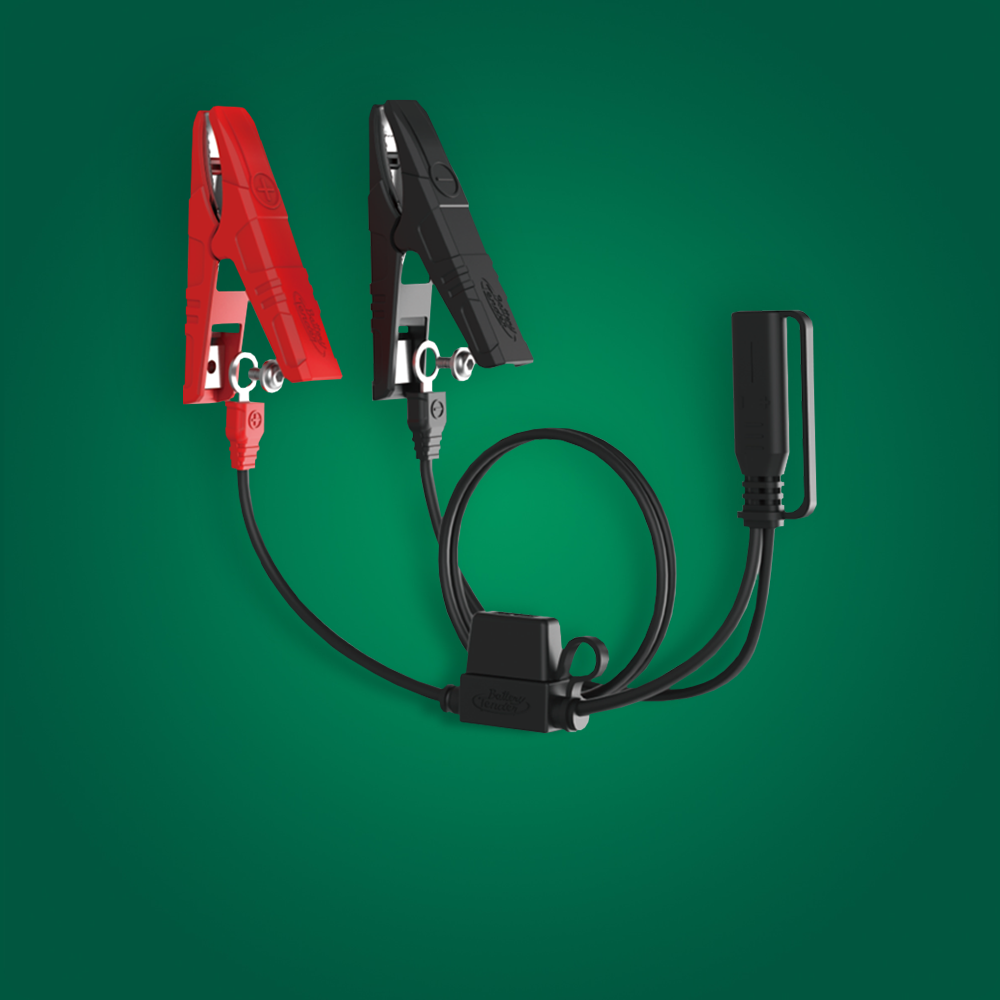
Many golf carts use proprietary DC charging receptacles that require specific plug adapters. Battery Tender offers dedicated DC plug accessory cables that connect PowerPlus chargers directly to the cart's existing charge port, eliminating the need to access individual batteries or modify wiring.
For 48V E-Z-GO TXT and RXV models with the 3-pin triangle connector, the Battery Tender 48V E-Z-GO DC Plug Accessory Cable (SKU 081-0205-EZ, $49.95) provides a direct plug-and-charge connection. For 48V Club Car DS and Precedent models from 1995–2013, the corresponding adapter (SKU 081-0200-CC, $49.95) matches the factory receptacle. These cables eliminate exposed terminals and reduce the risk of reverse-polarity connection errors.
Installation Best Practices for On-Board Golf Cart Charging
Permanent on-board mounting converts a portable charger into an integrated charging system. Mount the Battery Tender PowerPlus unit to a solid surface on the cart frame using the built-in mounting tabs and stainless steel hardware. Position the charger where it will not contact battery tops or obstruct electrolyte maintenance access on flooded cells.
Route AC input wiring to a location where a standard extension cord can reach when parked. Many golf cart owners install a weatherproof outlet (NFPA 70/NEC Article 210 compliant) at their parking location so charging begins automatically when the cart is parked. Ensure the circuit supplies adequate amperage — a 48V 15A charger draws approximately 900 watts at peak, requiring a dedicated 15-amp or 20-amp household circuit.
For flooded lead-acid batteries, ensure adequate ventilation. Charging produces hydrogen gas at concentrations above 4% by volume, which is flammable. The UL marine ignition protection certification on Battery Tender PowerPlus chargers means the sealed enclosure cannot ignite ambient hydrogen, but enclosed spaces still require ventilation per NFPA 30A guidelines for battery charging areas.
Frequently Asked Questions
Can a 48V golf cart charger be left connected all the time?
Yes, when the charger uses ISM technology. The Battery Tender PowerPlus 48V enters a demand-responsive Maintenance stage after the battery pack reaches full charge. It delivers short charge pulses only when voltage drops below a set threshold, preventing overcharge, electrolyte boil-off, and thermal damage. This makes indefinite connection safe for daily-use and seasonal-storage scenarios alike.
How long does it take to charge a 48V golf cart battery pack?
Charge time depends on pack capacity and depth of discharge. Using the formula (Ah × DOD) ÷ charger amps: a 225 Ah pack at 70% depth of discharge takes approximately 10.5 hours with a 15A charger like the Battery Tender PowerPlus 48V. A lighter 40% discharge recovers in roughly 6 hours. Most users plug in after the last ride and wake to a fully charged cart.
Will a 48V charger work on a 36V golf cart?
No. Applying 48 volts to a 36-volt battery pack will force dangerously high voltage into cells, causing overheating, excessive gassing, warped plates, and potential thermal runaway. Always match the charger voltage to the pack voltage exactly. Battery Tender PowerPlus chargers are available in dedicated 24V, 36V, and 48V models — each calibrated to the specific voltage and charging curve of its target system.
What makes a golf cart charger different from an automotive battery charger?
Golf cart chargers operate at system voltages of 24V, 36V, or 48V — not the 12V standard in automotive applications. They also deliver higher sustained amperage to recover deep-cycle batteries that routinely discharge 50–80%, compared to automotive batteries that rarely drop below 5% discharge. The Battery Tender PowerPlus line addresses both requirements with voltage-specific models and extended Absorption-stage charging to dissolve deep-cycle sulfation.
Conclusion
Selecting the right 48V golf cart charger is the single most impactful decision for protecting battery pack longevity and maintaining daily range. ISM 4-stage charging from Battery Tender eliminates the sulfation, overcharging, and undercharging problems that destroy deep-cycle batteries prematurely. The PowerPlus 48V combines 15A recovery output, IP68 waterproof construction, and UL marine ignition protection in a permanently mountable unit that handles the most demanding charge cycles in consumer battery applications. Whether managing a single personal cart or outfitting an entire fleet, matching the correct voltage, amperage, and protection rating to the application ensures reliable performance through every season.
Explore the complete lineup of golf cart chargers, DC plug accessories, and multi-bank solutions at the Battery Tender Golf Cart collection page.
Last updated: June 2026


