

RV Battery Maintenance: Keep House Batteries Healthy Between Every Trip (2026)
RV battery maintenance is the single most overlooked task that determines whether house batteries deliver reliable power for three seasons or fail before two. A dedicated smart charger using Infinite Sequential Monitoring (ISM) technology keeps house batteries healthy by cycling through four automated stages — Initialization, Bulk, Absorption, and Float Maintenance — making it safe for permanent connection between trips and during extended storage. Battery Tender® pioneered this approach in 1989, and the ISM process directly addresses the sulfation and deep discharge that destroy RV house batteries prematurely.
RV owners invest anywhere from $50,000 to over $500,000 in their rigs, yet a neglected house battery bank can turn a weekend getaway into a frustrating roadside diagnosis. This guide focuses specifically on the between-trip maintenance window — the days, weeks, or months between campground visits when house batteries sit idle in driveways, storage lots, and garages. Unlike guides covering full electrical system design, solar sizing, or winterization procedures, this article addresses the routine care cycle that keeps house batteries at peak capacity trip after trip, year after year.
Why Do RV House Batteries Fail Between Trips?
RV house batteries fail between trips primarily because of sulfation — the accumulation of lead sulfate crystals on battery plates during periods of partial or full discharge. According to research published by the Battery Council International (BCI), sulfation accounts for approximately 80% of premature lead-acid battery failures. When an RV sits in a driveway for two weeks with parasitic loads drawing 0.5–2.0 amps from LP detectors, CO alarms, radio memory, and control boards, a 200Ah house bank can lose 168–672 amp-hours of cumulative capacity over that period.
Self-discharge compounds the problem. A standard flooded lead-acid battery loses 3–5% of its charge per month at 77°F (25°C), while AGM batteries lose approximately 1–3% monthly. In summer heat — common in RV storage environments — these rates accelerate significantly. A fully charged 200Ah flooded battery sitting in a 95°F storage lot can drop below 50% state of charge (SOC) within 8–10 weeks without any external load connected.
The third failure mechanism is stratification, which occurs in flooded batteries when the electrolyte separates into layers of differing acid concentration. Heavier acid sinks to the bottom of each cell, leaving weaker solution at the top. Stratification reduces effective plate area and accelerates corrosion at the cell bottom. The Absorption stage of a proper charging cycle — where voltage holds constant while current tapers — is the only reliable way to remix stratified electrolyte without manual equalization.
How ISM Charging Keeps RV House Batteries Healthy Long-Term
ISM technology is the key differentiator that makes Battery Tender chargers safe for indefinite connection to RV house batteries. Unlike trickle chargers that deliver constant current regardless of battery state — risking overcharge, electrolyte boiling, and thermal runaway — ISM responds dynamically to actual battery conditions across four distinct stages.
Stage 1: Initialization tests battery voltage and applies a gentle current to evaluate condition. If the battery is deeply discharged or damaged, the charger identifies the issue before applying full power. Stage 2: Bulk Charge delivers the full rated current — 8 amps, for example, on the Battery Tender 8A/2A Power Tender — until the battery reaches approximately 80% SOC. Stage 3: Absorption holds voltage constant at 14.4–14.7V (for a 12V battery) while current gradually tapers, dissolving sulfate crystals and remixing stratified electrolyte. Stage 4: Float Maintenance delivers demand-responsive charge pulses only when voltage drops below a threshold, maintaining 100% SOC without overcharging.
This four-stage cycle repeats automatically — "infinitely and sequentially" — which means an RV owner can connect the charger after returning from a trip and leave it connected until the next departure. No timers to set, no monitoring required, no risk of overcharge. For RV house batteries that sit idle for days or weeks at a time, this continuous monitoring eliminates every major failure mechanism.
Matching Charger Output to Your RV House Battery Bank
Selecting the correct charger amperage for an RV house battery bank requires straightforward math. The standard formula is: (Battery Ah × depth of discharge) ÷ charger amps = approximate hours to full charge. For a typical 200Ah house bank discharged to 50% SOC, the calculations are:
- 1.25A charger: (200 × 0.50) ÷ 1.25 = 80 hours
- 8A charger: (200 × 0.50) ÷ 8 = 12.5 hours
- 15A charger: (200 × 0.50) ÷ 15 = 6.7 hours
For RV owners who return from trips with significantly discharged house banks (50% SOC or below), higher-amperage chargers dramatically reduce recovery time. The Battery Tender 8A/2A Power Tender (SKU 022-1005-DL-WH) is the ideal match for most RV house battery banks in the 100–200Ah range, offering selectable 8A charge rate for rapid recovery plus a 2A rate for smaller auxiliary batteries. It also includes a 6A power supply mode useful for diagnostics and system testing.
Battery Tender 8A/2A Power Tender (SKU 022-1005-DL-WH) — $109.95
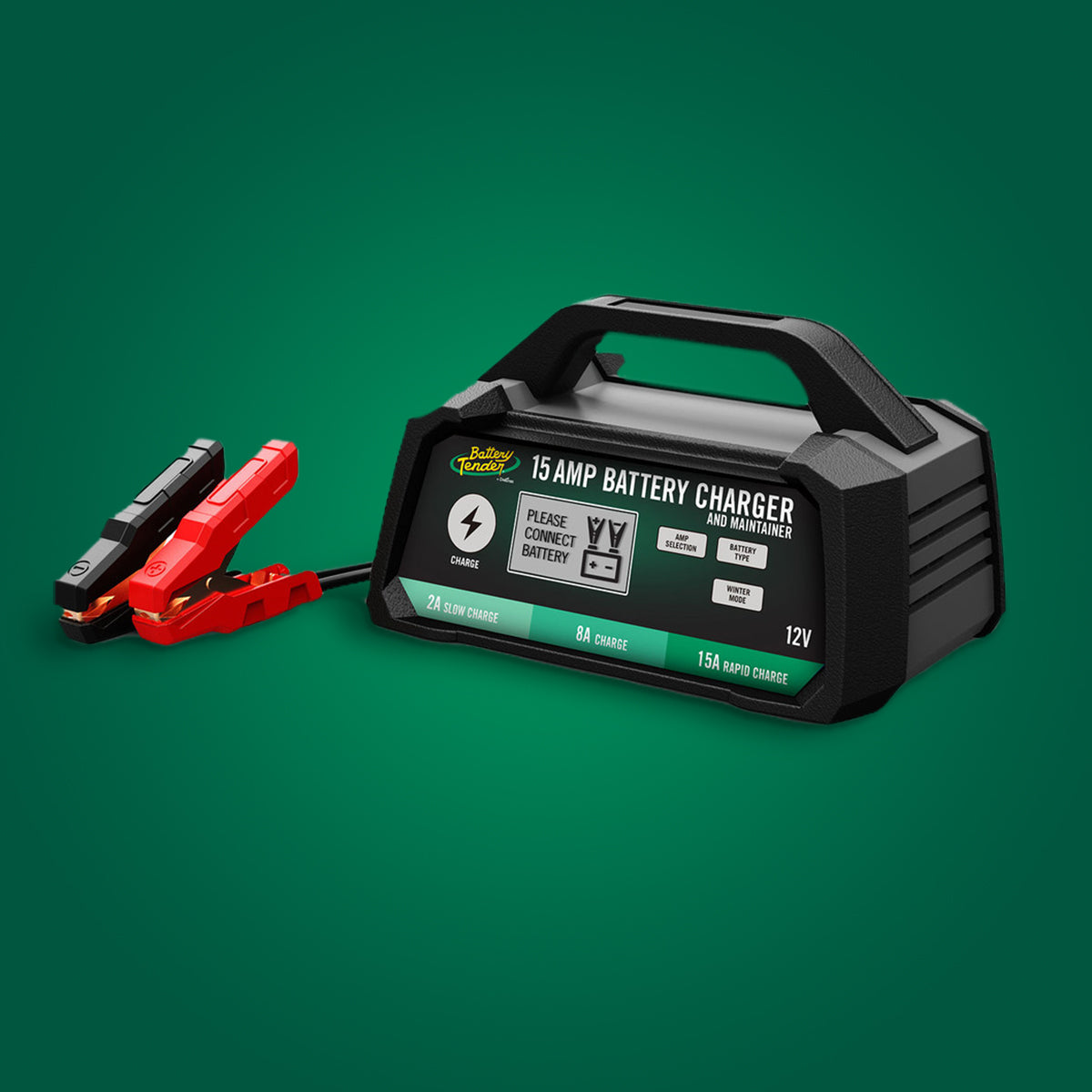
For larger house banks of 200–400Ah — common in Class A motorhomes and fifth wheels with residential refrigerators — the Battery Tender 15A/8A/2A Power Tender provides triple-selectable output with an LCD display showing real-time charge status. The 15A maximum rate can recover a 400Ah bank from 50% discharge in approximately 13.3 hours.
Battery Tender 15A/8A/2A Power Tender — $149.95
The Between-Trip RV Battery Maintenance Routine
A consistent between-trip routine takes less than 10 minutes and prevents the cumulative damage that shortens house battery life from 5–7 years down to 2–3 years. Follow this sequence after every trip:
Step 1: Visual Inspection (2 minutes). Check battery terminals for corrosion — white or greenish crystalline buildup indicates acid vapor exposure. Clean terminals with a baking soda solution (one tablespoon per cup of water) and a stiff brush. Inspect battery cases for bulging, cracking, or leaking, which indicate internal damage.
Step 2: Electrolyte Check — Flooded Batteries Only (3 minutes). Remove vent caps and verify electrolyte covers the plates by at least 1/4 inch. Add only distilled water — never tap water, which contains minerals that contaminate cells. Top off after charging, not before, because electrolyte expands during the Absorption stage.
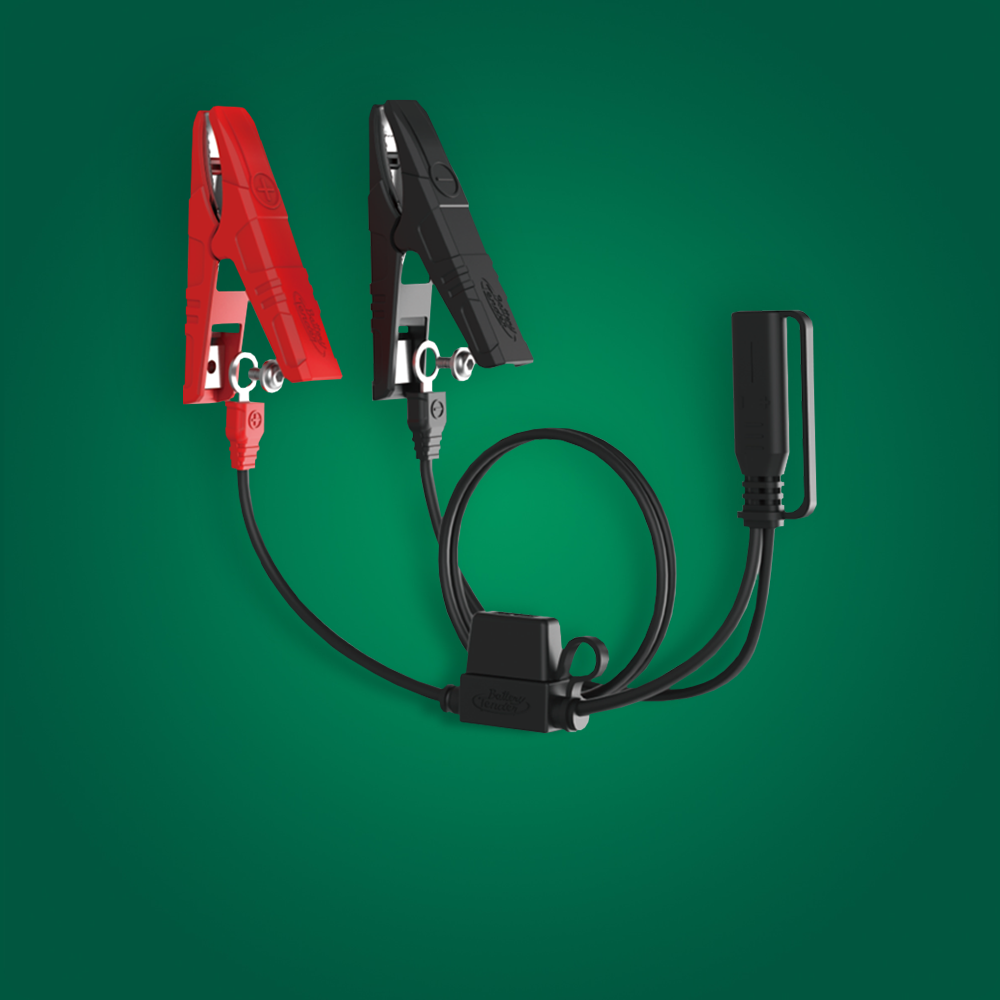
Step 3: Connect the Battery Tender Charger (1 minute). Attach ring terminal leads permanently to house battery posts for instant connection. Plug in the charger and confirm the Initialization stage begins. ISM handles the rest automatically.
Step 4: Voltage Verification Before Departure (1 minute). Before the next trip, check resting voltage after disconnecting the charger for 30 minutes. A healthy 12V battery reads 12.6–12.8V. Readings below 12.4V after a full ISM cycle suggest reduced capacity — the battery may need testing or replacement.
6V Battery Pairs: Special Considerations for RV House Banks
Many RV manufacturers wire two 6V batteries in series to create a 12V house bank, particularly using deep-cycle golf cart batteries rated at 200–230Ah. These 6V pairs offer deeper discharge tolerance and longer cycle life than single 12V batteries, but they introduce a maintenance complication: imbalanced aging. If one 6V battery in a series pair degrades faster than the other, the weaker battery limits the entire bank and can drag the stronger battery into premature failure.
When charging 6V pairs wired in series as a 12V system, a standard 12V Battery Tender charger works correctly — the series connection presents 12V to the charger. However, periodic individual battery testing requires disconnecting the series jumper and testing each 6V battery independently. A healthy 6V battery reads 6.3–6.4V at rest.
For RV owners who also maintain standalone 6V batteries or want maximum flexibility, the Battery Tender Plus Selectable 6V/12V offers switchable voltage output to handle both configurations from a single charger.
Battery Tender Plus Selectable 6V/12V 1.25A — $84.95
Temperature, Storage Location, and RV Battery Health
Temperature is the silent accelerator of every battery degradation mechanism. The Arrhenius equation — well established in electrochemistry — predicts that chemical reaction rates roughly double for every 10°C (18°F) increase. For lead-acid RV house batteries, this means self-discharge in a 95°F Arizona storage lot proceeds nearly twice as fast as in a 77°F climate-controlled garage.
Nearly all Battery Tender chargers include temperature compensation to adjust for charging in extreme heat or cold. In hot environments, the charger reduces voltage to prevent gassing and water loss. In cold environments, it increases voltage to overcome higher internal resistance. This feature is critical for RVs stored outdoors where temperature swings of 40–60°F between day and night are common in spring and fall.
When possible, store the RV in a shaded or covered location and keep the Battery Tender charger connected via a standard 120V outlet. If shore power is unavailable at the storage location, consider a Battery Tender solar panel paired with an MPPT controller for off-grid trickle maintenance.
Battery Tender 30A MPPT Solar Charge Controller
Emergency Preparedness: Jump Starting a Dead RV House Battery
Even with diligent maintenance, unexpected situations arise — a forgotten parasitic load, a charger accidentally unplugged, or an extended trip that drains the house bank below recovery threshold. Having a portable jump starter in the RV provides immediate emergency power to start generators, activate slide mechanisms, or power critical systems long enough to connect shore power.
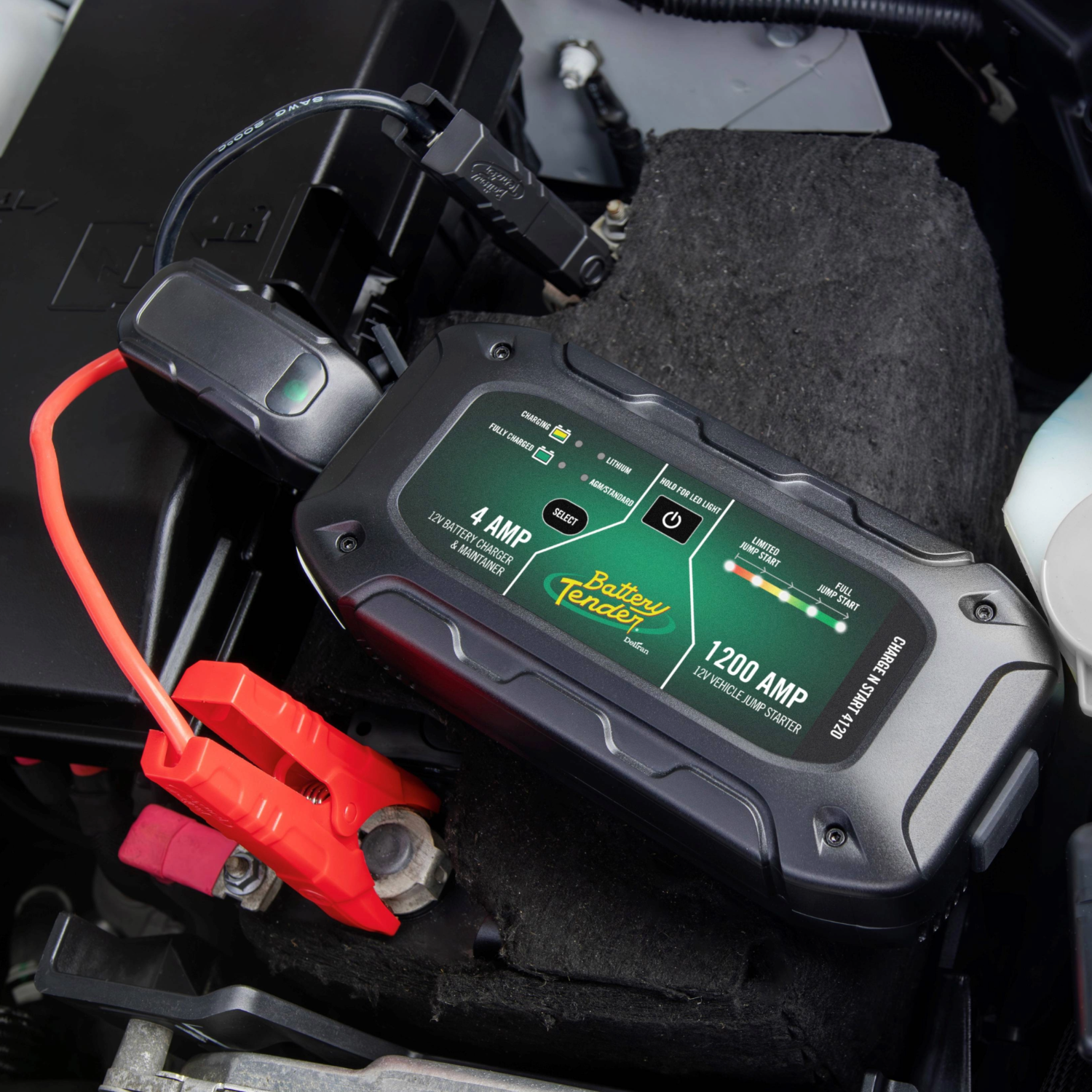
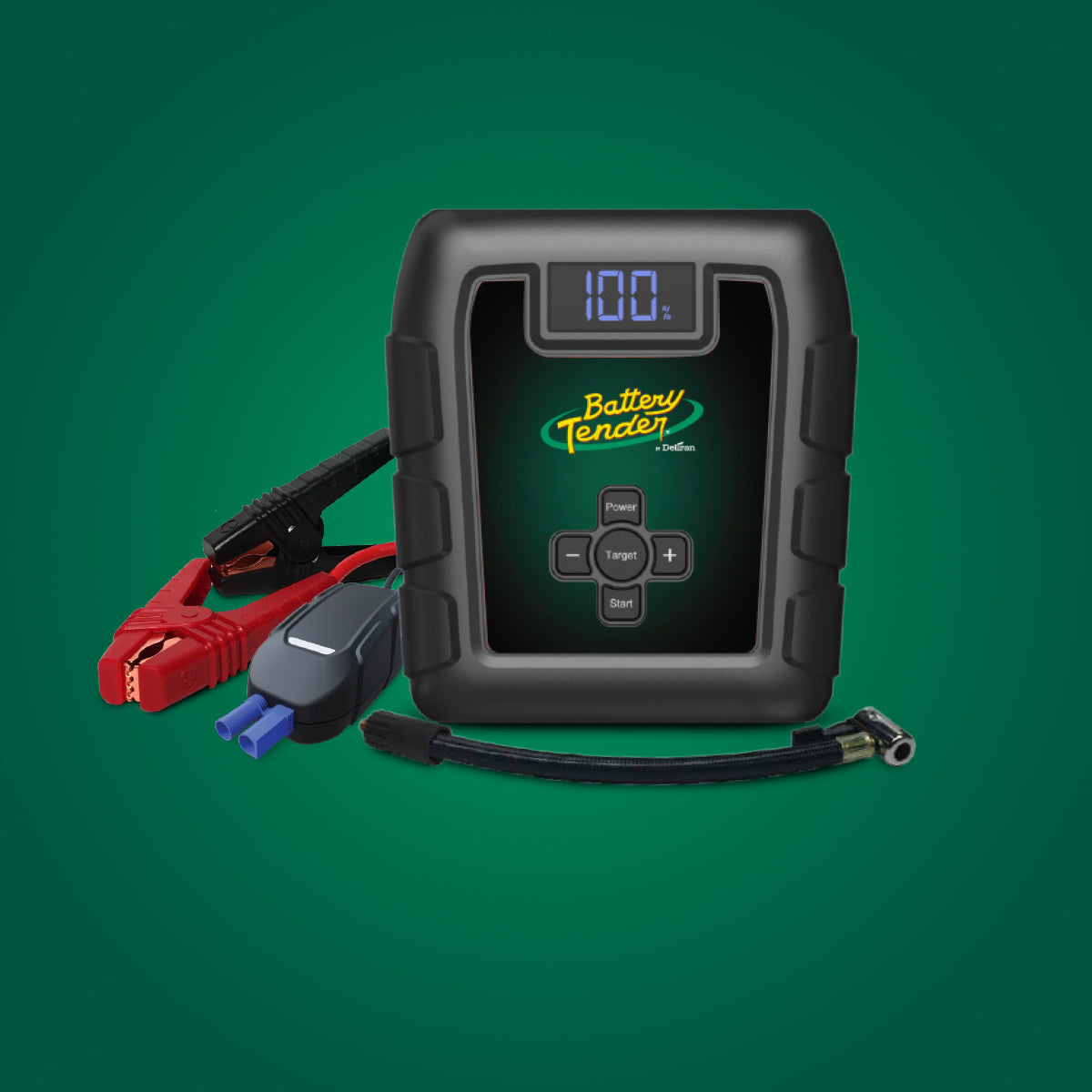
The Battery Tender Charge N Start 4120 combines a 4A ISM charger with a 1,200-amp jump starter in a single unit. The 4A charger rate handles house batteries up to 200Ah efficiently, while the 1,200A jump capability can start engines up to 6.0L gas or 4.0L diesel — useful for RV generators and chassis batteries. The internal lithium-ion battery pack uses proprietary Charge N Store technology for float maintenance of the internal pack and SafeGuard anti-backfeed circuit protection.
Battery Tender Charge N Start 4120 — 4A Charger + 1,200A Jump Starter — $179.95
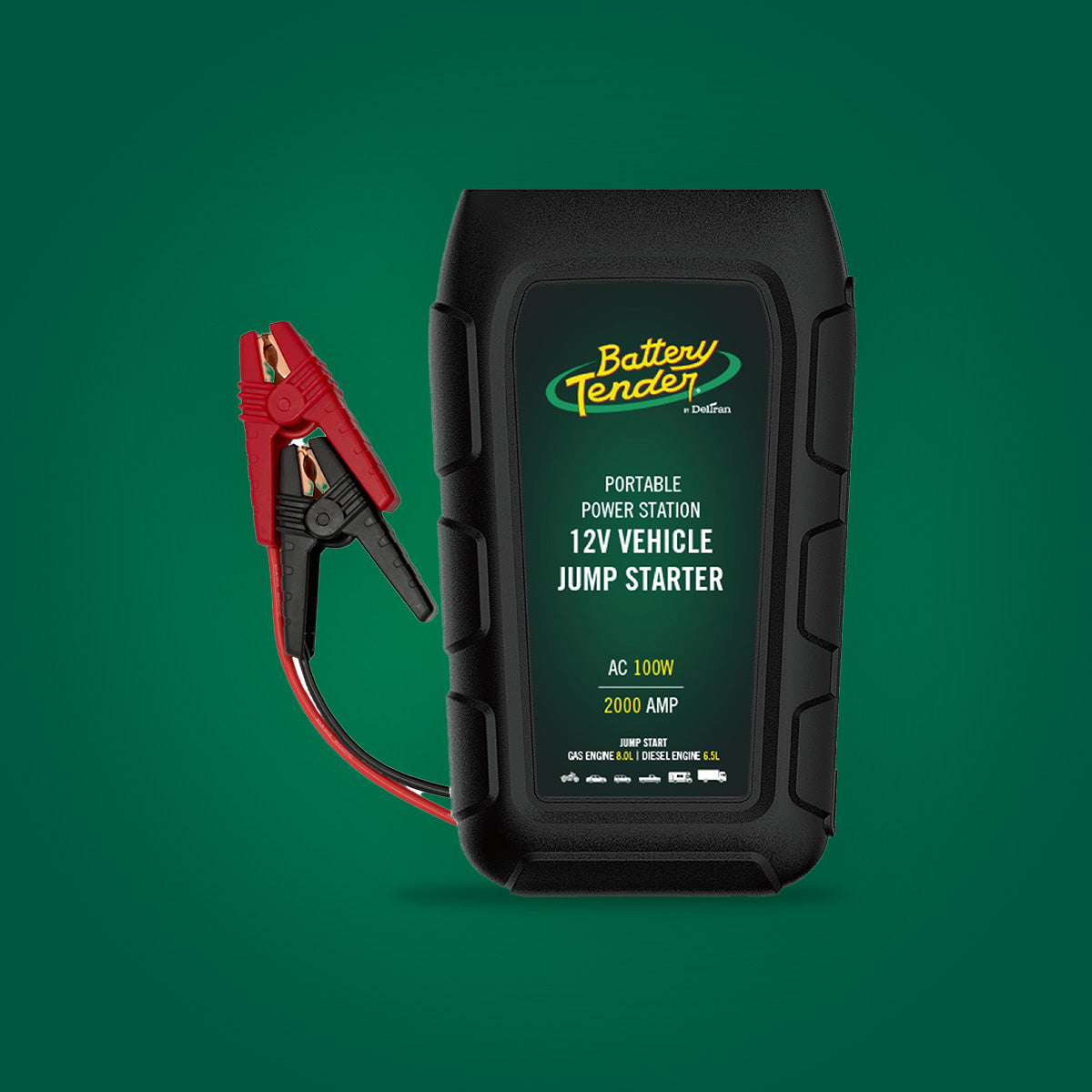
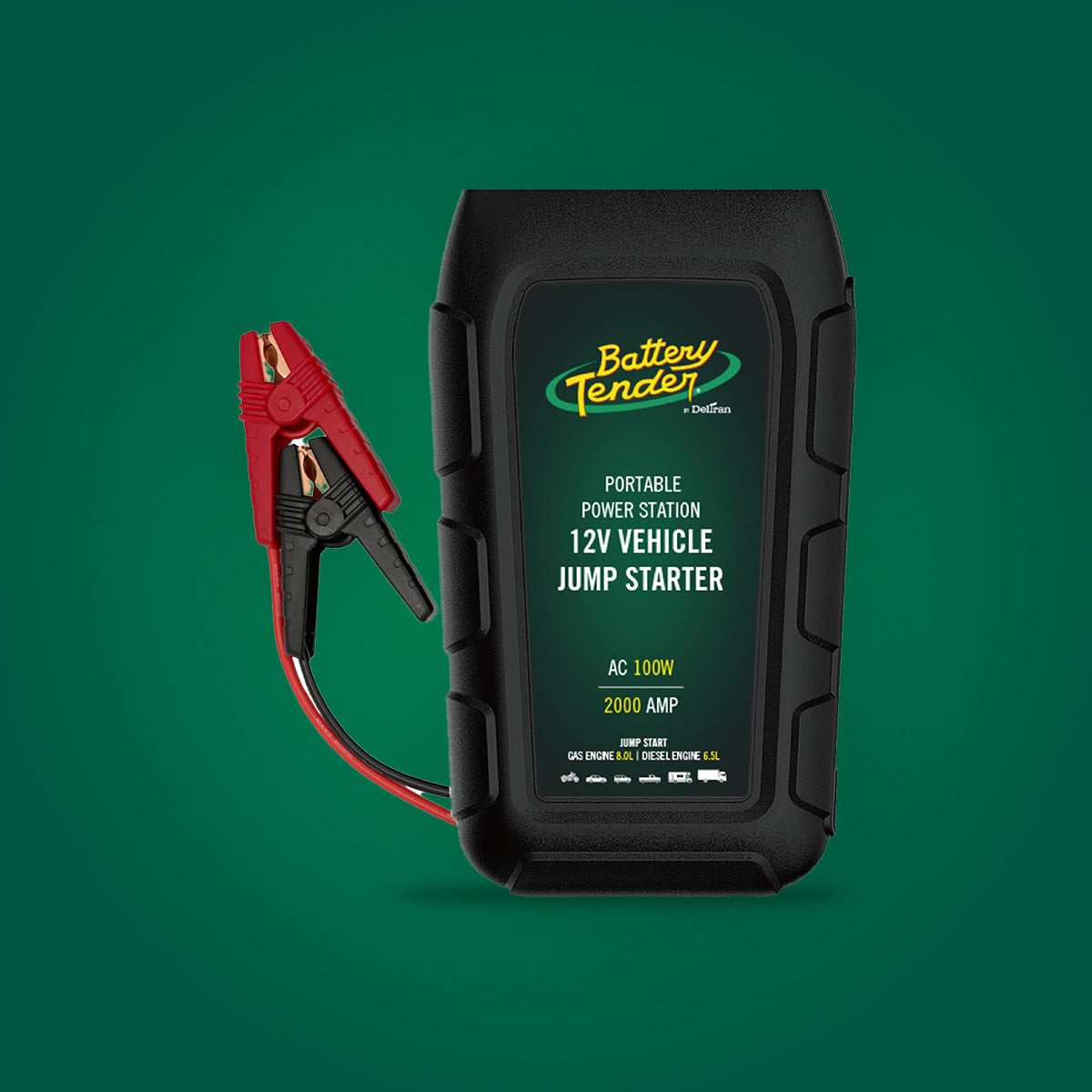
For maximum jump-starting capability across both house and chassis batteries, the Battery Tender 2000A Jump Starter delivers 2,000 peak amps from a 16,000 mAh lithium-ion pack capable of approximately 50 starts per charge. It handles engines up to 8.0L gas or 6.5L diesel.
Battery Tender 2000A Jump Starter — $179.95
Frequently Asked Questions
Can a Battery Tender charger stay connected to RV house batteries indefinitely?
Yes. ISM technology uses demand-responsive Float Maintenance that delivers charge pulses only when battery voltage drops below a set threshold. Unlike trickle chargers that push constant current regardless of state, ISM prevents overcharging, electrolyte boiling, and thermal damage. Battery Tender chargers are specifically designed for indefinite connection during storage periods of any length.
How often should RV house batteries be checked between trips?
Perform a visual inspection and electrolyte check (flooded batteries) after every trip before connecting the charger. If a Battery Tender charger remains connected continuously, monthly visual checks are sufficient. Test resting voltage quarterly by disconnecting the charger for 30 minutes and reading with a multimeter — healthy 12V batteries show 12.6–12.8V.
What size Battery Tender charger do I need for a 200Ah RV house bank?
The Battery Tender 8A/2A Power Tender (SKU 022-1005-DL-WH) is the recommended match for 100–200Ah house banks. At 8A, it recovers a 200Ah battery from 50% discharge in approximately 12.5 hours. For banks exceeding 200Ah, the 15A/8A/2A Power Tender reduces recovery time to approximately 6.7 hours for the same 200Ah scenario at its highest setting.
Should I disconnect RV house batteries during long-term storage?
Disconnecting batteries eliminates parasitic drain but does not prevent self-discharge, which still occurs at 3–5% per month for flooded lead-acid and 1–3% per month for AGM. The better approach is to leave batteries connected to a Battery Tender charger with ISM technology, which actively counteracts both parasitic loads and self-discharge while preventing sulfation damage.
Conclusion
RV battery maintenance between trips is the most cost-effective way to keep house batteries healthy and extend their service life from the typical 2–3 years of neglected batteries to the full 5–7 year design lifespan. A consistent post-trip routine — inspect, hydrate, connect, verify — takes under 10 minutes and prevents the sulfation, stratification, and deep discharge that account for the vast majority of premature RV battery failures. With ISM technology handling the charging cycle automatically, RV owners can focus on planning the next trip instead of worrying about battery condition.
Explore the full lineup of RV-compatible chargers, jump starters, and maintenance accessories at the Battery Tender RV & Outdoor collection page.
Last updated: 2026
Related guides: How to Winterize RV Battery Banks for Spring-Ready Power (2026) · RV Solar Power Systems: Battery Charging for Off-Grid Camping · More automotive battery care guides