


Charging Car Battery: Safe Step-by-Step Method (2026)
Charging car battery safely comes down to a charger sized to the battery, clean connections in the right order, and a full cycle that ends on its own. Connect red to positive, connect black to bare chassis metal, then plug in last. A 50Ah battery that is 50% discharged takes about 5 to 6 hours on a 5-amp charger.
Key Takeaways
- Measure rest voltage before you start: 12.6V or higher means full, and 12.0V means roughly 25% charge.
- A 5-amp charger fits most 40-100Ah car batteries, while 1.25A suits maintenance on smaller batteries.
- Connection order matters: positive clamp first, negative clamp to chassis ground, then AC power on.
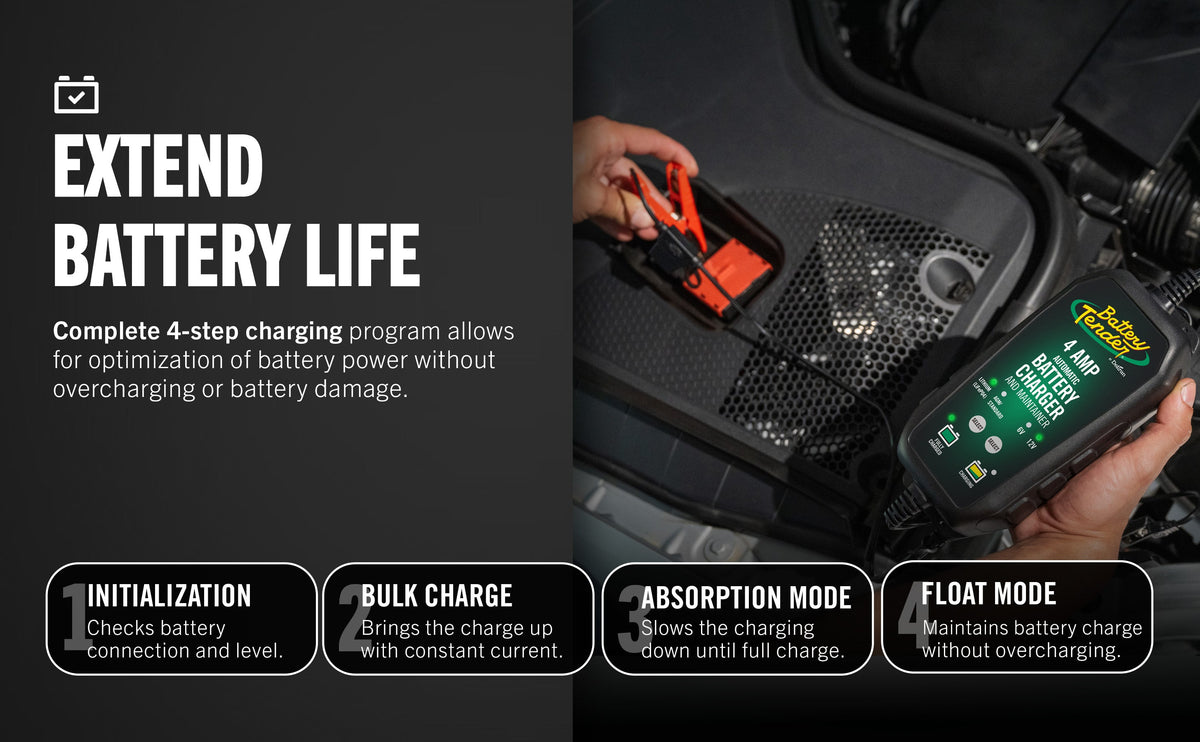
- The Battery Tender® Power Tender 5 Amp charger uses Infinite Sequential Monitoring (ISM), a four-stage process that switches to Float Maintenance once the battery is full, so the charger is safe to leave connected.
- An alternator maintains a battery but does not restore a deeply discharged one.
Before Charging Car Battery: Test, Inspect and Prepare
Start by measuring the battery, because rest voltage tells you how much charge is needed and whether charging is the right fix. Rest voltage is the reading after the battery has sat unused for at least two hours with the ignition off.
Read the rest voltage
Set a multimeter to DC volts and touch the probes to the battery posts. Compare the result against the table below for a 12V lead-acid battery at about 70°F.
| Rest voltage (12V) | Approximate state of charge | Action |
|---|---|---|
| 12.6V or higher | 100% | No charge needed |
| 12.4V | 75% | Top off, or maintain |
| 12.2V | 50% | Recharge soon |
| 12.0V | 25% | Recharge now |
| 11.9V or lower | Discharged | Recharge, then load test |
If the battery refuses to hold these numbers after a full charge, follow the car battery rest-voltage test guide to separate a failing battery from a charging problem. A load tester gives the definitive answer.
The Battery Tender 12V / 6V Battery Tester applies a 100-amp load to 12V batteries and a 50-amp load to 6V batteries. That makes it a practical check before and after charging, since a battery can show 12.6V and still collapse under cranking load.
Inspect and ventilate before you connect
Lead-acid batteries release hydrogen while charging, so work in a ventilated space with no sparks or open flame. Run through this checklist first:
- Look for a cracked case, bulging sides, or leaking electrolyte. Do not charge a damaged battery.
- Check for ice. A frozen battery must thaw completely before it is charged.
- Clean white or blue corrosion from the terminals with a baking soda and water solution and a wire brush.
- On serviceable flooded batteries, confirm the plates are covered with electrolyte, and top off with distilled water only.
- Turn off the ignition, lights, and accessories.
Step-by-Step Charging Car Battery Procedure
Follow these seven steps in order every time you recharge a car battery. The sequence keeps sparks away from the battery and protects the vehicle electronics.
- Unplug the charger from AC power. Never clamp onto a battery while the charger is energized.
- Connect the red (positive) clamp to the positive terminal, marked + or POS.
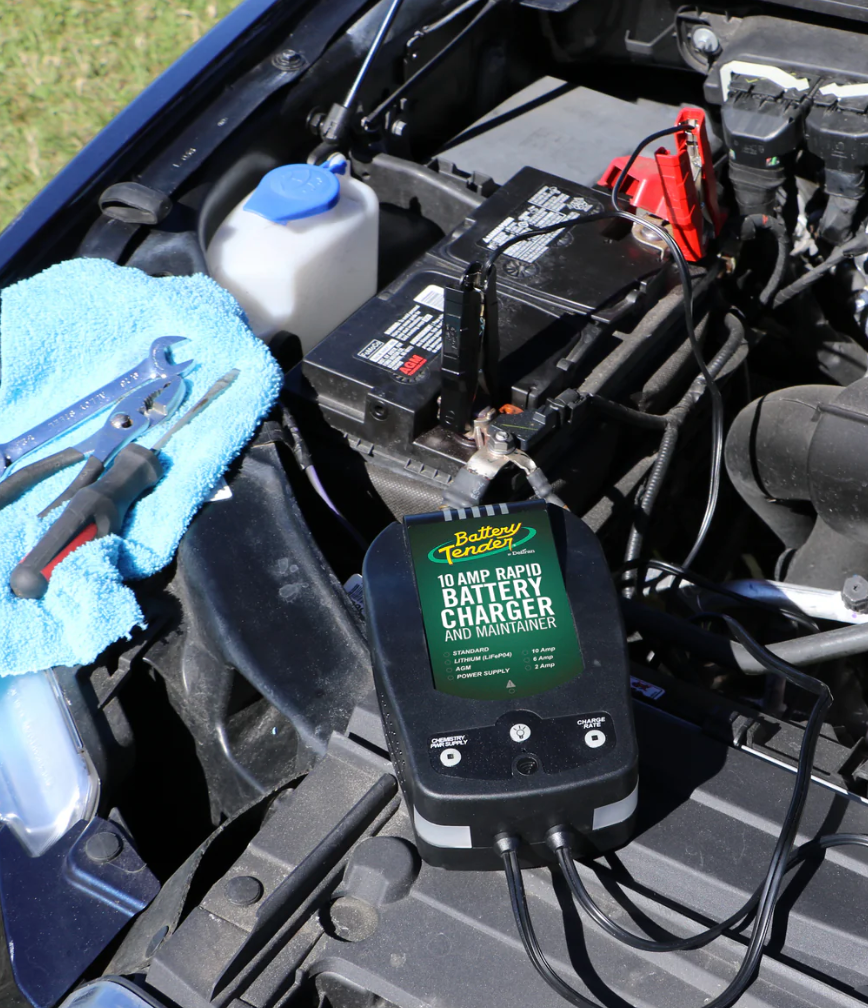
- Connect the black (negative) clamp to bare chassis metal or an engine bolt, away from the battery and fuel lines. This is the safer ground when the battery stays in the vehicle.
- Select voltage and chemistry if your charger offers settings: 12V for modern cars, and AGM or lithium modes only when the battery calls for them.
- Plug the charger into AC power. Confirm the indicator lights show charging.
- Let the cycle finish. Do not stop partway unless you are checking temperature. If the battery case feels hot, stop and let it cool.
- Disconnect in reverse: unplug AC first, remove the black clamp, then the red clamp.
After the cycle ends, let the battery rest for two hours and measure again. A reading of 12.6V to 12.8V confirms a full charge.
Temperature changes the target voltage a battery needs. Battery Tender chargers with temperature compensation raise output in cold garages and lower it in heat. Whenever possible, charge in a moderate environment between about 32°F and 90°F for the most accurate, efficient charge.
What Size Charger Fits Charging Car Battery Needs?
Match charger amps to battery amp-hours. A 5-amp charger recovers most car batteries in a day, while a 1.25-amp maintainer works better for upkeep than for rescue.
Use this formula for charge time: (battery Ah × depth of discharge) ÷ charger amps = approximate hours. The table below shows base times; add roughly 20% for the Absorption stage, when current tapers as the battery fills.
| Battery size | Typical vehicle | Energy to replace (50% discharged) | On 1.25A (Battery Tender Plus) | On 5A (Battery Tender Power Tender) |
|---|---|---|---|---|
| 40Ah | Compact car | 20Ah | About 16 hours | About 4 hours |
| 60Ah | Midsize sedan | 30Ah | About 24 hours | About 6 hours |
| 80Ah | SUV, light truck | 40Ah | About 32 hours | About 8 hours |
| 100Ah | Full-size truck, diesel | 50Ah | Too slow; use 5A | About 10 hours |
For a 12V car battery that has run flat, the 5-amp class is the right starting point. It recovers a 60Ah battery in a working day instead of a weekend, and the same unit holds the battery afterward.
The Battery Tender Power Tender 5 Amp also selects 6V, so one charger covers the family car and a vintage vehicle. It includes temperature compensation, which matters for a driveway or unheated garage.
Battery Tender Power Tender 5 Amp 12V/6V Battery Charger and Maintainer
Charging a 6V or 8V classic car battery
Classic cars often run 6V or 8V systems, and a 12V charger will damage them. Choose a charger built for that voltage, with a current low enough for the smaller battery.
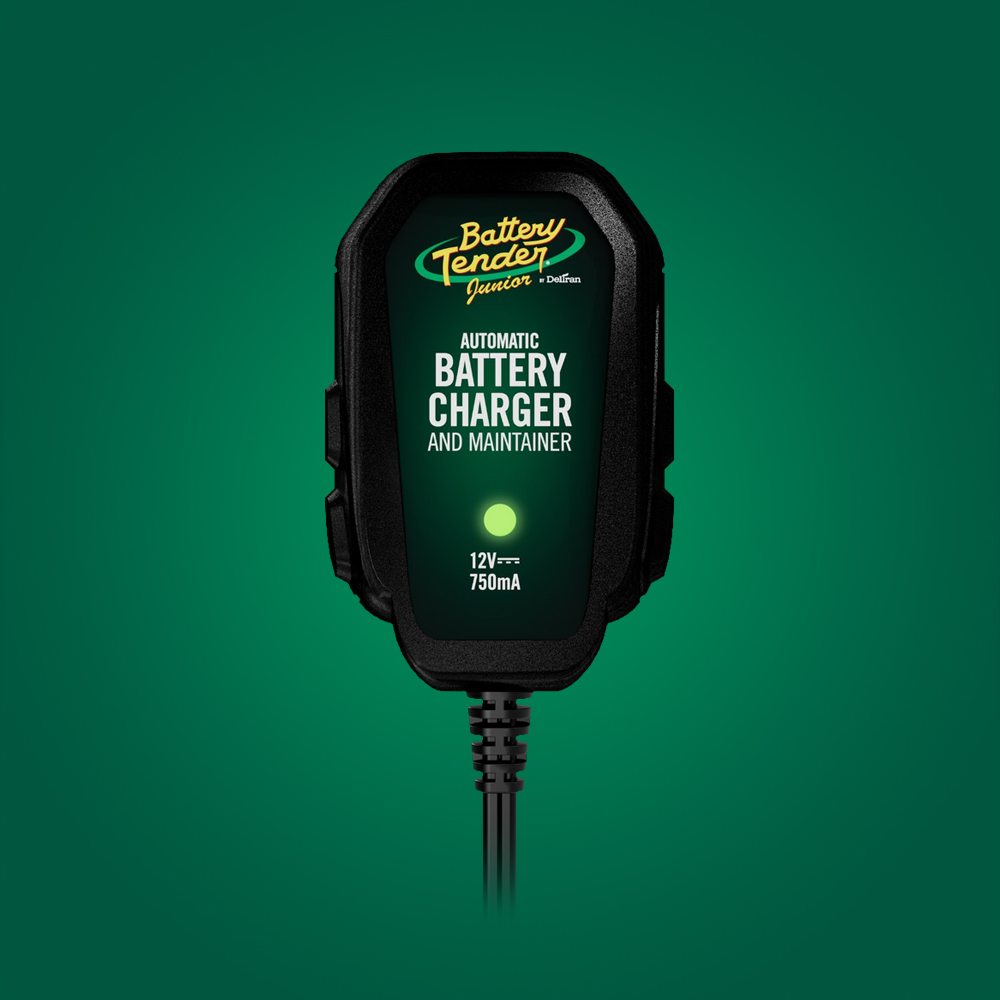
For a 6V battery, the Battery Tender Plus 6V delivers 1.25 amps with ISM control. It suits Model A, early Beetle, and pre-1955 vehicles that sit between drives.
Battery Tender Plus 1.25 AMP 6V Battery Charger and Maintainer
Some 1950s-era vehicles, certain Packard and Chrysler models among them, use 8V systems. The Battery Tender Plus 8V matches that voltage exactly.
Battery Tender Plus 1.25 AMP 8V Battery Charger and Maintainer
When you need a start before the charge finishes
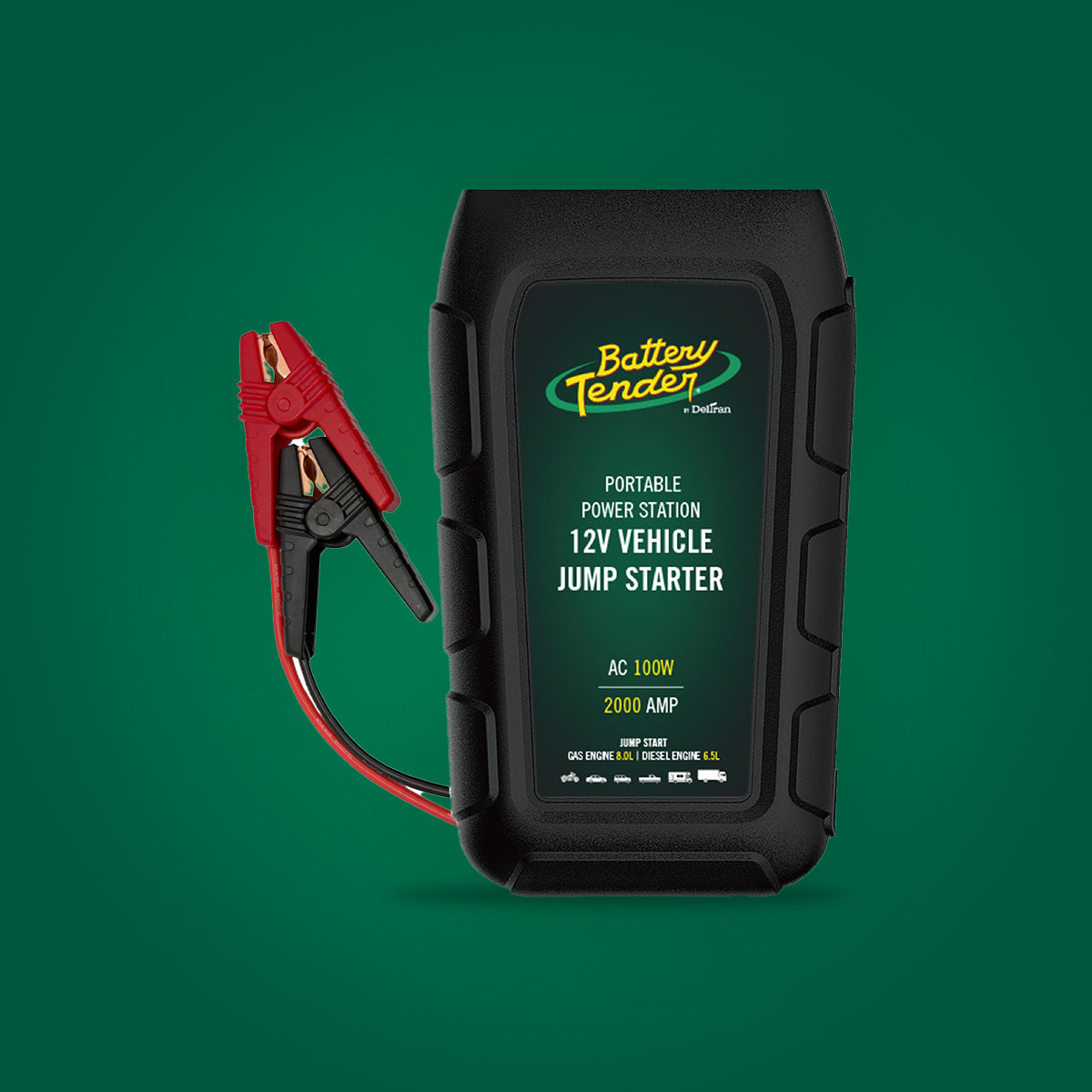
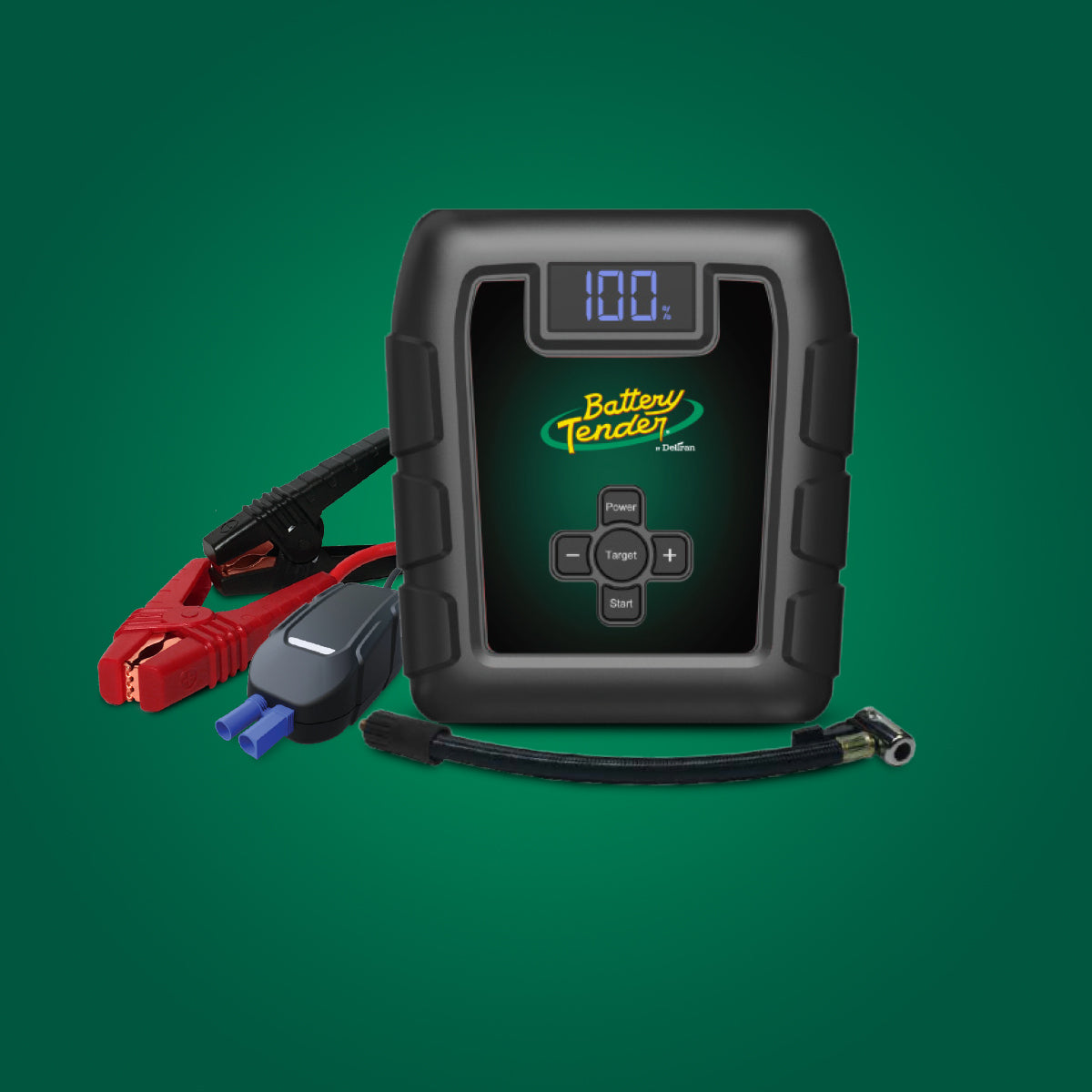
A charger restores the battery, while a jump starter only gets the engine turning. If you must drive now, a portable pack bridges the gap, and then you recharge the battery properly when you are home.
The Battery Tender Jump N Start 800 Amp pack is rated for gas engines up to 4.0L and diesels up to 2.0L. The built-in inflator also covers a low tire on the same trip.
Battery Tender Jump N Start 800 Amp Jump Starter and Tire Inflator
ISM vs. Conventional Trickle Chargers: Why Charging Stages Protect Your Battery
An ISM charger monitors the battery and changes its output at each stage, while a conventional trickle charger delivers constant current regardless of battery condition. That difference decides whether a battery lasts two years or five.
Infinite Sequential Monitoring (ISM) from Battery Tender runs four stages:
- Initialization: tests the battery and applies gentle current to determine its condition.
- Bulk Charge: delivers full rated current until the battery reaches about 80% state of charge.
- Absorption: holds voltage constant while current tapers, and breaks down early sulfate crystals.
- Float Maintenance: monitors voltage continuously and sends charge only when it drops.
Conventional trickle chargers skip this logic and keep pushing current after the battery is full, which dries out electrolyte, warps plates, and shortens battery life.
Float-only chargers sit in between: they hold constant voltage but have no Absorption stage, so recovery is slower. Sulfation builds when a battery sits partly discharged, and ISM keeps the battery from lingering there.
Batteries kept on a maintainer between drives commonly reach five years or more, while neglected batteries often fail at two to three. The gain is largest for vehicles driven less than weekly.
Households with several vehicles can maintain them together. The multiple car battery charger guide explains how a multi-bank setup gives each battery its own ISM cycle. For the alternator side of the story, read the car battery charging guide on alternators versus smart chargers.
Frequently Asked Questions
Is it safe to leave a charger on a car battery overnight?
Yes, if it is a smart maintainer. A Battery Tender charger using ISM tapers current through Absorption, then switches to Float Maintenance and charges only when voltage drops, so it can stay connected for weeks or months. A conventional trickle charger pushes constant current and can overheat and gas the battery overnight.
How do I know when charging car battery is finished?
Watch the charger's full-charge indicator, then disconnect and let the battery rest for two hours. Measure rest voltage with a multimeter. A reading of 12.6V to 12.8V confirms a full charge. If it falls below 12.4V after a completed cycle, the battery may be sulfated or failing and needs a load test.
Should I disconnect the car battery before charging?
Usually no. Modern smart chargers can charge a battery that stays in the vehicle. Turn off the ignition and all loads, clamp red to positive, clamp black to bare chassis metal away from the battery, then plug in. Remove the battery only if it is damaged, deeply sulfated, or your vehicle manual says to.
Can charging car battery revive a completely dead battery?
Sometimes. A battery that rests above about 10.5V often accepts a charge, especially if it went flat recently. A battery that has sat dead for months, or has a shorted cell, is usually beyond recovery. Charge it fully, let it rest, and load test it to decide.
What amp setting is best for charging car battery?
Use roughly 10% to 20% of the battery's amp-hour rating for a full recharge. A 5-amp charger suits most 40Ah to 100Ah car batteries. For maintenance between drives, 1 to 1.25 amps is enough. A smart charger manages higher amps safely, but extra current adds heat in small batteries.
Conclusion
Charging car battery correctly means testing first, sizing the charger to the amp-hours, connecting in the right order, and letting an ISM cycle finish before you disconnect. After that, a maintainer keeps the battery full so the next recharge is rarely needed.
Next step: measure your battery's rest voltage today, match it to the sizing table above, and pick a charger from the Battery Tender battery charger collection.