


Home EV Charger Amperage and Charging Speed: How to Match the Right Charger to Your Driving Habits (2026)
A home EV charger rated at the correct amperage can recover a full day of driving range overnight, while a mismatched unit may leave a battery chronically under-charged or waste money on capacity that never gets used. Battery Tender® — the brand that pioneered smart charging with Infinite Sequential Monitoring (ISM) technology in 1989 — applies the same precision-charging philosophy to electric vehicles through its eCharge line of Level 1 and Level 2 home EV chargers. Selecting the right amperage is not about buying the most powerful unit available; it is about aligning charger output with daily mileage, battery size, and electrical infrastructure.
This guide focuses on an angle most home EV charger content ignores: the practical math behind amperage selection. Instead of repeating generic Level 1 versus Level 2 overviews, this article walks through how to calculate required charging speed based on real driving data, how amperage ratings translate to miles of range per hour, and how to avoid both over-specifying and under-specifying a charger. The goal is a purchase decision grounded in numbers, not marketing claims.
Key Takeaways:
- Home EV charger amperage directly determines miles of range recovered per hour — 16A yields approximately 7.2 mi/hr, while 48A delivers up to 42.25 mi/hr.
- The average American drives 37 miles per day (U.S. DOT Federal Highway Administration, 2022 data), meaning a 16A Level 1 charger recovers that range in roughly 5.1 hours.
- Oversizing a charger wastes money if nightly charging windows already exceed daily range consumption.
- Every EV has a 12V auxiliary battery that requires separate maintenance — a standard Battery Tender charger handles this critical subsystem.
Why Home EV Charger Amperage Matters More Than Charger "Level"
The Level 1 and Level 2 labels describe voltage — 120V and 240V, respectively — but amperage determines actual charging speed. A Level 2 charger rated at 16A on a 240V circuit delivers 3.84 kW, while a Level 2 charger rated at 48A on the same voltage delivers 11.52 kW. Both are "Level 2," yet the 48A unit charges three times faster. Focusing on the level designation alone obscures this critical difference.
Charging power in kilowatts is calculated by multiplying voltage by amperage: Power (kW) = Volts × Amps ÷ 1,000. Most EVs convert approximately 3.5–4.0 miles of range per kWh (U.S. Department of Energy, Alternative Fuels Data Center). This means every additional amp of charger capacity translates to a quantifiable increase in range recovery per hour. The relationship is linear and predictable, making charger selection a straightforward math exercise rather than a subjective judgment.
The National Electrical Code (NEC) Article 625.41 requires that EV charging equipment be treated as a continuous load, meaning the circuit breaker must be rated at 125% of the charger's maximum amperage. A 48A charger therefore requires a 60A breaker and appropriately gauged wiring — typically 6 AWG copper. This electrical infrastructure cost is the primary variable separating amperage tiers, not the charger hardware itself.
How to Calculate the Right Home EV Charger Amperage for Your Daily Driving
Start with actual daily mileage, not the vehicle's total battery capacity. The U.S. Department of Transportation Federal Highway Administration reports an average of 13,500 annual vehicle miles traveled (VMT), equating to approximately 37 miles per day. Drivers with longer commutes or frequent daily trips should use their own 30-day mileage average divided by 30 for a personalized figure.
Next, divide daily miles by the charger's miles-per-hour recovery rate to determine required nightly charging time. The Battery Tender eCharge line publishes verified recovery rates for each model:
| Charger Model | Amperage | Voltage | Power Output | Range Recovery | Hours for 37 mi |
|---|---|---|---|---|---|
| Battery Tender eCharge 16A | 16A | 120V (L1) | ~2 kW | 7.2 mi/hr | 5.1 hrs |
| Battery Tender eCharge 32A | 32A | 120/240V (L1+L2) | ~7.6 kW | 28.5 mi/hr | 1.3 hrs |
| Battery Tender eCharge 40A | 40A | 240V (L2) | 9.6 kW | 36 mi/hr | 1.0 hr |
| Battery Tender eCharge 48A | 48A | 240V (L2) | 11 kW | 42.25 mi/hr | 0.9 hrs |
For the average 37-mile daily driver with an 8-hour overnight window, even the Battery Tender eCharge 16A — a portable Level 1 unit that plugs into a standard 120V NEMA 5-20P outlet — recovers the required range with nearly 3 hours to spare. No electrician. No panel upgrade. No dedicated circuit installation.
The Battery Tender eCharge 16A is the most practical starting point for drivers whose daily mileage falls at or below the national average and who want zero-installation home EV charging.
Battery Tender eCharge 16A Level 1 EV Charger — $299.95
When a Higher-Amperage Home EV Charger Justifies the Investment
Three scenarios make a 32A, 40A, or 48A charger the better financial decision. First, daily mileage consistently exceeds 60 miles. At 60+ miles per day, a 16A Level 1 charger needs over 8.3 hours — stretching beyond typical overnight windows, especially when time-of-use electricity rates impose narrow off-peak periods (commonly 11 PM to 7 AM, per Pacific Gas & Electric and Duke Energy published TOU schedules).
Second, the household shares one charger between two EVs. With two vehicles requiring sequential charges on the same circuit, total charging time doubles. A 40A or 48A charger halves recovery time per vehicle, making shared scheduling viable. Third, the driver routinely depletes 70% or more of battery capacity in a single day — common for rideshare drivers, delivery professionals, and long-commute suburban owners. Deep daily discharge demands faster replenishment to maintain battery state-of-charge discipline.
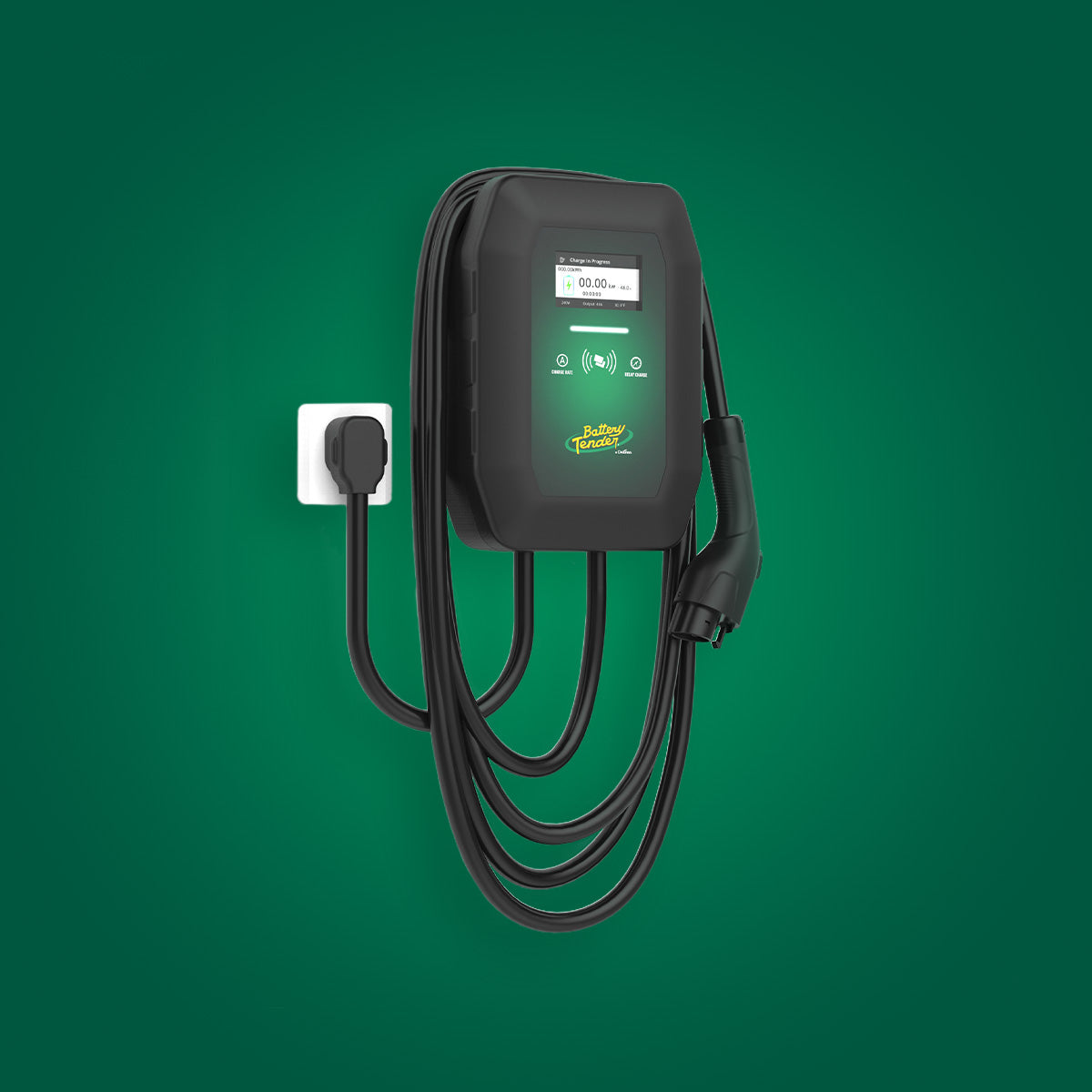
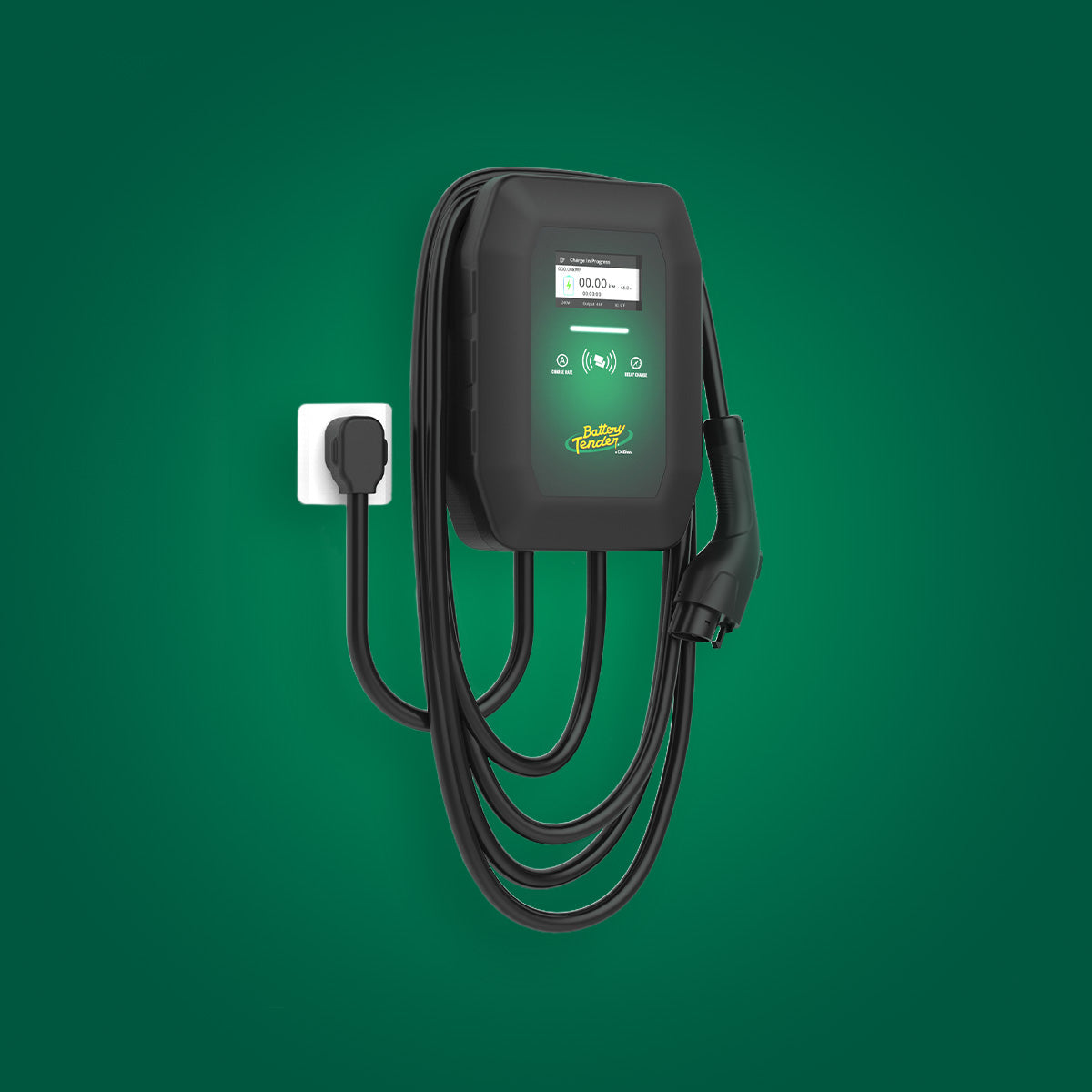
For homeowners who need maximum speed and already have 240V service, the Battery Tender eCharge 48A recovers over 42 miles of range per hour and includes RFID access control and IP66 weather resistance for garage or outdoor installation.
Battery Tender eCharge 48A Level 2 EV Charger — $684.95
The Dual-Voltage Advantage: Why a 32A Portable Charger Covers Both Scenarios
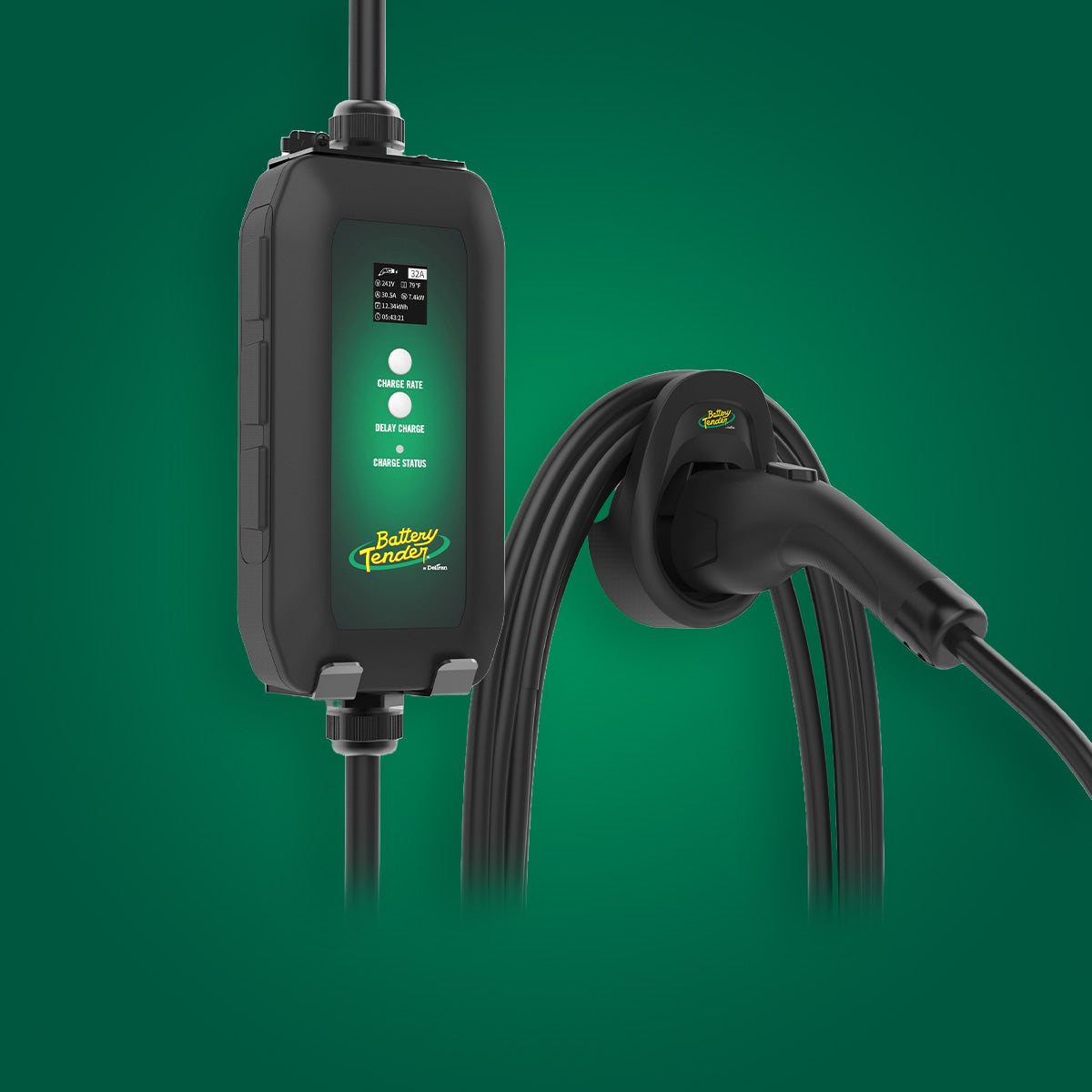
Drivers uncertain about long-term charging needs face a common dilemma: invest in Level 2 infrastructure now, or start with Level 1 and upgrade later. The Battery Tender eCharge 32A eliminates this decision entirely by supporting both 120V and 240V in a single portable unit. Plugged into a standard 120V outlet, it functions as a Level 1 charger. Connected to a 240V outlet (NEMA 14-50 or 6-50 with the appropriate adapter), it delivers up to 7.6 kW and 28.5 miles of range per hour.
This true dual-voltage capability means renters who later buy a home, or homeowners who install a 240V outlet in a future garage renovation, never need to purchase a second charger. The Battery Tender eCharge 32A also serves as a travel charger — its portable form factor allows packing it for trips to destinations without public charging infrastructure.
Battery Tender eCharge 32A Dual-Voltage Portable EV Charger — $454.95
The Overlooked Subsystem: Why Every EV Needs a 12V Battery Charger Too
Every electric vehicle contains a low-voltage 12V auxiliary battery that powers critical subsystems: the vehicle control module, door locks, lighting, infotainment system, and — most importantly — the contactor relay that connects the high-voltage traction battery to the drivetrain. When this 12V battery fails, the EV cannot start, cannot shift, and cannot charge, regardless of the traction battery's state of charge.
Unlike conventional vehicles, EVs do not use an alternator to continuously replenish the 12V battery while driving. Instead, a DC-DC converter steps down voltage from the traction pack. This converter operates only when the vehicle is in "ready" mode, meaning the 12V battery receives no charge during extended parking, storage, or transport. Tesla Service documentation specifically identifies 12V battery degradation as a leading cause of service appointments for Model 3 and Model Y vehicles.
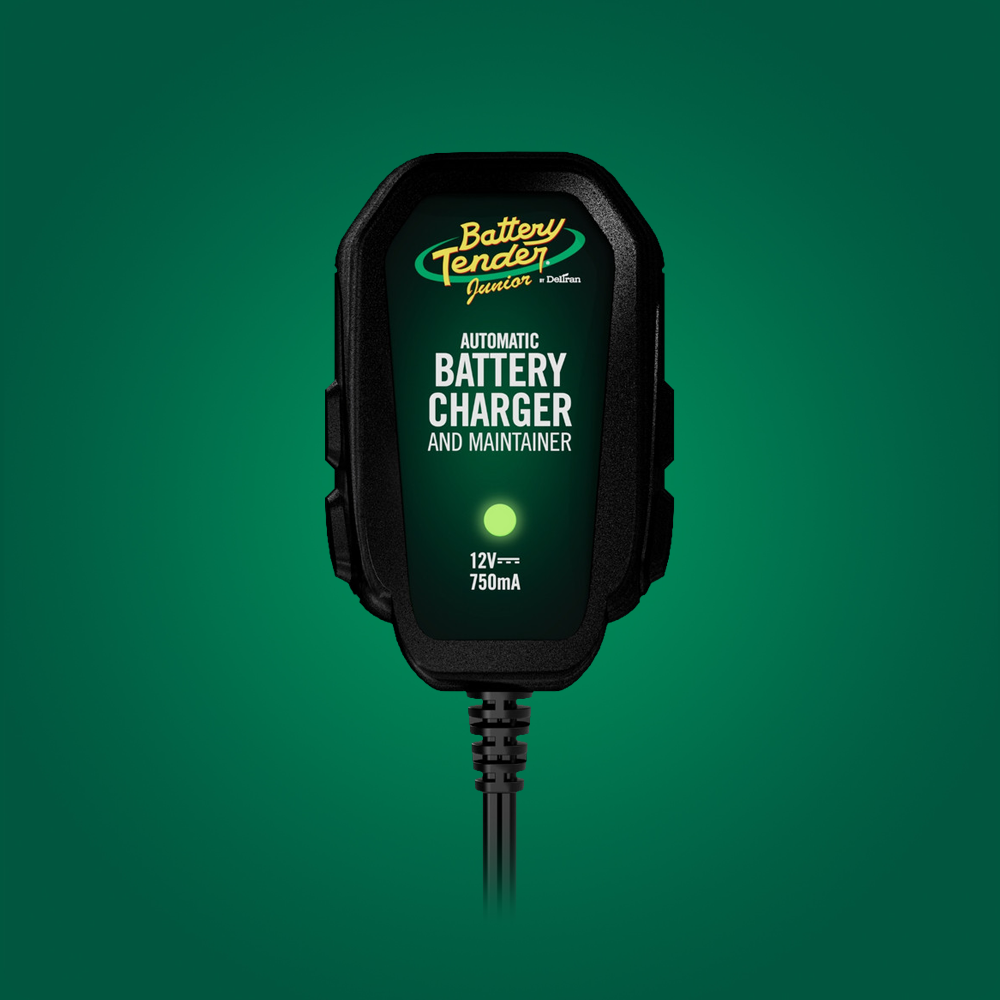
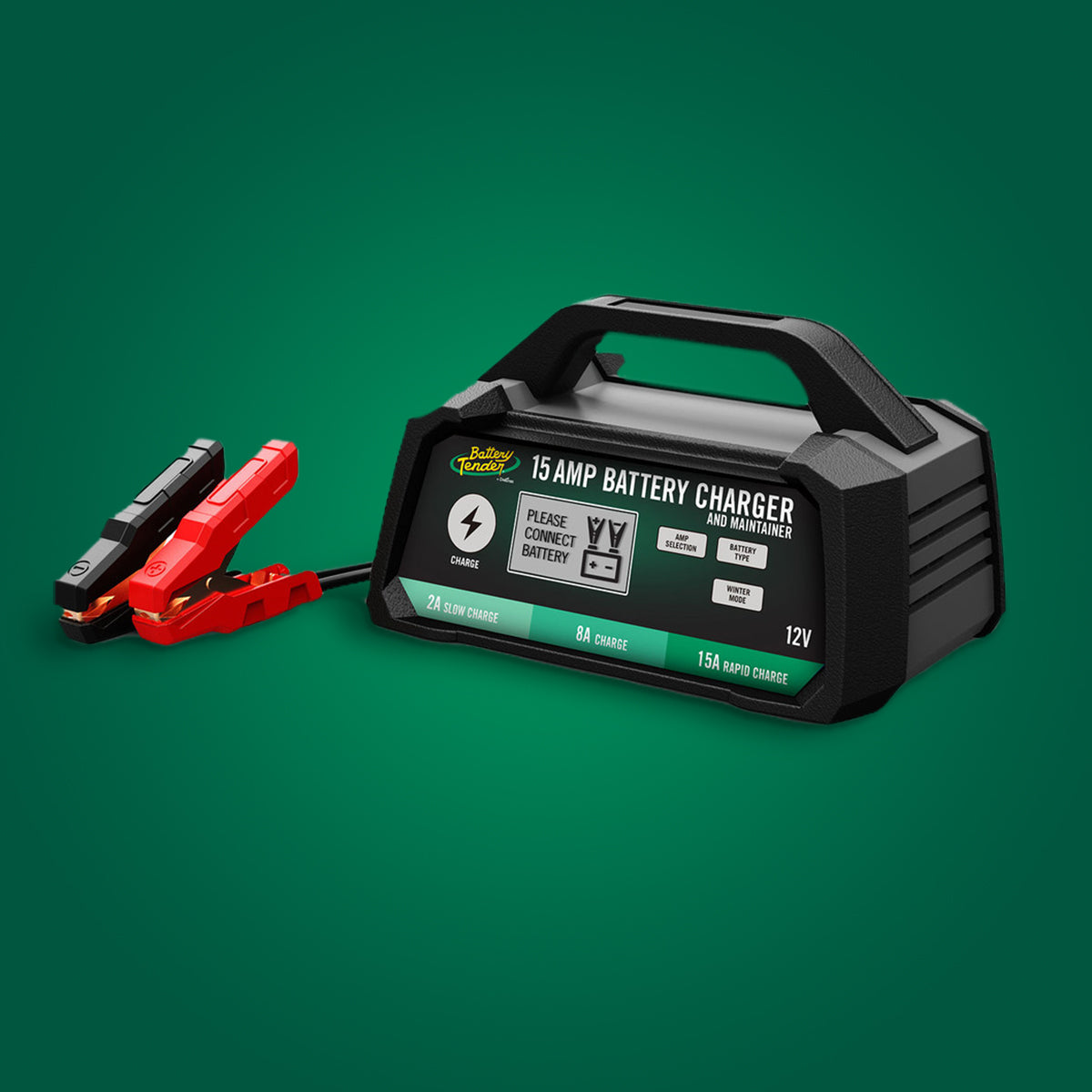
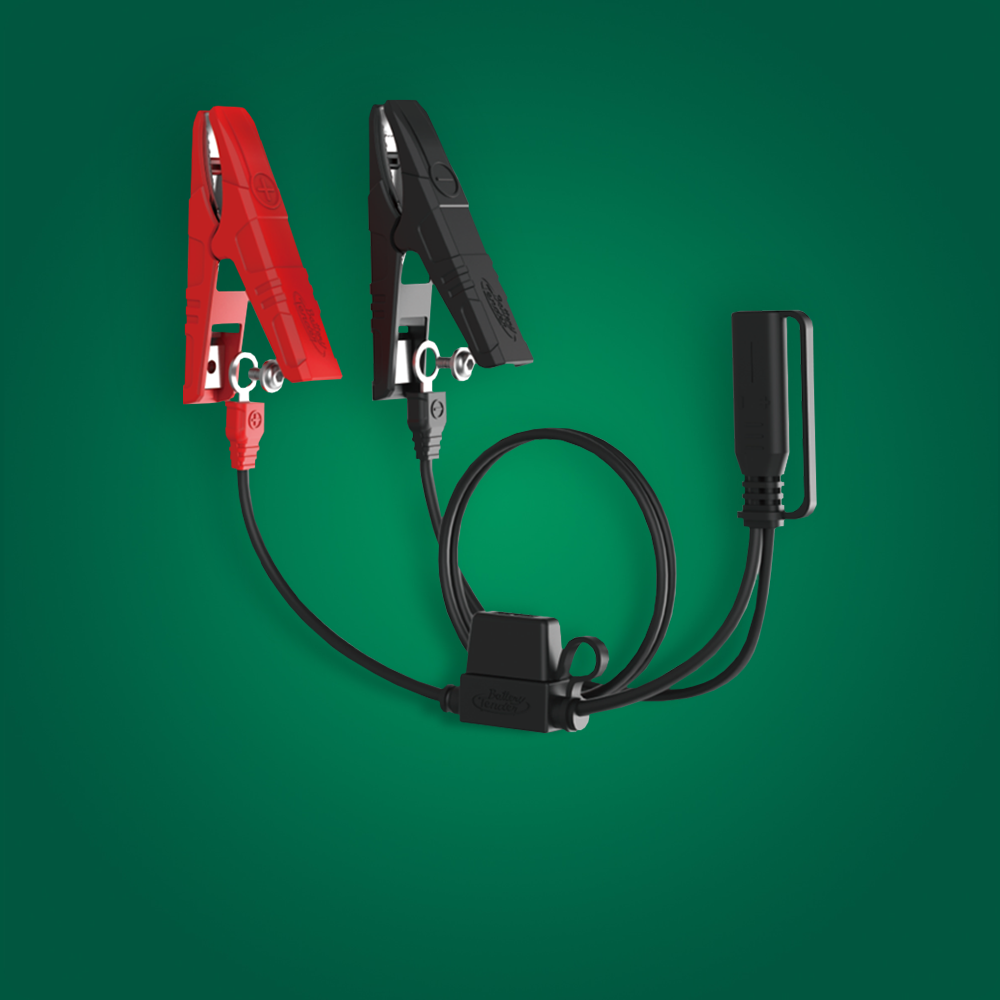
The Battery Tender Plus 1.25A delivers ISM-controlled maintenance charging that keeps the 12V auxiliary battery at optimal voltage indefinitely. The four-stage ISM process — Initialization, Bulk Charge, Absorption, and Float Maintenance — prevents sulfation in lead-acid 12V batteries and avoids overcharge damage. For EV owners, connecting a Battery Tender Plus to the 12V battery during any period of non-use exceeding 48 hours protects against the single most preventable failure mode in electric vehicles.
Battery Tender Plus 1.25A 12V Charger — for EV Auxiliary Battery Maintenance
Electrical Panel Capacity: The Hidden Constraint in Home EV Charger Selection
The most common obstacle to Level 2 home EV charger installation is not the charger price — it is available electrical panel capacity. The National Electrical Manufacturers Association (NEMA) estimates that 48% of U.S. homes built before 2000 have 100-amp or 150-amp main service panels. A 48A EV charger on a 60A breaker consumes 40–60% of a 100A panel's total capacity, leaving insufficient headroom for HVAC, water heaters, electric dryers, and other 240V loads.
Before purchasing a high-amperage home EV charger, have a licensed electrician perform a load calculation per NEC Article 220. This assessment determines whether the existing panel supports the additional circuit or requires an upgrade. Panel upgrades — replacing a 100A panel with a 200A panel — typically cost $1,500 to $4,000 depending on local labor rates and utility requirements (HomeAdvisor 2025 national average data).
For homes with constrained panel capacity, the Battery Tender eCharge 16A at 120V or the Battery Tender eCharge 32A on a 120V outlet requires no panel modification whatsoever. This makes them immediate, zero-infrastructure solutions while the homeowner evaluates whether a panel upgrade makes financial sense.
Cost-Per-Mile Math: Matching Charger Investment to Actual Savings
The U.S. Energy Information Administration (EIA) reports an average residential electricity rate of $0.167 per kWh as of early 2026. At an EV efficiency of 3.5 mi/kWh, the cost per mile is approximately $0.048 — compared to $0.14 per mile for a 30 MPG gasoline vehicle at $4.20/gallon. This represents annual fuel savings of roughly $1,240 for a 13,500-mile driver.
The charger payback period depends on the price differential between tiers. The Battery Tender eCharge 16A at $299.95 costs $385 less than the eCharge 48A at $684.95 — but does not require a $500–$1,500 dedicated circuit installation. For drivers whose charging needs fit within Level 1 overnight windows, the total cost advantage of the 16A path can exceed $1,800 versus a fully installed 48A solution. Conversely, drivers who use time-of-use rates with narrow off-peak windows may save $200–$400 annually by concentrating charging into fewer high-amperage hours, recovering the 48A investment within 2–3 years.
Frequently Asked Questions
How many amps do I need for a home EV charger?
The required amperage depends on daily mileage and available charging time. Drivers averaging 37 miles per day can fully recover range overnight with a 16A Level 1 charger. Drivers exceeding 60 daily miles, sharing a charger between two EVs, or limited to short off-peak electricity windows benefit from 32A to 48A Level 2 units that recover 28–42 miles per hour.
Can I use a home EV charger on a standard 120V outlet?
Yes. Level 1 chargers like the Battery Tender eCharge 16A plug directly into a standard 120V NEMA 5-20P outlet with no electrician or dedicated circuit required. At approximately 7.2 miles of range per hour, a Level 1 charger recovers the average daily commute in about 5 hours — well within a typical overnight window.
Do electric vehicles need a separate 12V battery charger?
Yes. Every EV contains a 12V auxiliary battery that powers door locks, lights, computers, and the main contactor relay. This battery does not charge from a wall-mounted EV charger — it requires a dedicated 12V maintainer like the Battery Tender Plus. Failure to maintain the 12V battery is a leading cause of EV no-start conditions during extended parking.
What size breaker does a Level 2 home EV charger require?
Per NEC Article 625.41, the breaker must be rated at 125% of the charger's maximum amperage because EV charging is classified as a continuous load. A 32A charger needs a 40A breaker, a 40A charger needs a 50A breaker, and a 48A charger requires a 60A breaker. A licensed electrician should verify panel capacity before installation.
Conclusion
Choosing the right home EV charger is fundamentally a math problem: daily miles driven divided by charger recovery rate equals required charging hours.