



Portable EV Car Charger Buying Guide: How to Choose the Right Unit for Every Scenario (2026)
A portable EV car charger is a plug-in electric vehicle supply equipment (EVSE) unit that connects to standard or high-voltage outlets without permanent wall mounting or hardwired installation. Battery Tender® brings over three decades of charging expertise — dating back to the first smart battery charger introduced in 1991 — to a portable EV charger lineup engineered for real-world flexibility. Whether charging overnight at a rental property, topping off at a campground, or keeping a backup charger in the trunk for emergencies, a portable unit eliminates dependence on public charging infrastructure.
This guide focuses specifically on how to evaluate, select, and use a portable EV car charger — a distinct angle from home installation guides and fixed wall-mount comparisons already covered elsewhere. The emphasis here is on portability-specific buying criteria: plug configurations, amperage trade-offs, cable management, outlet scouting, and the often-overlooked 12V auxiliary battery maintenance that every electric vehicle still requires. By the end, the right portable charging solution for any driving pattern and living situation will be clear.
Key Takeaways:
- Portable EV car chargers plug into existing outlets — no electrician, no permits, no permanent commitment.
- Level 1 (120V) units add approximately 3–7 miles of range per hour; Level 2 (240V) portables deliver up to 28–42 miles per hour.
- Dual-voltage portable chargers offer maximum flexibility for travel between 120V and 240V outlet availability.
- Every EV still contains a 12V auxiliary battery that requires separate maintenance charging to prevent system failures.
What Makes a Portable EV Car Charger Different from a Wall-Mount Unit?
A portable EV car charger is defined by three characteristics that separate it from fixed installations: no hardwiring requirement, plug-and-play outlet connection, and a form factor designed for transport and storage. Wall-mount Level 2 units like a 40A or 48A hardwired charger deliver maximum power but require a licensed electrician, a dedicated 240V circuit, and permanent placement. Portable units sacrifice some peak charging speed in exchange for the ability to charge anywhere an appropriate outlet exists.
The practical distinction matters most for renters, multi-vehicle households, drivers who travel frequently, and EV owners who park in different locations throughout the week. According to the U.S. Department of Energy's Alternative Fuels Data Center, approximately 80% of EV charging occurs at home — but "home" does not always mean a garage with a dedicated 240V circuit. A portable charger turns any compatible outlet into a charging station.
Portable units also serve as essential backup chargers. Even owners with permanent wall-mount installations benefit from keeping a portable unit in the vehicle for extended trips, visiting family, or charging at hotels and vacation rentals. The National Renewable Energy Laboratory (NREL) data from 2025 shows that range anxiety decreases by over 60% among EV drivers who carry a portable EVSE, compared to those relying exclusively on public infrastructure.
Level 1 vs. Level 2: Which Portable EV Car Charger Speed Do You Need?
The single most important decision when selecting a portable EV car charger is voltage level — and the answer depends on daily driving distance, overnight charging window, and outlet availability at regular parking locations.
Level 1 Portable Charging (120V)
Level 1 units plug into any standard 120V household outlet (NEMA 5-15 or 5-20). No installation is needed — just plug in and connect. Typical charging rates range from 3 to 7 miles of range per hour, depending on the vehicle and charger amperage. For a driver covering 30–40 miles daily, a Level 1 charger recovers that range in roughly 6–10 hours overnight. The Battery Tender eCharge 16A delivers up to 2kW of power from a 120V NEMA 5-20P outlet, adding approximately 7.2 miles of range per hour — faster than the 3–4 miles typical of the OEM travel chargers bundled with most new EVs.
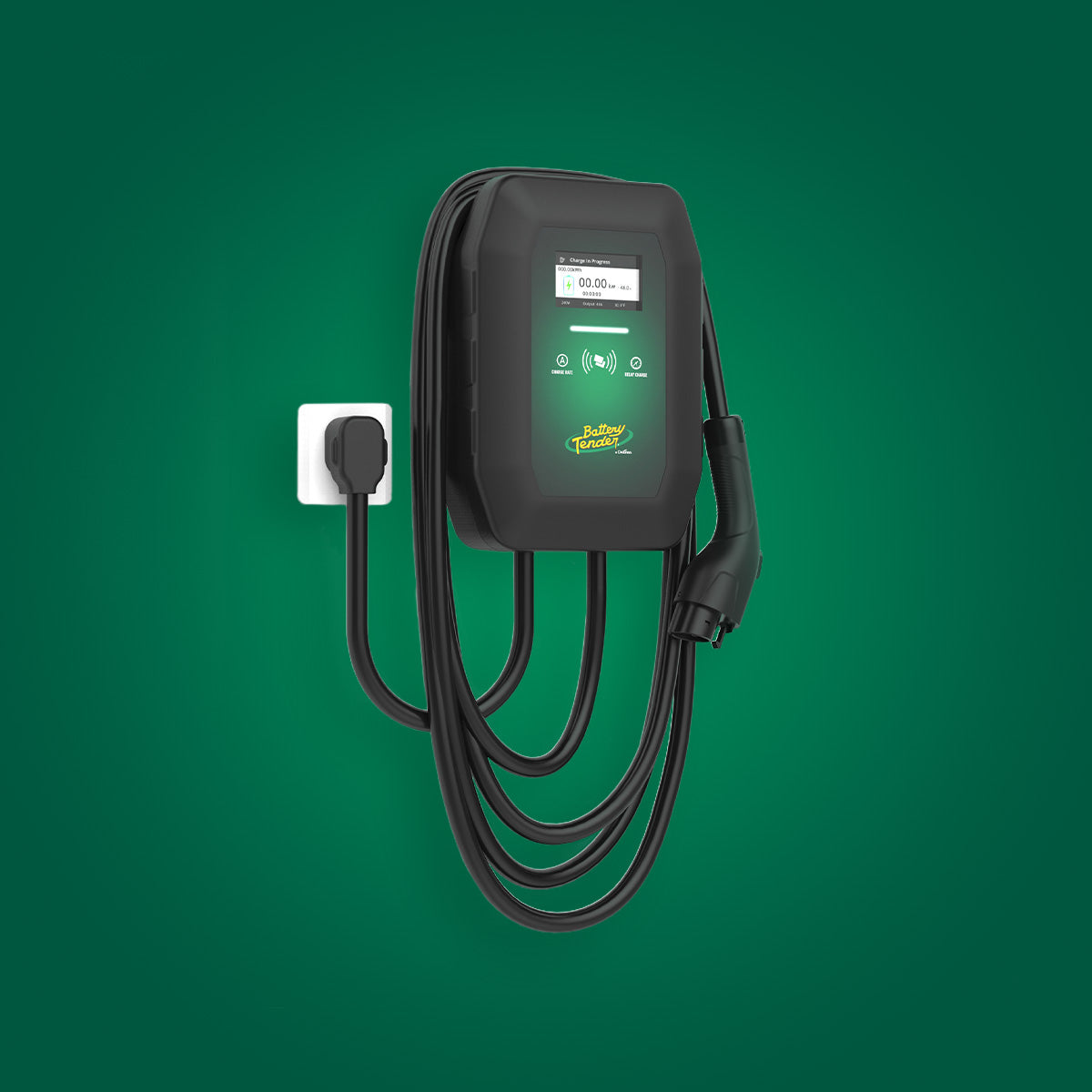
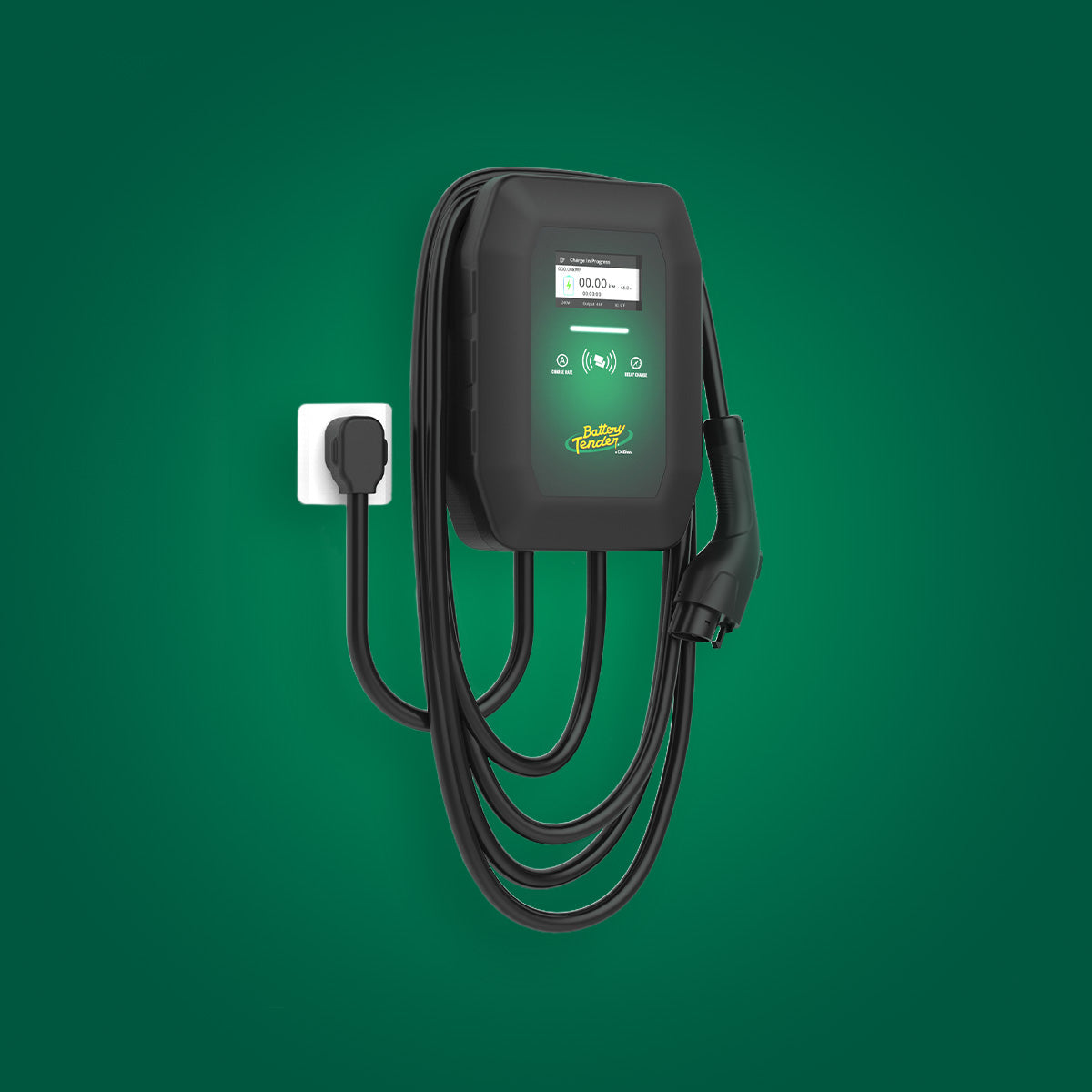
The Battery Tender eCharge 16A is a fully portable Level 1 unit that requires zero installation and fits easily in a trunk or cargo area for travel.
Battery Tender eCharge 16A Portable EV Charger — $299.95
Level 2 Portable Charging (240V)
Level 2 portable units connect to 240V outlets — the same type used by electric dryers, welders, or RV hookups. Charging speeds jump dramatically: a 32A portable charger delivers up to 28.5 miles of range per hour, while a 40A unit reaches approximately 36 miles per hour. A completely depleted 60 kWh battery recovers fully in roughly 8 hours on a 32A portable versus 30+ hours on Level 1.
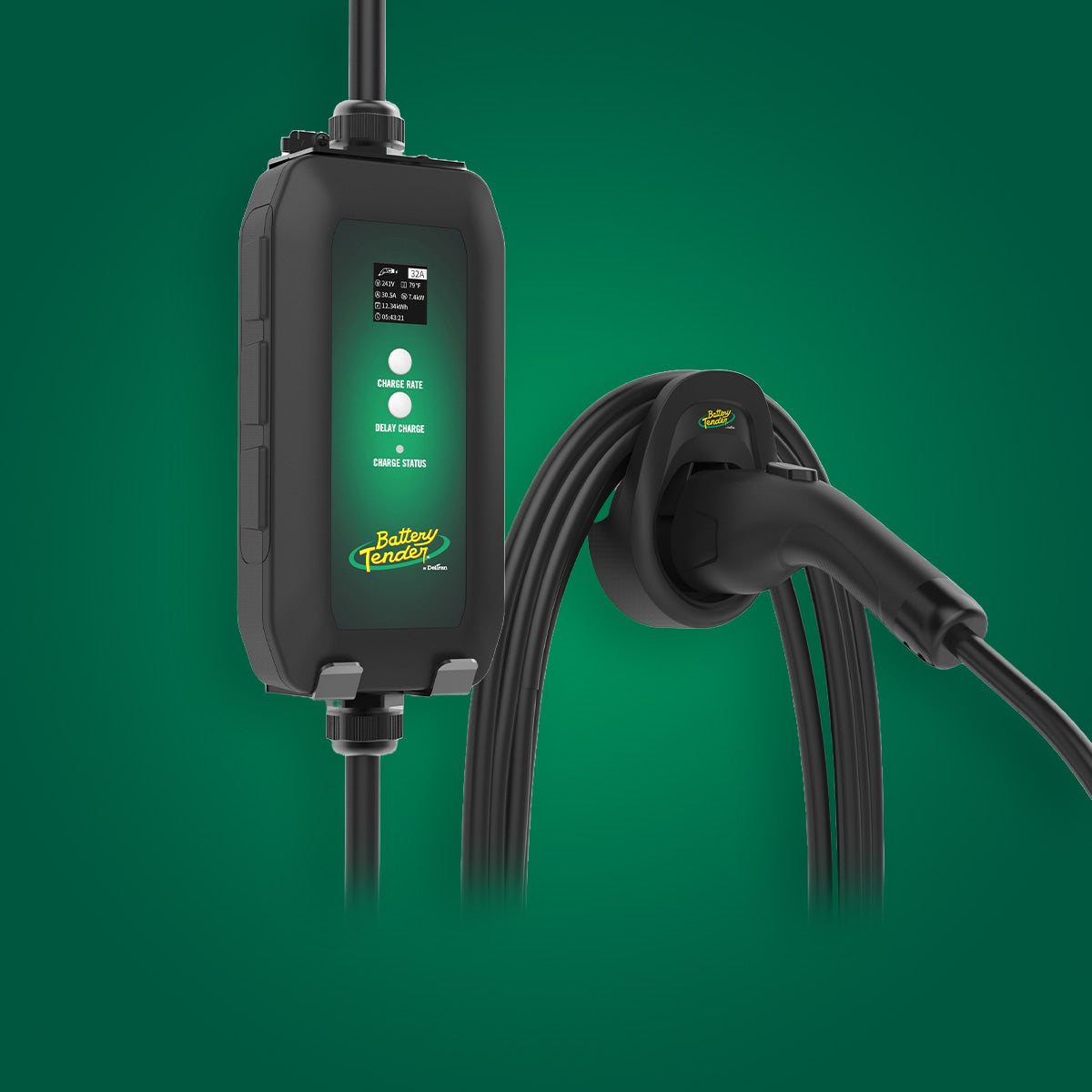
The key advantage of a portable Level 2 unit over a wall-mount version is dual-location flexibility. The Battery Tender eCharge 32A operates on both 120V and 240V power — true dual-voltage capability in a single unit. Plug it into a standard outlet for Level 1 speeds on the road, then connect to a 240V outlet at home or at a relative's dryer plug for Level 2 speed. This eliminates the need to own two separate chargers.
Battery Tender eCharge 32A Dual-Voltage Portable EV Charger — $454.95. Also available at Costco.com.
Five Critical Specs to Compare Before Buying a Portable EV Car Charger
Beyond voltage level, five specifications separate a high-quality portable EVSE from a unit that will frustrate and underperform. Evaluating these criteria before purchase prevents costly returns and charging disappointments.
1. Amperage rating. Higher amps equal faster charging within the same voltage tier. A 16A Level 1 charger charges roughly twice as fast as an 8A unit on the same 120V outlet. On Level 2, a 32A unit delivers 7.6 kW versus 3.8 kW from a 16A unit — doubling the effective speed. Always verify the vehicle's onboard charger accepts the amperage; most modern EVs accept at least 32A on Level 2, and many accept 40A or 48A.
2. Plug type (NEMA configuration). Portable Level 2 chargers use NEMA 14-30 (dryer), NEMA 14-50 (RV/range), or NEMA 6-50 (welder) plugs. Before purchasing, identify which 240V outlets exist at planned charging locations. The NEMA 14-50 is the most common for EV charging and RV parks.
3. Cable length. Portable chargers typically include 20–25 feet of charging cable. Measure the distance from the nearest outlet to the vehicle's charge port. Insufficient cable length is the most common complaint in portable EVSE reviews, according to J.D. Power's 2025 EV Ownership Satisfaction Study.
4. Connector standard. As of 2026, the J1772 (SAE J1772) connector remains the universal standard for Level 1 and Level 2 AC charging across non-Tesla EVs. Tesla vehicles equipped with the NACS port require an adapter for J1772 chargers, or a compatible NACS plug. Battery Tender offers a Tesla NACS Adapter (SKU 081-0400, $44.95) for seamless compatibility.
5. Safety certifications. Look for UL listing (UL 2594 or UL 2231) and an IP rating of at least IP65 for outdoor use. The National Electrical Code (NEC) Article 625 governs EVSE requirements. Battery Tender eCharge units meet applicable UL safety standards and carry IP66 weather resistance ratings on wall-mount models, ensuring safe operation even in exposed environments.
Real-World Portable EV Car Charger Scenarios: Matching the Unit to Your Situation
Apartment dweller with shared parking. A Level 1 portable charger is often the only option when no 240V outlet is available. The Battery Tender eCharge 16A plugs into any standard 20A outlet and delivers 7.2 miles of range per hour — sufficient to recover 60–80 miles during an overnight charge. Keep the unit in the trunk and charge wherever a compatible outlet is accessible.
Homeowner without a dedicated 240V circuit yet. The Battery Tender eCharge 32A dual-voltage unit starts on 120V immediately with no installation, then switches to full 240V Level 2 speed once an electrician installs a dedicated circuit. One purchase covers both phases, saving $300–$500 versus buying separate Level 1 and Level 2 units.
Road tripper and vacation traveler. A portable Level 2 charger turns any RV park, campground, or vacation rental with a dryer outlet into a fast-charging station. The 28.5 miles per hour delivered by the Battery Tender eCharge 32A means a 200-mile range recovery in roughly 7 hours — a full overnight charge.
Emergency backup for wall-mount owners. Even with a permanent home charger installed, carrying a portable unit eliminates range anxiety on long trips. According to the American Automobile Association (AAA), "dead battery" calls for EVs most frequently occur during multi-day road trips when drivers rely solely on public DC fast-charging networks.
The Overlooked Maintenance Need: Your EV's 12V Auxiliary Battery
Every electric vehicle — regardless of make, model, or main battery capacity — contains a separate 12V auxiliary battery that powers critical systems: door locks, infotainment, lighting, onboard computers, and the contactors that connect the high-voltage traction battery. When this 12V battery fails, the EV cannot start, cannot charge, and in some cases cannot be towed normally.
The 12V auxiliary battery is not maintained by a portable EV car charger or any EVSE. It requires a dedicated 12V battery charger-maintainer — the same type of smart charger that Battery Tender pioneered with Infinite Sequential Monitoring (ISM) technology. The ISM 4-stage process (Initialization → Bulk Charge → Absorption → Float Maintenance) keeps the 12V auxiliary at optimal voltage without overcharging, which is especially critical during extended parking or storage.
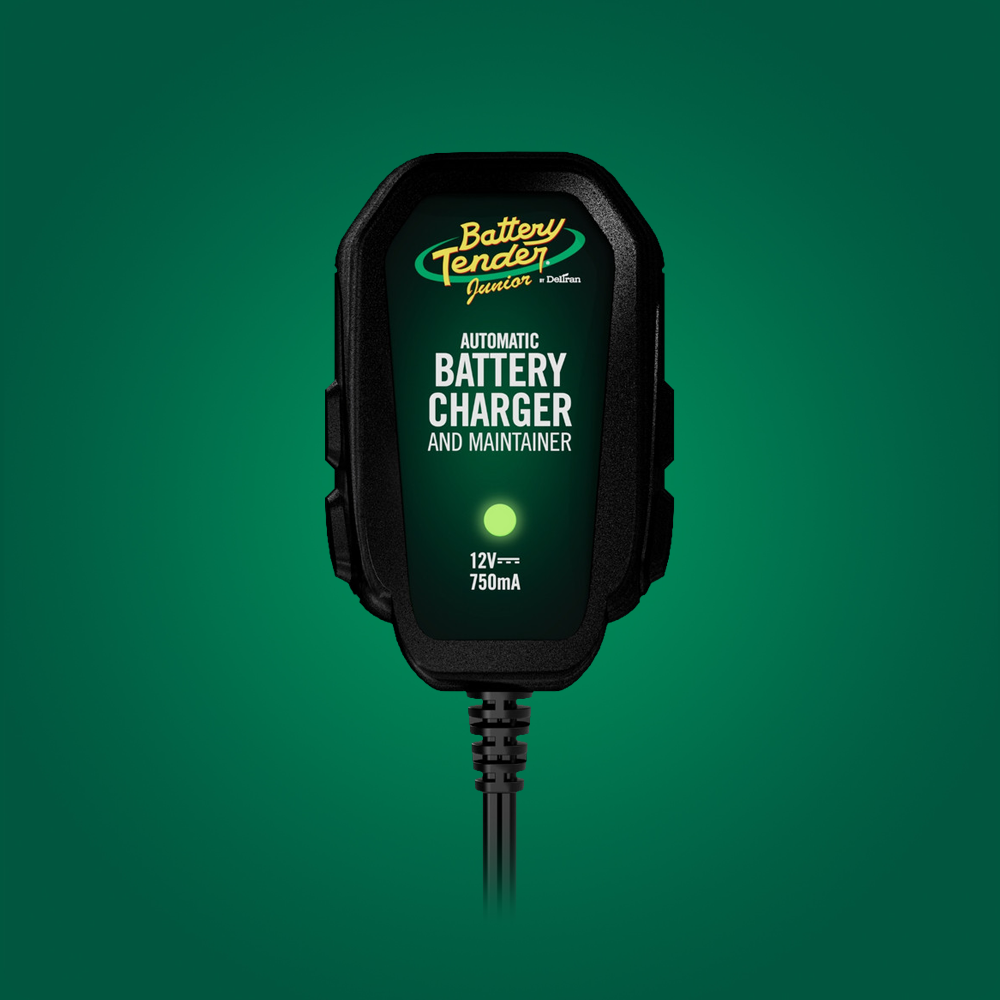
The Battery Tender Plus 1.25A 12V charger is the ideal companion to any portable EV car charger. Connect it to the 12V auxiliary battery during garage storage, vacation parking, or seasonal downtime. The Plus model includes temperature compensation for accurate charging across varying ambient conditions.
Battery Tender Plus 1.25A 12V Battery Charger
Portable EV Car Charger Safety and Best Practices
Portable EVSE safety begins with the outlet. Never use extension cords with any EV charger — the sustained high-amperage draw (12A–40A for hours) can overheat undersized wiring and create fire hazards. The NEC Article 625.44 requires EVSE to connect directly to a properly rated outlet or be permanently wired. If the outlet is too far from the vehicle, relocate the vehicle or install a closer outlet.
Inspect the outlet before every use. Loose receptacles, scorch marks, warm cover plates, or tripped breakers indicate wiring problems that must be addressed by a licensed electrician before charging. A portable charger is only as safe as the circuit supplying it.
⚠️ Safety Warning: Never modify a portable EV charger plug to fit an incompatible outlet. NEMA plug configurations exist specifically to prevent amperage mismatches that can cause overheating and electrical fires. If the available outlet does not match the charger plug, use only a UL-listed adapter rated for continuous duty at the charger's amperage, or have an electrician install the correct outlet.
Store the portable charger in a dry, clean bag or case when not in use. Protect the connector head from dirt, moisture, and physical damage. Coil cables loosely — tight coiling creates stress points that degrade insulation over time.
Frequently Asked Questions
Can a portable EV car charger work at any house or rental property?
A Level 1 portable EV car charger works at any location with a standard 120V household outlet rated for at least 15A–20A. Level 2 portable units require a 240V outlet (NEMA 14-30, 14-50, or 6-50). Before traveling, confirm outlet availability and breaker capacity with the property owner. The Battery Tender eCharge 32A dual-voltage unit works with both 120V and 240V outlets, maximizing compatibility across locations.
How long does it take to fully charge an EV with a portable charger?
Charging time depends on battery capacity and charger amperage. Use this formula: (battery kWh × depth of discharge) ÷ charger kW output = hours. For example, a 60 kWh battery at 50% depth of discharge on a 7.6 kW (32A) portable charger: (60 × 0.50) ÷ 7.6 = approximately 3.9 hours. On Level 1 at 2 kW, the same charge takes roughly 15 hours.
Do portable EV chargers work with Tesla vehicles?
Yes. Tesla vehicles with the NACS charging port can use J1772 portable chargers via an adapter. Battery Tender offers a Tesla NACS Adapter (SKU 081-0400, $44.95) that connects J1772 EVSE units — including the Battery Tender eCharge 16A and eCharge 32A — to Tesla vehicles. Newer non-Tesla EVs adopting NACS also work with standard J1772 adapters.
Does a portable EV car charger maintain the 12V auxiliary battery?
No. An EV car charger (EVSE) only charges the high-voltage traction battery. The 12V auxiliary battery in every electric vehicle requires a separate 12V charger-maintainer. The Battery Tender Plus 1.25A uses ISM technology to safely maintain the 12V auxiliary during storage and prevent the dead-battery failures that account for a significant portion of EV roadside assistance calls.
Conclusion
A portable EV car charger is not a compromise — it is a strategic charging tool that provides flexibility no wall-mount unit can match. For drivers who rent, travel, park in multiple locations, or simply want a reliable backup, portable EVSE from Battery Tender delivers the charging speed, safety certifications, and build quality that three decades of smart charging expertise produce. Pair any Battery Tender eCharge portable unit with a Battery Tender Plus for 12V auxiliary maintenance, and every charging need — traction battery and auxiliary — is covered.
Explore the complete lineup of portable and wall-mount EV chargers, adapters, and accessories on the Battery Tender EV Charger collection page.
Last updated: 2026
Related guides: EV 12V Auxiliary Battery Maintenance · EV Home Charging Setup: Everything First-Time EV Owners Need to Know · More EV charging guides


