



Battery Tender 2-Bank Charger: How to Charge Two Vehicles Simultaneously (2026)
Battery Tender® pioneered smart battery charging in 1989, and the ability to charge two vehicles simultaneously using a single 2-bank charger remains one of the most practical solutions for owners of multiple vehicles, seasonal equipment, or shared garages. A Battery Tender® 2-bank charger delivers independent Infinite Sequential Monitoring (ISM) to each connected battery, meaning two completely different vehicles—a daily driver and a stored motorcycle, for example—receive optimized, chemistry-specific charging through one compact unit plugged into a single wall outlet.
Unlike daisy-chaining two separate chargers or using a splitter cable (which shares current unevenly), a true 2-bank charger contains two electrically isolated charging circuits. Each bank monitors its battery independently, advancing through all four ISM stages at whatever pace that specific battery demands. The result is two fully maintained batteries with zero risk of overcharging, undercharging, or cross-circuit interference—all from one device. This guide covers exactly how simultaneous two-vehicle charging works, which setups benefit most, and how to install a Battery Tender® 2-bank charger for reliable, hands-free operation in 2026.
Key Takeaways:
- A 2-bank charger uses two independent ISM circuits to charge two vehicles simultaneously from one outlet.
- Each bank advances through 4 ISM stages independently—batteries at different charge levels receive exactly what they need.
- Multi-bank charging prevents sulfation and extends battery life from the typical 2–3 years to 5+ years per battery.
- Proper installation requires dedicated ring terminal harnesses and adequate wire routing for each vehicle.
How Does a Battery Tender 2-Bank Charger Charge Two Vehicles Simultaneously?
A 2-bank charger charges two vehicles simultaneously by housing two completely independent charging circuits inside a single enclosure. Each circuit—called a "bank"—has its own microprocessor, its own current-regulation hardware, and its own set of output leads. When two batteries are connected, Bank 1 and Bank 2 operate in parallel but are electrically isolated from each other, meaning the charge state of one battery has zero influence on the other.
This isolation is critical. If a motorcycle battery connected to Bank 1 is already at 90% state of charge while a car battery connected to Bank 2 is deeply discharged at 40%, each bank enters the appropriate ISM stage for its battery. Bank 1 might already be in the Absorption stage, tapering current to dissolve residual sulfate crystals, while Bank 2 is still in Bulk Charge mode, delivering full rated current. Neither bank waits for the other. Neither bank compromises output for the other.
This architecture differs fundamentally from using a Y-splitter cable to connect two batteries to one single-output charger. A splitter divides current between two batteries without monitoring either one individually. The battery with lower internal resistance draws more current, leaving the weaker battery—the one that needs charging most—underserved. A purpose-built 2-bank charger eliminates this problem entirely.
Understanding ISM 4-Stage Charging Across Two Banks
Every bank in a Battery Tender multi-bank charger runs the full ISM 4-stage charging process independently. ISM stands for Infinite Sequential Monitoring—a proprietary algorithm that continuously evaluates battery voltage and adjusts charging behavior in real time. The four stages are:
- Initialization — The charger tests the battery with a gentle current to assess condition and confirm a valid connection. If the battery is too deeply discharged or shorted, the charger will not proceed, protecting both the battery and the charger.
- Bulk Charge (Constant Current) — Full rated amperage flows into the battery until it reaches approximately 80% state of charge. This is the fastest charging phase.
- Absorption (Constant Voltage) — Voltage is held constant while current gradually tapers. This stage dissolves sulfate crystals that form on lead plates during discharge, a process critical to long-term battery health.
- Float Maintenance — Once the battery reaches full charge, ISM drops to demand-responsive monitoring. The charger delivers brief charge pulses only when voltage dips below a set threshold, keeping the battery at 100% without ever overcharging.
Because each bank runs ISM independently, one bank can be in Float Maintenance (battery fully charged, connected for weeks) while the other bank is in Bulk Charge (battery recently discharged). According to research published by the Society of Automotive Engineers (SAE), maintaining batteries above 12.4V prevents the sulfation cycle that causes 60–80% of premature lead-acid battery failures. ISM maintains voltage well above this threshold indefinitely.
Which Two-Vehicle Setups Benefit Most from a 2-Bank Charger?
Any scenario involving two batteries that sit idle for extended periods is an ideal candidate for simultaneous 2-bank charging. The most common configurations include:
- Daily driver + weekend motorcycle: The car stays charged between commutes, but the motorcycle battery drains during workweeks. A 2-bank charger keeps both topped off simultaneously.
- Two classic cars in a shared garage: Collector vehicles often sit for weeks or months between drives. Two banks eliminate the need to swap a single charger between vehicles.
- Truck + ATV/UTV in a barn or shop: Farm and utility setups frequently involve a full-size truck and a smaller powersport vehicle sharing the same structure.
- Seasonal vehicle + backup generator: One bank maintains a stored boat, snowmobile, or RV battery while the other keeps a standby generator battery at full charge.
- Two boats on a shared lift or trailer: When two vessels share dock space, a 2-bank charger avoids running separate AC circuits to separate chargers.
The critical advantage in every case is elimination of the "charger rotation" problem. When owners rely on one single-output charger and manually swap it between vehicles, one battery inevitably sits idle too long. A battery at rest loses approximately 1–3% of its charge per week at 77°F (25°C), and faster in warmer environments. Over a month of neglect, that translates to a 4–12% state-of-charge drop—enough to initiate sulfation on lead plates.
Best Battery Tender Products for Charging Two Vehicles Simultaneously
The product selection depends on battery sizes, installation environment, and whether the charger will be permanently mounted or portable. Below are the top options for two-vehicle simultaneous charging.
For Dedicated Two-Vehicle Garages: Battery Tender 2-Bank 1.25A
The purpose-built solution for charging two vehicles simultaneously is the Battery Tender 2-Bank charger. Each bank delivers 1.25A of independent ISM charging, making it ideal for maintaining two standard automotive or powersport batteries (14–80Ah each) without intervention. Wall-mount the unit between two parking spots, run permanent ring terminal harnesses to each vehicle, and leave the system connected indefinitely. Approximate charge time for two 50Ah batteries discharged to 50%: (50 × 0.50) ÷ 1.25 = 20 hours per battery, both charging simultaneously.
Battery Tender 2-Bank 1.25A 12V Charger
For Large Batteries or Outdoor Installations: Battery Tender 8A/2A Power Tender
When one or both vehicles have large-capacity batteries—full-size trucks, diesel vehicles, or large touring motorcycles with lithium batteries—the Battery Tender 8A/2A Power Tender (SKU 022-1005-DL-WH) provides significantly faster charging at up to 8A. Its IP65 weatherproof rating allows permanent outdoor installation, and selectable chemistry modes handle standard lead-acid, AGM, GEL, and lithium batteries. While this is a single-output unit, pairing two of these—one per vehicle—provides the fastest possible charge rate for oversized batteries that would take excessively long at 1.25A. For a 100Ah truck battery at 50% discharge: (100 × 0.50) ÷ 8 = 6.25 hours at the 8A setting versus 40 hours at 1.25A.
Battery Tender 8A/2A Power Tender (SKU 022-1005-DL-WH)
For Budget-Conscious Setups: Battery Tender Plus 1.25A
For owners who already have one Battery Tender Plus and want to add a second vehicle, purchasing a second Battery Tender Plus 12V 1.25A charger is the most cost-effective path. Each unit carries an industry-leading 10-year warranty, includes temperature compensation for accurate charging in garages that experience seasonal temperature swings, and handles batteries from 14–80Ah. Two Battery Tender Plus chargers plugged into the same power strip provide the same independent ISM charging as a 2-bank unit, with the added flexibility of being portable—disconnect one and bring it to a friend's garage, a boat ramp, or a storage unit.
Battery Tender Plus 12V 1.25A Charger
How to Install a 2-Bank Charger for Two Vehicles: Step-by-Step
Proper installation maximizes convenience and safety. Follow these steps for a permanent two-vehicle charging station:
- Select a mounting location: Choose a central point between both vehicles, near a 120V outlet. The charger should be mounted on a wall or shelf at least 18 inches above the floor to avoid contact with standing water. Ensure adequate ventilation—lead-acid batteries can produce trace hydrogen gas during Bulk Charge.
- Route output cables: Run each bank's output cable along walls or ceiling joists to reach the respective vehicle. Use cable clips or conduit to prevent tripping hazards. Leave enough slack so vehicles can be moved slightly without disconnecting.
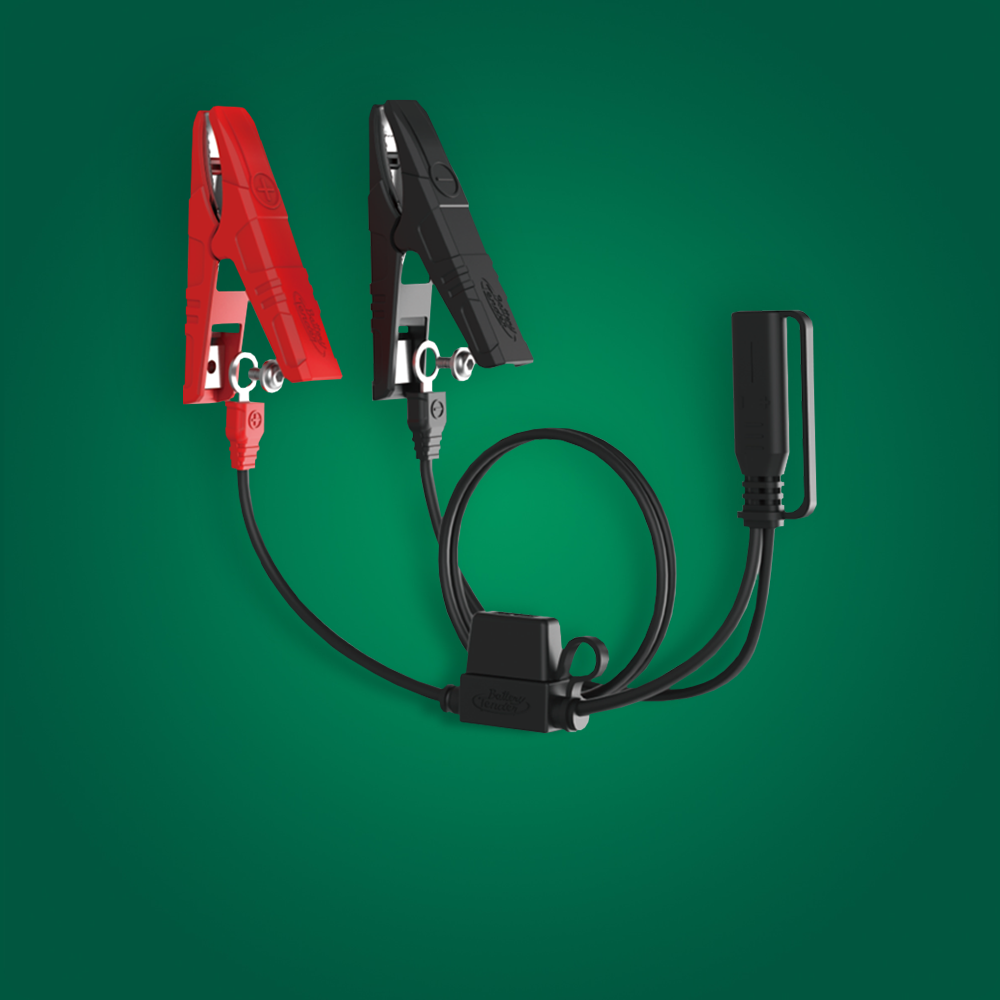
- Install ring terminal harnesses: Connect the ring terminal leads permanently to each battery's terminals (positive and negative). These stay attached to the battery at all times. The quick-disconnect connector at the other end of the harness makes connection and disconnection tool-free.
- Connect and verify: Plug the charger into the AC outlet, then connect each bank's output to the corresponding ring terminal harness. Verify that each bank's LED indicator confirms proper connection and begins the Initialization stage.
- Label each bank: Mark Bank 1 and Bank 2 cables with tags identifying which vehicle each serves. This prevents confusion when reconnecting after maintenance or vehicle movement.
Safety note: Always connect the charger to the battery before plugging the charger into the wall outlet. Disconnect in reverse order—unplug from the wall first, then disconnect from the battery. This sequence prevents sparking at the battery terminals. The National Fire Protection Association (NFPA) recommends maintaining at least 24 inches of clearance around charging equipment for ventilation and fire safety.
Why a Battery Tender 2-Bank Charger Outperforms Two Trickle Chargers
Some vehicle owners attempt simultaneous two-vehicle charging with inexpensive trickle chargers. This approach introduces real risk. A trickle charger delivers constant current regardless of battery state—it has no mechanism to detect when a battery reaches full charge and no ability to reduce or stop current flow. Left connected for days or weeks, a trickle charger will overcharge the battery, boiling off electrolyte in flooded lead-acid types and generating excessive heat in sealed AGM and GEL batteries.
Overcharging accelerates plate corrosion, warps internal grids, and can cause thermal runaway in extreme cases. According to battery industry data, chronic overcharging reduces battery lifespan by 30–50%. By contrast, ISM charging from Battery Tender maintains batteries indefinitely without overcharging, extending typical battery life from 2–3 years to 5+ years. Over two vehicles, that translates to roughly $200–$400 in avoided replacement batteries over a 5-year period—more than paying for the charger itself.
Temperature compensation adds another layer of protection that trickle chargers lack entirely. Nearly all Battery Tender chargers include temperature compensation to adjust for charging in extreme heat or cold. In a garage that drops to 20°F in January and climbs to 100°F in August, the voltage setpoint shifts accordingly—higher in cold (batteries need more voltage to reach full charge) and lower in heat (batteries reach full charge at lower voltage).
Scaling Beyond Two Vehicles: 5-Bank and 10-Bank Options
For owners who anticipate expanding beyond two vehicles, Battery Tender offers 5-bank and 10-bank chargers that apply the same independent ISM architecture at larger scale. The Battery Tender 5-Bank delivers 4A per bank with selectable 6V/12V chemistry—ideal for collector car garages with 3–5 vehicles. The Battery Tender 10-Bank scales to fleet and commercial applications, maintaining up to 10 batteries from a single unit.
Battery Tender 5-Bank 4A Selectable Charger
Starting with a 2-bank charger and understanding the independent-bank architecture makes the transition to larger multi-bank systems seamless. The installation principles—permanent ring terminals, labeled cables, central mounting, proper ventilation—remain identical regardless of how many banks are involved.
Frequently Asked Questions
Can a Battery Tender 2-bank charger charge two different battery types at the same time?
Yes. Each bank operates independently with its own ISM circuit. Bank 1 can charge a standard flooded lead-acid car battery while Bank 2 simultaneously charges an AGM motorcycle battery. Each bank adjusts its voltage and current output to match the specific battery connected to it, so different sizes, types, and states of charge are handled without conflict.
Is it safe to leave a 2-bank charger connected to two vehicles indefinitely?
Yes. ISM technology is specifically designed for indefinite connection. Once a battery reaches full charge, the charger enters Float Maintenance and delivers charge pulses only when voltage drops below the maintenance threshold. There is no constant current flowing into a fully charged battery, so overcharging cannot occur. Battery Tender chargers are safe to leave connected for weeks, months, or even years.
How long does a Battery Tender 2-bank charger take to charge two vehicles simultaneously?
Charge time depends on battery capacity and depth of discharge. Use the formula: (battery Ah × depth of discharge) ÷ charger amps = approximate hours. For a 60Ah car battery at 50% discharge on a 1.25A bank: (60 × 0.50) ÷ 1.25 = 24 hours. Both banks charge simultaneously, so two identical batteries at the same discharge level would both finish in approximately 24 hours—not 48.
Do I need two separate electrical outlets for a 2-bank charger?
No. A 2-bank charger plugs into a single standard 120V household outlet. The unit draws modest wattage—typically under 60W total—well within the capacity of any standard 15A or 20A residential circuit. This is one of the primary advantages over using two separate chargers, which require two outlets and consume more total energy.
Conclusion
A Battery Tender 2-bank charger solves the multi-vehicle maintenance challenge with a single device that charges two vehicles simultaneously using independent ISM circuits. Each bank delivers the full 4-stage charging process—Initialization, Bulk Charge, Absorption, and Float Maintenance—tailored to its specific battery, regardless of what the other bank is doing. For garage setups with two vehicles, this architecture eliminates charger swapping, prevents sulfation-related battery failures, and extends battery life well beyond the 2–3 year average that unmanaged batteries typically deliver.
Whether starting with a dedicated 2-bank unit or pairing two Battery Tender Plus chargers for maximum flexibility, the key is ensuring every stored or infrequently driven vehicle receives continuous ISM maintenance. Explore the full lineup of smart chargers and multi-bank solutions at the Battery Tender charger collection page.
Last updated: June 2026