






Classic Car Battery Care: Collectors Complete Guide (2026)
This classic car battery care collectors complete guide explains how to protect batteries in vehicles worth $20,000 to $500,000 or more using smart charging technology designed for long-term storage. Battery Tender® pioneered smart battery charging in 1989 and introduced the first consumer smart charger in December 1991, giving collector car owners a solution purpose-built for vehicles that sit weeks or months between drives. The key is Infinite Sequential Monitoring (ISM), a proprietary 4-stage charging process that prevents sulfation — the number one cause of battery failure in stored classic cars — while remaining safe for indefinite connection to vehicles in garages, barns, and climate-controlled storage facilities.
Whether a collection includes a single 1957 Chevrolet Bel Air with a 6-volt electrical system or a multi-car stable spanning decades from pre-war roadsters to 1990s sports cars, proper battery maintenance prevents costly damage and ensures every vehicle starts reliably when it matters most. A Battery Tender Plus charger costing $54.95 to $84.95 provides year-round protection backed by a 10-year warranty — an investment that amounts to less than 0.1% of most collector vehicles' appraised value. This guide covers everything from understanding vintage electrical systems to selecting the correct charger, connecting it safely, and maintaining battery health across entire collections.
Key Takeaways:
- Classic cars sitting 6–12 months lose approximately 5–10% of battery charge per month, leading to deep sulfation within 90 days
- Pre-1960s vehicles use 6-volt electrical systems requiring a dedicated 6V charger — a 12V charger will damage these batteries
- ISM 4-stage charging safely maintains batteries indefinitely without overcharging, boiling electrolyte, or damaging plates
- A $64.95 Battery Tender Plus with a 10-year warranty protects vehicles valued at $20,000–$500,000+
- Multi-bank chargers allow simultaneous maintenance of 2–10 collector vehicles from a single outlet
Why Classic Car Batteries Fail During Storage
Classic car batteries fail during storage primarily because of sulfation, a chemical process where lead sulfate crystals form on battery plates during discharge and harden into permanent deposits when left uncharged. According to research published by the Society of Automotive Engineers (SAE), sulfation accounts for approximately 80% of premature lead-acid battery failures. A fully charged 12V battery reads 12.6–12.8 volts at rest. After 30 days of sitting without a maintenance charge, voltage typically drops to 12.2–12.4V. After 90 days, it can fall below 12.0V — the threshold where sulfation begins causing irreversible damage.
For collector cars, the consequences extend beyond simple inconvenience. A dead battery that leaks acid can corrode irreplaceable wiring harnesses, damage original battery trays, and stain engine compartments in concours-quality restorations. Deep discharge also stresses original generators and voltage regulators in pre-alternator vehicles (generally those built before 1963), as these components must work harder to recharge a severely depleted battery. The electrical load during recovery charging can damage period-correct components that cost thousands of dollars to source and restore.
Parasitic draw compounds the problem. Even disconnected batteries self-discharge at a rate of 3–5% per month at 68°F (20°C). In connected vehicles, clocks, alarm systems, and electronic control modules in later classics can draw 20–50 milliamps continuously, draining a typical 60Ah battery in 50–120 days. Temperature extremes accelerate the process: self-discharge rates double for every 18°F (10°C) increase in ambient temperature, making unheated garages in warm climates particularly problematic.
Understanding 6-Volt vs. 12-Volt Classic Car Electrical Systems
Identifying the correct system voltage is the most critical step in classic car battery care for collectors. Most American vehicles manufactured before 1955 and many European cars built through the early 1960s use 6-volt positive-ground electrical systems. General Motors transitioned to 12V in 1955, Ford followed in 1956, and Chrysler completed the switch by 1956 as well. Connecting a 12V charger to a 6V battery will overcharge the battery, boil electrolyte, warp plates, and potentially crack the case — destroying an often hard-to-source component.
A fully charged 6V lead-acid battery reads approximately 6.3–6.4V at rest. A fully charged 12V battery reads 12.6–12.8V. Collectors can verify system voltage by checking the battery itself (three cells visible through the case = 6V; six cells = 12V) or by reading the voltage with a multimeter across the battery terminals. Some vehicles were converted to 12V by previous owners; always verify the actual battery installed rather than assuming based on year alone.
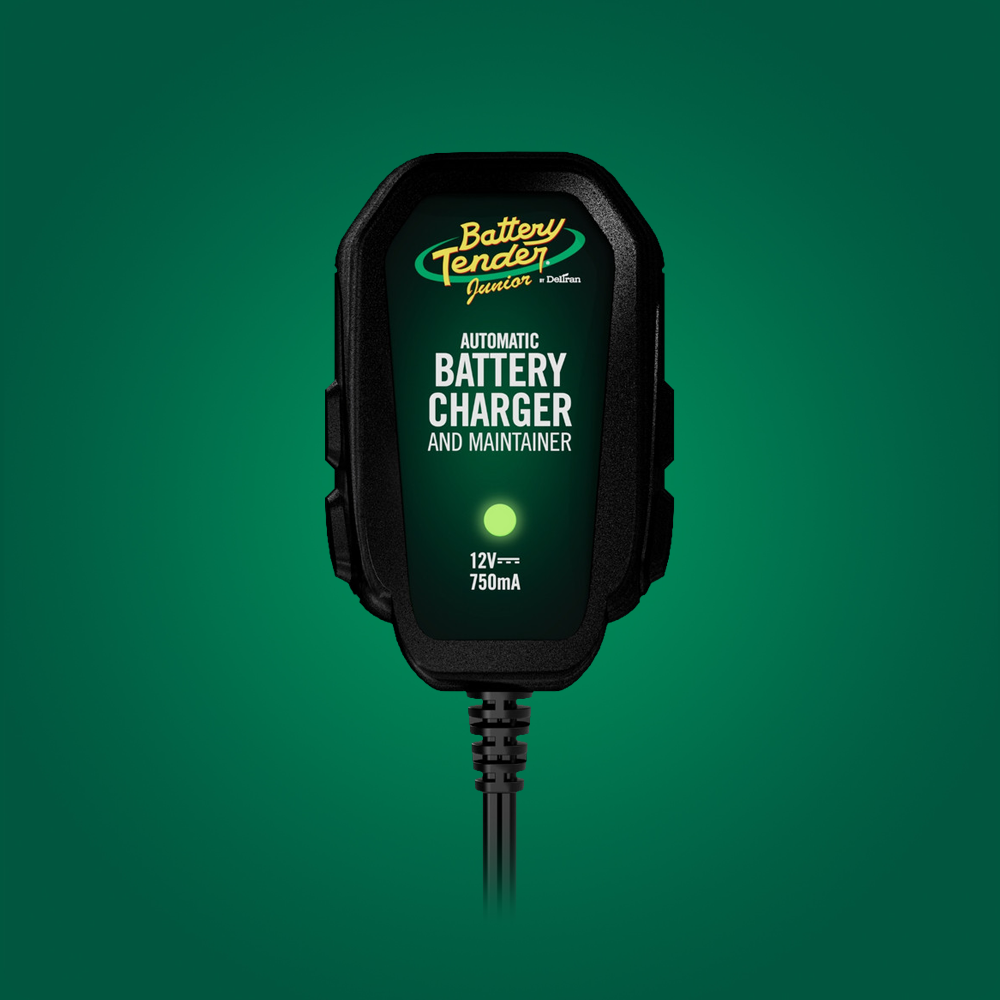
For collectors with pre-1960s vehicles, the Battery Tender Plus 6V 1.25A delivers the correct charging voltage at a gentle 1.25-amp rate that matches the smaller capacity of vintage 6V batteries, which typically range from 40Ah to 70Ah. The ISM technology automatically adjusts output through all four stages, making it safe for indefinite connection to these irreplaceable electrical systems.
Battery Tender Plus 6V 1.25A — $54.95
How ISM Technology Protects Collector Car Batteries Year-Round
ISM technology protects collector car batteries through a 4-stage automatic charging cycle that adjusts output based on real-time battery condition. Unlike trickle chargers that deliver constant current regardless of battery state — risking overcharge, electrolyte loss, and plate damage — ISM responds dynamically and can remain connected indefinitely without monitoring. This distinction matters enormously for collector vehicles that may sit for 6–12 months between events or pleasure drives.
The four stages operate as follows. Stage 1: Initialization tests the battery and applies gentle current to assess condition, verifying the battery can accept a charge safely before proceeding. Stage 2: Bulk Charge (constant current) delivers the full rated amperage — 1.25A in the case of the Battery Tender Plus — until the battery reaches approximately 80% state of charge. Stage 3: Absorption (constant voltage) holds voltage constant while tapering current, dissolving soft sulfate crystals that formed during storage. Stage 4: Float Maintenance monitors voltage continuously and delivers demand-responsive charge pulses only when voltage drops below the maintenance threshold.
Stage 3 is particularly valuable for collector cars. During the absorption phase, the controlled constant-voltage charge actively reverses early-stage sulfation that accumulated during weeks or months of sitting. Traditional float chargers skip this stage entirely, applying only constant voltage without the targeted absorption period needed to recondition sulfated plates. For a collector car battery that sat through an entire winter, this absorption stage can recover capacity that would otherwise be permanently lost.
Selecting the Right Charger for Your Classic Car Collection
Charger selection depends on three factors: system voltage, number of vehicles, and battery capacity. The charging time formula — (battery Ah × depth of discharge) ÷ charger amps = approximate hours — helps estimate recovery time. A typical 60Ah classic car battery discharged to 50% would require approximately (60 × 0.50) ÷ 1.25 = 24 hours on a 1.25A Battery Tender Plus charger. This gentle rate is ideal for older batteries with thinner plates that cannot tolerate high-amperage fast charging.
For collectors with both pre-1955 vehicles (6V) and later classics (12V), the Battery Tender Plus Selectable 6V/12V handles both system voltages from a single unit. A selector switch allows safe operation at either voltage, eliminating the need to own separate chargers and, more importantly, eliminating the risk of connecting the wrong charger to the wrong vehicle. At $84.95, it covers every collector car from a 1936 Ford to a 1996 Corvette.
Battery Tender Plus Selectable 6V/12V 1.25A — $84.95
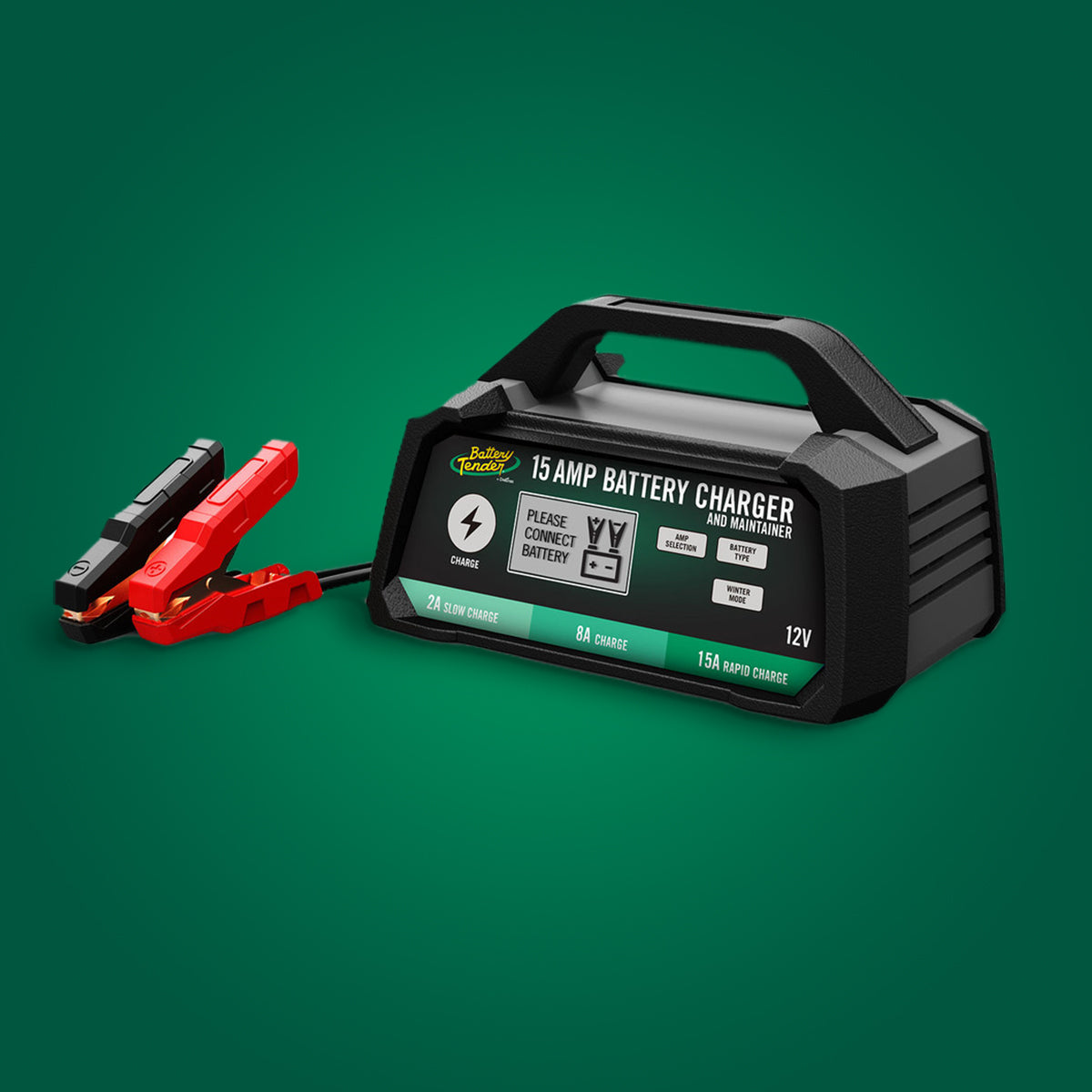
Collectors maintaining four or more vehicles should consider the Battery Tender 4-Bank charger, which provides four independent ISM charging channels from a single AC outlet. Each bank delivers 1.25A and operates independently, meaning one bank can be in bulk charge recovering a recently acquired barn-find battery while another bank maintains a concours car in float mode. At $234.95 for four channels, the per-vehicle cost of $58.74 is comparable to buying individual chargers while saving outlet space and simplifying garage wiring.
Battery Tender 4-Bank 1.25A Selectable Charger — $234.95
Step-by-Step: Connecting a Battery Tender Charger to a Classic Car
Proper connection protects both the charger and irreplaceable vehicle components. Follow these steps for safe installation on any collector vehicle.
Step 1: Inspect the battery. Check for cracked cases, bulging sides, corroded terminals, and low electrolyte levels. Clean terminal posts with a wire brush and baking soda solution (one tablespoon per cup of water). A battery with a cracked case or reading below 2V (6V system) or 4V (12V system) should be replaced rather than recharged.
Step 2: Identify system voltage and polarity. Verify whether the vehicle is 6V or 12V and whether it uses positive-ground or negative-ground wiring. Most pre-1955 American cars and many British cars through the 1960s use positive ground, meaning the positive terminal connects to the chassis. Consult the vehicle's service manual if unsure.
Step 3: Install the ring terminal harness. Every Battery Tender charger includes a ring terminal harness (also called a pigtail lead). Attach the red ring to the positive battery post and the black ring to the negative post. Route the quick-disconnect connector to an accessible location near the grille or fender well. This allows connection and disconnection without opening the hood — critical for cars with complex hood latches or fragile hinges.
Step 4: Connect and verify. Plug the charger's quick-disconnect into the ring terminal harness, then plug the charger into a grounded AC outlet. The LED indicator should show red (charging) initially, transitioning to green when the battery reaches full charge and enters float maintenance. If the charger flashes an error, the battery may have an internal short or be too deeply discharged for the initialization stage to accept.
Classic Car Battery Care Best Practices for Collectors
Beyond connecting a smart charger, several practices extend battery life and protect collector vehicle electrical systems during long-term storage.
Maintain electrolyte levels. Flooded lead-acid batteries — the type original to most classic cars — lose water through normal charging and evaporation. Check levels monthly and add only distilled water (never tap water) to maintain electrolyte 1/4 inch above the plates. Overfilling causes overflow during charging, spreading corrosive acid onto battery trays and surrounding components.
Apply terminal protectant. After cleaning and connecting ring terminals, apply a thin coat of dielectric grease or dedicated battery terminal protectant to exposed metal surfaces. This prevents corrosion from humidity and acid fumes without interfering with electrical contact at the terminal-to-ring interface.
Start and run periodically — but correctly. Starting a classic car for 30 seconds and shutting it off does more harm than good. Each start consumes approximately 3–5Ah from the battery, and the original generator or early alternator needs 20–30 minutes of running at moderate RPM to replace that energy. Short starts also introduce moisture into the engine oil and exhaust system without reaching operating temperature. If driving is not possible, maintaining the battery on a Battery Tender charger is more effective than periodic starting.
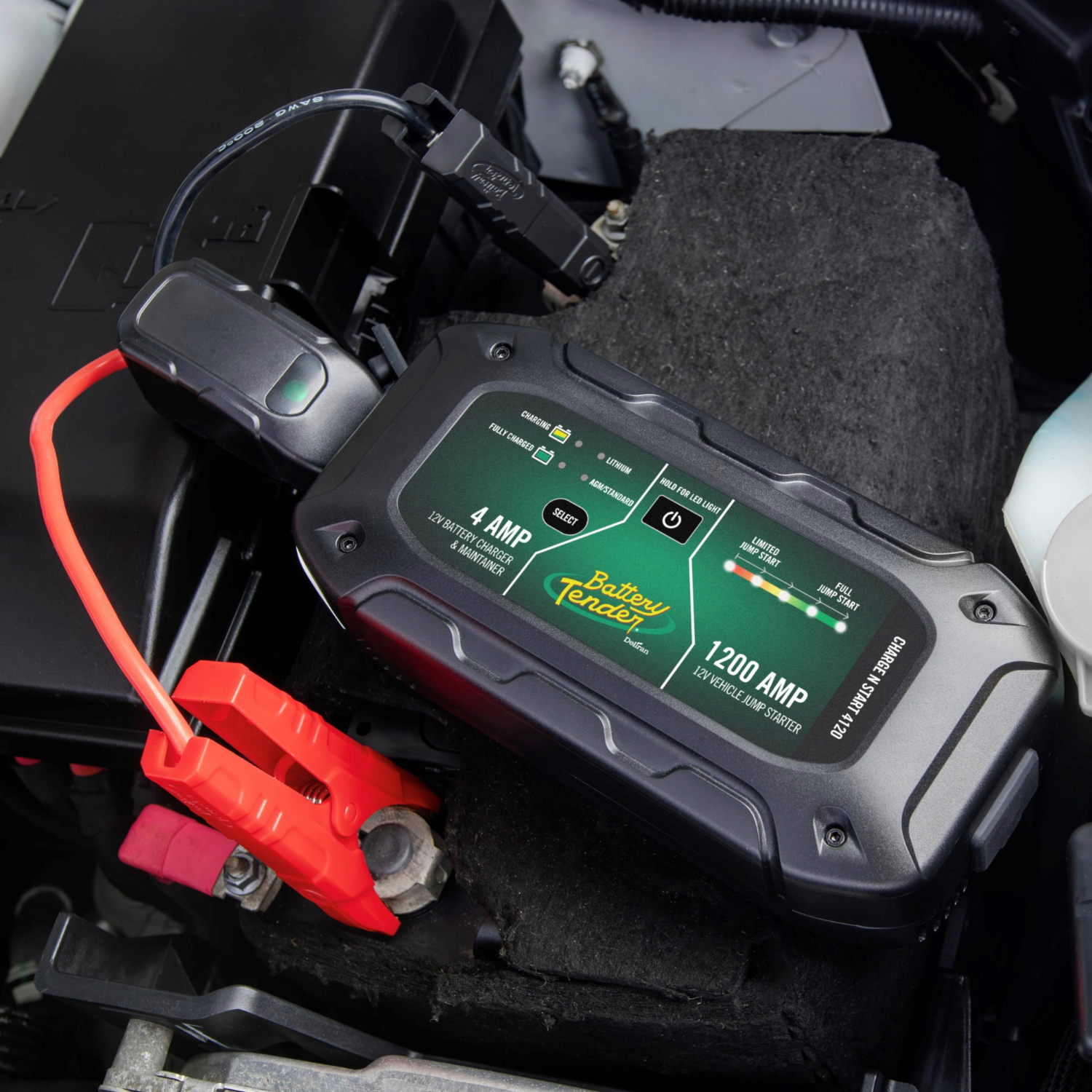
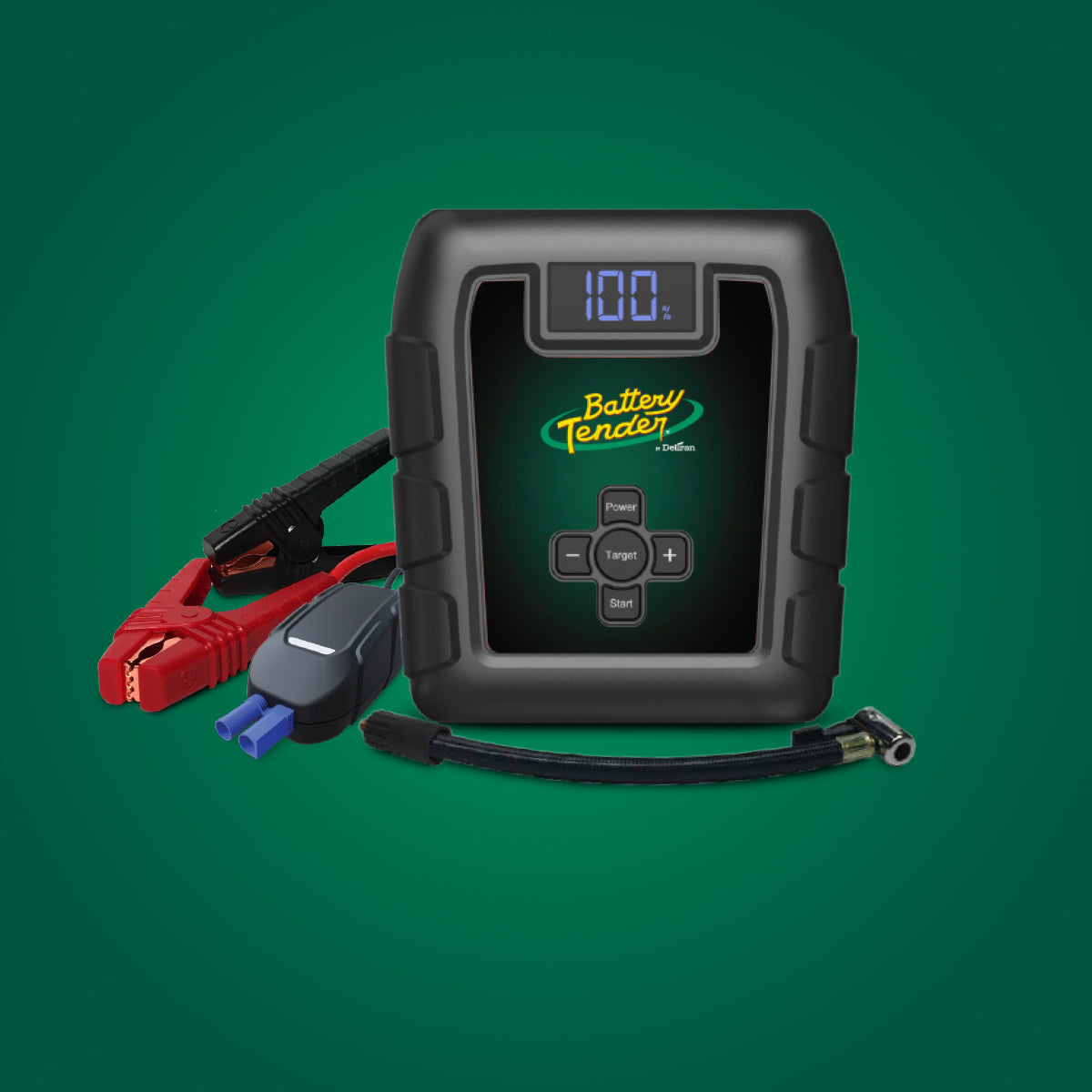
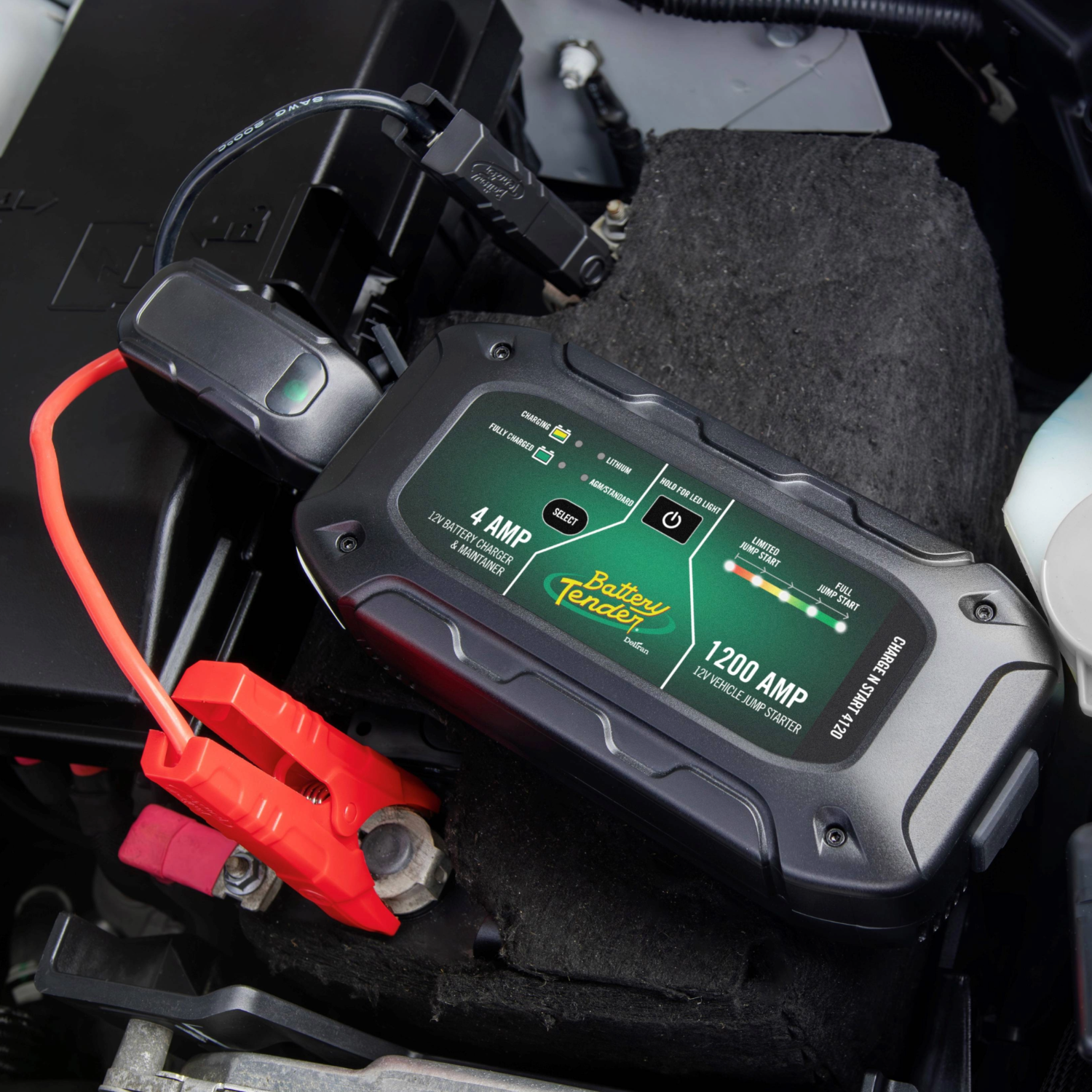
For collectors who also want the security of emergency starting capability, the Battery Tender Charge N Start 1100 combines a 1A smart charger with a 1,000-amp lithium-ion jump starter. The internal lithium-ion battery holds a charge for months via proprietary Charge N Store float maintenance, providing backup starting power for vehicles in remote storage locations without nearby AC outlets.
Battery Tender Charge N Start 1100 — 1A Charger + 1,000A Jump Starter — $139.95
Managing Battery Care Across a Multi-Car Collection
Collectors with five or more vehicles face a logistical challenge: providing reliable maintenance charging to every battery without running extension cords across the garage or overloading circuits. A dedicated charging station using multi-bank Battery Tender chargers solves this efficiently. The Battery Tender 5-Bank charger maintains five vehicles from a single 120V outlet, with each bank independently running its own ISM cycle. For larger collections, the Battery Tender 10-Bank handles ten vehicles simultaneously with selectable 6V/12V operation per bank at 4A per channel.
Electrical planning matters. A 5-Bank charger drawing 1.25A per bank consumes approximately 6.25A total at peak — well within a standard 15A household circuit. A 10-Bank at full output draws approximately 12.5A. Avoid sharing circuits with compressors, dehumidifiers, or other high-draw equipment. Installing a dedicated 20A circuit for charging infrastructure is a worthwhile investment for serious collections.
Label every ring terminal harness with the corresponding vehicle name or bay number. Color-coded quick-disconnect covers and numbered tags prevent the costly error of connecting a 12V charger output to a 6V vehicle. On selectable-voltage multi-bank units, verify each bank's voltage setting before connecting a new vehicle.
Frequently Asked Questions
Can a Battery Tender charger be left connected to a classic car all winter?
Yes. ISM technology makes Battery Tender chargers safe for indefinite connection. During Stage 4 float maintenance, the charger delivers demand-responsive pulses only when battery voltage drops below the maintenance threshold. There is no constant current flowing, which eliminates the overcharging, electrolyte boiling, and plate damage caused by traditional trickle chargers. Thousands of collector car owners leave Battery Tender chargers connected for 6–12 months of winter storage annually.
How do I know if my classic car has a 6-volt or 12-volt electrical system?
Check the battery itself: a 6V battery has three filler caps (three cells at 2.1V each), while a 12V battery has six. Alternatively, use a multimeter across the terminals — a charged 6V battery reads approximately 6.3V, and a 12V battery reads approximately 12.7V. Most American cars switched to 12V between 1955 and 1956, but always verify the installed battery since previous owners may have converted the electrical system.
Will a 1.25-amp charger damage a small classic car battery?
No. A 1.25A charge rate falls well within safe parameters for classic car batteries, which typically range from 40Ah to 70Ah capacity. The general guideline is that charge current should not exceed 10% of battery capacity, meaning a 40Ah battery can safely accept up to 4A. At 1.25A, the Battery Tender Plus provides a gentle charge that is particularly well-suited to older batteries with thinner plates and decades-old construction.
What is the best charger for a collection with both 6V and 12V classic cars?
The Battery Tender Plus Selectable 6V/12V at $84.95 handles both voltages from a single unit via a manual selector switch. For collectors maintaining four or more vehicles, the Battery Tender 4-Bank or 5-Bank charger provides independent ISM channels, each configurable for 6V or 12V operation. This allows simultaneous maintenance of mixed-voltage collections without purchasing separate chargers for each voltage.
Conclusion
This classic car battery care collectors complete guide demonstrates that protecting a valuable collection starts with understanding voltage requirements, selecting the correct ISM-equipped charger, and maintaining consistent charging discipline during storage. Sulfation destroys more classic car batteries than any other factor, and the 4-stage ISM process from Battery Tender directly prevents it through intelligent, demand-responsive maintenance charging that remains safe for year-round connection. From a single pre-war 6V roadster to a 20-car collection spanning every decade, the right Battery Tender charger delivers reliable protection at a fraction of the cost of a single replacement battery — let alone the value of the vehicles it protects.
Explore the full lineup of classic car charging solutions at Battery Tender Classic Cars.
Last updated: 2026