



Faq's and support
Battery Education
Battery Basics & Care
Understanding how batteries work helps you protect your investment and avoid unexpected failures.
What causes vehicle batteries to die over winter?
When a vehicle sits unused, its battery naturally loses charge through self-discharge — typically 2–5% per month at room temperature. Cold temperatures accelerate this. Modern vehicles also draw a small parasitic current even when off (alarm systems, computers, key fobs). A battery left in this state long enough undergoes sulfation — lead sulfate crystals harden permanently on the battery plates — which cannot be reversed. A Battery Tender® maintainer connected during storage prevents all of this by continuously offsetting the discharge and keeping the battery at 100%.
What is battery sulfation and why is it the #1 cause of battery failure?
Sulfation occurs when a lead-acid battery is left in a discharged or partially discharged state. Lead sulfate crystals harden permanently on the battery plates — think of it like concrete: once it transitions from a liquid to a solid state, it cannot be undone. Hardened sulfation permanently reduces the battery's ability to accept and deliver charge, and no charger can reverse it. Prevention through continuous float maintenance is the only real solution. A Battery Tender® maintainer keeps the battery at 100%, preventing sulfation from forming.
What is ISM — Infinite Sequential Monitoring™ — and why does it matter?
ISM is Battery Tender®'s proprietary charging algorithm used in every charger. Unlike basic chargers that deliver constant current regardless of battery state, ISM continuously monitors battery voltage and moves through four stages automatically: Initialization (health check), Bulk Charge (full-rate charging), Absorption (current tapering as the battery approaches full), and Float Maintenance (micro-current that offsets self-discharge indefinitely). ISM is what makes Battery Tender® chargers safe to leave connected for months — even years — without battery damage.
What does "float maintenance mode" mean?
Float maintenance is the fourth and final stage of ISM charging. Once the battery reaches 100% charge, the charger drops to a very low maintenance current that precisely offsets the battery's natural self-discharge rate. If battery voltage drops from parasitic loads or cold, it automatically resumes charging and returns to float. This is fundamentally different from a trickle charger, which delivers constant current regardless of battery state and will overcharge a battery left connected for weeks.
What voltage indicates a fully charged 12V battery, and how does temperature affect it?
A fully charged 12V lead-acid battery measures approximately 12.6–12.8V at rest. At 12.4V the battery is about 75% charged; at 12.0V around 50%; below 11.8V it is considered discharged. Temperature significantly affects performance: a battery at 0°F (-18°C) has roughly 40–50% of its room-temperature capacity. Battery Tender® chargers include automatic temperature compensation — adjusting charge voltage upward in cold to ensure a complete charge and downward in heat to prevent overcharging.
What is the difference between flooded, AGM, GEL, and Lithium batteries?
Flooded lead-acid — the most common and least expensive type found in most cars and trucks. They require occasional water top-offs and vent hydrogen gas during charging. AGM (Absorbed Glass Mat) — electrolyte sealed in glass mat separators, spill-proof and vibration-resistant. GEL — excellent for deep discharge but sensitive to high charge rates. Lithium (LiFePO4) — lighter, faster to charge, longer cycle life than lead-acid but requires a charger specifically designed for lithium chemistry. Most Battery Tender® Multi-Chemistry models support all four types — check your specific model for compatibility.
Does leaving a battery in a discharged state for a long time damage it permanently?
Yes — a battery left deeply discharged for an extended period will likely suffer permanent sulfation damage. The longer the battery sits discharged, the more irreversible the damage. Even batteries at partial charge (50–75%) degrade significantly faster than those maintained at full charge. The single most effective thing you can do to extend battery life is keep it fully charged at all times — which is exactly what a Battery Tender® maintainer does.
What does "cold cranking amps" (CCA) mean?
Cold Cranking Amps measures a battery's ability to start an engine at 0°F (-18°C) for 30 seconds while maintaining adequate voltage. Higher CCA means more starting power in cold conditions. As a battery ages, sulfation reduces its effective CCA even if it still holds a surface charge. The Battery Tender® 12V/6V Battery Tester performs a load test that accurately assesses whether your battery still has sufficient CCA to reliably start your vehicle.
How do you connect batteries and chargers in series and parallel?
Learn all about connecting batteries in series and parallel at batterytender.com/series-parallel.
How is the Battery Tender® Junior battery charger different from a trickle charger?
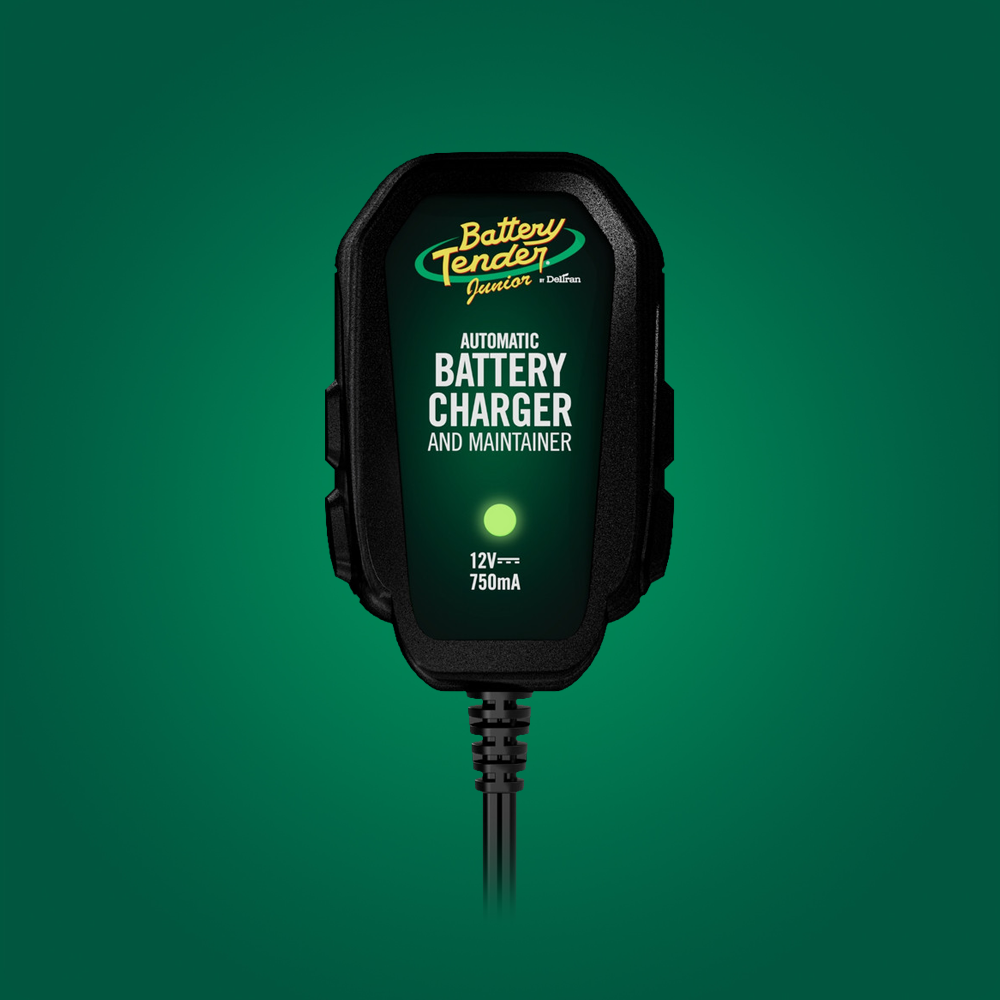
The Battery Tender® Junior battery charger has microprocessor controlled power electronic circuitry which enables it to preform and safely control a number of sophisticated charging functions, well beyond the capability of inexpensive trickle chargers. Some legacy marketing literature refers to the Junior as a “Trickle Charger with a Brain”. That description was based in context on two parts, first the relatively low output current, and second, the reduced level of charge control sophistication on earlier Junior models relative to the Plus. Since mid-2006 the only major functional difference between the Junior and the Plus is the maximum amplitude of the charger current, 0.75 and 1.25 amperes, respectively. Even though the marketing description may still be applicable, again, in a limited context, we can say now that the Junior has a larger brain that enables it to create maximum charge effectiveness with minimal output current amplitude.
After connecting the Junior to a battery and then applying AC power, it first conducts a number of checks during Initialization Mode to ensure that the battery functioning normally. Then it will deliver its full charge at a constant rate of 0.75 amperes. This is called the Bulk Charge Mode. The battery voltage will rise and when it reaches a predetermined level the Junior will hold the battery charge voltage constant at that level, allowing the charge current amplitude to drop. This is the Absorption Charge Mode. The Absorption Charge Mode is complete when the battery charge current drops below a very low value, usually below 1/8 ampere. Some Junior models have timers to limit the duration of the Absorption Charge Mode.
After the current drops or the allotted time expires (typically several hours), the Junior automatically switches to a Float / Maintenance Charge Mode. The purpose of the Float / Maintenance Charge Mode is to maintain the battery voltage just slightly (typically between 1/10 and ½ volt) above where it would be if it were fully charged and sitting at rest. This keeps the battery topped off at voltages well below the gassing voltage of a lead acid battery.
Based on price alone, trickle chargers often appear to be a better economic choice for the typical consumer, but trickle chargers do not have the advantage of sophisticated electronic control. Therefore, as they allow the value of charge current to trickle down to what appears to be safe levels, the output voltage of the charger may very well rise to an unacceptably high level, sometimes even going higher than 16 VDC depending on the charger type and the battery that is connected to it. This magnitude of voltage is far above the gassing voltage of a lead acid battery. If the battery remains connected to this high level of voltage for an extended period of time, extreme damage may be done to the battery. Without Battery Tender® type electronic safety controls, what appears to be an initial cost savings for the charger may actually cost several times the charger price in replacement batteries.
Is the Battery Tender® Junior battery charger more expensive than a trickle charger?
There is a good chance that the Battery Tender® Junior. will cost no more or maybe even less than some trickle chargers presently on the market. Even if the Battery Tender Junior. does cost more, it will not be much more. With the performance improvements designed into the Junior since 2006, the total cost of ownership should be much less. The Junior is now essentially a lower power version of the Battery Tender® Plus. Considering that you will avoid the likely dramatic reduction in battery life resulting from using a trickle charger, the Junior will more than make up the difference in price by extending the useful life of only one engine start battery. The Battery Tender Junior. comes with a 5 year limited warranty.
Buying Guide
Choosing the Right Charger
Any Battery Tender® charger is safe for any compatible battery — ISM ensures even high-output models protect small batteries. The choice is primarily about recovery speed.
Which Battery Tender® charger is right for my vehicle?
Key principle: ISM makes every charger safe on any compatible battery regardless of size — higher output just means faster recovery. Chargers work "down": any higher-output model covers everything below it.
- Motorcycles, ATVs, scooters, powersports, lawnmowers, PWC: Junior 750mA or Junior Multi-Chemistry 1A (for Lithium) — the Plus 1.25 Amp also works great for both powersports and car storage
- Cars, compact SUVs, sedans (up to 80Ah): Battery Tender® Plus 1.25 Amp for storage; PowerTender® 3–5 Amp for faster recovery
- Full-size trucks, large SUVs, RVs, marine (80–200Ah): PowerTender® 5–10 Amp
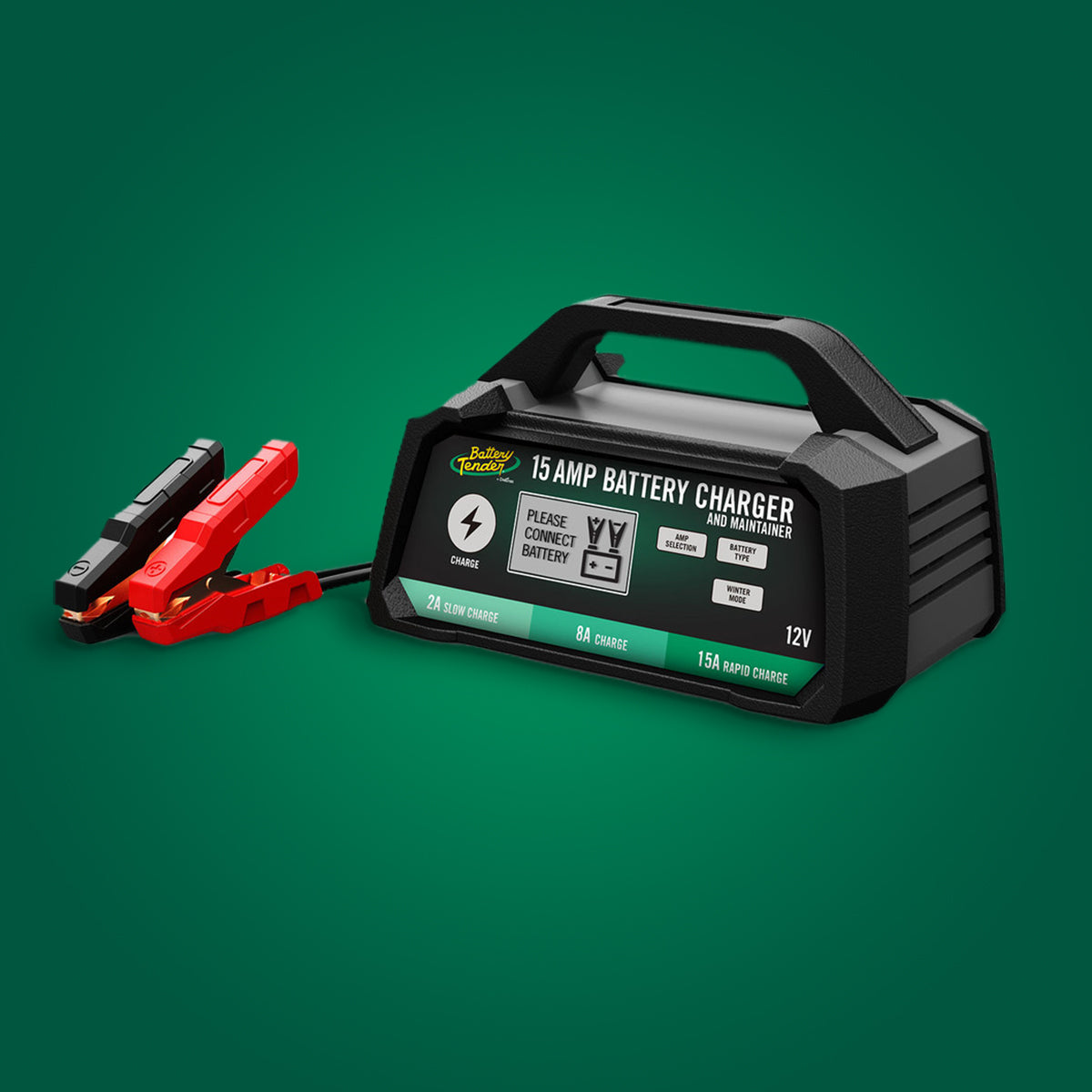
- Heavy-duty diesel, large commercial (200Ah+): PowerTender® 15 Amp
- Classic cars (6V): Plus 6V 1.25 Amp; or any 3–5 Amp PowerTender® with 6V/12V switching
- Golf carts (36V or 48V): PowerPlus 36V or PowerPlus 48V
- Multiple vehicles: 2-Bank, 4-Bank, 5-Bank, or 10-Bank
What is the difference between the Junior, Plus, and PowerTender® lines?
All three lines use the same ISM 4-stage algorithm and are safe for indefinite connected storage. The Junior (750mA–1 Amp) is sized for small powersports batteries. The Plus (1.25 Amp) handles most automotive batteries up to 80Ah — the flagship with a 10-Year warranty, equally capable on powersports storage. The PowerTender® line (3–15 Amp) is for larger batteries, faster turnaround, and commercial applications. All include spark-proof connections, reverse polarity protection, and automatic temperature compensation.
What does the Amp output rating on a charger mean?
Amp output is the rate of current delivery during the bulk charging phase. A 60Ah battery depleted to 50% would take approximately 30 hours on a 1 Amp charger, 6 hours on a 5 Amp charger, and 4 hours on an 8 Amp charger. All Battery Tender® chargers enter float maintenance automatically — so Amp rating affects recovery speed, not safety. Thanks to ISM, even high-output chargers are safe on the smallest batteries.
Does my battery chemistry affect which charger I need?
Yes — particularly for Lithium (LiFePO4) batteries. Standard lead-acid chargers deliver a different float voltage than lithium requires. Battery Tender® Multi-Chemistry models (like the Junior Multi-Chemistry) switch between lead-acid and lithium modes via a selector. For flooded, AGM, and GEL batteries, any standard Battery Tender® charger is appropriate. Always check the battery label and set the correct mode before connecting.
Can I use one charger for both my modern 12V car and my classic 6V vehicle?
Yes — the ideal choice is any Battery Tender® PowerTender® in the 3–5 Amp range with both 6V/12V voltage switching and full Multi-Chemistry selection. The 3 Amp, 4 Amp, and 5 Amp 12V/6V models support both voltage systems and all battery chemistries — one charger handles any battery in your collection. Always confirm the correct voltage setting before connecting.
How do I charge a battery that has been completely dead for months?
If the battery is simply deeply discharged but has not yet developed significant sulfation, connecting a Battery Tender® charger will begin restoring capacity. The key variable is how long the battery has been discharged. Sulfation begins forming within days of a battery dropping below full charge and becomes increasingly permanent over time. If the charger's LED does not illuminate within a few minutes of connection, the battery likely has extensive permanent damage and should be load-tested or replaced. Prevention is always more effective — connect a Battery Tender® before the battery reaches deep discharge.
How are the BatteryTender® Plus and Junior battery chargers different from other automatic battery chargers?
Many automatic battery chargers simply turn off when the battery voltage rises to a preset level or when the charge current falls below a certain level. With the battery sitting idle, its internal losses will consume much of its stored charge. Depending upon the age and condition of the battery, it may only take a couple of months before the battery loses more than 90% of its charge. The amount of charge lost tracks pretty well with the reduction in battery terminal voltage.
Some automatic chargers will restart when they sense that the battery voltage is too low. As a battery goes through these types of cycles of repeated charging and idle self-discharge to low capacity levels, the useful battery life may be dramatically reduced.
Both the BatteryTender Plus & Junior battery chargers do not turn off after they charge the battery. They automatically switch to a safe float voltage level that keeps the battery charged and yet does not do any harm to the battery. In fact, in most cases, this type of charge maintenance will extend the battery’s useful life by at least 50%.
Some customers have reported battery life increases of more than double what they had before using the Battery Tender Plus or Battery Tender Junior battery chargers.
Is the Battery Tender® Plus battery charger more expensive than a trickle charger?
In simple terms, comparing only the “off-the-shelf”, retail price dollars, probably yes. However, in terms of the total cost of ownership, including the likely dramatic reduction in battery life resulting from using a trickle charger, then the answer is ABSOLUTELY NO. The Battery Tender® Plus will more than make up the difference in price by extending the useful life of only one engine start battery. Multiply this savings over the 10 year Deltran warranty period and you will save enough in battery cost to more than pay for the Battery Tender® Plus battery charger.
How long can I leave the Battery Tender® Plus battery charger connected to a battery?
In theory, you can leave the Battery Tender® Plus battery charger connected to a battery forever. That’s a really long time. Sales people like to say, “Just plug it in and forget about it!” However, practically speaking, it is a good idea to check on the battery at least once every couple of weeks. Strange things can happen. Sometimes a battery can have a weak cell that won’t show up until the worst possible time. Of course, that time is usually when the battery is connected to a charger, and you are out of town on vacation.
If something goes wrong, then you have to deal with the question of the chicken and the egg. Which came first? Did the battery fail because it was connected to the charger or did the charger fail because it was connected to the battery? Good luck sorting that one out.
With a battery and a charger connected together, it’s a much better idea to be proactive and anticipate problems, however unlikely they may be. In more than 99.9% of cases, nothing will go wrong. That still leaves about 0.1% where something might. Learn to respect electricity. A little common sense can go a long way.
Also consider this. No matter how good a product is, anything can break. In fact, everything will break, eventually. There are only 2 questions to be answered. 1) When will it fail? & more importantly 2) How will it fail? If a product is designed and built well, a manufacturer will set a long warranty period, usually several years, to support that notion. Deltran, and other responsible manufacturers, invest a tremendous amount of time, effort, and money to ensure that their products will fail in a relatively safe manner. For electronic products, at the very least that means no electrical shock or fire hazard.
The Battery Tender® Plus battery charger has a 10 year limited warranty, which is unprecedented among battery charger manufacturers. And it is listed with Underwriter’s Laboratories to comply with both US and Canadian electrical product safety standards for battery chargers used with engine start batteries.
Can the Battery Tender® Plus battery charger be used to charge more than 1 battery simultaneously if the batteries are connected in series?
Yes, but series connections have more restrictions than parallel connections. A series connection means that positive post of one battery is electrically connected to the negative post of the next battery, and the positive post of that battery is connected to the negative of the next battery and when all the connections are made, the positive post of the last battery and the negative post of the first battery becomes the connection point for the entire battery pack. The voltage of a series connected battery pack is sum of the voltage of each battery in that pack. So if two 6 volt batteries are connected in series, then the voltage of the battery pack is 12 volts.
There are more restrictions on charging battery packs connected in series than there are for parallel connected battery packs. The nominal battery voltages (i.e. 12V, 8V, 6V, 4V, 2V) must be the same on each battery, and the batteries must be the same lead acid type (flooded, AGM, or Gel Cell). Also the batteries must be close to the same size in terms of amp hour capacity, and they must be close to the same level of discharge. It is also a good idea that the batteries be approximately the same age and that they be in relatively the same general condition.
If all 4 of these conditions are met, and if the total voltage of the pack is 12 volts (or 8 volts, or 6 volts depending upon the Plus model), then yes, the Battery Tender Plus battery charger can be used to charge more than 1 battery simultaneously when those batteries are connected in series. This will not work if the total battery voltage is greater than the voltage of the Battery Tender Plus (12V, 8V, or 6V).
Can the Battery Tender® Plus battery charger be used to charge more than 1 battery simultaneously if the batteries are connected in parallel?
Yes, but with restrictions. A parallel connection means that positive posts of each battery are electrically connected together and the negative posts of each battery are electrically connected together. The voltage of a parallel connected battery pack is exactly the same as the voltage of each battery in that pack.
If the nominal battery voltages (i.e. 12V, 8V, 6V) are the same on each battery, and if the batteries are the same lead acid type (flooded, AGM, or Gel Cell), then yes, the Battery Tender® Plus battery charger can be used to charge more than 1 battery simultaneously when those batteries are connected in parallel. Just remember that 2 batteries in parallel behave like one large battery. The charge storage capacity of each battery simply adds together. Two 12 volt batteries, each with 25 amp hour capacities, will look like one 12 volt battery with a 50 amp hour capacity. You may be able to charge more than 1 battery simultaneously, but it will take longer
Can I leave the Battery Tender Plus® battery charger connected to a battery while I’m using the battery to power another appliance like a radio?
Actually, this is basically the same situation that exists by default on many of today’s complex, computer controlled vehicles that have a wide range of on-board electronic devices, many of which consume electric power even when the vehicle is not running. So the short answer is ‘Yes, you can leave the Battery Tender Plus battery charger connected to a battery even when it is being used to provide power to another appliance. However, this is definitely not a simple yes or no type of question. There are definitely some things to consider that may limit this type of usage.
Think about how consumer electronic products are used and consequently, how they are designed. To keep the price low and competitive, it is important to limit the battery charger applications to a realistic, manageable portion from the vast number of ways in which a battery charger may be used.
The simplest applications involve charging and maintaining vehicle engine start batteries. The advantage in this application is that there is almost always another, larger source of electric power to charge the battery while the vehicle is running. So the off-line engine start battery charger need not normally supply the full amount of charge stored by the battery. One common exception would be when the vehicle battery is drained because lights were left on.
The point is that the engine start battery charger is not normally expected to deliver its maximum charge current for extremely long, extended periods of time.
Is there any danger that the Battery Tender® Plus battery charger can cause any damage to other automotive electronic systems while it is connected to the battery in my automobile?
No. As long as the automotive electronics system is functioning properly, there should be no problem. Typical automotive electronic systems run on the alternator output of approximately 14 to 15 volts. The maximum charge voltage output of the Battery Tender® Plus battery charger is in the same range and less than 15 volts. For the majority of the time, the Battery Tender® Plus will be operating in float / maintenance mode so the maximum voltage output will be less than 14 volts.
How is the Battery Tender® Plus battery charger different from the Battery Tender battery charger?
OVERVIEW and COMPARISON: The Battery Tender and Battery Tender Plus battery chargers are both designed to provide a quick, economical means to recharge motorcycle and engine start batteries used in other power sports equipment. Typically, power sports engine start batteries are in the 12 Ah to 20 Ah capacity ranges. Both chargers are constant voltage type with precisely regulated output current limits. Both chargers have a regulated, nearly constant 1.25-ampere output charge current during the bulk charge phase. Physically, there is virtually no difference between these 2 chargers. Both the Battery Tender and the Battery Tender Plus operate in 3 charge modes, bulk charge, absorption charge, and float charge.
Both the Battery Tender® and the Battery Tender® Plus are 4-step chargers meaning that they operate in 4 charge distinct modes: initialization, bulk charge, absorption charge, and float / maintenance charge. The legacy marketing literature and the operating instructions do not identify the original Battery Tender® as having an initialization mode. Therefore there is a lot of old literature that refers to Battery Tender® chargers as 3-step chargers. However the basic initialization functionality was present but there was no LED status indication; the Battery Tender® simply would not allow output voltage to activate unless a battery was properly connected to the charger. The Battery Tender® Plus does have an LED indication to indicate a faulty battery connection, which, with a little extra software and battery checks, completes the mechanization of ‘initialization’, the 4th charging step, even though time sequentially it is actually the 1st step.
RECHARGING AGM BATTERIES: The Battery Tender® has an absorption charge mode, but the the Battery Tender® Plus has a different absorption mode maximum charge voltage and a timer to hold the absorption voltage longer. These specific changes were made to accommodate the charging requirements of Absorbed Glass Mat (AGM) style lead acid batteries.
Can the Battery Tender® Plus successfully perform the initial charge on a new, flooded, motorcycle battery?
Background: The motorcycle dealers receive batteries from the manufacturer in a dry state. The plates are dried out, and there is no acid in the cell compartments. (Do not confuse this with a dry-cell battery.) The dealer must fill the individual battery cells with acid and then put them on a shop charger to pre-charge prior to selling them to a customer. As the batteries arrive from the manufacturer, the plates are approximately 80% "formed". The initial pre-charge, post-formation charge, or more correctly, formation-finishing charge, must be conducted at a specific power level and for a specific time period. Each manufacturer has its own recommendations, for example one manufacturer recommends that the charger deliver a constant current equal to 10% to 15% of the battery amp-hour capacity and that the charge current be applied to the battery for a period of 5 to 10 hours.
Answer 1) Certainly if the dealer has properly pre-charged the battery after filling it with acid, then the answer is ABSOLUTELY YES.
Answer 2) If the dealer has not properly pre-charged the
newly filled battery prior to the sale, then the answer is YES, WITH SOME QUALIFICATIONS:
Qualification A) The Battery Tender® Plus should be left on the new battery for a minimum of 24 hours on float, in addition to whatever amount of time it takes for the charger to get to the float stage. It is not clear how to correlate the 80% formed plates with a given state of charge once the cells are filled with acid. To be safe, assume that the batteries require a full 100% charge after the cells are filled.
For example, a 16 Ah battery will take about 13 hours to get to the absorption voltage (constant 14.4 Volts). It may take another 6 to 8 hours to reach the float voltage (constant 13.2 Volts). This may sound awkward; because what happens is that the battery charge current drops while the absorption voltage is held constant. When the battery current drops to 0.1 amp, or if 6 to hours have elapsed at the absorption voltage, the charger automatically switches its output from 14.4 V to 13.2 V. So it may take the better part of 20 hours to reach the float stage. Add another 24 hours to that and you are at 44 hours. Throw in another 4 hours for good measure and you get a nice round, even 48 hours, or 2 days.
Qualification B) Although there are probably several charging methods that will be equally effective, regardless of who manufactures the battery, in the interests of technical consistency, they will not officially sanction any initial charging method other than those published in their technical applications literature.
How can the Battery Tender® Plus battery charger that is rated at 1.25 amperes recharge a battery as fast as another charger that is rated at 3 amperes?
Short Answer:
Deltran’s claim that the 1.25 amp Battery Tender Plus battery charger will charge a battery in the same amount of time as a typical 3 amp charger is based on the fact that the Battery Tender Plus charge current is very nearly constant during the bulk charge period, while a typical 3 amp charger, configured like so many chargers on the market, is not.
Detailed Answer:
You would think that a 3 amp charger would recharge a battery roughly 3 times faster (actually only 2.4 times faster) than a 1.25 amp charger. There are 2 main reasons why this is not true.
First, the way a battery reacts to charge current is complex. The simplest approximate calculations for recharge time only work for about the first 75 or 80% of the charge and only if the charge current is nearly constant. Returning the last 20 to 25% of the charge to the battery is also a complex and time consuming process. It may very well take as long to return the last 20% of the battery charge as it took to return the first 80%.
Second, and just as important, is the way that battery charger manufacturers rate the output current of their charger products. Let’s say that the 3 amp rating is based on a peak current value during the initial charge phase and the 1.25 amp rating is nearly constant for entire time that it takes to return 80% of the battery charge. Let’s also say that the 3 amp current only exists long enough to return 10% of the battery charge and then it tapers down to 1 amp for the next 70%.
The dimensions or units describing electrical charge are the Coulomb or, more conveniently in the context of battery charging, the Amp-Hour. The abbreviation for amp hour is Ah.
A battery charger delivers charge (amp-hours) to the battery by using an electrical current (Amps) at its output over a period of time (Hours). The numerical product of the electrical current and time period is the amount of charge delivered. This is true in a general sense for any charger.
Now let’s do some math. For a 100 Ah battery, 10% = 10 Ah, 70% = 70 Ah, and 80% = 80 Ah.
10 Ah / 3 A = 3.3 Hours, 70 Ah / 1 A = 70 Hours, So this particular 3 amp charger takes 73.3 hours to return 80% of the charge to a 100 Ah battery that was fully discharged.
80 Ah / 1.25 A = 64 Hours, so a nearly constant 1.25 amp charger (that would be the Battery Tender® Plus) takes only 64 hours to return 80% of the charge to a 100 Ah battery that was fully discharged.
Marketing and sales people like big performance numbers because they believe that those numbers enhance the perception of value. The truth is that the best value for a battery charger should be based on the total cost of ownership for both the charger and the batteries that it is charging and maintaining. If a charger has a smaller output current rating, but recharges the battery in less time, and if it maintains the batteries in a full state of charge by employing a float / maintenance function those are both good things help to make the batteries last longer. Of course, the Battery Tender® Plus does both of those things very well.
What happens if the AC power is removed from the Battery Tender® Plus battery charger while it is connected to a fully charged battery?
If the battery is fully charged, then the Battery Tender Plus battery charger’s green light will be on. Once the AC power is removed from the Battery Tender Plus battery charger, the green light will go out and the charger not have any effect on the battery. The Battery Tender Plus battery charger is protected from reverse current, so it will not discharge the battery. Of course, like we said earlier when discussing nominal voltage mismatches between a battery and a charger, the battery will not be recharged either.
When AC power is restored to the Battery Tender Plus battery charger, it will restart its charge cycle. The sequence of events should go something like this. The red light will come on for a few minutes. Then the green light will start flashing while the red light stays on. The next thing that happens is what may confuse some people who use the Battery Tender Plus battery charger. Remember, the battery was fully charged, so you may ask, “Why doesn’t the green light just come right back on?”
The reason that the green light doesn’t come on immediately is that when the charger first comes on, the battery is sitting there, fully charged, at a voltage of about 12.9 volts. The charger immediately tries to bring the battery voltage up to about 14.5 volts. This takes a finite amount of time, although it should only be a few minutes if the battery is fully charged. Then, when the battery reaches 14.5 volts, the charger will hold it there until one of two things happen. Either the battery charge current will drop to less than 0.1 amp (from an initial value of 1.25 amps) or, if the current does not drop below 0.1 amp, then the charger will hold the battery voltage at 14.5 volts for 6 to 8 hours.
There are a couple of reasons why the battery current may not drop below 0.1 amp. First, on a larger battery, like an automotive SLI battery, the internal losses of the battery may consume more than 0.1 amp. Second, if the vehicle or the system that the battery is connected to has appliances that consume electricity, then that consumption of electricity, coupled with the battery internal losses may very likely exceed the 0.1 amp limit. This second cause is very common and its result is that the Battery Tender Plus battery charger’s timer circuits will be fully engaged. So it will take 6 to 8 hours for the green light to come on. Fortunately, the Battery Tender Plus has the ability to continue to supply its full current even after it has switched over to the lower, float, maintenance charge voltage of 13.2 volts. When the charger turns the green light back on, it also drops its output voltage to this float, maintenance charge level of 13.2 volts.
Note: It only takes a momentary AC power outage to cause the Battery Tender Plus battery charger to reset.
Jump Starting
Jump Starters
Portable lithium jump starters for roadside emergencies — no second vehicle required.
What size Battery Tender® jump starter do I need for my vehicle?
- Motorcycles, ATVs, scooters, lawnmowers, gas to 4.0L including most V6 engines: 600 Amp — or the Charge N Start 1100 for the same coverage plus built-in smart battery maintenance
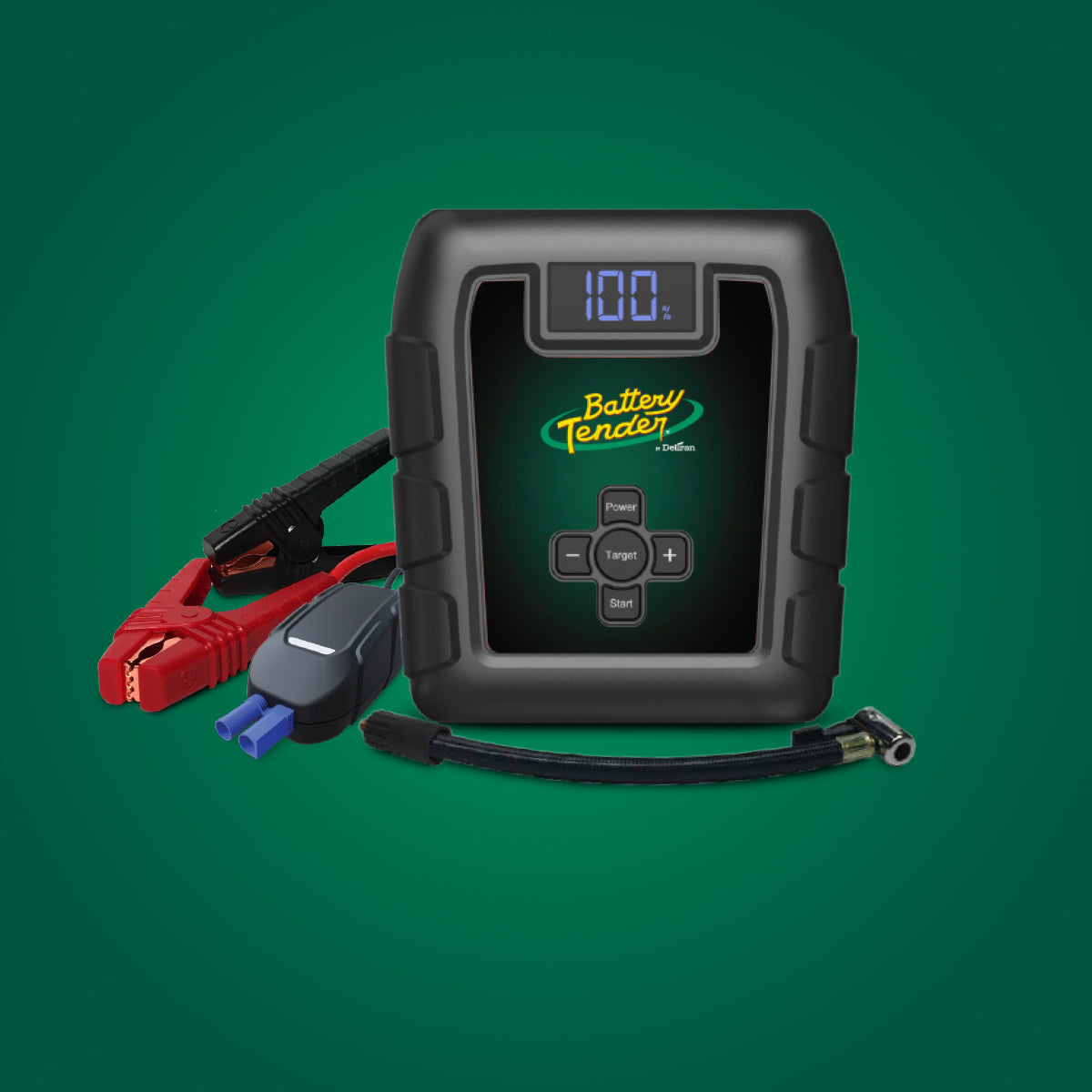
- Compact and mid-size cars, crossovers, V4–V6: 800 Amp + Tire Inflator — handles jump starting AND flat tires in one compact unit
- Full-size cars, SUVs, V6/V8, gas to 7.0L / diesel to 5.5L: 1500 Amp — or Charge N Start 1120 / CNS 4120 for combined jump and maintenance
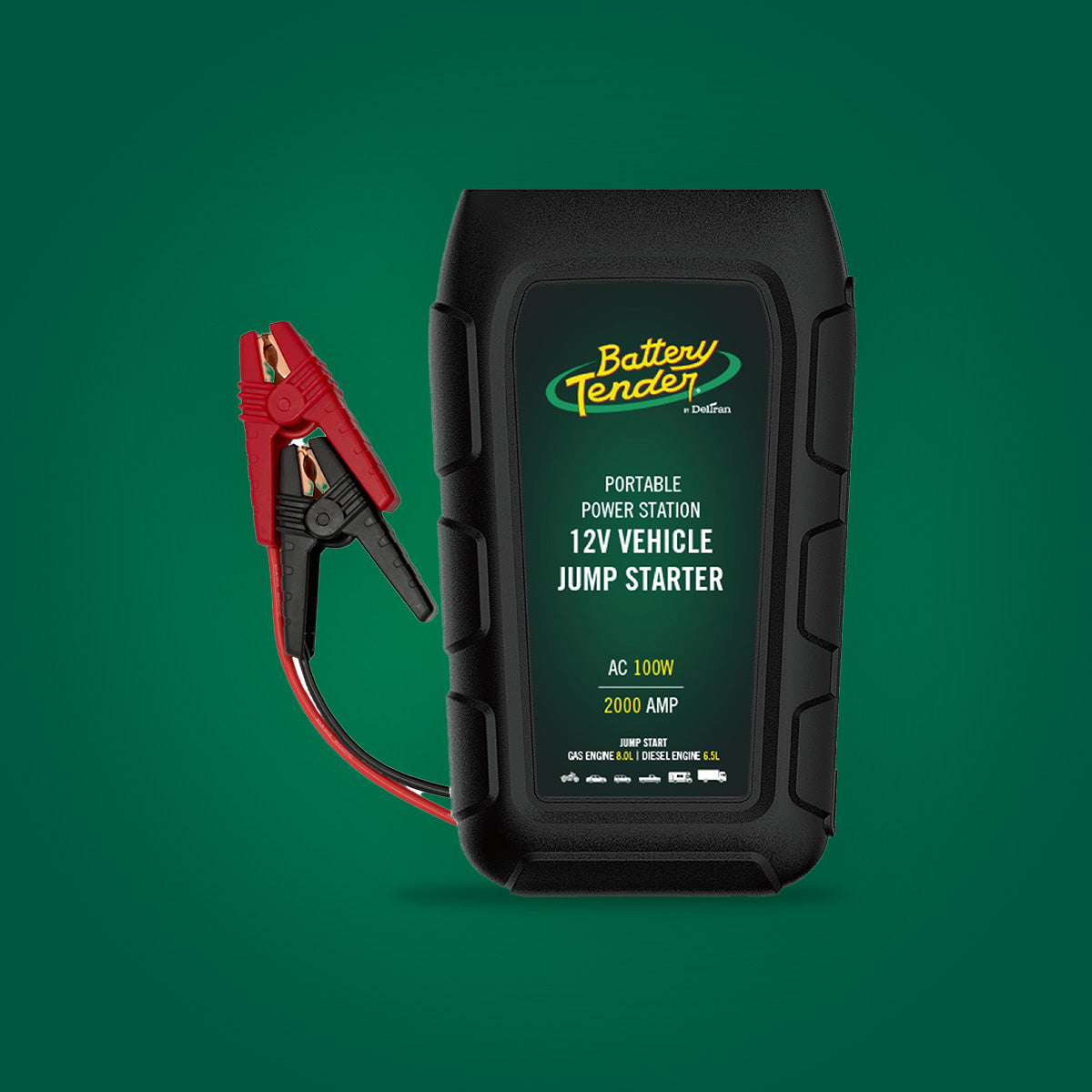
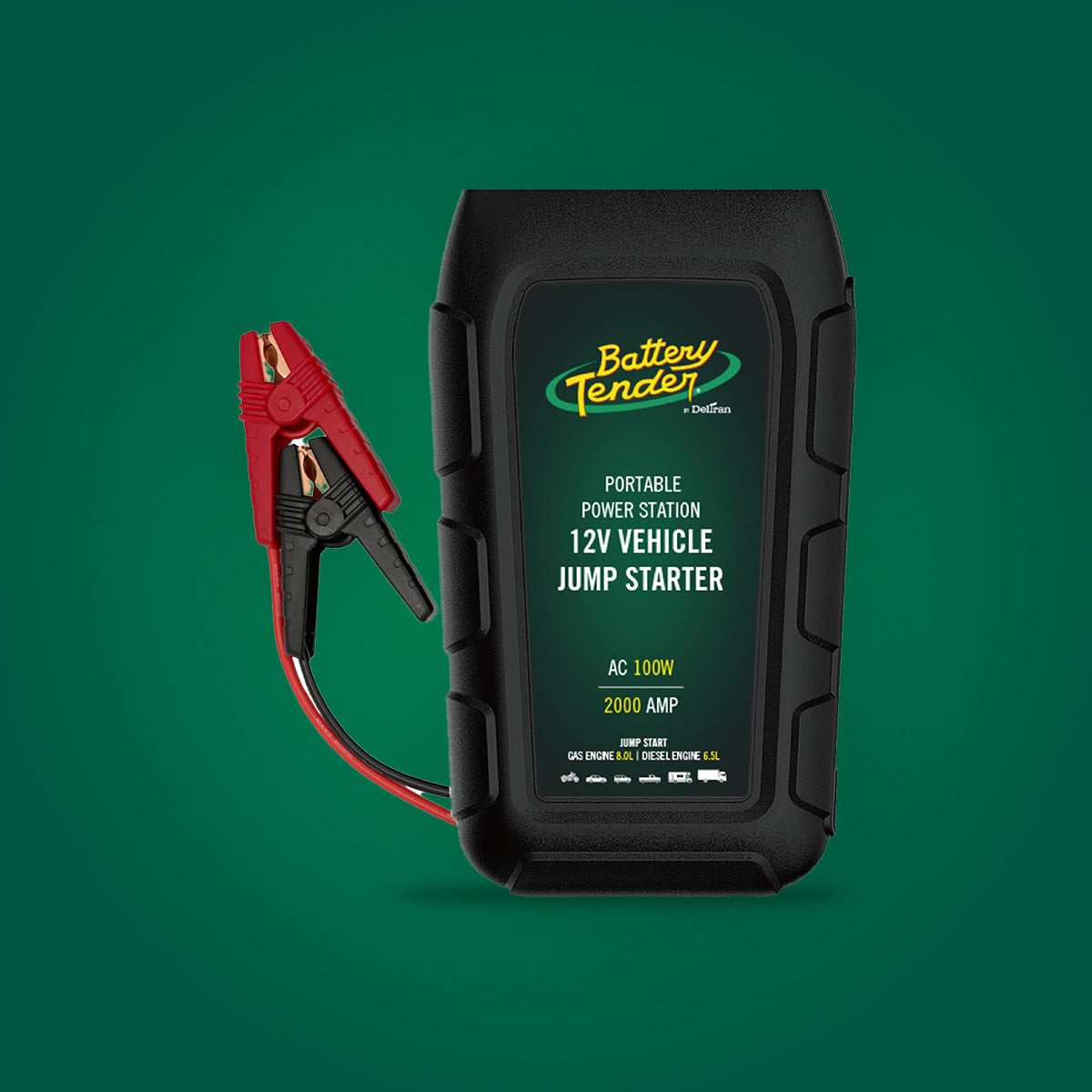
- Full-size trucks, large SUVs, gas to 8.0L / diesel to 6.5L: 2000 Amp or 2000 Amp Power Station (adds 100W AC inverter)
- Heavy-duty diesel, Class 8, large commercial: 2000 Amp at maximum — consider dedicated commercial equipment for engines above 6.5L diesel
The Charge N Start units are a hybrid: portable smart charger/maintainers with an integrated jump starter. See the Charge N Start section for full details.
What makes the 800 Amp Jump Starter + Tire Inflator unique?
The Battery Tender® 800 Amp Jump Starter and Tire Inflator is the only model that handles both of the most common roadside emergencies in one compact device. The built-in digital tire inflator reaches 140 PSI and can inflate a standard passenger car tire from completely flat to full pressure in approximately 8 minutes. Set your target PSI and the inflator stops automatically when reached — no over-inflation risk. It covers gas engines to 4.0L and diesel to 2.0L with the same spark-proof clamps and reverse polarity protection as the full lineup. USB charging ports included. Read more about roadside preparedness on our blog
How do I safely use a portable jump starter?
Connect the red (positive) clamp to the positive (+) battery terminal first, then the black (negative) clamp to the negative (−) terminal or an unpainted metal ground on the vehicle. Activate the jump starter, then attempt to start the vehicle. The spark-proof clamps and reverse polarity protection prevent current flow if connected incorrectly — no arcing, no ECU damage risk. After starting, disconnect in reverse order: negative first, then positive. No second vehicle needed, no four-cable sequence, no risk of overloading another vehicle's alternator.
How is a portable jump starter better than traditional jumper cables?
Traditional jumper cables require a second vehicle, a four-cable hookup sequence, and the donor vehicle's alternator — which can struggle in cold weather. They also produce dangerous arcing when connected to a live battery terminal, which can ignite hydrogen gas from the battery and damage modern vehicle electronics. Battery Tender® jump starters are self-contained, deliver controlled current through spark-proof clamps, require no donor vehicle, and include reverse polarity protection that prevents any current from flowing until the connection is confirmed correct.
How long does a jump starter hold its charge in storage?
Battery Tender® jump starters use lithium-ion technology with a low self-discharge rate — typically retaining 70–85% charge after 6 months in storage at room temperature. Best practice: check the LED charge indicator monthly and recharge when below 50%. Always verify a full charge at the start of winter and before long road trips. Recharge via the included Type-C cable or 12V DC adapter.
Can my jump starter charge my phone or USB devices?
Yes — all Battery Tender® jump starters include USB-A and USB-C output ports for charging smartphones, tablets, GPS units, and other devices. The 2000 Amp Power Station also includes a 100W AC inverter for running laptop chargers, CPAP machines, and other AC devices — making it genuinely useful as an everyday power bank, not just an emergency tool.
2-in-1 Charger + Jump Starter
Charge N Start
The only product line that combines a smart battery maintainer and a portable jump starter in one unit.
What is the Charge N Start and how is it different from owning a charger and jump starter separately?
The Battery Tender® Charge N Start is a portable 2-in-1 device that combines a smart battery charger/maintainer with a built-in lithium jump starter. When plugged into a standard 120V outlet, it maintains your vehicle battery continuously using ISM technology. When you need emergency cranking power, the integrated 1000–1200 Amp jump starter activates through its own dedicated clamps, drawing from the internal lithium battery. Unplug the unit and take it with you as a portable jump starter anywhere you go. One device replaces a separate battery maintainer and a separate portable jump starter entirely. Learn more about smart battery maintenance
How does the Charge N Start work as a portable unit?
The Charge N Start is fully portable — not a permanently installed system. At home or anywhere near a standard 120V outlet, plug it in and it continuously maintains your vehicle's battery using ISM smart charging. Unplug it and it operates as a standalone jump starter powered by its internal lithium battery — take it to a parking lot, a job site, a campsite, or keep it in your trunk. For customers who want one product that serves as both home battery maintainer and on-the-go emergency jump starter, the CNS eliminates the need for two separate devices.
What is the difference between the CNS 1100, CNS 1120, and CNS 4120?
- CNS 1100: 1000 Amp jump / 1 Amp charging — Gas to 5.0L / Diesel to 3.0L — best for motorcycles, compact cars, and smaller engines
- CNS 1120: 1200 Amp jump / 1 Amp charging — Gas to 6.0L / Diesel to 4.0L — covers most passenger cars, SUVs, and light trucks
- CNS 4120: 1200 Amp jump / 4 Amp charging — Gas to 6.0L / Diesel to 4.0L — same jump power as 1120 but charges a depleted car battery approximately 4x faster
Does the Charge N Start use the same cables for charging and jumping?
No — the Charge N Start has two separate sets of clamps. The charging/maintenance clamps connect to the battery for continuous ISM float maintenance. The jump starter clamps are a separate dedicated set used specifically for emergency cranking power. The jump starter operates independently from the AC charging circuit. Do not use the charging clamps for jump starting or vice versa.
Can I leave the Charge N Start connected all winter?
Yes — indefinite connected storage is exactly what it's designed for. Once the battery is fully charged, the CNS enters ISM float maintenance mode automatically, delivering only the micro-current needed to offset natural self-discharge. There is no overcharge risk on any supported chemistry. Connect in the fall, disconnect in the spring — the battery will be in better condition than when you stored it, and the jump starter will be fully charged and ready if needed.
What vehicles is the Charge N Start designed for?
The CNS family covers motorcycles, ATVs, UTVs, scooters, compact cars, sedans, SUVs, trucks, and light-duty vehicles within the engine size ratings for each model. It is not designed for heavy-duty diesel applications (Class 8 trucks, large agricultural equipment with engines above 6.5L diesel). All CNS units charge and maintain all 12V battery chemistries: flooded lead-acid, AGM, GEL, sealed maintenance-free, and Lithium.
Does the Charge N Start include the same safety features as other Battery Tender® products?
Yes — both clamp sets include spark-proof circuitry and reverse polarity protection. No current is delivered until connections are confirmed correct, protecting your vehicle's ECU, alternator, and electronics. The charging circuit uses the same ISM algorithm and temperature compensation found in every Battery Tender® charger.
What battery types does the Charge N Start support?
The charging/maintenance function supports all 12V battery chemistries: flooded lead-acid, AGM, GEL cell, sealed maintenance-free, and Lithium (LiFePO4). The jump starter supports 12V lead-acid and Lithium starting batteries. The unit is not compatible with 6V, 24V, or higher-voltage systems.
Fleet & Multi-Vehicle
Multi-Bank & Fleet Charging
Charge and maintain multiple batteries simultaneously from a single AC connection — each bank fully independent.
What is a multi-bank charger and who uses them?
A multi-bank charger maintains multiple batteries simultaneously from a single AC connection, with each bank operating completely independently. Battery Tender® offers several families:
- 2-Bank and 4-Bank (1.25 Amp/bank): Wall-mountable, IP65, Lithium-compatible — ideal for garages with 2–4 vehicles
- 5-Bank and 10-Bank (4 Amp/bank): Per-bank voltage and chemistry selection — ideal for dealerships, large collections, and mixed fleets
- WaveCharge 2-Bank, 3-Bank, 4-Bank (3 Amp/bank): IP67-rated, 6V/12V, all chemistries — marine-grade multi-bank for any environment
- WaveCharge Pro 2-Bank, 3-Bank, 4-Bank (10 Amp/bank): IP68, ETL and CETL, UL marine ignition protection — highest-power multi-bank option
Do all banks charge simultaneously at full output?
Yes — each bank delivers its full rated Amp output simultaneously, regardless of what other banks are doing. Banks never share or split current. A deeply discharged battery on one bank does not affect charging on any other bank.
Can I mix different battery types and voltages across banks?
On the 5-Bank and 10-Bank units, yes — each bank has independent voltage (6V/12V) and chemistry selectors. On the WaveCharge Standard 2/3/4-Bank units, each bank independently supports 6V or 12V and all chemistries including Lithium. The 2-Bank and 4-Bank units support all lead-acid chemistries and Lithium. The WaveCharge Pro series is 12V only but supports all chemistries at 10 Amp per bank.
How do I install a multi-bank charger permanently?
All Battery Tender® multi-bank units include mounting hardware for wall installation. The WaveCharge and WaveCharge Pro series include mounting templates and IP67/IP68 ratings for outdoor installation. Mount near your vehicle storage area, run bank cables to each vehicle's battery, and plug into a standard AC outlet. Quick disconnect extension cables in 6 ft, 12 ft, and 25 ft lengths extend reach — a 25 ft extension gives approximately 33 ft total reach per bank.
What is the maximum cable reach on a multi-bank charger?
The 2-Bank and 4-Bank include cables with approximately 7.5 ft reach per bank. The 5-Bank and 10-Bank provide over 13 ft of total reach. WaveCharge Pro models have dedicated 5 ft and 10 ft marine-grade extension cords. Adding a 25 ft extension to the included cable gives approximately 33 ft of total reach per bank, enough to service vehicles in standard stalls from a single wall-mounted unit.
Solar Charging
Solar Battery Maintenance
Charge and maintain batteries anywhere the sun shines — no AC power needed.
How does solar battery maintenance work?
A solar panel converts sunlight into DC current, which flows through a charge controller to the battery. The controller prevents overcharging and applies ISM-style multi-stage charging. The charging process restarts naturally each day with available sunlight. This makes solar ideal for batteries in remote locations, outdoor equipment, electric gates, electric fences, and vehicles without convenient access to AC power.
Can a solar charger recover a dead battery?
Yes — solar chargers can recover a discharged battery, but it takes longer than a wall charger. The 5W panel produces approximately 300mA in full sun. The 35W panel produces approximately 2 Amp in full sun and can recover a moderately discharged battery in a day or two of good sunlight. For severely depleted batteries, a wall charger for initial recovery followed by solar maintenance is most practical. Once fully charged, all Battery Tender® solar chargers automatically enter float maintenance mode.
What size solar panel do I need?
- Motorcycles, ATVs, small powersports: 5W panel — sufficient for pure maintenance. Also ideal for electric gates, electric fences, and remote equipment.
- Compact cars, boats: 17W panel — maintenance and reasonable recovery
- Larger vehicles, RVs, marine: 35W panel — the largest panel and controller combo in the lineup; or pair a larger third-party panel with a Battery Tender® solar controller
Do I need a charge controller with my solar panel?
Yes — a controller prevents overcharging and reverse current drain at night. Battery Tender® 17W and 35W solar chargers include a controller. For third-party panels, Battery Tender® offers standalone controllers from 5–45W (PWM) up to 50 Amp (PWM), and a 30 Amp MPPT controller for maximum efficiency in larger installations.
Can solar charging work in winter?
Yes — solar panels generate power in cold, clear winter conditions, sometimes more efficiently than in summer heat. Battery Tender® chargers include automatic temperature compensation to adjust charge voltage appropriately in cold conditions. A solar panel paired with a Battery Tender® controller will keep batteries properly maintained through winter wherever sufficient sunlight reaches the panel. Read our winter battery storage guide
Marine & Industrial
Marine & On-Board Charging
On-board smart chargers engineered for marine, industrial, and commercial environments.
What makes the PowerPlus line different from standard Battery Tender® chargers?
The PowerPlus line is purpose-built for permanent on-board installation in marine, industrial, and commercial environments — but also works as portable or wall-mounted units for fleet facilities. Key differences: IP68 waterproofing (rated for 1-meter submersion — the highest in the Battery Tender® lineup), UL marine ignition protection (safe in bilges with gasoline fumes), back feed protection (prevents reverse current into the AC circuit), and availability in 12V, 24V, 36V, and 48V configurations for any battery system.
What is the WaveCharge line and what makes it marine-grade?
WaveCharge is Battery Tender®'s multi-bank on-board marine charger line for boats maintaining 2, 3, or 4 batteries from shore power simultaneously. The Standard WaveCharge series (2-Bank, 3-Bank, 4-Bank) supports 6V or 12V at 3 Amp per bank with IP67 rating. The Pro series (2-Bank 20A, 3-Bank 30A, 4-Bank 40A) delivers 10 Amp per bank at 12V with IP68 rating, ETL and CETL certification, and UL marine ignition protection.
What is UL marine ignition protection and why does it matter?
UL marine ignition protection certifies that the charger will not ignite flammable vapors — specifically gasoline fumes that accumulate in boat bilges and engine compartments. Uncertified chargers should never be installed in enclosed marine compartments. Battery Tender® PowerPlus and WaveCharge Pro chargers carry this certification, making them the correct choice for below-deck installation. Back feed protection prevents reverse current from flowing into shore power infrastructure, protecting the marina's electrical system.
What is the difference between IP67 and IP68 waterproofing?
IP67 means fully dust-tight and waterproof to 1 meter for 30 minutes. IP68 means fully dust-tight and waterproof beyond 1 meter for extended periods — the highest standard rating. Battery Tender® products with IP67 include the Weather Resistant charger, several PowerTender® models, and WaveCharge Standard series. IP68 products include the PowerPlus series, WaveCharge Pro series, and several PowerTender® models. IP68 is the correct specification for bilge installation and pressure wash exposure.
Can I leave an on-board charger connected at the dock all season?
Yes — all Battery Tender® on-board chargers (PowerPlus and WaveCharge) use ISM float maintenance safe for indefinite connected operation on all supported battery chemistries. Connect to shore power at the start of the season — the batteries will be at 100% capacity whenever you're ready to go. The IP67/IP68 ratings ensure the charger handles humidity, spray, and moisture conditions of year-round dock storage. Read our marine battery maintenance guide
Specialty Vehicles
Golf Carts & Specialty Vehicles
Golf carts, trolling motors, and specialty equipment — choosing the right voltage and maintaining your battery bank.
How do I know what voltage system my golf cart uses?
Golf carts traditionally run on 36V or 48V battery systems assembled from individual 6V or 8V lead-acid batteries in series. To determine your cart's voltage from a flooded lead-acid bank: count the water fill holes on one battery (3 holes = 6V, 4 holes = 8V) and multiply by the number of batteries. Six 6V batteries = 36V. Six 8V = 48V. Eight 6V = 48V.
However, 36V and 48V Lithium (LiFePO4) battery packs are increasingly becoming the standard replacement, particularly for 48V systems. These drop-in packs replace the entire lead-acid bank, reducing weight and improving performance. Battery Tender® PowerPlus 36V and PowerPlus 48V chargers support both traditional lead-acid banks and lithium replacements.
Can I use a standard 12V Battery Tender® to maintain golf cart batteries?
No — a 12V charger cannot charge a 36V or 48V golf cart battery bank. You need either the PowerPlus 36V or PowerPlus 48V for charging the full bank, or a Battery Tender® 8V 1.25 Amp charger for individually maintaining 8V batteries. Individually maintaining each battery during off-season storage extends the life of the entire pack — a weak cell in a series bank degrades performance and life of every other battery.
Can I plug the PowerPlus directly into my golf cart's factory charging port?
Yes — with the appropriate OEM-compatible DC plug accessory. Battery Tender® offers model-specific plug adapters for Club Car DS/Precedent (48V), EZ-GO TXT/RXV (48V), Yamaha G19/G22/G29 (48V), and EZ-GO Medalist/TXT (36V). These allow you to plug and unplug through the cart's standard charging receptacle — ideal for fleet facilities and golf cart barns.
What is the best way to extend golf cart battery life?
The most impactful practices: charge after every use, never leave the pack in a discharged state, individually maintain each battery during seasonal storage, use a charger designed for your battery voltage, and check water levels in flooded lead-acid batteries monthly. Sulfation from chronic partial discharge is the leading cause of premature golf cart battery failure. A Battery Tender® PowerPlus charger connected to shore power between rounds keeps the pack perpetually topped off. Read our golf cart battery guide
Are Battery Tender® PowerPlus chargers compatible with Lithium golf cart battery upgrades?
Yes — all Battery Tender® PowerPlus chargers support Lithium (LiFePO4) batteries in addition to lead-acid. If you've upgraded your golf cart to a lithium battery pack, the PowerPlus charger handles it correctly. Ensure the charger is set to the correct chemistry mode if it has a manual chemistry selector.
Electric Vehicles
EV Charging
Home EV charging made simple — Level 1 and Level 2 options for every driveway.
What is the difference between Level 1 and Level 2 EV charging?
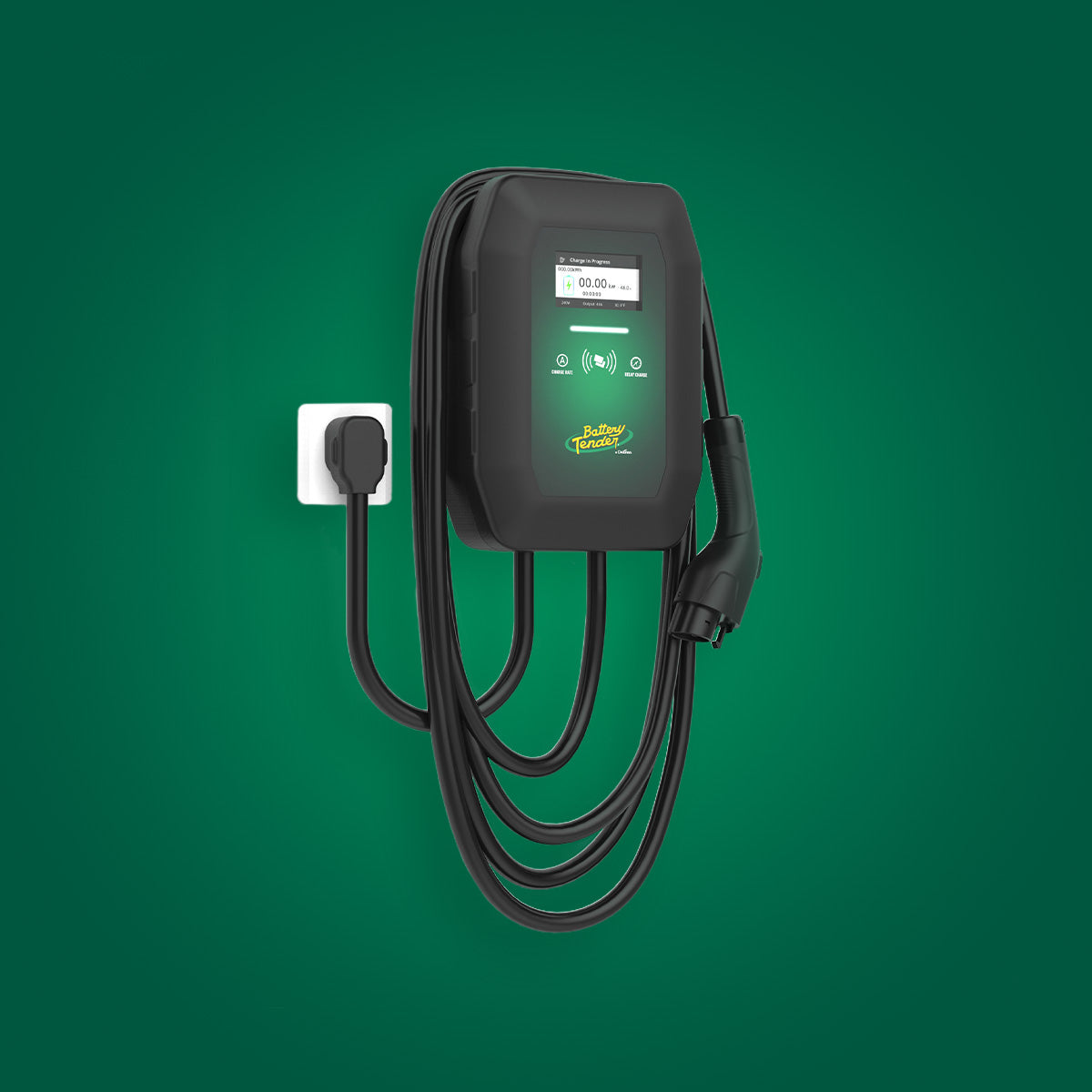
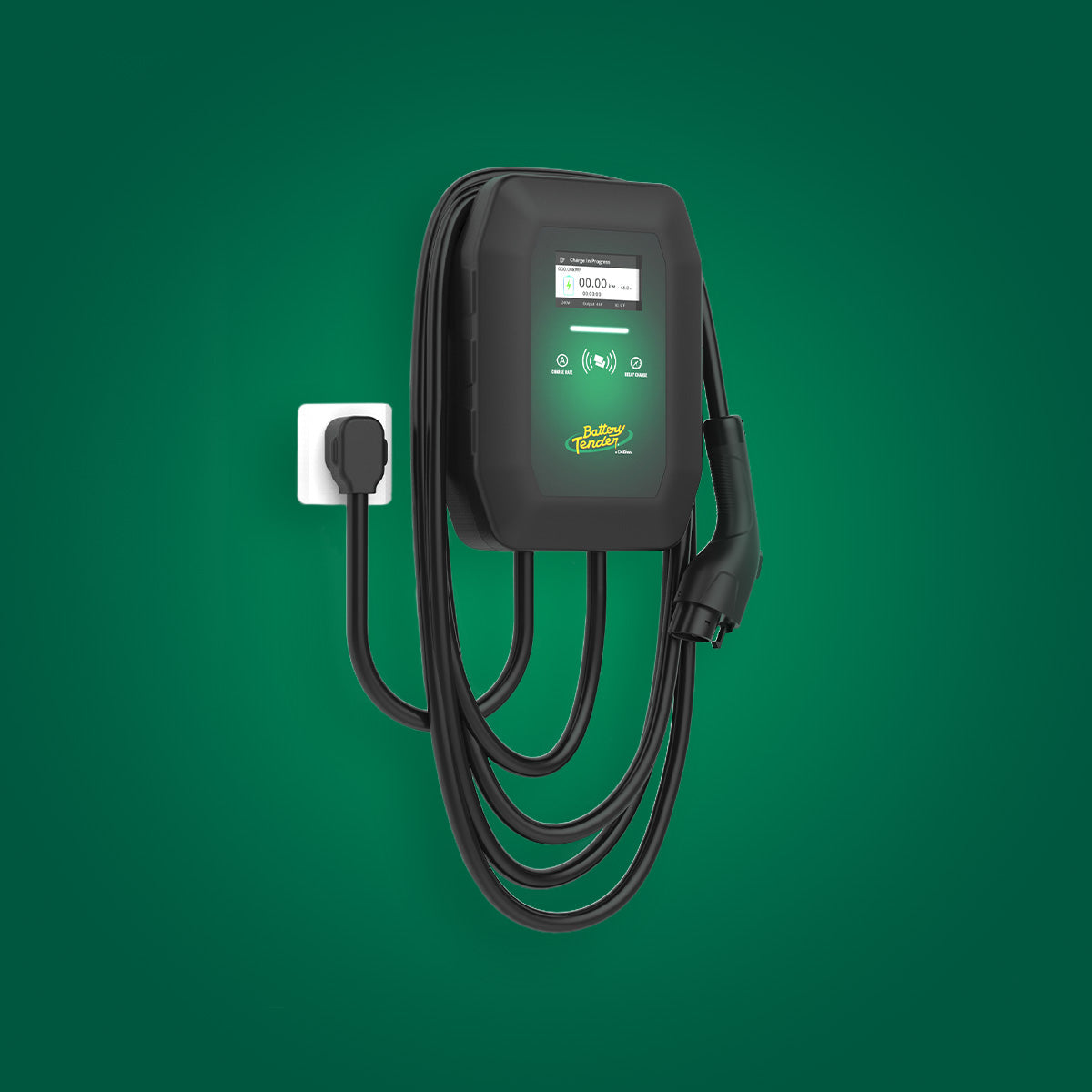
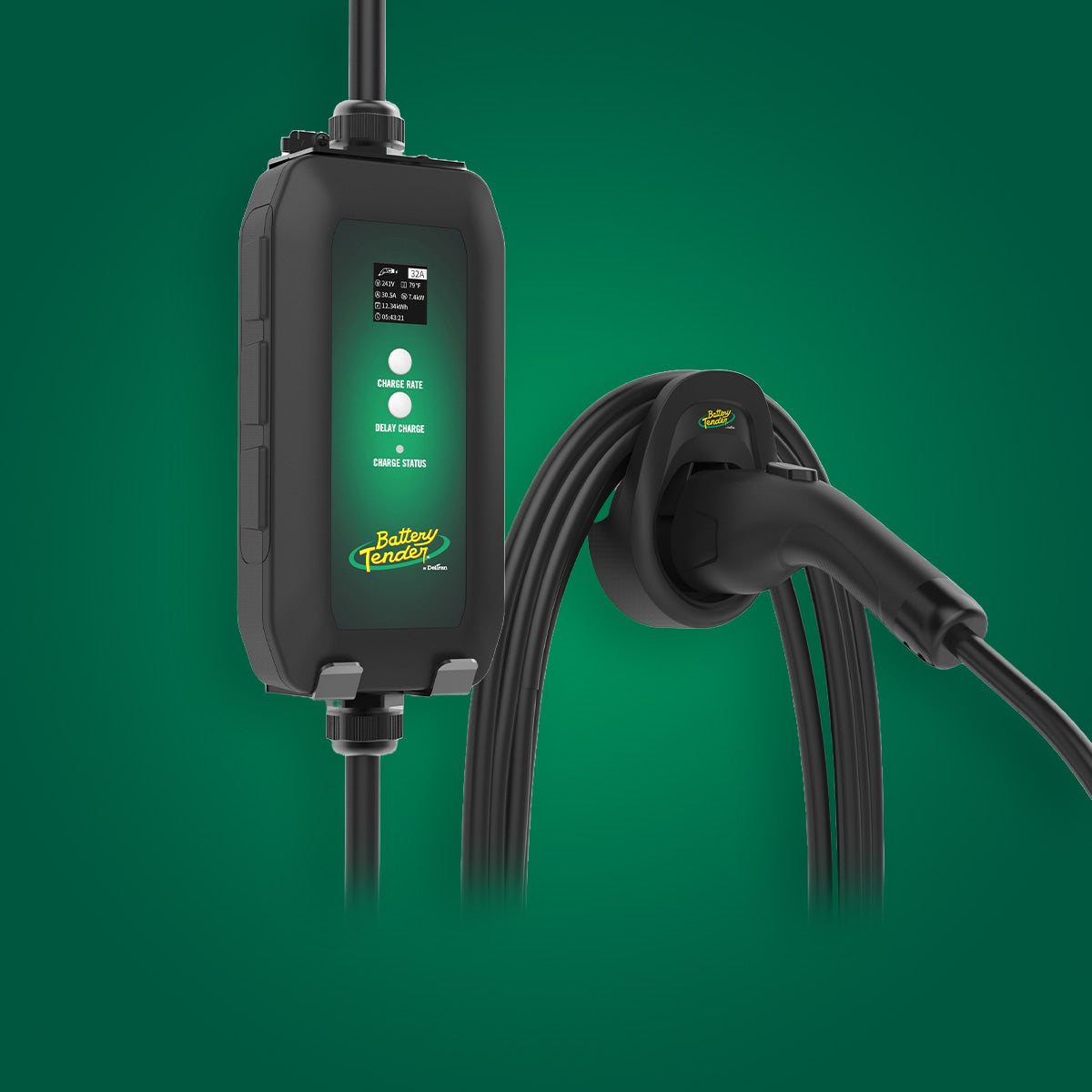
Level 1 uses a standard 120V household outlet — no special electrical work required — and adds approximately 12–15 miles of range per hour. Practical for plug-in hybrids and shorter-range EVs. Level 2 uses a dedicated 240V circuit and adds 20–42 miles of range per hour depending on the charger's Amp output. Level 2 is the standard for home EV charging and can fully charge most long-range EVs overnight. Battery Tender®'s eCharge line covers both: the eCharge 16 is Level 1; the eCharge 32, 40, and 48 are Level 2.
How fast will a Battery Tender® eCharge Level 2 charger charge my EV?
- eCharge 32 (32 Amp): ~28.5 miles of added range per hour
- eCharge 40 (40 Amp): ~36 miles of added range per hour
- eCharge 48 (48 Amp): ~42 miles of added range per hour
Actual speed varies by vehicle — vehicles with lower onboard AC acceptance rates will charge at the lower of the two limits.
What electrical work do I need for a Level 2 EV charger?
The eCharge 32 includes a NEMA 14-50R adapter for the standard 240V outlet — no electrician required if this outlet already exists. The eCharge 40 requires a dedicated 240V, 50-amp circuit. The eCharge 48 requires a dedicated 240V, 60-amp circuit. Both support hardwired or plug-in installation. Consult a licensed electrician for new circuit installation.
Are Battery Tender® eCharge chargers compatible with all electric vehicles?
All eCharge chargers use the SAE J1772 connector — compatible with all non-Tesla EVs and plug-in hybrids (Chevrolet Bolt, Nissan Leaf, Ford Mustang Mach-E, Hyundai Ioniq, Kia EV6, Rivian, BMW i-series, and more). For Tesla vehicles, the Battery Tender® J1772 Adapter (081-0400) converts the standard J1772 connection to the Tesla-style connector with no reduction in charging speed.
What is RFID access control on the eCharge 40 and 48?
RFID access control is an optional security feature on the eCharge 40 and eCharge 48. The charger functions normally without it — RFID does NOT need to be enabled for home use. When activated, the charger only operates when an authorized RFID card is tapped. Two RFID cards are included. Most useful for shared environments: apartment buildings, townhomes with shared driveways, or commercial parking.
Support
Troubleshooting
Can't find your answer? Call +1 386-736-7900, Mon–Fri 8AM–4:30PM ET or email our Florida-based support team.
What do the LED lights mean on my Battery Tender® charger?
- Solid red = Bulk charging in progress
- Flashing green = Absorption phase — battery approaching full charge (approximately 80–99%)
- Solid green = Fully charged, float maintenance mode active — safe to leave indefinitely
- Flashing red = Fault condition — check connections and battery
The 15/8/2 Amp PowerTender® features a full LCD display showing current, voltage, battery chemistry, and charge stage in real time.
My charger is showing a fault light — what should I do?
A fault condition typically indicates incorrect polarity (red clamp on negative, black on positive), a bad connection (loose clip, corrosion on terminals), or a battery too damaged to accept charge. First: disconnect the charger, wait 30 seconds, verify connections are correct (red to positive, black to negative), clean any corrosion from the terminals, and reconnect. Most fault conditions clear on the second attempt. If the fault persists, the battery may have suffered irreversible sulfation damage and should be load-tested or replaced.
My battery keeps dying even with the maintainer connected — why?
Possible causes: the AC outlet has lost power (check the circuit breaker); the charger output cable has a damaged connector or broken wire; the battery has lost significant capacity due to aging or sulfation; or there is an unusually high parasitic drain on the vehicle that exceeds the charger's float output. If your vehicle draws more than 150–200mA at rest, consider a higher-output model. See our battery maintenance troubleshooting guide
Can a Battery Tender® recover a completely dead battery?
If the battery is simply deeply discharged but has not yet developed significant sulfation, connecting a Battery Tender® will begin restoring capacity. The key variable is how long the battery has been discharged. Sulfation begins forming within days of a battery dropping below full charge and becomes increasingly permanent over time. If the charger's LED does not illuminate within a few minutes of connection, the battery likely has extensive permanent damage and should be load-tested or replaced.
My Battery Tender® Junior is connected but the battery still died — why?
Modern vehicles increasingly have significant always-on parasitic loads (GPS tracking, heated grips, security systems, Bluetooth modules). If your vehicle's resting current draw exceeds the Junior's 750mA output, the battery will slowly discharge. Measure the vehicle's parasitic draw; if it exceeds 150–200mA, consider the Junior Multi-Chemistry 1A, Plus 1.25 Amp, or PowerTender® 3 Amp.
My charger worked fine last season but won't charge this year — what should I check?
Check the AC outlet (plug another device in to confirm power), inspect the output cable and clamps for physical damage or corrosion, verify the connector is fully seated, and test the battery voltage with a voltmeter before connecting. If the charger shows no signs of life, try a different outlet. If problems persist, contact support@deltran-global.com or call +1 386-736-7900.
Why does my charger feel warm during use?
Some warmth during the bulk charging phase is normal — all battery chargers convert some energy to heat as part of the charging process. If the charger feels extremely hot, disconnect it and contact support. Never cover a charger during use or store it in an enclosed compartment while charging — adequate ventilation is important for normal operation.
Company
Warranty & Support
Warranty coverage, support contacts, and where to find Battery Tender® products.
Where are Battery Tender® products designed and manufactured?
Battery Tender® is a brand of Deltran Corporation, headquartered in DeLand (Volusia County), Florida — where the brand has been designing and engineering battery maintenance products since 1965. Deltran has been operating from Florida for over 60 years and remains the longest-standing battery maintainer brand in North America.
How do I contact Battery Tender® support?
- Support Email: support@deltran-global.com
- Orders: orders@deltran-global.com
- Phone: +1 386-736-7900
- Hours: Monday–Friday, 8AM–4:30PM ET
What is covered under Battery Tender® warranties?
Battery Tender® warranties cover defects in materials and workmanship under normal use. Coverage does not include physical damage from misuse, water submersion beyond the product's IP rating, unauthorized modification, or use outside the product's specifications. Warranty periods vary — from 1 Year on accessories to 10 Years on the Battery Tender® Plus flagship (021-0128). To make a warranty claim, contact support@deltran-global.com with proof of purchase and a description of the defect. View full warranty information
Where can I purchase Battery Tender® products?
Battery Tender® products are available online at batterytender.com and through authorized retailers nationwide. Find a store near you →
For fleet, commercial, or bulk purchasing inquiries, contact orders@deltran-global.com.
What happened to the Deltran Connected App?
The Deltran Connected app, which provided wireless monitoring for select Battery Tender® products, has been discontinued and is no longer supported. As a result, the app will no longer function, and WiFi connectivity is no longer available for chargers that previously included this feature.
Why was the app discontinued?
To continue providing the best battery charging solutions, we made the decision to remove WiFi connectivity from our chargers and discontinue the Deltran Connected app. This change allows us to focus on the reliability and performance of our core products.
What does this mean for my product?
For Battery Tender WIFI-enabled chargers: The charger itself continues to function as designed, delivering the same trusted performance—it simply no longer connects to the app.
For the Wireless Battery Monitor: This product relied on the Deltran Connected app for data display, so it is no longer functional.
What are my options?
We understand that this may be disappointing news. While the app is no longer available, we stand by our products and appreciate your loyalty. If this change impacted your Battery Tender product, please reach out to support@deltran-global.com.
HAVE ADDITIONAL QUESTIONS?
Contact Us
If you have any questions about your recent purchase or need help finding the perfect charger, our dedicated customer service team is here to assist you. We're committed to helping you get the most out of your Battery Tender products.


