




Solar Trickle Charger vs. Smart Solar Maintainer: What Actually Protects Your Battery (2026)
A solar trickle charger uses a small photovoltaic panel to deliver constant, unregulated current to a 12V battery — keeping it topped off during storage without needing an electrical outlet. While that sounds convenient, the "trickle" approach carries a fundamental flaw: most basic solar trickle chargers lack charge regulation, meaning they push current into the battery regardless of its state of charge. Over days and weeks, that unregulated flow can overcharge a battery, boil electrolyte, warp internal plates, and permanently reduce capacity. Battery Tender® pioneered a smarter approach, combining solar panels with intelligent charge controllers that monitor voltage and automatically adjust or stop current flow when the battery reaches full charge.
This guide explains exactly how traditional solar trickle chargers work, why they risk damaging the batteries they are supposed to protect, and how solar maintainers with built-in charge controllers deliver genuinely safe, set-and-forget power for boats, RVs, farm equipment, classic cars, and any vehicle stored far from an outlet. Understanding the difference can save hundreds of dollars in premature battery replacement costs — and hours of frustration when a vehicle will not start after months in storage.
Key Takeaways:
- A basic solar trickle charger sends constant current with no voltage regulation, creating overcharge risk during prolonged connection.
- Smart solar maintainers include built-in charge controllers that stop or reduce current when the battery is full.
- Battery Tender solar chargers use multi-step charging logic compatible with lead-acid, AGM, GEL, and lithium 12V batteries.
- Solar maintenance eliminates the need for electrical outlets, making remote and off-grid storage practical and safe.
- A 17W solar panel with a charge controller can maintain batteries on boats, RVs, tractors, and stored vehicles indefinitely.
What Is a Solar Trickle Charger and How Does It Work?
A solar trickle charger is a small solar panel — typically 1W to 10W — wired directly to a 12V battery through alligator clips or ring terminals. It converts sunlight into DC electricity and feeds that current straight into the battery at a low, constant rate. The concept is simple: replace the small amount of energy a battery naturally loses to self-discharge (roughly 1–3% per month for lead-acid, less for lithium), so the battery stays ready to start a vehicle even after weeks or months of sitting idle.
The problem lies in the word "constant." A true trickle charger — whether solar-powered or AC-powered — does not monitor the battery's voltage or state of charge. It delivers the same current whether the battery is at 50% or 100%. According to the Battery Council International (BCI), sustained overcharging is one of the top three causes of premature battery failure. For a flooded lead-acid battery, overcharging accelerates water loss from the electrolyte. For sealed AGM or GEL batteries, which cannot have water added, the damage is irreversible. And for lithium batteries, unregulated overcharging can trigger thermal events that compromise safety.
Basic solar panels sold as "trickle chargers" at hardware stores often include nothing more than a blocking diode — a component that prevents reverse current flow at night but does absolutely nothing to regulate charge voltage during the day. That blocking diode is not a charge controller. It does not protect the battery from overcharging. Understanding this distinction is essential before choosing a solar charging solution for long-term storage.
Why a Solar Trickle Charger Can Damage Your Battery
The damage from an unregulated solar trickle charger is cumulative and often invisible until the battery fails. When voltage across a fully charged 12V lead-acid battery exceeds approximately 14.4V without tapering, electrolysis begins — splitting water in the electrolyte into hydrogen and oxygen gas. In a flooded battery, this means the electrolyte level drops and plate tops become exposed to air, causing irreversible sulfation on the exposed lead. The International Electrotechnical Commission (IEC 60896) identifies sustained overcharge as a primary accelerant of positive grid corrosion in valve-regulated batteries.
AGM and GEL batteries are even more vulnerable. These sealed designs rely on precise internal gas recombination. Excessive charging current forces gas production beyond the recombination rate, building internal pressure that can vent the safety valve. Once an AGM battery vents, it permanently loses capacity — there is no way to restore the lost electrolyte. A $200+ marine AGM battery can be ruined in a single storage season by a $15 unregulated solar panel.
Temperature compounds the problem. A solar panel mounted on a boat deck or RV roof operates in direct sunlight, where surface temperatures regularly exceed 50°C (122°F). Higher temperatures lower the voltage threshold at which overcharging begins. Without temperature-compensated voltage regulation, a solar trickle charger that seems harmless in winter can cause significant damage during summer months.
How Smart Solar Maintainers Solve the Overcharging Problem
A smart solar maintainer pairs a solar panel with an integrated charge controller that actively monitors battery voltage and adjusts current delivery accordingly. This is a fundamentally different architecture from a raw solar trickle charger. The charge controller acts as an intelligent intermediary — allowing full current when the battery needs energy and reducing or stopping current flow when the battery approaches full charge.
Battery Tender solar chargers use 3-step charging logic that mirrors the approach found in wall-powered smart chargers. The system delivers bulk current during the initial charging phase, transitions to a reduced-current absorption phase as voltage rises toward the target, and then shifts to a maintenance mode that provides only enough energy to offset self-discharge. This multi-step approach prevents the sustained high-voltage condition that causes overcharging damage.
The critical advantage is that a Battery Tender solar maintainer can remain connected to a battery indefinitely — through an entire off-season — without any risk of overcharging. That is the definition of true set-and-forget maintenance. No timers to set, no periodic disconnection required, no worry about returning to a damaged battery after months of storage.
Which Solar Maintainer Wattage Matches Your Battery?
Solar panel wattage determines how much current the system can generate under ideal sunlight conditions. Choosing the right wattage depends on battery capacity, parasitic draw from onboard electronics, and average sunlight hours at the storage location.
For motorcycles, ATVs, jet skis, and small engines with batteries in the 5–20 Ah range, a 5W solar panel generates approximately 0.3A in peak sunlight — more than enough to offset self-discharge and keep a small battery fully maintained. The Battery Tender 5W Solar Panel connects directly to any 12V battery and includes a charge controller to prevent overcharging, making it an ideal replacement for an unregulated solar trickle charger on compact vehicles.
Battery Tender 5W Solar 12V Battery Charger
For mid-size applications — stored cars, bass boats, utility trailers, and farm equipment with batteries in the 40–80 Ah range — the Battery Tender 17W Mountable Solar Charger delivers approximately 1A of peak current and includes a built-in charge controller that prevents overcharging across all 12V battery chemistries: standard lead-acid, AGM, GEL, and lithium. The waterproof panel mounts permanently to a roof, deck, or dashboard, and the integrated controller eliminates the need for a separate regulation device. This is the most versatile option for vehicle owners who want a permanent, no-outlet solar maintenance installation.
Battery Tender 17W Mountable Solar 12V Battery Charger with Controller
For larger batteries, dual-battery setups, or locations with limited sunlight hours, the Battery Tender 35W Mountable Solar Charger generates roughly 2A of peak current — enough to maintain batteries up to 100+ Ah and recover light discharge from parasitic draws such as alarm systems, GPS trackers, or bilge pump circuits. Pair it with a Battery Tender MPPT solar controller for maximum energy harvest efficiency, especially in partially shaded or overcast environments where pulse-width modulation (PWM) controllers lose significant output.
Battery Tender 35W Mountable Solar 12V Battery Charger
Best Applications for Solar Battery Maintenance
Solar maintainers excel in any scenario where a vehicle or battery sits idle far from an electrical outlet. Boat lifts, marina slips, remote farm buildings, unheated storage barns, airport long-term parking lots, and off-grid cabins are all environments where running extension cords is impractical or impossible. A roof-mounted 17W or 35W panel draws energy from ambient daylight — even on overcast days — and feeds it through a charge controller to the battery below.
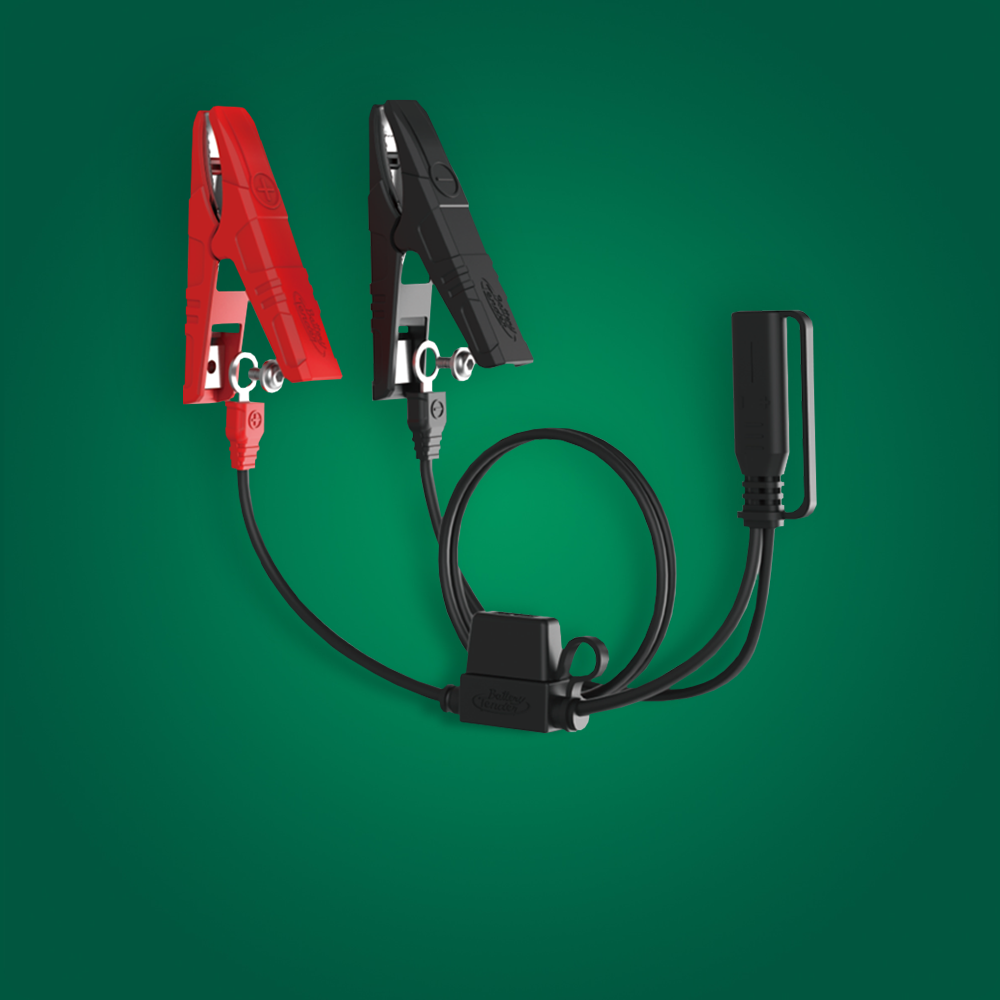
Classic car and collector vehicle owners benefit particularly from solar maintenance during show-season gaps. A battery sitting in a climate-controlled garage still self-discharges at 1–3% per month. Over a 6-month winter, that can reduce a 60 Ah battery to below 50% state of charge — deep enough to trigger lead sulfation that permanently reduces capacity. A Battery Tender 5W solar panel on the dashboard, connected through the existing Battery Tender ring terminal harness, maintains full charge through the entire off-season without any wiring modifications.
RV and camper owners face the additional challenge of parasitic draws from LP gas detectors, CO alarms, and refrigerator control boards that can drain a house battery at 0.5–2A continuously. For these applications, the 35W panel paired with a Battery Tender 30A MPPT Solar Charge Controller provides enough daily energy input to offset parasitic loads and maintain full charge simultaneously.
How to Install a Solar Battery Maintainer
Installing a Battery Tender solar maintainer takes less than 15 minutes and requires no electrical expertise. Follow these steps for a permanent, weather-resistant installation:
- Choose a mounting location. Select a surface that receives direct sunlight for at least 4–6 hours daily. Boat decks, RV roofs, tractor hoods, and vehicle dashboards all work. Angle the panel toward the sun for maximum energy harvest — even a 15° tilt toward the equator improves winter output by 10–15%.
- Secure the panel. Use the included mounting hardware or industrial-grade adhesive pads for permanent installations. The Battery Tender 17W and 35W mountable panels include pre-drilled mounting holes for screw attachment to fiberglass, aluminum, or wood surfaces.
- Run the cable to the battery. Route the output cable from the panel to the battery compartment. Use grommets or cable glands wherever wiring passes through bulkheads to maintain water integrity.
- Connect to the battery. Attach ring terminals to the battery posts (positive to positive, negative to negative). Verify polarity before final connection. The built-in charge controller will begin monitoring battery voltage immediately and deliver current only when needed.
- Verify operation. Check the indicator light on the charge controller. A solid or blinking LED confirms the system is actively monitoring and maintaining the battery.
Once installed, no further action is required. The charge controller handles all regulation automatically — a genuine set-and-forget system that works whether the vehicle sits for two weeks or twelve months.
Solar Trickle Charger vs. Smart Solar Maintainer: Side-by-Side Comparison
| Feature | Basic Solar Trickle Charger | Battery Tender Smart Solar Maintainer |
|---|---|---|
| Charge Regulation | None (blocking diode only) | Built-in multi-step charge controller |
| Overcharge Protection | No | Yes — automatic voltage cutoff |
| Safe for Indefinite Connection | No — risk increases with time | Yes — designed for months of unattended use |
| Battery Chemistry Support | Lead-acid only (no lithium safety) | Lead-acid, AGM, GEL, lithium |
| Weather Resistance | Varies — often minimal | Waterproof panels with sealed connectors |
| Status Indication | None | LED charge status indicator |
Frequently Asked Questions
Can a solar trickle charger overcharge a battery?
Yes. A basic solar trickle charger without a charge controller delivers current regardless of battery voltage. Over days or weeks, this constant input pushes voltage above safe thresholds — typically 14.4V for 12V lead-acid — causing electrolyte loss, plate corrosion, and permanent capacity reduction. Smart solar maintainers with built-in controllers eliminate this risk by stopping current at full charge.
How many watts of solar do I need to maintain a car battery?
A 5W solar panel generates approximately 0.3A in peak sunlight — sufficient to offset self-discharge on most car batteries (40–80 Ah) during storage. For vehicles with parasitic draws from alarm systems or onboard electronics, a 17W panel provides roughly 1A of peak current and handles both self-discharge and light accessory loads. The Battery Tender 17W Mountable Solar Charger includes a built-in controller for complete overcharge protection.
Will a solar maintainer work on lithium batteries?
Battery Tender solar maintainers with built-in charge controllers are compatible with 12V lithium (LiFePO4) batteries in addition to standard lead-acid, AGM, and GEL types. Lithium batteries require precise voltage cutoff points — typically 14.6V — that unregulated solar trickle chargers cannot provide. The integrated controller in Battery Tender solar chargers manages lithium-safe voltage thresholds automatically.
Can I leave a Battery Tender solar charger connected all year?
Yes. Battery Tender solar maintainers are designed for indefinite connection. The built-in charge controller continuously monitors battery voltage and delivers current only when the battery drops below its maintenance threshold. During full-sun days, the controller prevents overcharging. At night, a blocking diode prevents reverse current drain. This makes year-round, unattended solar maintenance completely safe for all supported 12V battery types.
Conclusion
The term "solar trickle charger" describes what many vehicle owners are searching for — a simple, no-outlet way to keep a stored battery alive. But the trickle charger approach, with its unregulated constant current, creates the very problem it claims to solve: battery damage from overcharging. Smart solar maintainers from Battery Tender replace that risky approach with built-in charge controllers, multi-step charging logic, and compatibility across lead-acid, AGM, GEL, and lithium chemistries. Whether maintaining a motorcycle with a 5W panel, a boat with a 17W mountable system, or an RV with a 35W installation, Battery Tender solar chargers deliver genuinely safe, set-and-forget battery maintenance wherever sunlight reaches.
Explore the complete lineup of solar charging solutions to find the right wattage and configuration for every vehicle and storage scenario: Battery Tender Solar Battery Chargers.
Published: 2026 | Last Updated: June 2026


