


Diesel Truck Battery Maintenance: The Complete Guide for Heavy-Duty Starting Power
Diesel truck battery maintenance is an entirely different discipline from gasoline vehicle battery care — with higher stakes, greater complexity, and less margin for error. The compression ratios that give diesel engines their torque and efficiency demand cranking power exceeding 1,000 CCA for a modern 6.7L turbodiesel, roughly twice the requirement of a comparably sized gasoline engine. Add sub-zero temperatures, dual-battery parallel systems, and extended idle cycles, and the battery demands of a working diesel truck become genuinely formidable. Battery Tender® has engineered chargers, maintainers, and jump starters specifically for these heavy-duty applications — and understanding why each product exists starts with understanding what diesel batteries actually endure.
Why Diesel Engines Are So Hard on Batteries
A gasoline engine ignites its air-fuel mixture with a spark plug. A diesel engine ignites by compressing air until it becomes hot enough to combust injected fuel — no spark required. Achieving that compression in a cold cylinder requires the starter motor to fight through compression ratios of 16:1 to 23:1, compared to 8:1 to 12:1 in gasoline engines. The physics are unforgiving: more compression resistance means more torque required from the starter motor, which means more current drawn from the battery.
A modern Ford 6.7L Power Stroke, GM 6.6L Duramax, or Ram 6.7L Cummins can draw 600 to 800 amps at the moment of starter engagement on a warm day. At 0°F, that same engine may require an extended cranking event as the oil is thick, the cylinders are cold, and compression builds slowly. The battery must sustain high current output for longer than a gasoline engine ever demands — and it must do this while itself operating at reduced efficiency in the cold.
This is why diesel truck battery maintenance is not optional. It is the difference between a truck that starts on a January morning and one that leaves its driver stranded.
Understanding Dual-Battery Systems in Diesel Pickups
Most modern diesel pickup trucks use dual-battery systems wired in parallel. Two batteries in parallel doubles the available CCA and total reserve capacity while keeping system voltage at 12V. A single battery capable of reliably cranking a modern turbodiesel in cold weather would be impractically large and heavy — two batteries of manageable size solve that problem.
The parallel configuration creates a maintenance challenge that many truck owners underestimate. Because both batteries share the same positive and negative bus, a weaker battery acts as a load on the stronger one. The stronger battery continuously works to bring the weaker one up to its voltage level, accelerating its own discharge. A truck with one healthy 800 CCA battery and one degraded 500 CCA battery does not have 1,300 CCA available — it has less effective cranking power than either rating suggests, because the healthy battery is partially depleted compensating for the weak one.
Two rules follow from this: replace both batteries simultaneously when either one fails, and always charge or maintain both batteries together. Connecting a charger to only one battery in a parallel system while leaving the other disconnected will not fully charge the connected battery — current bleeds through the interconnect wire to the unconnected battery, splitting the charge unevenly.
Diesel Truck Battery Maintenance: Choosing the Right Charger
The battery bank in a diesel pickup — typically two batteries totaling 140 to 200Ah of combined capacity — requires a charger with enough output current to recover a depleted bank in reasonable time, not just trickle-maintain it. Selecting the correct charger output is a practical decision based on how quickly recovery is needed and how large the combined battery bank is.
For single-output chargers, Battery Tender offers three strong options depending on recovery time requirements:
The Battery Tender Power Tender® Plus 5 Amp Heavy Duty Charger (022-0258) is a reliable entry point for diesel truck owners whose trucks see regular use and need dependable overnight maintenance rather than rapid recovery. At 5A, it handles a moderately discharged diesel battery bank overnight without issue and transitions automatically to float maintenance once full charge is reached. Its heavy-duty construction is purpose-built for shop and job site environments.
The Battery Tender PowerTender 10 Amp Multi-Chemistry Battery Charger represents the recommended balance of speed and versatility for most diesel pickup truck owners. A fully discharged 80Ah battery recovers to full charge in approximately 8 to 10 hours at 10A — versus 16 to 20 hours at lower outputs. Selectable chemistry protocols handle both AGM and standard flooded lead-acid batteries, with automatic maintenance mode once the battery reaches full charge. For truck owners who need the vehicle ready by a specific departure time rather than having an unlimited overnight window, 10A is a meaningful step up.
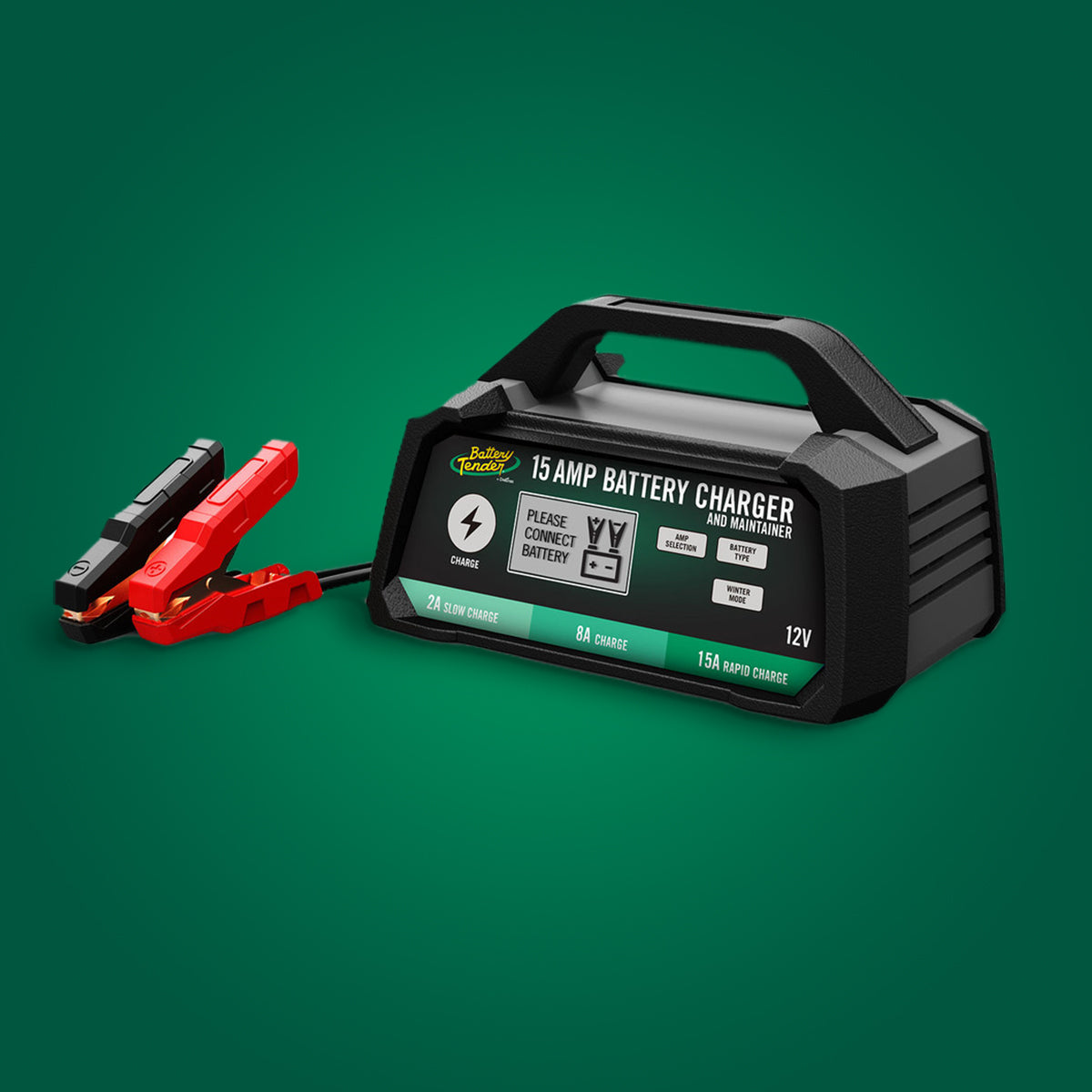
When fastest single-output recovery is the priority, the Battery Tender Power Tender® 15 Amp / 8 Amp / 2 Amp Selectable Chemistry Charger is the high-output choice. At 15A, a 90Ah battery discharged to 25% returns to full charge in approximately 4 to 5 hours — fast enough to prepare a truck for an early departure after discovering a weak battery the previous evening. The three-stage output selection also allows dropping to 2A for long-term maintenance storage without risk of overcharging, making this charger as versatile as it is powerful.
Two-Bank Charging for Parallel Diesel Battery Systems
The most technically correct approach to diesel truck dual-battery maintenance is simultaneous two-bank charging — connecting a dedicated charger output to each battery independently. This ensures both batteries receive a complete, individually monitored charge cycle rather than sharing current through a parallel connection where one battery's state of charge influences the other's charging rate.
Battery Tender offers two purpose-built options for dual-battery diesel applications, and the right choice depends primarily on whether recharge speed is a critical factor:
When fast recharging matters — a work truck that needs to be back in service quickly — the Battery Tender WaveCharge™ Pro 2-Bank Selectable Onboard Battery Charger is the premier solution. Each bank operates independently with its own high-output charge profile and maintenance algorithm, so a battery at 40% and a battery at 60% are each brought to full charge simultaneously without one dragging down the other's recovery rate. For fleet operators and working trucks where downtime costs money, the WaveCharge Pro's speed and precision make it the definitive dual-battery charger.
When recharge time is less urgent — a truck in weekend or seasonal use that primarily needs reliable long-term maintenance — the Battery Tender WaveCharge™ 2-Bank Selectable 6V/12V 6 Amp Onboard Battery Charger and Maintainer provides the same independent per-bank monitoring and selectable chemistry at a more relaxed output level. Each bank maintains its own charge profile, ensuring both batteries arrive at full charge regardless of their individual starting states. For trucks that sit for extended periods between use, the WaveCharge 2-Bank is the most rigorous long-term maintenance strategy available.
Emergency Starting: Jump Starters Sized for Diesel Truck Battery Failures
Even with rigorous diesel truck battery maintenance, emergency starting capability is essential for any working diesel truck. A battery can fail suddenly from an internal short circuit regardless of maintenance history, and a truck in a remote location with a dead battery requires more than a set of jumper cables and a passenger car.
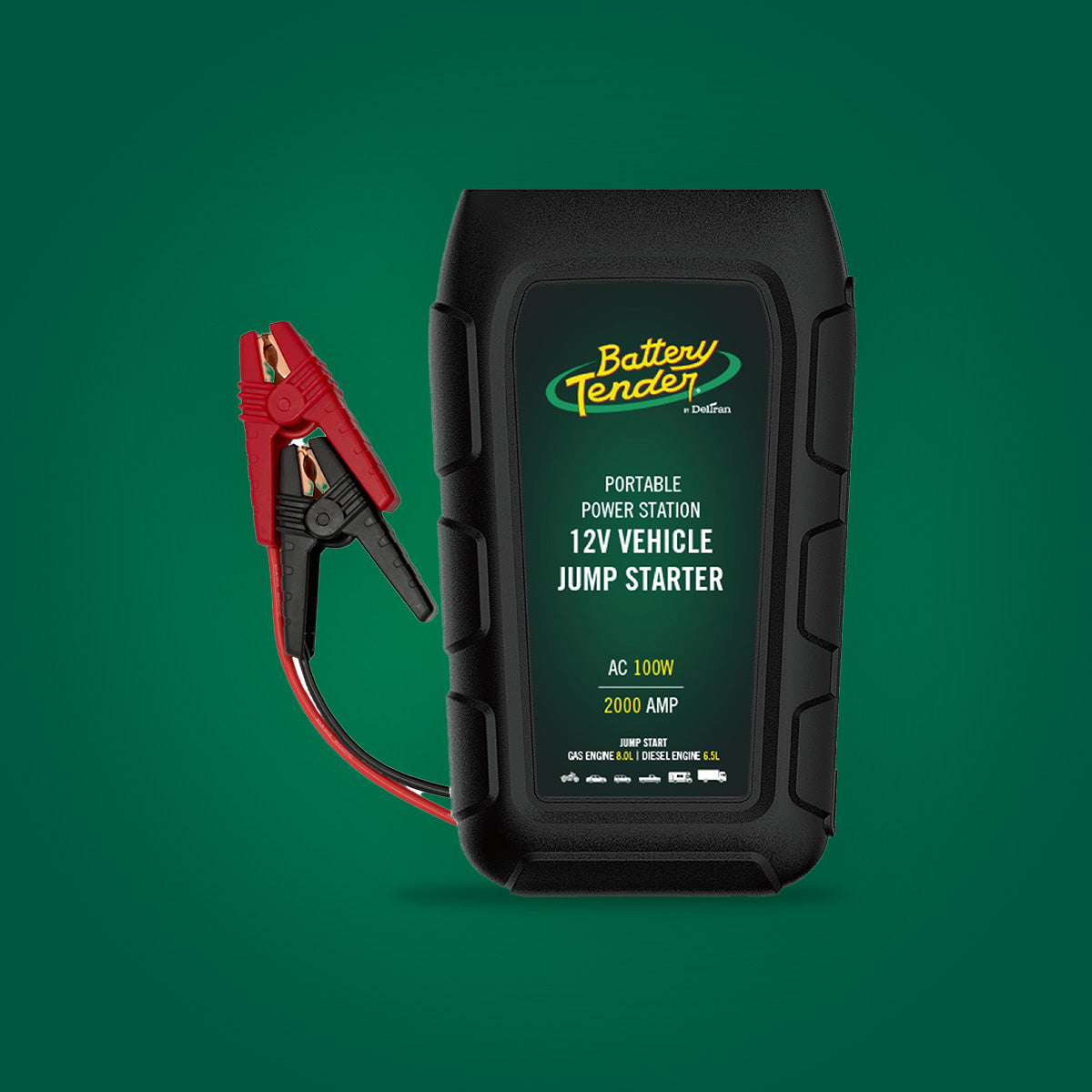
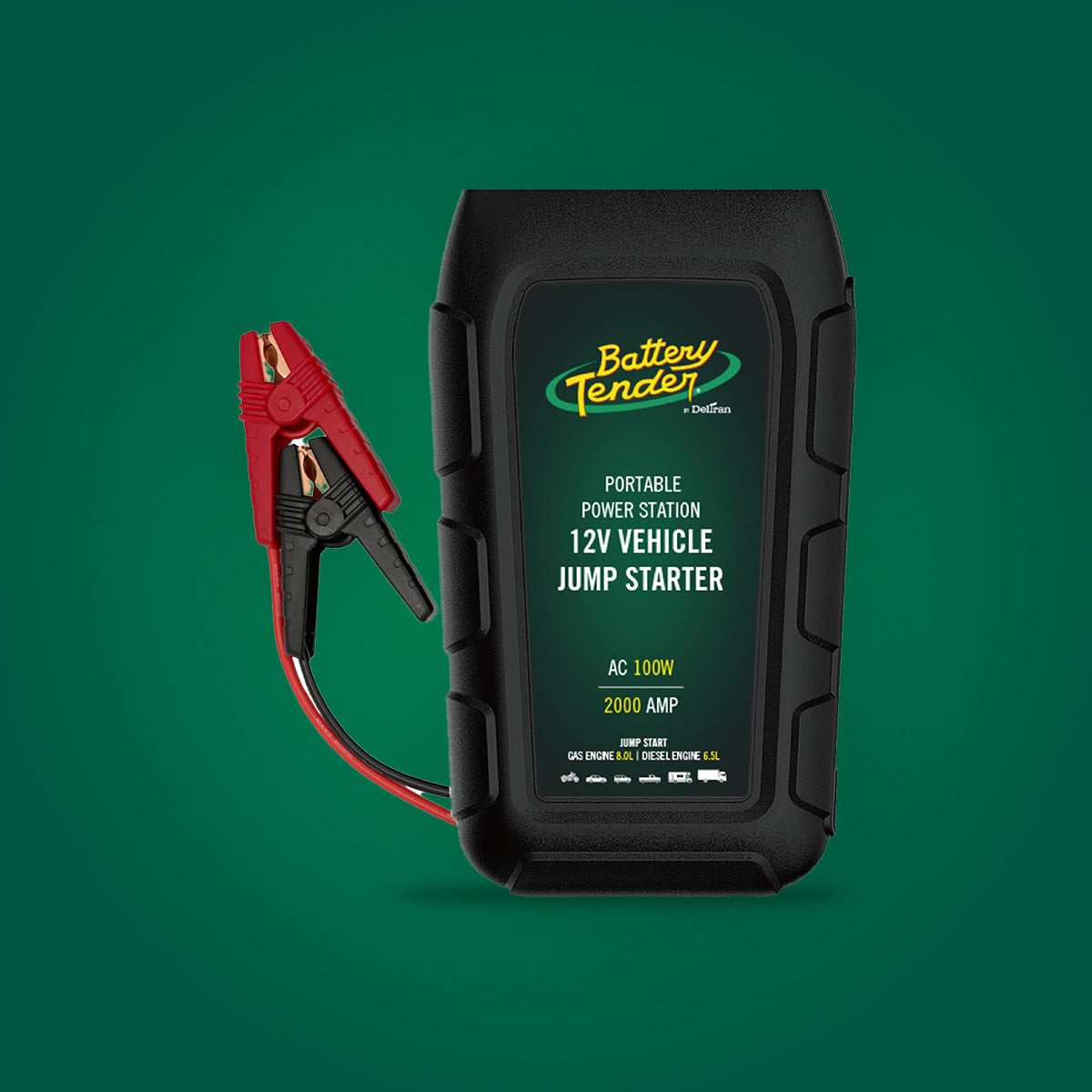
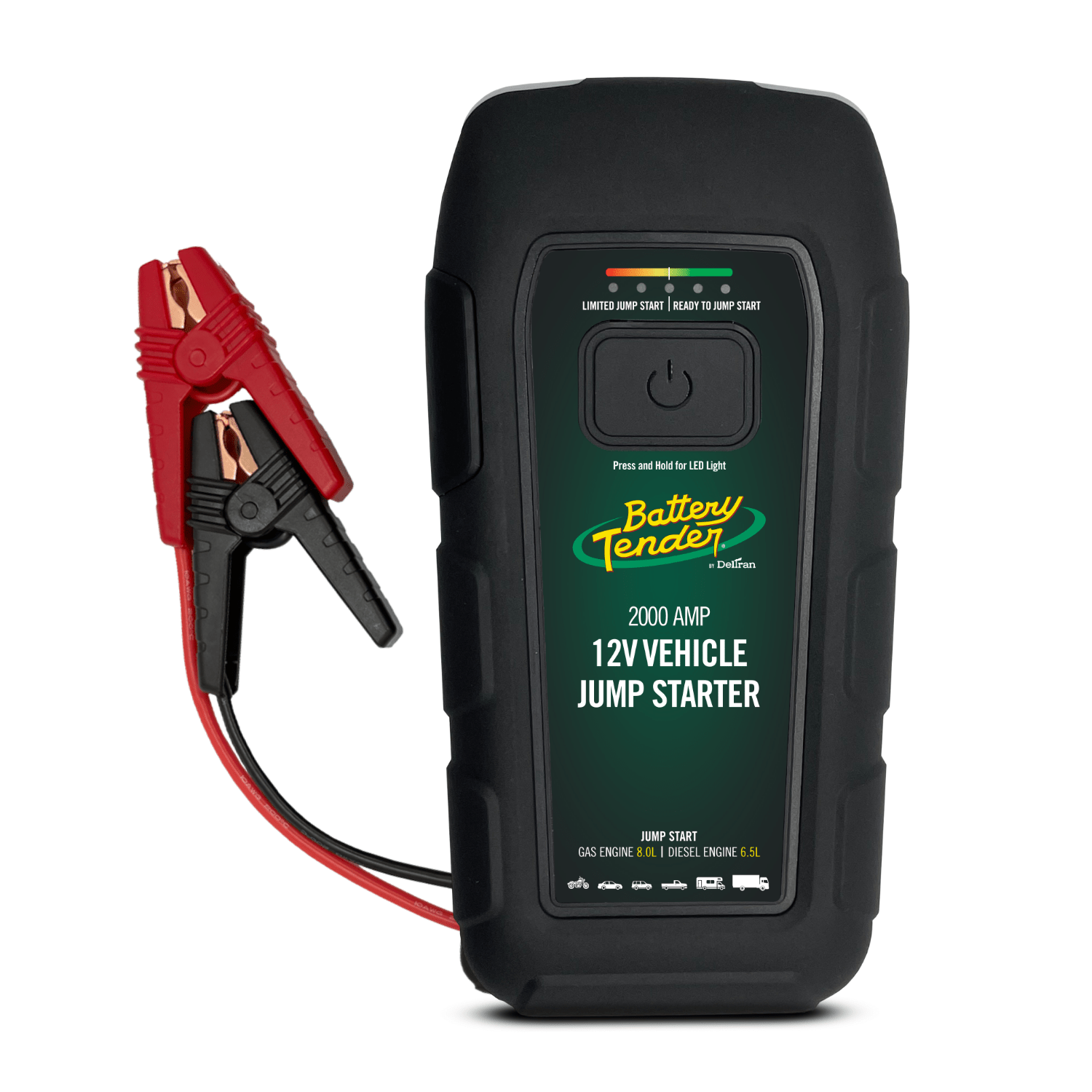
The Battery Tender 2000 Amp Jump Starter is built for heavy-duty diesel starting requirements. At 2,000 peak amps, it delivers the instantaneous current a turbodiesel starter requires at the moment of engagement — including in cold weather when battery chemistry is suppressed and engine resistance is high. Unlike compact lithium jump starters designed for gasoline passenger cars, this unit provides the sustained cranking current a diesel engine needs if it does not fire on the first attempt.
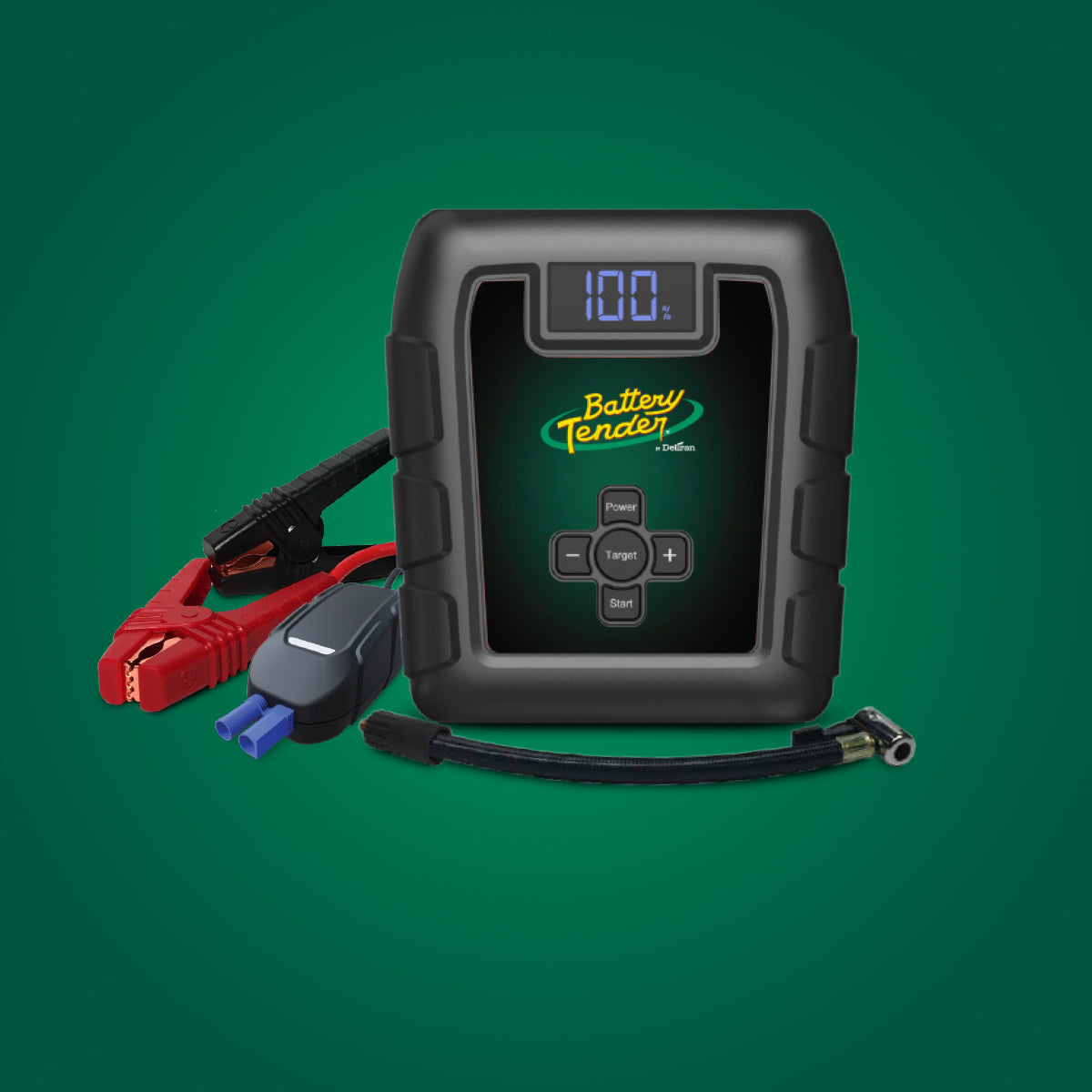
For truck owners who want a solution that combines emergency jump-starting capability with onboard charging convenience, the Battery Tender Charge-N-Start™ Battery Charger and Jump Starter is a standout option. It functions as both a battery maintainer and an emergency jump starter — keeping the truck battery at full charge during storage while remaining ready to deliver jump-start power without swapping equipment or locating a separate device. For diesel trucks that alternate between active use and extended downtime, the Charge-N-Start eliminates the need to manage two separate tools for two separate problems.
Keeping either unit accessible in a working diesel truck is a straightforward insurance policy against the consequence of a battery failure in the field.
Cold Weather Starting and Temperature Compensation
Cold weather is where diesel truck battery maintenance directly determines whether the truck starts or not. At 32°F, a fully charged lead-acid battery delivers approximately 80% of its rated CCA. At 0°F, that figure drops to roughly 40%. A diesel engine at the same temperature requires more cranking effort than it does in warm conditions because cold oil resists the crankshaft, cold cylinders build compression more slowly, and fuel viscosity affects injection timing.
The combined effect is severe: at 0°F, a battery that is even partially discharged may deliver only 30 to 35% of its warm-weather CCA capacity, while the engine demands more than its normal cranking power. The margin between available power and required power collapses rapidly, and a diesel engine that cranks slowly in extreme cold will often fail to ignite — not because the battery completely failed, but because it fell below the threshold needed to spin the engine fast enough for compression ignition to occur.
Battery Tender smart chargers automatically adjust charging voltage in cold conditions. Cold battery chemistry accepts charge less efficiently, and a charger that applies normal room-temperature voltage in a 20°F garage will leave a battery at 90 to 92% state of charge rather than a true 100%. Temperature-compensating chargers apply slightly elevated voltage to overcome this effect and ensure the battery reaches genuine full charge. A diesel truck maintained on a Battery Tender charger through winter — even in an unheated garage — arrives at every cold start in the best possible condition.
Battery Maintenance Best Practices for Diesel Truck Owners
Beyond selecting the right charger, diesel truck battery maintenance involves a set of practices that extend battery life and prevent the premature failures that dual-battery systems are particularly vulnerable to:
- Charge both batteries simultaneously. When connecting a single-output charger to a parallel dual-battery system, connect directly to one battery and allow the parallel connection to distribute charge. Never disconnect one battery while charging the other — the sudden voltage difference can damage electronics.
- Replace batteries in pairs. A new battery paired with an old battery in a parallel system guarantees accelerated degradation of the new battery as it compensates for the old one. The labor cost of replacing one battery twice exceeds the cost of replacing both once.
- Maintain batteries during storage periods. A diesel work truck that sits for two or more weeks without use will self-discharge enough to begin sulfation — the crystalline buildup on battery plates that permanently reduces capacity. A Battery Tender maintainer connected during any extended downtime prevents this entirely.
- Test battery health annually. A conductance tester or load tester provides objective data on each battery's remaining capacity. Testing in late summer, before cold weather arrives, allows proactive replacement rather than reactive emergency replacement in January.
- Inspect terminals and connections regularly. Diesel trucks generate significant vibration that loosens battery connections over time. Loose connections increase resistance, reduce effective CCA, and can cause charging system faults. Inspect and torque battery terminals at every oil change interval.
Frequently Asked Questions About Diesel Truck Battery Maintenance
How often should I charge or maintain my diesel truck batteries?
Any diesel truck that sits unused for more than two weeks benefits from a maintainer connection during that downtime period. Trucks in daily use typically do not need supplemental charging unless electrical loads — accessories, extended idling, or cold weather — exceed what normal alternator charging offsets. A Battery Tender maintainer connected during any planned downtime, including winter storage, prevents sulfation and ensures a full charge state at every cold start.
What charger output do I need for a dual-battery diesel truck?
A single-output charger of at least 5A is the practical minimum for diesel truck use, with 10A to 15A recommended for faster recovery of a large dual-battery bank. For the most technically correct approach, a two-bank charger — such as the WaveCharge Pro for fast recovery or the WaveCharge 2-Bank for maintenance-focused use — provides independent charge profiles for each battery simultaneously, which is the optimal method for parallel dual-battery systems.
Why does one battery in my diesel truck keep dying faster than the other?
Uneven aging between paired batteries is the most common symptom of a parallel system where one battery has degraded. The weaker battery continuously draws current from the stronger one, accelerating discharge in both. If one battery consistently tests weaker, replace both as a pair. Replacing only the failed battery leaves a new unit coupled to an aging one — the new battery will degrade prematurely as a direct result of compensating for its weaker partner.
What CCA rating do I need for cold-weather diesel starting?
Most modern 6.5L to 6.7L turbodiesel pickups specify 750 to 1,000 CCA per battery in a dual-battery system — consult the OEM specification for your specific truck. Never replace with batteries rated below the OEM specification, and consider choosing batteries at the top of the acceptable CCA range if the truck operates regularly in temperatures below 10°F, where the gap between available cranking power and required cranking power is smallest.
When is a 2,000 amp jump starter necessary for a diesel truck?
For full-size diesel pickups with 6.6L to 6.7L engines — particularly in cold weather — 2,000 peak amps provides the margin needed for reliable emergency starting. A jump starter that struggles to crank a cold diesel on the first attempt may not recover enough capacity for a second try. Higher output ensures the first attempt has the best possible chance of success, which matters significantly when the truck is in a remote location or a time-sensitive situation.
How does the Charge-N-Start differ from a standard jump starter?
The Battery Tender Charge-N-Start Battery Charger and Jump Starter combines onboard battery maintenance with emergency jump-start capability in a single unit. A standard jump starter is a reactive tool — stored until needed. The Charge-N-Start proactively keeps the truck battery at full charge during storage, eliminating the conditions that make emergency starting necessary in the first place, while remaining ready to deliver jump-start power if needed. For diesel trucks that cycle between active use and extended downtime, it addresses both problems with one device.
Conclusion: Diesel Truck Battery Maintenance Done Right
Diesel truck battery maintenance is a discipline built around the reality that diesel engines are mechanically demanding, cold weather is punishing to battery chemistry, and dual-battery parallel systems require equal, simultaneous attention to both units. The tools that make this manageable — the right charger output, temperature-compensating charge profiles, selectable chemistry modes, independent two-bank charging, and genuine emergency starting power — are precisely what Battery Tender heavy-duty products provide.
A diesel truck that starts reliably at 0°F after two weeks on a job site is not a matter of luck. It is the direct result of batteries that were fully charged, properly maintained, and connected to equipment designed for the specific demands of heavy-duty diesel applications. Choose the right single-output charger for your recovery time requirements — the Power Tender Plus 5 Amp for regular overnight maintenance, the 10 Amp Selectable Smart Charger for balanced speed and versatility, or the Power Tender 15 Amp Selectable for the fastest single-output recovery. Step up to the WaveCharge Pro or WaveCharge 2-Bank for true independent dual-battery charging. Keep a 2,000 Amp Jump Starter or a Charge-N-Start accessible behind the seat. Proper diesel truck battery maintenance means the truck that earns its keep will always start when it matters most.