


12V Motorcycle Battery Guide: Types, Care, and Charging (2026)
A 12V motorcycle battery is the single electrical component that determines whether a motorcycle starts reliably or leaves a rider stranded. Battery Tender® pioneered smart charging technology in 1989, and since introducing the first consumer smart charger in 1991, the company has helped millions of riders keep their 12V motorcycle batteries healthy through seasonal storage, daily riding, and everything in between. Understanding how a 12V motorcycle battery works — its chemistry, capacity ratings, discharge behavior, and charging requirements — is the foundation of reliable motorcycle ownership.
Most motorcycle batteries fall between 7 Ah and 30 Ah, a fraction of the 40–100 Ah capacity found in automotive batteries. That smaller capacity makes motorcycle batteries more vulnerable to parasitic drain, sulfation during storage, and permanent damage from deep discharge. This guide covers the anatomy of a 12V motorcycle battery, explains how different chemistries behave, provides exact charging-time math, and identifies the maintenance practices that extend battery life from the typical 2–3 years to 5 years or more.
What Makes a 12V Motorcycle Battery Different from a Car Battery?
A 12V motorcycle battery shares the same nominal voltage as a car battery, but the similarities end there. Motorcycle batteries are physically smaller, lighter, and built to deliver high cranking amps relative to their modest capacity. A typical sportbike battery holds 8–12 Ah, while a touring motorcycle may use a 20–30 Ah battery. By comparison, most passenger vehicles require 48–70 Ah batteries.
This smaller capacity creates a critical vulnerability: a 10 Ah motorcycle battery drained to 50% depth of discharge has lost only 5 Ah of energy — an amount that parasitic draws from alarm systems, ECUs, and clocks can consume in as little as 2–4 weeks of inactivity. According to the Battery Council International (BCI), lead-acid batteries that remain below 12.4V (approximately 75% state of charge) for extended periods develop irreversible sulfation on plate surfaces, permanently reducing capacity.
Motorcycle batteries also face more extreme vibration than car batteries. Engines with fewer cylinders produce stronger harmonic vibrations, and the battery is typically mounted closer to the engine. This is why most modern motorcycle batteries use Absorbent Glass Mat (AGM) construction rather than traditional flooded lead-acid — the fiberglass mat separators immobilize the electrolyte and resist vibration damage far better than liquid electrolyte sloshing between plates.
Understanding 12V Motorcycle Battery Types and Chemistries
Three primary chemistries dominate the 12V motorcycle battery market in 2026. Each chemistry has distinct charging requirements, weight characteristics, and lifespan profiles that directly affect which charger and maintenance approach a rider should use.
Conventional Flooded Lead-Acid
Flooded lead-acid batteries contain liquid sulfuric acid electrolyte and require periodic water level checks. These batteries are becoming less common in new motorcycles but remain prevalent in older models, budget bikes, and some cruiser platforms. They vent hydrogen gas during charging and must be mounted upright. Typical lifespan: 2–3 years with proper maintenance. Nominal resting voltage when fully charged: 12.6–12.8V.
AGM (Absorbent Glass Mat)
AGM batteries account for the majority of OEM motorcycle batteries shipped in 2026. The electrolyte is absorbed into fiberglass mat separators, making them spill-proof and mountable at angles up to 45 degrees in most designs. AGM batteries deliver higher cranking amps per pound than flooded batteries and tolerate vibration better. Typical lifespan: 3–5 years. Fully charged resting voltage: 12.8–13.0V. AGM batteries require careful charge voltage regulation — overcharging above 14.4V during bulk and absorption phases can dry out the mats and cause irreversible damage.
Lithium Iron Phosphate (LiFePO4)
Lithium motorcycle batteries are now mainstream across sport, adventure, and racing applications. A lithium 12V motorcycle battery typically weighs 60–80% less than an equivalent AGM unit and holds voltage more consistently under load. Fully charged resting voltage: 13.2–13.6V. Lifespan: 5–8 years with proper charging. Lithium batteries require chargers with lithium-specific charging profiles — standard lead-acid charge algorithms can damage lithium cells by applying incorrect absorption voltages. According to IEC 62619 safety standards, lithium batteries used in motive applications should include integrated Battery Management Systems (BMS) to prevent overcharge and deep discharge damage.
How to Calculate 12V Motorcycle Battery Charging Time
Precise charging time depends on three variables: battery capacity (Ah), depth of discharge (%), and charger output (amps). The formula is straightforward:
(Battery Ah × Depth of Discharge) ÷ Charger Amps = Approximate Hours
For example, a 12 Ah AGM motorcycle battery discharged to 50% connected to a 0.75A charger:
- (12 Ah × 0.50) ÷ 0.75A = 8 hours
The same battery connected to a 1.25A charger:
- (12 Ah × 0.50) ÷ 1.25A = 4.8 hours
Actual charge times run slightly longer because the absorption stage (Stage 3 of the Battery Tender Infinite Sequential Monitoring process) reduces current as the battery approaches full charge. Plan for an additional 10–20% beyond the calculated estimate. This math also demonstrates why motorcycle-specific chargers in the 0.75A–1.25A range are ideal — they charge overnight without risk of exceeding the battery manufacturer's recommended charge rate, which is typically 10–20% of rated Ah capacity.
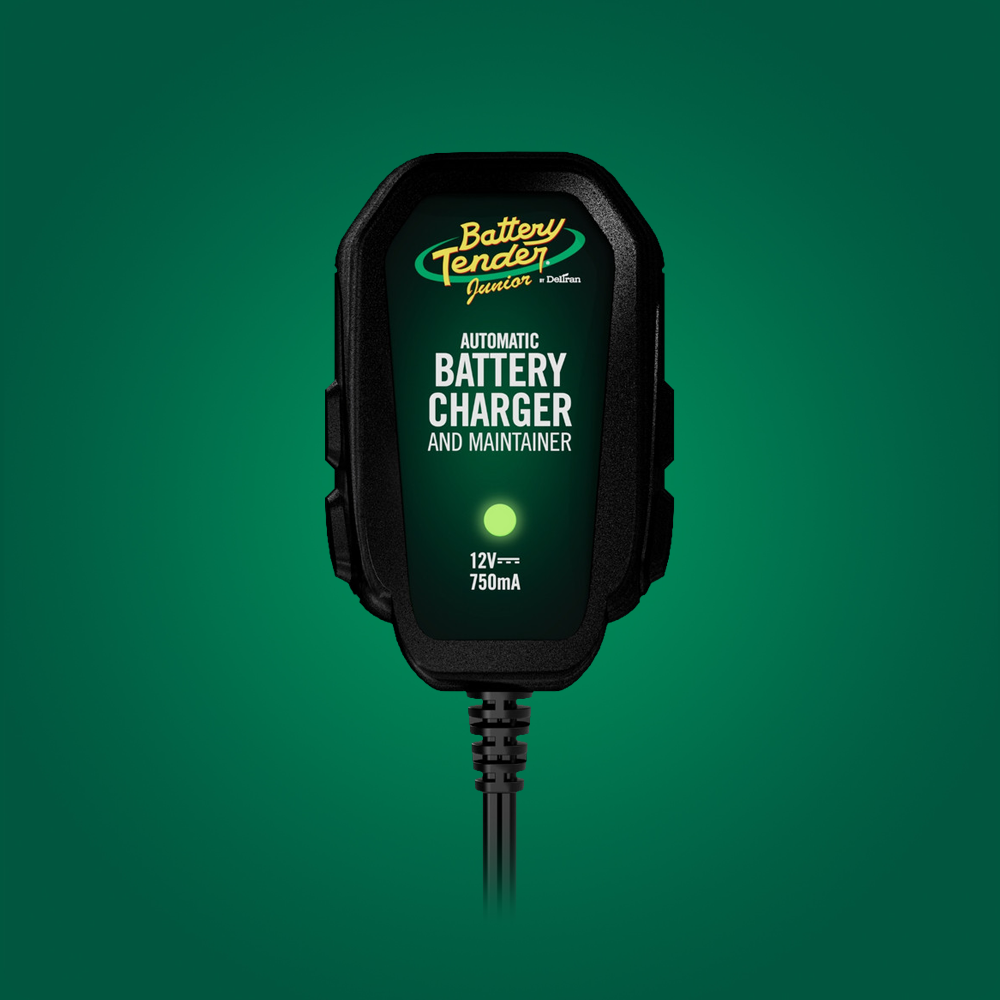
The Battery Tender Junior 12V 750mA is purpose-built for this charging range. At 750mA output, it delivers the appropriate charge rate for batteries between 2 Ah and 30 Ah — the entire spectrum of motorcycle batteries — without risking overheating or gassing.
Battery Tender Junior 12V 750mA Battery Charger
The 4-Stage ISM Charging Process and Why It Matters for a 12V Motorcycle Battery
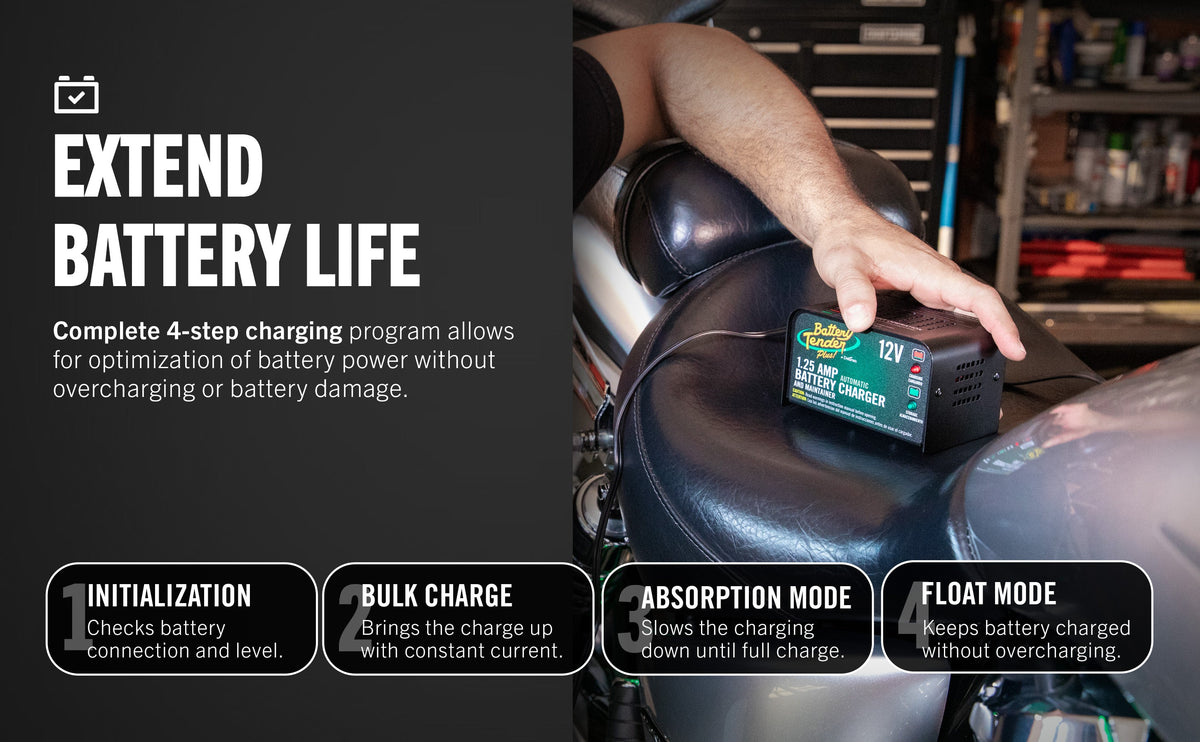
Battery Tender chargers use Infinite Sequential Monitoring (ISM), a proprietary 4-stage charging process that automatically adapts to the battery's condition. ISM is what separates intelligent charging from the dangerous constant-current approach used by traditional trickle chargers.
The four stages work as follows:
- Initialization — The charger tests the battery and applies gentle current to determine condition and acceptance rate. If the battery is too deeply discharged or damaged, the charger identifies the problem before applying full current.
- Bulk Charge (Constant Current) — Full rated current flows into the battery until it reaches approximately 80% state of charge. For a Battery Tender Junior, this means a steady 750mA.
- Absorption (Constant Voltage) — The charger holds voltage constant while current tapers naturally. This stage dissolves sulfate crystals that have formed on plate surfaces — a critical benefit for batteries that have sat partially discharged.
- Float Maintenance — Demand-responsive charge pulses activate only when battery voltage drops below a set threshold. The battery remains at full charge indefinitely without overcharging.
This 4-stage process is fundamentally different from float chargers (which skip the absorption stage entirely) and trickle chargers (which push constant current regardless of battery state, creating overcharge risk). ISM technology makes it safe to leave a Battery Tender charger connected to a 12V motorcycle battery for the entire duration of seasonal storage — whether that is 3 months or 9 months.
Choosing the Right Charger for a 12V Motorcycle Battery
Selecting the correct charger depends on battery chemistry, capacity, and intended use. The wrong charger can undercharge a battery (leaving sulfation unchecked) or overcharge it (boiling electrolyte in lead-acid, damaging cells in lithium).
For Standard Lead-Acid and AGM Motorcycle Batteries
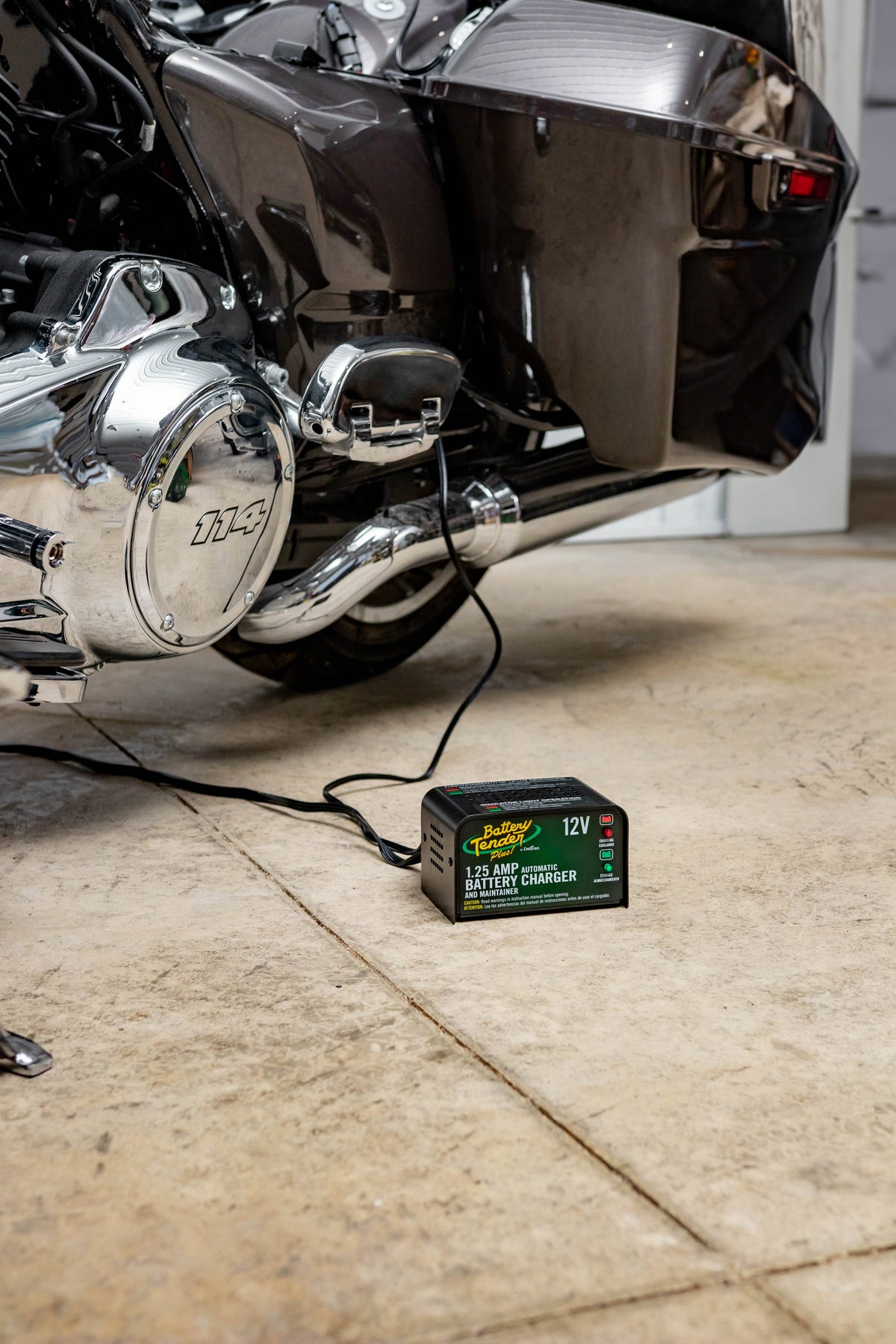
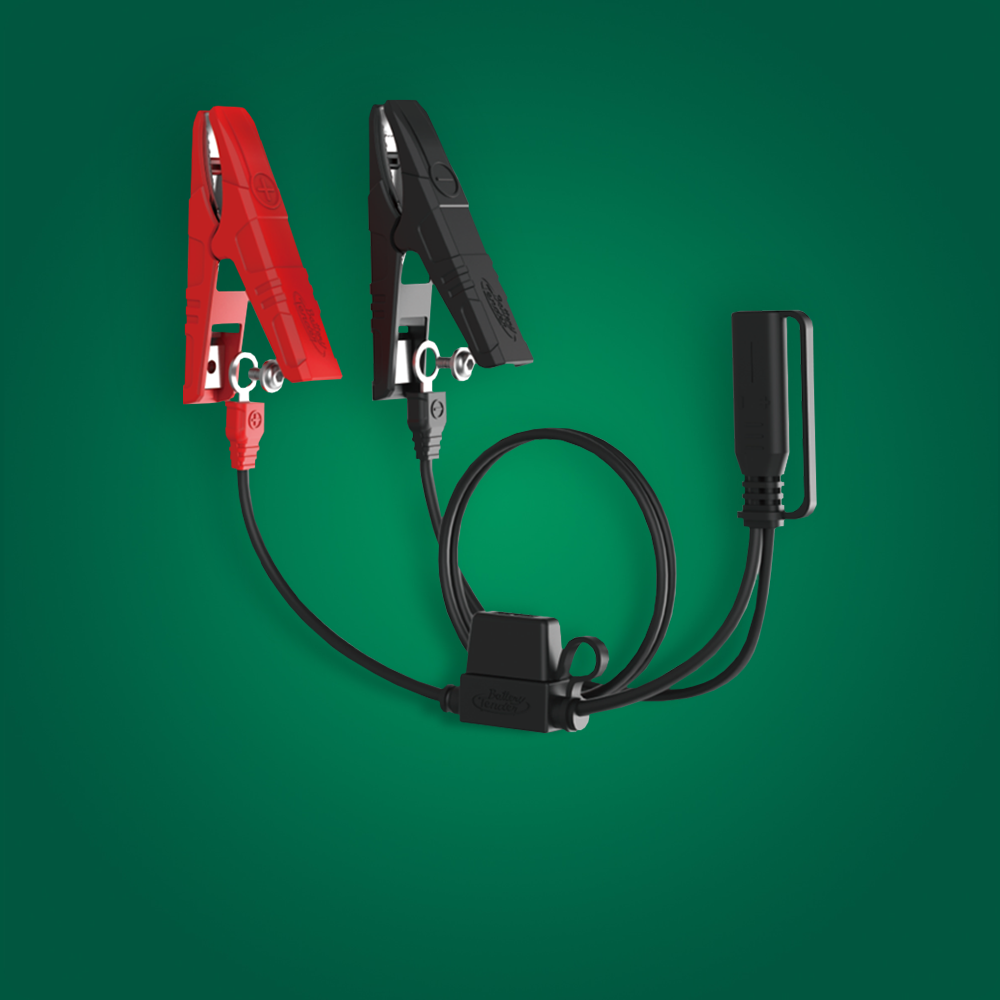
The Battery Tender Junior 12V 750mA remains the benchmark for motorcycle battery maintenance. At 750mA, it charges a typical 10 Ah battery from 50% discharge in approximately 6.7 hours — ideal for overnight recovery. The unit includes a 5-year warranty and comes with both alligator clips and ring terminal harness for permanent installation. Riders in extreme climates (consistently below 20°F or above 110°F) should consider Battery Tender chargers such as the Battery Tender Plus, which include temperature compensation.
Battery Tender Junior 12V 750mA Battery Charger
For Lithium-Equipped Motorcycles
Riders with LiFePO4 batteries need a charger with a dedicated lithium charging profile. The Battery Tender Junior 1A Selectable lets riders switch between lead-acid and lithium modes with a single button. At 1A output, it handles lithium batteries from 2 Ah to 30 Ah safely, adjusting charge voltage to the 14.2–14.6V range that lithium cells require rather than the 14.4–14.8V used for lead-acid.
Battery Tender Junior 1A Selectable Battery Charger
For Touring and Large-Displacement Bikes
Touring motorcycles with heated grips, audio systems, GPS units, and large-displacement engines typically use 18–30 Ah batteries. The Battery Tender Plus 1.25A delivers faster charging for these larger batteries — a 24 Ah battery at 50% discharge charges in approximately 9.6 hours versus 16 hours with a 750mA charger. The Battery Tender Plus includes temperature compensation for accurate charging in garages that experience wide temperature swings, and carries a 10-year warranty.
Battery Tender Plus 12V 1.25A Battery Charger
Reading 12V Motorcycle Battery Voltage: What the Numbers Mean
Voltage readings provide the most accessible snapshot of battery health. A digital multimeter set to DC volts, placed across the battery terminals with no load applied and the motorcycle off for at least one hour, reveals the approximate state of charge:
| Resting Voltage (Lead-Acid/AGM) | Approximate State of Charge | Action Required |
|---|---|---|
| 12.7V–12.8V | 100% | Healthy — maintain on charger during storage |
| 12.4V–12.6V | 50–75% | Charge soon — sulfation beginning |
| 12.0V–12.3V | 25–50% | Charge immediately — significant sulfation risk |
| Below 12.0V | Below 25% | Deeply discharged — may be unrecoverable |
For lithium motorcycle batteries, resting voltages run higher: a fully charged LiFePO4 battery reads 13.2–13.6V. Any lithium 12V motorcycle battery reading below 12.0V may have triggered the internal BMS low-voltage cutoff and could require a specialized recovery charge or replacement.
Emergency Starting: When a 12V Motorcycle Battery Dies Unexpectedly
Even with diligent maintenance, unexpected battery failures happen — extreme cold snaps, accidental accessory drain, or aging batteries at end of life. Carrying a compact jump starter alongside a maintenance charger provides complete battery preparedness.
The Battery Tender Charge N Start 1100 combines a 1A ISM charger with a 1,000-amp lithium-ion jump starter in a single unit. The charger section handles all 12V battery types (standard lead-acid, AGM, GEL, and lithium), while the lithium-ion jump pack starts engines up to 5.0L gas and 3.0L diesel — more than sufficient for any motorcycle engine. The proprietary Charge N Store technology maintains the internal lithium-ion jump pack at full readiness, and the SafeGuard anti-backfeed circuit prevents electrical damage during the jump-start process.
Battery Tender Charge N Start 1100 — 1A Charger + 1,000A Jump Starter
For riders who want dedicated jump-start capability without an integrated charger, the Battery Tender 600A Jump Starter fits in a tank bag or saddlebag. Its 6,400 mAh lithium-ion battery delivers up to 600 peak amps — sufficient for motorcycle engines of any displacement — and includes a USB charging port for phones and GPS devices.
Battery Tender 600A Portable Jump Starter
Frequently Asked Questions
How long does a 12V motorcycle battery last?
A 12V motorcycle battery lasts 2–5 years depending on chemistry, climate, and maintenance. Flooded lead-acid batteries average 2–3 years, AGM batteries last 3–5 years, and lithium LiFePO4 batteries can reach 5–8 years. Maintaining a battery on a Battery Tender charger during storage periods significantly extends lifespan by preventing sulfation and deep discharge damage.
Can a regular car charger charge a 12V motorcycle battery?
Using a high-amperage car charger on a small motorcycle battery risks overcharging, overheating, and permanent damage. Motorcycle batteries typically range from 7–30 Ah and should be charged at 10–20% of rated capacity — meaning 0.7A to 3A for most bikes. Battery Tender chargers in the 0.75A–1.25A range are specifically designed for this capacity range and include ISM technology that prevents overcharging.
What is the difference between a trickle charger and a Battery Tender charger for motorcycles?
A trickle charger pushes constant current into a battery regardless of charge state, creating overcharge risk if left connected. A Battery Tender charger uses 4-stage ISM technology that automatically transitions from bulk charging to absorption to float maintenance. The charger monitors battery voltage continuously and delivers current only when needed, making it safe for indefinite connection during seasonal storage.